


What Will Make an Executive Candidate Truly Stand Out in 2026
Table of Content
- Signal 1 — Durable Value Creation with Explainable Mechanics
- Signal 2 — Governable Modernization, AI Impact with Oversight Maturity
- Signal 3 — A Visible Decision System Under Uncertainty
- Signal 4 — Executive EQ Strategic Advantage Under Pressure
- Signal 5 — Institution-building, Capability that Outlasts the Leader
- Conclusion — Standing Out by Standing Still
- FAQs
- Sponsorship over surface performance: Boards are underwriting risk as much as hiring talent, so trusted references and coherent proof would matter even more now than interview performance.
- Results plus mechanics: Headline outcomes are not enough. Candidates must show how value was created, with decisions, operating model changes, and governance that can be repeated in new contexts.
- Governed modernization, not AI theater: AI and technology stories help only when they show controlled, measurable impact, clear adoption, and explicit boundaries where humans still lead.
- Leadership as a system, not a moment: Boards will now look even more at how leaders decide under uncertainty, stabilize tense rooms, and build institutions that outlast them through better decision rights, cadence, and talent development.
For any ambitious executive candidate, the path to the top in 2026 is likely to be defined by a single unwritten rule. They must be sponsorable – even more than before . In the evolving world of modern executive search, standing out requires more than a strong track record. It requires the kind of executive presence that credible leaders are willing to back privately and consistently.
Boards today are increasingly focused on underwriting risk as much as they are on acquiring talent. According to Boston Consulting Group, directors in 2026 will expect leaders to possess an undeniable track record that can overcome deep organizational inertia. This reinforces the reality that reputational signals and trusted references often carry more weight than the interview itself.
In the coming months of 2026, the most successful candidates will be those who can translate their experience into clear evidence of governance and value.
This blog lays out five signals that are expected to shape executive selection in 2026, and it shows executive candidates how to prepare the kind of proof decision makers can trust and defend.
Signal 1 — Durable Value Creation with Explainable Mechanics
As we move deeper into 2026, headline results alone will likely cease to be a sufficient differentiator. What will separate one executive candidate from another is the ability to show durability, causality, and repeatability.
In other words, executive candidates must provide proof that value creation was driven by decisions and systems that can work again under new constraints.
This is where executive presence becomes more than confidence. The executive candidate who earns support can explain, plainly, how the operating model changed, how decisions were made, and how performance was managed through a consistent cadence.
McKinsey’s work on operating models reinforces that operating design is a bridge between strategy and day-to-day work.
Evidence That Holds in Reference Conversation
A sponsorable executive candidate can describe value creation in cause and effect:
- What changed in the operating model, including decision rights, cadence, and accountability.
- How capital allocation choices were made, including what was funded, slowed, or stopped.
- Which pricing or portfolio moves improved quality of earnings.
- What was monitored after decisions, and what signals would have triggered a course
This is the part of executive presence that boards remember, because it reads as disciplined truth. It also gives sponsors clean language they can repeat without editing.
Signal 2 — Governable Modernization, AI Impact with Oversight Maturity
In many boardrooms, AI is now a standing item. It appears in strategy discussions, risk reports, and disclosure drafts. For an executive candidate, this means AI narratives without clear outcomes or controls are likely to hurt, not help.
What Credible AI will Mean in 2026
The second signal is whether an executive candidate can show that AI and technology have improved performance in a way that remains controlled.
McKinsey’s 2025 State of AI confirms that meaningful enterprise-wide bottom-line impact is still rare, even as usage grows. In that setting, a credible executive candidate is one who can show that AI has moved beyond pilots into core operations and that it is managed with discipline. This is the practical heart of AI in executive search.
Proof Points That Survive Scrutiny
Boards are likely to look for a small number of examples that combine value and control. For any senior executive candidate, strong evidence often has three parts:
- Two or three AI or advanced analytics initiatives that are live, not experimental, and tied to P&L, risk, or customer metrics.
- Adoption detail: who uses the system, what changed in daily work, and which roles carry accountability.
- Explicit limits: what remains human-led, and why that choice protects trust, safety, or brand.
Described in this way, the AI story supports executive presence rather than sounding like promotion. It also fits directly into executive search trends that emphasize disciplined scaling rather than experimentation for its own sake.
Signal 3 — A Visible Decision System Under Uncertainty
In 2026, judgment for an executive candidate will sit less in style and more in method. Boards are expected to look for how a leader reaches a decision when information is incomplete, and conditions may shift quickly.
The System Behind Major Decisions
A standout executive candidate can describe a repeatable decision system, not isolated moments. That system may usually include:
- Stated assumptions: Writing down what must be true for a strategy to work before resources are committed.
- Disconfirming evidence: A deliberate process for seeking data that contradicts the preferred path.
- Instrumentation: A clear dashboard of what was watched after the decision was made to ensure execution stayed on track.
These elements reveal disciplined executive decision-making skills, not improvisation rewritten after the fact. They give sponsors a view of how an executive candidate thinks, not just what happened.
To discuss senior hiring, reach out to Vantedge today.
Signal 4 — Executive EQ Strategic Advantage Under Pressure
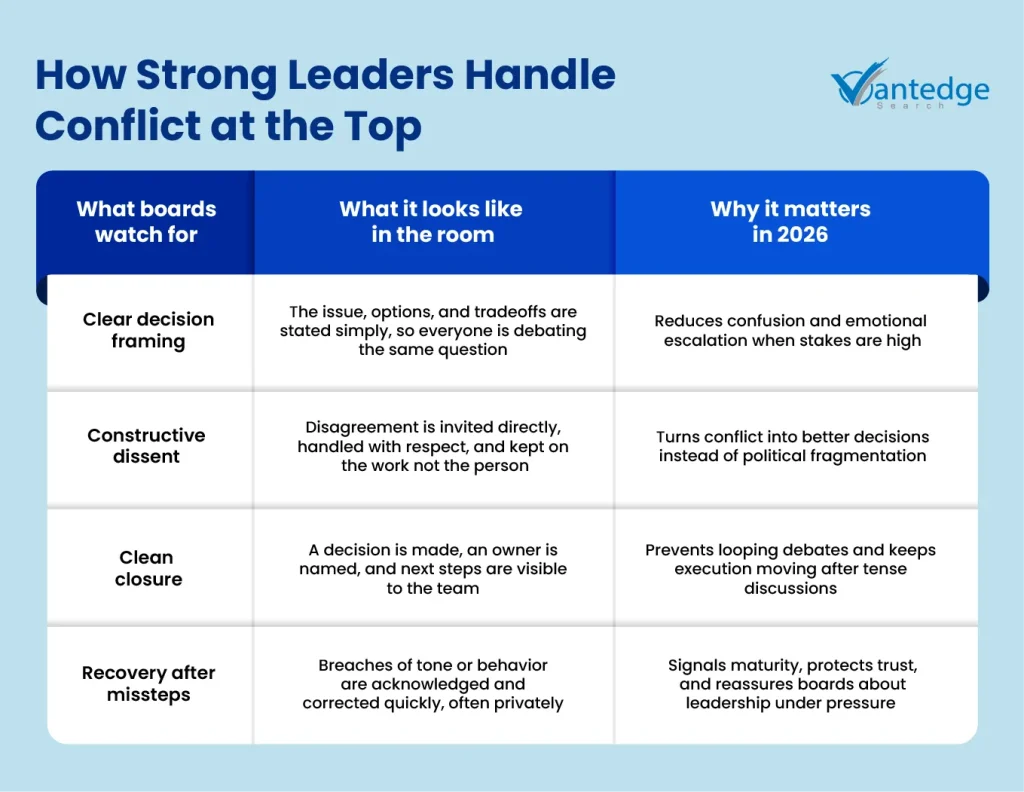
In 2026, EQ is likely to be treated as an execution and risk factor. For an executive candidate, it is assessed through room stability: whether disagreement becomes rigorous debate that improves decisions or turns into fragmentation that slows delivery. This is a core part of executive presence and a recurring theme across executive search trends.
What Boards are Likely to Test in 2026
Executive teams are built for high-stakes decisions, and conflict is expected to rise when priorities collide. HBR’s 2025 guidance on executive-team conflict notes that disagreement is particularly fraught at the top because strong leaders represent distinct parts of the business and carry real power in the room.
Boards will screen for whether an executive candidate can keep the leadership table functional under pressure, without avoiding conflict and without letting it become personal.
What “Room Stability” Looks Like in Practice
Sponsors tend to respond to observable patterns rather than intent. A strong executive candidate must typically demonstrate:
- Clear framing of the decision and the trade-offs, using plain language
- Dissent handled directly, with dignity preserved and no blame theater
- A clean close: decision made, owner named, follow-up made visible
- Corrections handled promptly and privately when standards are breached
These behaviors reflect executive leadership skills because they keep judgment intact when tension is high and time is limited.
Signal 5 — Institution-building, Capability that Outlasts the Leader
In 2026, boards are expected to draw a clearer line between leaders who carry the enterprise on their shoulders and leaders who leave the enterprise stronger than they found it. For an executive candidate, the question is not only “Can this person deliver” but “What will the organization look like after several years of their decisions.”
What Boards Will Look for Inside the Enterprise
Institution-building will be read in a few specific places, not as an abstract concept. Boards and organizations are likely to focus on whether an executive candidate has:
- Clarified decision rights so that important calls are made at the right level, without constant escalation.
- Upgraded the leadership bench, with observable successors for critical roles and visible development of direct reports.
- Established a leadership cadence that allows cross functional execution without relying on crisis meetings.
- Managed talent moves in a way that raises capability without destabilizing core operations.
These patterns speak directly to executive presence at an enterprise scale. They also align with executive search trends that put more emphasis on how an executive candidate shapes the top team and the system, not just their own remit.
Conclusion — Standing Out by Standing Still
Across 2026, the executive candidate who truly stands out will be the one decision-makers can support with confidence, privately and consistently. That confidence is built through five signals: durable value with clear mechanics, governed modernization with real AI impact, a visible decision system under uncertainty, EQ expressed as room stability under pressure, and institution-building that reduces fragility.
The selection dynamic is straightforward. When claims are hard to verify, confidence drops. When proof is coherent, governance is credible, and leadership behavior holds alignment; sponsorship becomes easier.
In 2026, the difference between “qualified” and “selected” is often the same difference between a compelling story and a defensible one.
For confidential conversations on leadership opportunities and mandates, contact Vantedge Search today.
FAQs
An executive candidate is a senior leader being considered for a top role such as CEO, CFO, COO, or functional head. They are assessed for enterprise impact, governance maturity, leadership presence, and fit with board priorities.
Executive candidates are evaluated through interviews, track record evidence, leadership behavior, and references. Boards test how outcomes were achieved; decision-making capability under uncertainty; and the ability to lead teams, manage risk, and build durable capabilities.
In 2026, standout candidates will be sponsorable. They show durable value with clear mechanics, governable modernization including AI outcomes, a visible decision system, calm room leadership under pressure, and institution-building that lasts.
Boards look for leaders who can deliver results while reducing risk. They want credible references, clear governance thinking, strategic judgment, strong communication, modern tech awareness, and the ability to align executives and build resilient organizations.
The strongest AI proof shows live initiatives, not pilots, that improve profit, risk, or customer outcomes. Pair that with clear adoption, named owners, and explicit limits where humans still make the final call.
Leave a Reply