


5 Ways C-suite Leaders Can Lead Through Geoeconomic Conflict in 2026
Table of Content
- In 2026, boards are increasingly expected to treat geoeconomic confrontation as a standing constraint on C-suite strategy, with direct impact on where growth is feasible and how risk is governed.
- The most board-relevant exposure is expected to surface at senior leadership level through policy and regulatory shocks, corridor-specific trade constraints, capital and payments friction, and technology and data limits.
- Senior leaders are likely to be assessed on C-suite performance traits that reduce leadership misalignment, including geostrategic literacy, disciplined decision records under uncertainty, and steady stakeholder alignment.
- This blog outlines five internal standards that many C-suites are expected to put in place during 2026, so decisions stay timely and credible, including corridor-level exposure visibility, clear decision rights, option-based resilience choices, and one consistent stakeholder narrative.
Introduction: 2026 As an Operating Condition, Not a One-off Shock
In 2026, board conversations are likely to get more tense. Strategy can be commercially sound, yet operating permission can tighten quickly through policy change, enforcement posture, or corridor disruption. For C-suite leaders, the standard is increasingly about disciplined leadership under constraint, not dramatic crisis response.
Geoeconomic conflict can be defined in one clear line as the use of tariffs, export controls, sanctions, investment limits, and technology and data rules to advance national objectives through economic means. This is no longer peripheral. It is increasingly shaping where companies can sell, how they can source, what they can ship, where they can place data, and which counterparties remain acceptable at C-suite level.
The C-suite impact is direct. Decisions that once sat within procurement, legal, or treasury can escalate into CEO conflict discussions because the margin for error has tightened and stakeholder scrutiny has intensified. The World Economic Forum’s Global Risks Report 2026 places geoeconomic confrontation at the top of the global risk list, a signal that boards and investors are already treating this as a central planning constraint.
This piece does not attempt to forecast the next flashpoint. It sets out what is increasingly expected inside the C-suite in leadership development, governance, and talent, so C-suite strategy stays credible when constraints shift. In executive hiring, the question is not only whether a leader performs under pressure. It is whether that leader can maintain alignment when trade-offs are unavoidable.
Expected Risks: The C-Suite Risk Picture for 2026
Rather than list every risk, it is more useful to see how geoeconomic friction tends to arrive at C-suite level. In 2026, many leaders are expected to see pressure build through a small set of channels that move quickly from policy into operations and reputation.
- Policy and regulatory shocks. Export controls, sanctions extensions, licensing delays, and extraterritorial enforcement can change what the business can ship, sell, fund, or support. Gartner’s 2025 survey of senior risk executives placed an unsettled regulatory and legal environment as the top emerging risk.
- Trade and supply chain constraints. Corridor disruption, supplier restrictions, and higher insurance or rerouting costs can turn a margin issue into a service issue. The C-suite performance test is speed: how fast the company can switch inputs or routes without breaking compliance.
- Capital and payments friction. Counterparty restrictions and bank de-risking can slow transactions, reprice deals, and constrain working capital. This is where CEO conflict can become a growth constraint even when demand remains intact.
- Technology and data constraints. Localization requirements and cross-border data limits can force changes in operating models and vendor choices, with knock-on effects for security and delivery.
- Trust, reputation, and workforce pressure. Stakeholders increasingly judge where you operate, with whom, and how you explain trade-offs. When messaging drifts, leadership misalignment becomes visible fast.
For most leadership teams, the question is not whether these risks exist, but where exposure concentrates and what will trigger a measured response.
Align your next C-suite hire with Vantedge Search.
Five Ways C-Suite Leaders Can Lead Through Geoeconomic Conflict in 2026
In 2026, geoeconomic conflict is set to strengthen as a design constraint that touches revenue, supply, technology, payments, and reputation at C-suite level. The Global Risks Report 2026 ranking of geoeconomic confrontation as a leading global risk aligns with why boards are asking for clearer decision logic and sharper exposure visibility.
What follows describes what is expected to be in place inside a high-performing C-suite, so that choices remain timely, credible, and aligned.
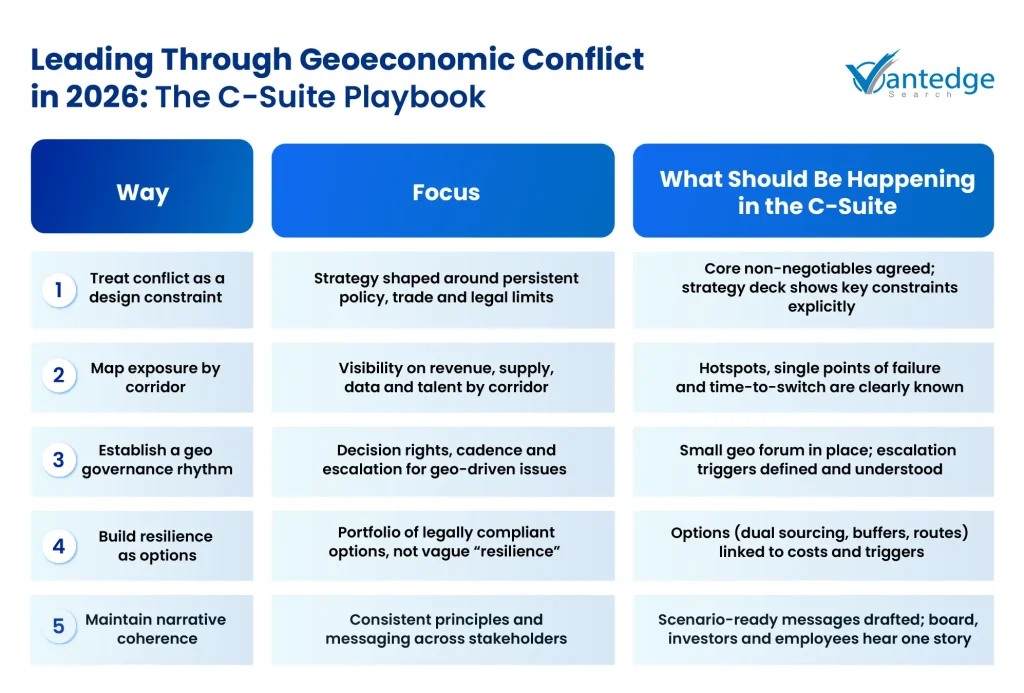
1. Treat Geoeconomic Conflict as a Design Constraint
High-performing senior leaders treat geoeconomic conflict alongside cybersecurity and liquidity as a persistent condition. The base plan is expected to hold together even when constraints tighten, because in a time-bound CEO conflict discussion the organization will follow what is already built into C-suite strategy rather than improvise.
A practical starting point is agreement on a small set of non-negotiables. Compliance integrity, employee safety, and continuity for critical customers are typical anchors because they remain defensible under scrutiny. When non-negotiables are vague, leadership misalignment tends to surface at the worst moment, with the CEO, CFO, and GC working from different risk tolerances.
Constraint-aware design also supports capital allocation. It helps separate growth moves that still work under tighter constraints from those that need conditions to proceed. Over time, this strengthens C-suite performance because the organization shifts within a pre-agreed range rather than rewriting strategy under pressure.
2. Map Exposure by Corridor, Not Just by Country
Country risk lists have value, but they often miss how disruption travels. Corridor-level mapping can give senior leaders a more operational view of exposure, showing where revenue, suppliers, data flows, and key talent nodes depend on the same corridor.
A corridor map does not need to be complex. It should make three things visible at the board level.
First, revenue concentration by corridor, not only by geography. Second, critical suppliers and service providers tied to that corridor, including logistics, cloud, payments, and compliance dependencies. Third, time-to-switch for critical inputs, vendors, and key roles, expressed in realistic weeks, not optimistic targets.
This is also where regulatory risk management meets operating reality. Trade policy uncertainty can move faster than contract cycles, and corridor mapping helps the C-suite see which commitments are fragile and which are durable. The WTO trade outlook underscores how policy shifts can materially change trade conditions, reinforcing the value of corridor visibility for C-suite strategy decisions.
Thresholds should be clear. Decisions to monitor, mitigate, or pivot should not depend on who speaks loudest. Clear triggers reduce improvisation and protect C-suite performance when time is tight.
3. Establish a Lightweight Geoeconomic Governance Rhythm
In many organizations, the weakest link is not intelligence. It is governance. When geoeconomic issues are handled ad hoc, decisions drift across functions and the company pays in delay, rework, and inconsistent messaging.
Senior leaders benefit from a small, regular forum that is decision-focused, not a reporting ceremony. The format can be simple. A set cadence, a short agenda tied to decisions, and clear escalation triggers when an issue becomes material.
Decision rights should be unambiguous at C-suite level. Many firms find clarity in a model where the CEO owns posture and market-level trade-offs, the CFO owns capital allocation shifts and buffers, the general counsel owns compliance posture and licensing strategy, the COO owns switching plans and continuity mechanics, and the CHRO owns mobility risk and critical role coverage.
A lightweight rhythm also protects executive capacity. It reduces noise by separating what is material from what is merely concerning. It helps the C-suite decide faster and reduces the risk of reactive moves that later need public correction.
4. Build Resilience as a Portfolio of Options
In 2026, resilience is increasingly expected to be expressed as options, not as a generic aspiration. Each option should have a defined cost, a trigger, an owner, and an activation path. This framing helps boards evaluate global business resilience without relying on vague statements.
Options can include dual sourcing, modular design choices, selective buffers, contract flexibility, alternate routing, and compliant payment paths. Some options are operational, while others are commercial or legal, such as contract clauses that preserve delivery rights under compliance change. Talent continuity and vendor viability can also be treated as options, particularly where specialized skills or regulated service models are involved.
Metrics make the options real. Time-to-switch, days-to-recover, and depth of substitutes can give the board a clearer view of risk posture than inventory targets alone. This also improves regulatory risk management because decision triggers can be tied to measurable thresholds rather than informal signals.
The key leadership move is trade-off clarity. A resilience option may cost margin, add complexity, or slow speed, and those costs should be priced openly. When the C-suite can articulate cost and trigger in the same sentence, the C-suite strategy becomes easier to defend under scrutiny.
5. Maintain Narrative Coherence Under Pressure
In contested conditions, trust often breaks when explanations appear inconsistent. Stakeholders can accept difficult choices, but they rarely tolerate shifting rationales. Narrative coherence is therefore increasingly treated as a C-suite-level control, not only a communications task.
A principle-based narrative is expected to answer a few stable questions. What does the company stand for. How does it balance obligations across markets. How are employees and customers considered when constraints tighten. How does governance work when trade-offs are real.
Scenario-ready language can further reduce risk. When decisions come quickly, the board pack, investor communication, internal town halls, and regulatory dialogue should reflect the same core logic. This is not about spin; it is about credibility, and it directly affects C-suite impact during high-pressure cycles.
Narrative coherence also reduces leadership misalignment internally. When the C-suite aligns on principles and decision rationale early, downstream leaders carry a consistent message. That consistency is a quiet advantage in 2026, especially when scrutiny is high and trust is fragile.
Constraint Changes Who Gets Chosen
In fragmented environments, access becomes selective. Customers, regulators, financiers, and strategic partners quietly reduce optionality in their own networks. They consolidate toward counterparties that appear operationally predictable and institutionally coherent. This dynamic is subtle but powerful: when uncertainty rises, stakeholders prefer fewer, steadier relationships rather than broader, riskier exposure.
For Senior leaders, this shifts the strategic frame. Geoeconomic conflict does not merely impose constraints; it alters competitive selection. Firms that project steadiness under scrutiny attract disproportionate confidence. Those that appear reactive or internally divided experience widening discount — in valuation, partnership terms, and leadership recruitment. Over time, volatility redistributes opportunity toward organizations whose discipline is visible before crisis headlines arrive.
Conclusion: Leading in a Permanently Contested Economic Landscape
Geoeconomic conflict is expected to remain a defining feature of business conditions through 2026 and beyond. For C-suite leaders, the implication is direct and demanding. Competitive position is increasingly shaped by the ability to operate with constraints that can tighten quickly and unevenly across markets.
In this setting, C-suite performance is less about prediction and more about internal readiness. Decision-making discipline matters because speed without a recorded rationale creates avoidable exposure. Governance matters because clear decision rights and escalation triggers reduce drift when policy risk becomes operational.
Narrative coherence matters because trust erodes when employees, investors, and regulators hear different explanations for the same choice. Talent architecture also becomes a board-level variable, since leadership misalignment and gaps in geostrategic literacy can turn manageable regulatory risk management into compounding cost.
The leadership teams that hold steady are likely to be those that notice signals early, surface trade-offs explicitly, and make decisions that remain timely and credible under scrutiny.
If your leadership team needs a steady hand for turbulent times, partner with Vantedge Search to find C-suite professionals with tested crisis judgment.
FAQs
Geoeconomic conflict is increasingly shaping market access, supplier viability, capital movement, and compliance obligations, so C-suite strategy choices can change faster than annual planning cycles. The C-suite impact often shows up first as delivery risk, higher regulatory burden, and tougher trade-offs on growth and cost.
It means treating tariffs, export controls, sanctions, investment restrictions, and tech or data rules as standing constraints within C-suite level decisions. Strong C-suite performance is reflected in faster, aligned calls on markets, corridors, capital allocation, and people without recurring fire drills or leadership misalignment.
Preparation typically includes corridor-based exposure mapping, clear thresholds for action, and a lightweight governance rhythm across the CEO, CFO, GC, COO, and CHRO. It also includes a practical option set for global business resilience and a stable stakeholder narrative that reduces reputational drift during CEO conflict moments.
C-suite teams can start by agreeing on a short set of non-negotiables such as compliance boundaries, employee safety, and continuity priorities. That shared baseline supports regulatory risk management and makes the next step, corridor exposure mapping with thresholds, far more decisive.
Geostrategic literacy, decision hygiene under uncertainty, and stakeholder stamina tend to matter most at C-suite level. These skills reduce leadership misalignment and help protect C-suite impact when the pace of policy change forces high-stakes trade-offs.
Leave a Reply