


In this edition of The Vantedge Point, we examine a shift that is becoming harder for boards and CEOs to ignore: complexity is no longer arriving in sequence. Technology, energy, climate risk, regulation, geopolitics, capital allocation, and workforce pressure are increasingly converging inside the same decisions. What once belonged to separate functions now sits within one strategic frame. That convergence is changing the work of leadership. It is compressing timelines, surfacing trade-offs earlier, and making alignment across the enterprise more critical.
This issue looks at what that means in practice. Our cover story explores why leaders must now think across systems, not silos. Expert perspectives from Satya Nadella, Jensen Huang, and Jamie Dimon show how technology, infrastructure, policy, and workforce dynamics are moving together. The career section outlines the capabilities executives need to build for this environment, while the C-suite movements reflect how organizations are redesigning leadership roles for integration. The message is clear: in the age of convergence, leadership advantage belongs to those who can hold complexity together.

Executive leadership has always involved managing complexity. What is changing now is the behavior of that complexity.
The boardroom challenges of the coming years are not multiplying — they are converging.
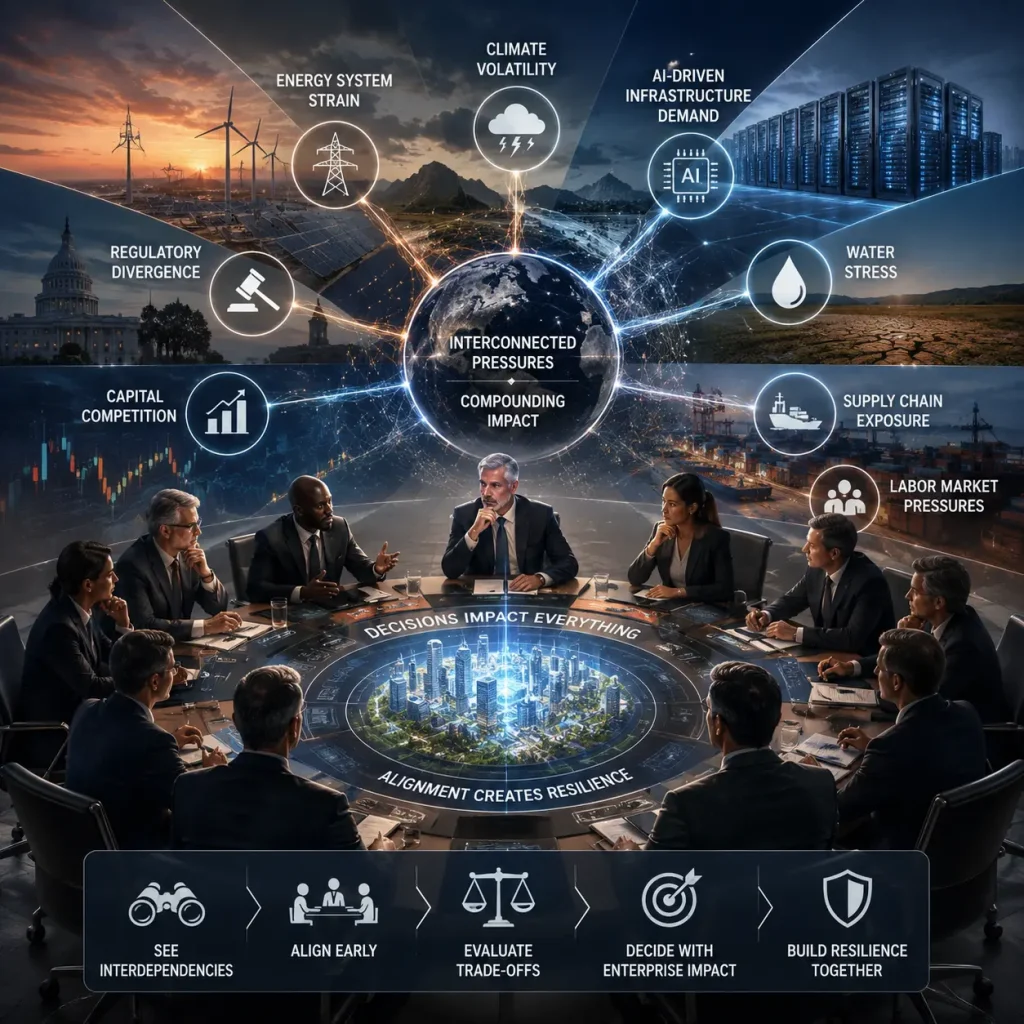
Across industries, pressures that once moved on separate tracks are arriving together: climate volatility, energy system strain, AI-driven infrastructure demand, water stress, supply chain exposure, regulatory divergence, capital competition, and tightening labor markets. A recent synthesis by S&P Global, Top 10 Sustainability Trends to Watch in 2026, captures how wide this landscape has become.
While framed through a sustainability lens, the report reveals something broader: many of the forces reshaping enterprise strategy are increasingly interconnected. Sustainability is simply where these interactions become most visible.
Read as a list, these forces suggest expansion: more variables, more oversight, more specialist mandates.
Experienced in the boardroom, they feel different.
They no longer line up. They collide.
Geopolitical fragmentation is intensifying this pattern. Conflicts, sanctions regimes, and shifting trade alignments increasingly shape operational choices around energy sourcing, technology access, logistics routes, and capital deployment. Strategy and geopolitics, once treated as adjacent concerns, now intersect directly inside day-to-day enterprise planning.
A digital expansion initiative illustrates the shift. What might once have been framed as a technology investment now carries simultaneous implications: energy demand commitments, grid reliability considerations, water dependencies, emissions exposure, capital allocation trade-offs, and often regulatory or community scrutiny. Growth strategy and infrastructure constraints arrive in the same conversation.
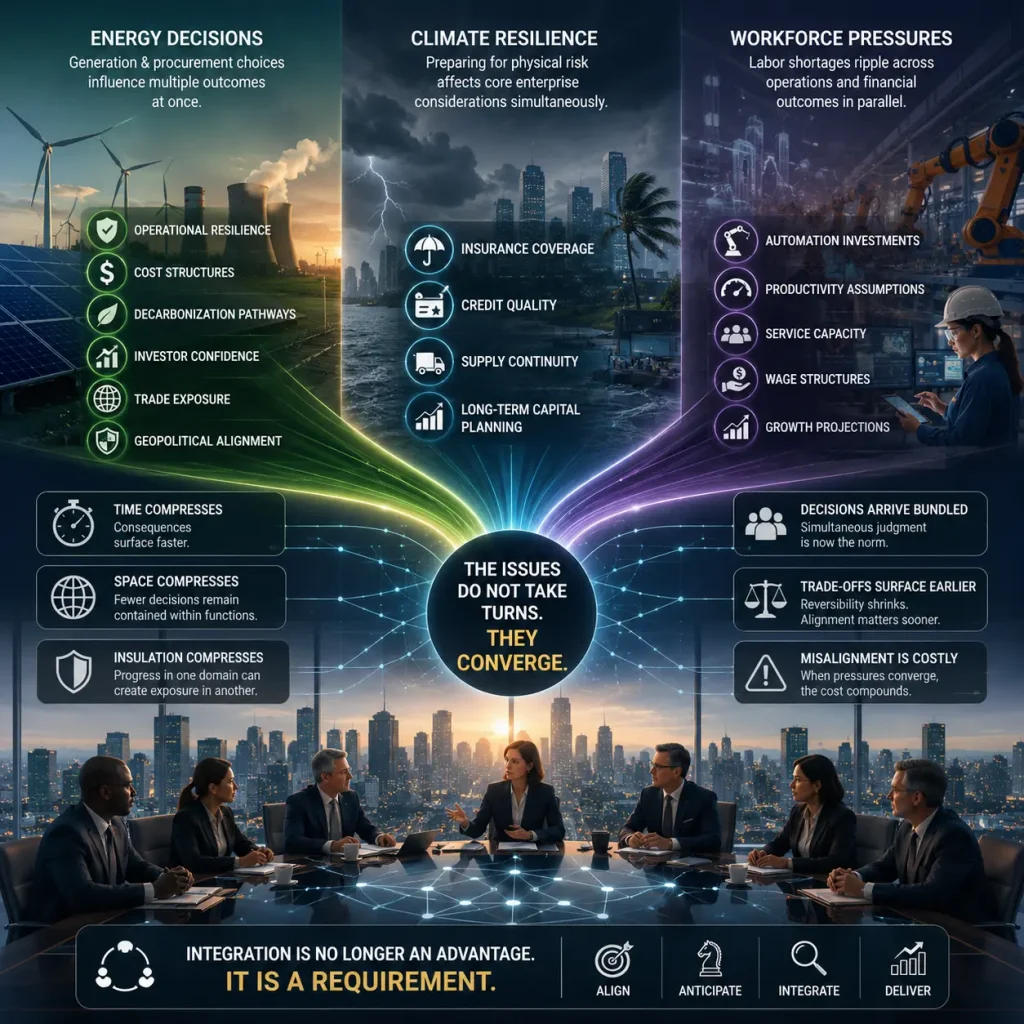
Energy decisions behave similarly. Choices about generation and procurement influence operational resilience and cost structures while shaping decarbonization pathways, investor confidence, trade exposure, and geopolitical alignment at the same time. What once sat inside operations now reaches into finance, strategy, and risk in a single move.
Climate resilience planning follows the same pattern. Preparing assets for physical risk affects insurance coverage, credit quality, supply continuity, and long-term capital planning simultaneously. Adaptation is no longer adjacent to enterprise strategy; it is embedded within it.
Workforce pressures complete the picture. Labor shortages influence automation investments, productivity assumptions, service capacity, wage structures, and growth projections in parallel. Talent strategy now carries direct operational and financial consequences.
The issues do not take turns. They converge.

That convergence is reshaping leadership work in a specific way: it is compressing decision-making.
Time compresses because consequences surface faster. Space compresses because fewer decisions remain contained within functions. Insulation compresses because progress in one domain can create exposure in another.
Leaders are discovering that choices once staged sequentially now demand simultaneous judgment. A capital decision cannot wait for infrastructure planning. A growth initiative cannot ignore resource constraints. A compliance response cannot be separated from competitive positioning. Decisions increasingly arrive bundled, carrying enterprise-wide implications from the outset.
This changes the rhythm of executive work.
Trade-offs surface earlier. Reversibility shrinks. Alignment matters sooner. Functional excellence remains necessary, but it no longer shields the enterprise from cross-domain friction. When pressures converge, the cost of misalignment compounds quickly.
Organizations are adjusting in practical ways. Investment committees are expanding their lens beyond financial returns to include infrastructure readiness and resource dependencies. Technology roadmaps are evaluated alongside energy intensity and location strategy. Risk discussions are moving upstream into operating decisions rather than remaining downstream in reporting cycles. Workforce planning is being tied directly to automation strategy and service capacity.
These adjustments are less about new frameworks and more about operating posture: who is in the room earlier, which assumptions are shared across functions, and how rigorously second-order effects are tested before commitments are made.
None of this is entirely new. Strong leaders have long understood that enterprises operate as integrated systems and that major decisions carry ripple effects. What has changed is the frequency and immediacy of those effects.
Boundaries that once created managerial clarity now create blind spots. Sequential planning struggles when variables move together. Siloed optimization can generate enterprise drag.
Decision compression makes integration less of an advantage and more of a requirement.
It also reframes leadership readiness. Companies will always depend on operators who deliver performance and innovators who drive growth. But converging pressures place a growing premium on executives who can navigate enterprise-wide trade-offs, align domains under time pressure, and maintain coherence when priorities overlap.
That capability is rarely developed within narrow mandates. It grows through cross-functional responsibility, enterprise-scale roles, and experience with decisions whose consequences extend beyond immediate lines of authority. It is built where complexity is lived and trade-offs are real.
The expanding sustainability agenda is one visible expression of this broader shift. It signals an operating environment where interactions matter more than categories — and where leadership is measured by how well decisions hold together under pressure.
The terrain has not simply become more complex. It has become more compressed. Leadership is adapting accordingly.
The convergence described in the cover story is already visible in how global leaders are interpreting the shifts unfolding across technology, infrastructure, and the global economy. From Satya Nadella’s focus on integrating AI breakthroughs with enterprise operating models, to Jensen Huang’s view of artificial intelligence as a platform transforming multiple industries simultaneously, and Jamie Dimon’s assessment of how technological disruption is colliding with geopolitical and economic change, a common thread emerges. These leaders are not describing isolated developments; they are responding to a landscape where technological, economic, and strategic forces increasingly move together — reinforcing the central premise of this issue: leadership today is less about managing individual disruptions and more about addressing convergence across systems.
Satya Nadella’s recent reflections on AI, infrastructure, and enterprise change point to a leadership reality that goes well beyond technology adoption. What stands out is his insistence on the “complete thought”: not just identifying the next breakthrough, but understanding where value will actually be created, how it will be delivered, and what it will demand from the rest of the enterprise. In that framing, AI is not a standalone innovation agenda. It is inseparable from compute infrastructure, capital allocation, business model design, workflow redesign, and governance. That is what makes his perspective so relevant to the current moment. The most consequential executive decisions are no longer neatly contained within functions; they arrive already entangled, forcing leaders to think about demand, deployment, economics, and risk in the same breath.
Equally telling is Nadella’s emphasis on change management as the real test of execution. He suggests that the hardest part is rarely the invention itself, but the organizational ability to absorb it — to reshape workflows, redefine how work gets done, and scale innovation into something commercially and operationally meaningful. For leadership teams, that is a subtle but important shift. The question is no longer who owns a new technology, but whether the enterprise is prepared to integrate it coherently. In an environment where infrastructure, talent, regulation, and strategy increasingly move together, Nadella’s view reinforces a broader truth: leadership advantage now lies less in reacting to disruption and more in building organizations capable of converting interconnected change into durable value.
Source: Satya Nadella — Microsoft’s AGI plan & quantum breakthrough

At the 2026 World Economic Forum in Davos, Jamie Dimon described artificial intelligence as a technology comparable in scale to electricity or the internet—one that is already reshaping industries and decision-making. JPMorgan, he noted, is actively embedding AI across its operations, with roughly 500 use cases under development and an internal large language model used by about 150,000 employees weekly to work with company data. For Dimon, the technology is not merely about efficiency: it is likely to transform how customers interact with financial institutions and how businesses operate, especially as AI agents accelerate the speed and scale of decision-making.
But Dimon also emphasized that technological disruption is unfolding alongside broader structural pressures—from geopolitical tensions to shifts in trade policy and labor markets. While AI will eliminate some jobs, he argued it will also change and create others, making it essential for governments and businesses to plan for retraining and workforce transitions. In his view, leaders cannot treat these forces in isolation: companies must adapt simultaneously to technological change, new competitors such as fintech firms, and a rapidly evolving global economic environment. For boards and executives, that means preparing for a future where strategy, technology, policy, and workforce dynamics are increasingly intertwined.
Source: JPMorgan CEO Jamie Dimon’s Interview @WEF 2026 (Transcript) – The Singju Post

Jensen Huang describes artificial intelligence as “a new Industrial Revolution,” reflecting how the company’s technology has expanded far beyond its origins in video game graphics. In a televised interview, he highlighted how Nvidia’s GPUs power AI systems used in drug discovery, advanced materials research, climate and weather modeling, robotics, and manufacturing. Demonstrations included AI-generated protein structures for new medicines, digital twin simulations that model weather far faster and with much lower energy use than traditional supercomputers, and humanoid robots being tested for factory work.
Taken together, these applications show how the same computing platform is being used across scientific research and industrial production. Huang also addressed workforce implications, saying productivity gains have historically been linked to company growth and hiring, while acknowledging some jobs will become obsolete. He emphasized the need for a “human in the loop,” noting machines cannot understand every circumstance, and agreed AI inspires both optimism and concern: “It’s both.”
Source: Jensen Huang Nvidia 60 Minutes Interview Transcript | Rev
CXO Movements
Marsh
Marsh McLennan’s insurance brokerage business, Marsh, has expanded the role of Mark McGivney, who will serve as Executive Vice President and Chief Operating Officer in addition to his current position as Chief Financial Officer, effective April 15, 2026. Reporting to CEO John Doyle, McGivney will help drive company strategy, oversee cross-business initiatives, and lead inorganic growth efforts, building on nearly two decades of leadership within the firm.
Corebridge Financial Inc.
Corebridge Financial, Inc. has appointed Christopher Filiaggi as Interim Chief Financial Officer effective April 24, 2026, succeeding Elias Habayeb, who will depart the same day. Filiaggi, currently Chief Accounting Officer, will retain his existing role while joining the executive leadership team, ensuring continuity as the company moves forward with its planned merger with Equitable Holdings.
Source: Corebridge Appoints Interim CFO Amid Leadership Transition – The Globe and Mail
The Coca-Cola Company
The Coca-Cola Company has appointed Tapaswee Chandele as Global Chief People Officer, effective May 1, 2026, succeeding Lisa Chang, who will step down after seven years and remain as a senior advisor through year-end. Chandele, a longtime company leader since 2001, most recently served as senior vice president and executive assistant to the CFO, and brings extensive experience in global talent management and HR strategy.
Source:The Coca-Cola Company Selects New Global Chief People Officer :: The Coca-Cola Company (KO)
Conagra Brands, Inc.
Conagra Brands, Inc. has appointed John Brase as President and Chief Executive Officer, effective June 1, 2026, succeeding Sean Connolly, who will step down after more than a decade in the role. Brase, most recently President and COO of The J.M. Smucker Co., brings over 35 years of consumer goods experience, including nearly 30 years at Procter & Gamble, and is expected to lead the company’s next phase focused on growth, operational execution, and brand strength.
Source: Conagra Brands Appoints John Brase as President and Chief Executive Officer
FedEx Corporation
FedEx Corporation announced that CFO John Dietrich will step down effective June 1, 2026, following the planned spinoff of its FedEx Freight business, with Claude Russ serving as interim CFO during the search for a successor. Dietrich will remain with the company through July 31 to support the transition as FedEx continues restructuring to focus on its core delivery operations.
Source:FedEx CFO John Dietrich to step down | Reuters
Southwest Airlines
Southwest Airlines Co. has appointed Sabrina Callahan as its first Chief Digital and Marketing Officer and Nandika Suri as Vice President of Rapid Rewards, strengthening its leadership team to enhance customer experience and digital engagement. Callahan will lead the airline’s marketing and digital strategy to drive growth and brand connection, while Suri will oversee the loyalty program, focusing on increasing engagement and long-term customer value.
Dow Inc.
Dow Inc. has named Karen Carter as its next Chief Executive Officer, effective July 1, 2026, succeeding Jim Fitterling, who will transition to executive chair. Currently Chief Operating Officer, Carter brings over 30 years of experience at Dow, including leading its packaging and specialty plastics business, and will guide the company’s ongoing transformation and focus on innovation, performance, and sustainability.
Source: Dow names former packaging leader as CEO | Packaging Dive
S&P Global
S&P Global has appointed Firdaus Bhathena as Executive Vice President and its first Chief Technology and Transformation Officer, effective April 27, 2026. Reporting to CEO Martina Cheung, he will lead a unified enterprise technology organization to drive adoption of emerging technologies and advance the company’s transformation. Bhathena joins from FIS Global, where he served as Global CTO, bringing experience in technology infrastructure, software development, and data and AI innovation.
The Home Depot
The Home Depot has appointed Franziska Bell as Executive Vice President and Chief Technology Officer, effective April 6, 2026. In this role, she will lead the company’s technology strategy, including product management, data, and AI, with a focus on creating a more connected and data-driven customer experience. Bell joins from Ford Motor Company, where she led AI transformation, and brings prior leadership experience from BP, Uber, and Toyota.
Source: Home Depot Inc (HD) Stock Message Board | InvestorsHub
Broadcom Inc.
Broadcom Inc. has announced that Amie Thuener will become Chief Financial Officer effective June 12, 2026, succeeding Kirsten M. Spears, who will retire after 12 years with the company and remain as an advisor during the transition. Thuener joins from Alphabet Inc., where she served as Vice President, Corporate Controller and Chief Accounting Officer, bringing extensive experience in global financial operations and reporting.
Source: Broadcom Announces Planned Chief Financial Officer Transition
Alaska Air Group
Alaska Air Group has appointed Lindsay-Rae McIntyre as Chief People Officer, bringing her in from Microsoft where she served as Chief Diversity Officer. Reporting to CEO Ben Minicucci, she will oversee talent strategy, employee experience, leadership development, and HR operations. The move comes as Alaska continues executive reshuffling following its 2024 acquisition of Hawaiian Airlines.
Source: Alaska Air names Microsoft’s Lindsay-Rae McIntyre to HR role – The Business Journals
Caterpillar Inc.
Caterpillar Inc. announced that CFO Andrew Bonfield will retire in October 2026, with company veteran Kyle Epley set to succeed him after assuming the role in May. Bonfield, who joined in 2018, helped steer the company toward AI-driven growth, contributing to record revenues in 2025 despite tariff-related challenges. He will remain as a senior advisor through October to support the leadership transition.
Source: Caterpillar CFO Andrew Bonfield to retire, names company veteran as successor | Reuters
Oracle Corporation
Oracle Corporation has appointed Hilary Maxson as Chief Financial Officer, effective April 6, 2026, reporting to CEO Clay Magouyrk. She will lead Oracle’s global finance organization as the company scales its cloud and AI-driven growth amid strong demand for infrastructure and applications. Maxson joins from Schneider Electric, where she served as Group CFO, bringing experience in managing large-scale, capital-intensive global operations.
Source: Oracle Appoints Hilary Maxson as Chief Financial Officer
Pep Boys
Pep Boys has appointed Nik Umrani as Chief Information Officer to lead its technology strategy and drive digital transformation. Bringing over two decades of experience, most recently as Global CIO at NSM Insurance Group / Novacore, Umrani will focus on leveraging AI, cloud, and enterprise technology to support growth and enhance customer service. His appointment underscores Pep Boys’ continued investment in technology and leadership as the automotive service industry evolves.
Source: Pep Boys Appoints Nik Umrani as Chief Information Officer
A close reading of these leadership changes reveals more than routine executive reshuffling—they point to a broader recalibration of priorities across industries. The pattern suggests organizations are aligning leadership structures to navigate a complex mix of technological disruption, operational pressure, and evolving customer expectations.
Taken together, these developments point to a clear trend: leadership structures are being redesigned to support transformation at scale. Companies are not just filling roles—they are redefining them to balance innovation with execution, signaling a future where technology, talent, and strategy are tightly integrated at the top.
If the defining leadership challenge today is convergence, the defining leadership capability is integration. Executives are no longer simply managing individual domains—technology, infrastructure, policy, talent—but navigating how these systems interact under pressure. That shift demands new habits of thinking and decision-making that go beyond traditional management playbooks.
In a converging system, the most consequential impacts of a decision often appear outside the domain where it was made. To build this capability, leaders should deliberately embed second-order reviews into strategic decision-making. One emerging practice is requiring major initiatives to include a short “system impact brief” that identifies how the decision could influence adjacent domains such as infrastructure, regulation, capital markets, or supply chains. Over time, this trains leadership teams to instinctively scan beyond immediate outcomes and recognize ripple effects before they surface operationally.
Markets move quickly, but infrastructure moves slowly—and often determines what strategies are actually possible. Leaders can strengthen this awareness by incorporating infrastructure intelligence into strategic planning. This may include regular briefings on energy markets, compute capacity trends, logistics corridors, water availability, or emerging grid constraints in expansion regions. Few executive dashboards currently track these indicators systematically, yet they increasingly shape where growth can occur. Developing the habit of scanning infrastructure signals helps leaders anticipate constraints before they become competitive barriers.
Most executives were trained to solve problems sequentially—strategy first, operations later, compliance afterward. Converging pressures demand a different discipline: evaluating multiple trade-offs at the same time. Leaders can develop this skill by restructuring internal decision processes so that technology, finance, sustainability, regulatory, and operational perspectives evaluate major initiatives together rather than sequentially. Over time, this builds a leadership reflex to weigh competing priorities simultaneously rather than discovering conflicts later in execution.
Functional depth remains essential, but convergence places growing value on leaders who can move comfortably across domains. Developing this fluency requires intentional exposure beyond one’s core expertise. Executives can cultivate it by participating in strategic discussions outside their primary function, commissioning short internal briefings on unfamiliar systems—such as energy infrastructure, climate risk modeling, or supply chain geopolitics—or rotating senior leaders through cross-functional initiatives. The objective is not mastery of every field, but the ability to recognize when interactions between systems could reshape strategic outcomes.
Public policy increasingly influences technology access, energy costs, and supply chain design. Yet most leadership teams still treat policy as a compliance function rather than a strategic signal. Leaders can begin changing this by integrating policy horizon scanning into strategy discussions. This involves tracking emerging regulatory debates, industrial policy trends, and geopolitical alignments that could shape future operating conditions. When policy intelligence becomes part of strategic planning rather than a reaction to regulation, leaders gain a clearer view of how markets may evolve.
Convergence places stress on organizational alignment. Technology teams may push rapid scaling, finance may emphasize cost discipline, sustainability teams may advance environmental targets, and operations may prioritize reliability. Leaders must ensure these priorities reinforce rather than undermine one another. One emerging practice is conducting periodic enterprise coherence reviews—cross-functional sessions where major initiatives are evaluated collectively to ensure progress in one domain does not create risk in another. Leaders who consistently maintain this alignment build organizations capable of navigating complex pressures without fragmentation.