


Remote Leadership Fatigue: Re-energizing Distributed Executive Teams
Table of Content
- Introduction: Why Remote Leadership Fatigue Matters Now
- How Distributed Executive Work Actually Runs Today
- How Remote Leadership Fatigue Shows Up in the C-Suite
- System-Level Causes of Remote Leadership Fatigue
- Resetting Day-to-Day Working Patterns for Distributed Executive Teams
- Board-Level and Talent Implications for 2026
- Conclusion
- FAQs
- Remote leadership fatigue has become a structural risk that affects CEO tenure, C-suite continuity, and enterprise value.
- Visible signs include executive burnout, slower decisions, meeting overload, and growing dependence on a small inner circle.
- Core causes sit in work design: unclear decision rights, overloaded calendars, messy channel usage, and persistent time-zone imbalance.
- Progress comes from a sharper executive rhythm, clear decision rules, simple digital norms, and explicit expectations in senior role briefs.
Introduction: Why Remote Leadership Fatigue Matters Now
Remote leadership fatigue has shifted from a marginal concern to a central boardroom topic as executive teams operate across time zones, channels and investor expectations. Microsoft’s Work Trend Index reports a 16 percent jump in meetings after 8 p.m., and about 30 percent of meetings now span multiple time zones.
This is not a passing blip. DDI’s Global Leadership Forecast finds that 40 percent of stressed leaders have considered stepping out of leadership roles, a direct threat to succession and continuity. At the same time, rigid return to office rules have been linked to higher attrition risk among senior leaders, which can compound pressure on the top team.
For boards, CEOs, founders, HR leaders, and investors, the central question is direct: how do you sustain distributed team leadership without driving executive burnout, and how do you keep executive teams effective under persistent virtual leadership challenges and remote leadership challenges.
The sections that follow set out the signals to watch, the system-level causes behind them, and the practical resets that support leadership resilience and executive team collaboration in 2026.
How Distributed Executive Work Actually Runs Today
Remote and hybrid work are now the default context for many senior leaders. Executive teams make critical calls over video, often with colleagues they rarely meet in person. This pattern widens access to talent but also raises the load on leaders. To understand remote leadership fatigue, it is worth looking at how distributed team leadership actually runs today.
Flex Expectations in Senior Roles
For senior candidates, flexibility in where they work is no longer a perk; it is a basic condition for considering a role. A recent survey on workplace culture shows a clear majority prefer hybrid or fully remote patterns; preference is even stronger among high-demand specialist and leadership talent.
Many executive teams now include members based in different cities or countries, not just different floors of the same building. That shifts how leaders build relationships with investors, clients, and internal stakeholders, because a significant share of those interactions now happens on screen.
The “Always Available” Load
The same flexibility that attracts senior talent often comes at the cost of a longer working day. When executive teams are spread across regions, there is almost always someone online who wants an answer, a quick call, or an update.
At the same time, leaders juggle long chat threads, email chains, and informal messages from many directions. Remote leadership challenges are no longer about learning new tools; they are about staying present and decisive amid the continual fragmentation of attention.
Why This is a Structural Risk
This pattern matters because it quietly weakens the conditions under which good leadership decisions are made.
Analysts at Gartner warn that rigid onsite policies can increase attrition risk among senior people, especially when workloads already feel unsustainable. When constant availability becomes the unspoken rule, remote leadership fatigue stops being a personal struggle and becomes a structural business risk for retention, continuity, and performance at the top.
How Remote Leadership Fatigue Shows Up in the C-Suite
Remote leadership fatigue does not always appear in headline incidents. It reveals itself in how executive teams think, interact, and choose where to spend time. Patterns inside the C-suite often shift months before formal performance indicators start to move. Boards, investors, and HR leaders who can recognize these patterns early are better placed to protect leadership resilience and executive team collaboration.
Cognitive and Emotional Signs
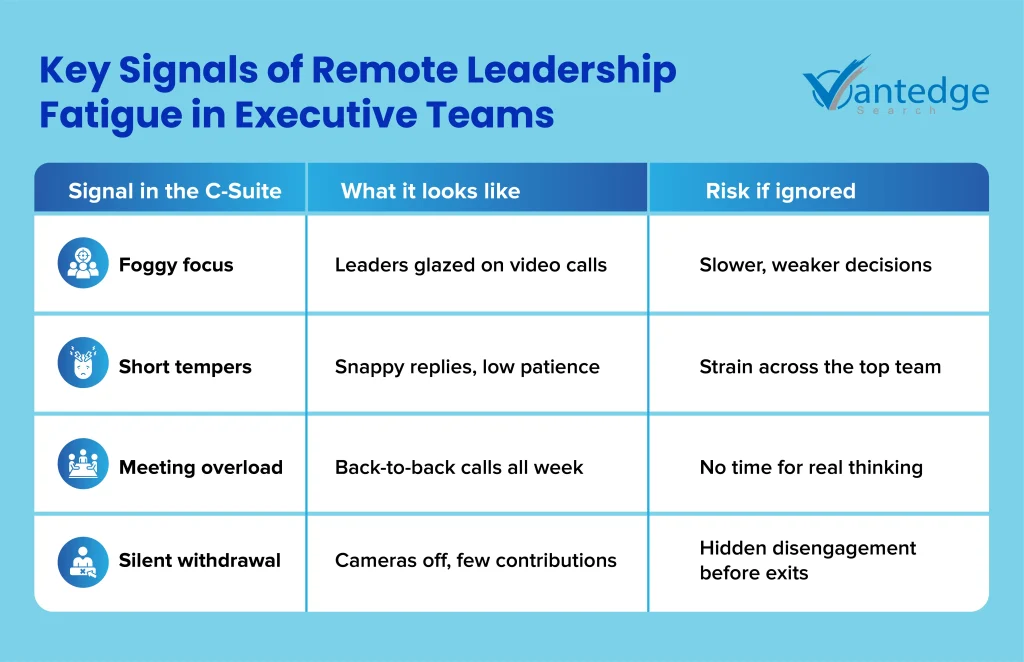
Inside the role, many executives describe a gradual change rather than sudden collapse. They arrive at meetings already depleted, even after weekends or short breaks. Staying fully engaged through long sequences of virtual sessions becomes harder, and details slip through the cracks. Minor irritations become magnified, and curiosity about new ideas fades. Informal check-ins with colleagues are replaced by short, clipped exchanges over email or chat.
Over time, this combination of factors dulls the quality of judgment and weakens coaching conversations with direct reports. It also reduces the likelihood that early warning signals from the organization receive proper attention.
Team-level Patterns
At the team level, remote leadership fatigue reshapes how the C-suite operates. Decision items appear on the agenda repeatedly without reaching closure, because challenge and debate require more energy than anyone has to spare. Meetings tilt toward long sequences of reporting with limited discussion. Between meetings, leaders retreat into their own portfolios, handling immediate fires and leaving cross functional priorities under-served.
Digital channels grow more crowded and sharper in tone as patience runs low. The collective effect is a shift from calm, forward-looking leadership to reactive behavior driven by inboxes and notifications.
Early Signals for Boards and CHROs
For boards and talent officers, the indicators are often structural before they are personal. A sudden spike in reliance on fractional interim leaders can signal that the permanent bench is thinning out or refusing to step up due to perceived burnout risks.
Gartner data highlights that many senior executives are actively looking for exits, driven by sustainable workload concerns. If a small nucleus of two or three people is carrying the entire decision load while others fade into the background, the leadership structure is already brittle.
System-Level Causes of Remote Leadership Fatigue
It is a strategic error to view fatigue solely as a failure of personal resilience. In distributed organizations, exhaustion is often a rational response to irrational workflow design. When the infrastructure of collaboration is broken, even the most disciplined leaders eventually deplete their reserves.
The solution lies not in better stress management, but in recognizing that the operating model itself often generates the friction.
Treating Burnout as Only an Individual Issue
Many organizations respond to strain in the C-suite by sending leaders to resilience workshops or adding wellbeing apps. These steps help, but recent leadership research shows the main drivers of burnout sit in the system. Seramount’s 2025 paper notes that about 70 percent of executives are considering roles that better support their wellbeing, pointing to structural causes rather than weak stamina.
Remote leadership fatigue is therefore a signal to adjust design and expectations, not just individual mindset.
Structural Issues in Distributed Executive Work
Several recurring features of distributed work patterns push directly against leadership resilience:
- Unclear decision ownership
When it is not clear who has the final call, topics bounce between meetings and stakeholders. - Scattered channels and constant switching
Important conversations are spread across email, chat, and informal messaging. Without clear rules, everything feels urgent, and leaders spend their days switching context rather than making considered choices. - Inconsistent signals about onsite vs remote participation
If expectations around physical presence differ by leader or by meeting, executives spend extra energy second-guessing what is acceptable. That uncertainty adds to stress and can create perceived fairness gaps. - Time-zone imbalance
When the same people always join late night or early morning calls to make timing work for others, the personal cost to those leaders builds up week after week.
Taken together, these structural issues feed remote leadership challenges and intensify remote leadership fatigue for the very people the organization depends upon.
Cultural and Relationship Factors
Even with good structures, culture can either act as a buffer or amplify pressure. Virtual settings reduce informal contact and make it harder to notice when someone is close to their limits. When some executives are on site and others dial in, remote participants can feel peripheral to the real discussion.
Over time, this can erode trust and psychological safety, which makes it less likely that leaders will speak openly about capacity or risk.
Resetting Day-to-Day Working Patterns for Distributed Executive Teams
To break the cycle of fatigue, organizations must move from ad-hoc flexibility to deliberate structural design. This requires a fundamental reset of how the executive team interacts, shifting from a culture of constant presence to one of high-impact synchronization. The goal is to reduce the cognitive tax of collaboration while increasing the velocity of decision-making.
A Deliberate Executive Rhythm
McKinsey’s insights on organizational health suggest that clarity of purpose is a primary driver of effectiveness. For the C-suite, this means establishing a small, protected set of high-value meetings focused exclusively on strategy, capital allocation, and critical talent decisions.
Routine status updates and information sharing should be shifted entirely to asynchronous formats such as recorded memos or written briefs, allowing leaders to consume content at their own pace. This protects deep-work blocks, ensuring that when the team does convene, the time is used for debate and resolution, not recitation.
Clean Decision Rights and Records
Remote leadership challenges grow when no one is sure who decides. Executive teams benefit from a simple decision framework that spells out who proposes, who gives input, who signs off, and who communicates the outcome. They must record major decisions in a shared log that captures the rationale, owner, and timelines, so people across functions see the same source of truth.
This will reduce repeat debates, help new leaders join quickly, and allow colleagues in other time zones to stay aligned without extra calls.
Clear Digital Communication Norms
Without rules, digital channels become noise. High-functioning executive teams establish strict protocols for communication. This includes defining which channels are reserved for true urgencies versus background information and setting explicit expectations for response windows.
For example, a “no-response-expected” protocol for weekends or specific time blocks can be transformative. Additionally, implementing a pre-read culture where materials are digested before the meeting ensures that live time is dedicated to high-value discussion rather than presentation, significantly reducing the duration and frequency of required video calls.
Protecting Energy and Resilience at the Top
Sustaining a distributed leadership team requires more than just efficient mechanics; it requires a proactive defense of the team’s energy reserves. Boards and CEOs must recognize that resilience is a finite resource that must be cultivated through structural support and cultural permission.
Conditions that Actually Help
Real resilience comes from agency, not just time off. Leaders are far less likely to burn out when they experience:
- Meaning in their work
A clear link between their daily agenda and the organization’s direction, so the load feels purposeful rather than arbitrary. - Control over workload and schedule
Some ability to shape their calendar, set boundaries, and decide when deep work happens, instead of living entirely in reaction mode. - A climate of respect and psychological safety
Signals from peers, the CEO, and the board that it is acceptable to speak openly about pressure and constraints.
Well-designed hybrid models, with predictable patterns for when to be on site and when to work remotely, also tend to be associated with lower exhaustion than rigid, office-only patterns. Taken together, these findings indicate that leadership resilience is less about personal toughness and more about whether the organization creates sensible conditions for senior roles.
Practical Habits for the Executive Team
Executive Teams can translate those conditions into daily practice through a short, disciplined set of habits:
- Agree on shared contact hours
Define normal hours for calls and messages and treat out-of-hour contact as the exception, reserved for issues that genuinely cannot wait. - Set up confidential peer groups
Create small, trusted circles within the top team where leaders can discuss workload, remote leadership challenges, and personal capacity without formal minutes or judgment. - Review executive roles regularly
Ask the CEO and CHRO to review each executive role at least once a year, checking scope, headcount, and expectations against reality. Where roles have quietly expanded, adjust targets or resources instead of letting pressure accumulate. - Model sustainable behavior from the top
The CEO and board chair can make it visible that they respect boundaries by avoiding late night email barrages and by using planned forums, not constant ad hoc demands, to seek input.
These habits support leadership resilience and help executive team collaboration remain strong even when virtual leadership challenges and remote leadership fatigue are part of daily life.
Board-Level and Talent Implications for 2026
The impact of remote leadership fatigue extends beyond the current quarter; it fundamentally alters the stability of the organization. Boards must now view executive endurance as a critical component of governance and risk management.
Succession and Continuity Risk
Sustained fatigue is shortening the effective shelf-life of C-suite leaders. This trend accelerates the rise of portfolio and fractional career paths, where top talent prefers advisory bursts over permanent ownership.
For nomination committees, this creates a volatile pipeline. Traditional succession planning relies on long tenures to groom internal candidates, but if potential successors burn out before they ascend, the organization faces a sudden leadership vacuum.
Questions Directors and CEOs Should Ask
Given these dynamics, directors and CEOs can sharpen their oversight by asking:
- Where does the executive team’s collective attention go each week—and does that map to the company’s real sources of value and risk?
→ A reality check on focus allocation. It surfaces whether time is being spent on operational noise instead of strategic leverage.
- Which conversations consistently defer decisions, and what does that reveal about unspoken tension or lack of clarity among leaders?
→ Diagnoses latent misalignment and psychological safety issues that can erode decision velocity.
- If one or two senior leaders stepped away, which decisions—or cultural norms—would immediately stall?
→ Tests dependence and succession resilience inside the top team itself, not just the wider organization.
- How often does the executive team review its own operating rhythm and norms, rather than only the business’s performance?
→ Encourages self-governance and adaptation of leadership practices—an early-warning system for drift or burnout.
- What proportion of the executive team’s energy is spent translating strategy to the organization versus compensating for gaps below or beside them?
→ Quantifies leadership drag and clarifies whether the team is leading strategically or constantly bridging structural weaknesses.
Treating these questions as part of core risk and talent oversight helps boards address remote leadership fatigue at its source.
Conclusion
Remote leadership fatigue sits at the intersection of strategy, risk, and talent. It directly affects who is willing to carry senior responsibility, how quickly decisions are made, and how resilient Executive Teams are when conditions turn against them. Remote leadership challenges, virtual leadership challenges, and the demands of distributed team leadership will not recede. What can change is how organizations design and support work at the top.
The organizations that respond thoughtfully will recalibrate decision processes, reset meeting patterns, and clarify digital norms so that leadership resilience is protected, not drained. Executive team collaboration will be treated as a critical asset, not something that is left to chance on video calls and chat threads.
At Vantedge Search, we understand that hiring at the top is about more than filling a seat; it is about securing the vision.
Connect with us today for advisory conversations on structuring resilient executive teams and identifying leaders capable of driving high performance in a distributed world.
FAQs
Remote leadership fatigue is the cumulative strain senior leaders experience when they run distributed teams under constant visibility, extended hours and digital overload. It matters now because it is driving higher CEO and C-suite turnover, weakening succession plans and directly affecting decision quality at the top.
Key signs include persistent tiredness, shorter attention spans, irritability, and reduced curiosity in senior leaders. At team level you see slower or repeated decisions, meetings that are mostly one way reporting, sharper tone in digital channels and a few executives carrying disproportionate load.
System-level causes include unclear decision rights, meeting calendars crowded with low value sessions, scattered communication across many channels, and persistent time zone imbalance. Cultural factors such as weak psychological safety for remote participants and inconsistent expectations around office presence add further strain.
They can redesign the executive rhythm around a small number of high value meetings, move routine updates into written or recorded formats, and protect deep work blocks in senior calendars. Clear decision frameworks and a simple decision log help cut repeat debates and limit unnecessary calls across time zones.
Practical habits include setting shared contact hours, reserving out of hours communication for genuine emergencies and building confidential peer groups inside the C-suite. Regular reviews of role scope and support, along with visible boundary setting by the CEO and board chair, help senior leaders sustain performance over time.
Leave a Reply