


GenAI Upskilling for CXOs: What Boards Will Expect in 2026
Table of Content
- Why GenAI Literacy Is Now a Board-Level Concern
- What “GenAI-Ready” Looks Like for the C-Suite
- How Boards Are Likely to Test CXO Readiness in 2026
- Building a GenAI Upskilling Plan for the C-Suite
- Implications for Boards, CEOs, HR Leaders, and Investors
- Conclusion: GenAI Fluency as a Condition for Trust
- FAQs
GenAI literacy may become a baseline expectation for CXOs in 2026.
Even if companies move at different speeds, boards can still press for clear decision quality and accountable oversight, because the risk of unmanaged GenAI use won’t wait for perfect readiness.
Scrutiny tightens where value creation, controls, and disclosure meet.
High-impact GenAI use cases, sensitive data workflows, and public-facing claims draw the sharpest board attention, particularly when governance and risk ownership are unclear.
Boards screen the operating model, not the buzzwords.
They test ownership, decision rights, human review rules, vendor dependency, and whether leaders can explain trade-offs without external translators.
Readiness improves with focus and discipline.
Role-based GenAI Upskilling for CXOs, targeted Executive AI training, and CXO-sponsored initiatives tied to real decisions create board-ready confidence and reduce drift.
Board agendas entering Q1 2026 are shifting in a measurable way. The conversation has moved past “What is GenAI?” and toward two questions that are harder to answer with confidence: what has GenAI changed in the business so far, and what risks has it introduced.
That shift is visible in public disclosure behavior. According to Harvard Law Corporate Governance Forum, in 2025, almost half of companies in a proxy disclosure review explicitly cited AI risk as part of board oversight of enterprise risk, triple the prior year’s rate (48% vs 16%). Separately, The Conference Board reported that 72% of S&P 500 companies now flag AI as a material risk, up from 12% in 2023. For boards, these are not communications trends. They are governance signals that set expectations for AI governance in 2026.
The practical implication is direct: GenAI literacy is becoming a baseline requirement for CEOs and their teams. Directors are likely to ask whether the C-suite can evaluate GenAI trade-offs without relying on slogans, and whether GenAI upskilling for CXOs is being treated as a business priority, not an HR project.
This blog lays out what boards are positioned to expect in 2026, and how leadership teams can respond through focused C-suite training, stronger AI leadership, and disciplined Executive AI training, especially for US-listed and PE-backed companies. For global operators, it also matters that the EU AI Act includes an AI literacy obligation for staff and others operating AI systems on an organization’s behalf.
Why GenAI Literacy Is Now a Board-Level Concern
GenAI is no longer a side discussion for technology committees. It is increasingly treated as a board-level matter because it affects risk oversight language in proxy statements, decision rights in management, and the credibility of what leadership teams state publicly about AI programs. This is where GenAI literacy becomes a practical requirement for directors and a non-negotiable expectation for the C-suite.
From Technical Topic to Fiduciary Question
As mentioned earlier, Harvard’s Corporate Governance Forum highlighted that nearly half of reviewed companies referenced AI risk within board risk oversight discussions, a sharp increase from the prior year. This includes companies that created dedicated proxy statement sections on AI governance rather than folding it into general risk language.
What matters is not the number itself. What matters is the board expectation it creates. Once peer companies describe AI governance in more detail, directors expect management to speak with comparable clarity. That expectation makes GenAI literacy a shared leadership requirement, not a single-executive specialty.
Regulatory, Disclosure, and Policy Pressures
Regulators and standard setters are intensifying the push for clearer AI-related disclosures. In 2025, the SEC’s focus on “AI washing” and material risk factors led to a significant change in reporting behavior: close to half of proxy statements referencing AI risk now link it directly to board oversight, often delegating specific responsibilities to audit or technology committees.
Parallel pressure comes from international obligations. The EU AI Act requires organizations to take measures aimed at a sufficient level of AI literacy among staff and others operating AI systems on their behalf, strengthening the case for role-based executive AI training and documented C-suite training plans.
What “GenAI-Ready” Looks Like for the C-Suite
For boards, GenAI Upskilling for CXOs is not about turning executives into engineers. It is about whether the leadership team can judge GenAI opportunities and risks with the same confidence they bring to capital allocation, M&A, or cyber incidents. A GenAI-ready C-suite combines a shared baseline of GenAI literacy, role-specific depth, and visible behaviors that signal accountability to the board and to investors.
A Shared Baseline Across the Top Team
For non-technical executives, GenAI literacy means possessing a clear, functional grasp of the technology’s core mechanics and limitations. It is not about coding, but about competence in the concepts that drive value and risk. Every CXO must understand the difference between predictive models and generative agents; and also be conversant in the risks of data privacy, bias, and hallucinations, where models confidently present false information as fact.
Crucially, this baseline includes the ability to challenge AI business cases. Leaders must know enough to ask whether a vendor’s claim is technically feasible or if an internal pilot has sufficient guardrails against toxic content or model drift.
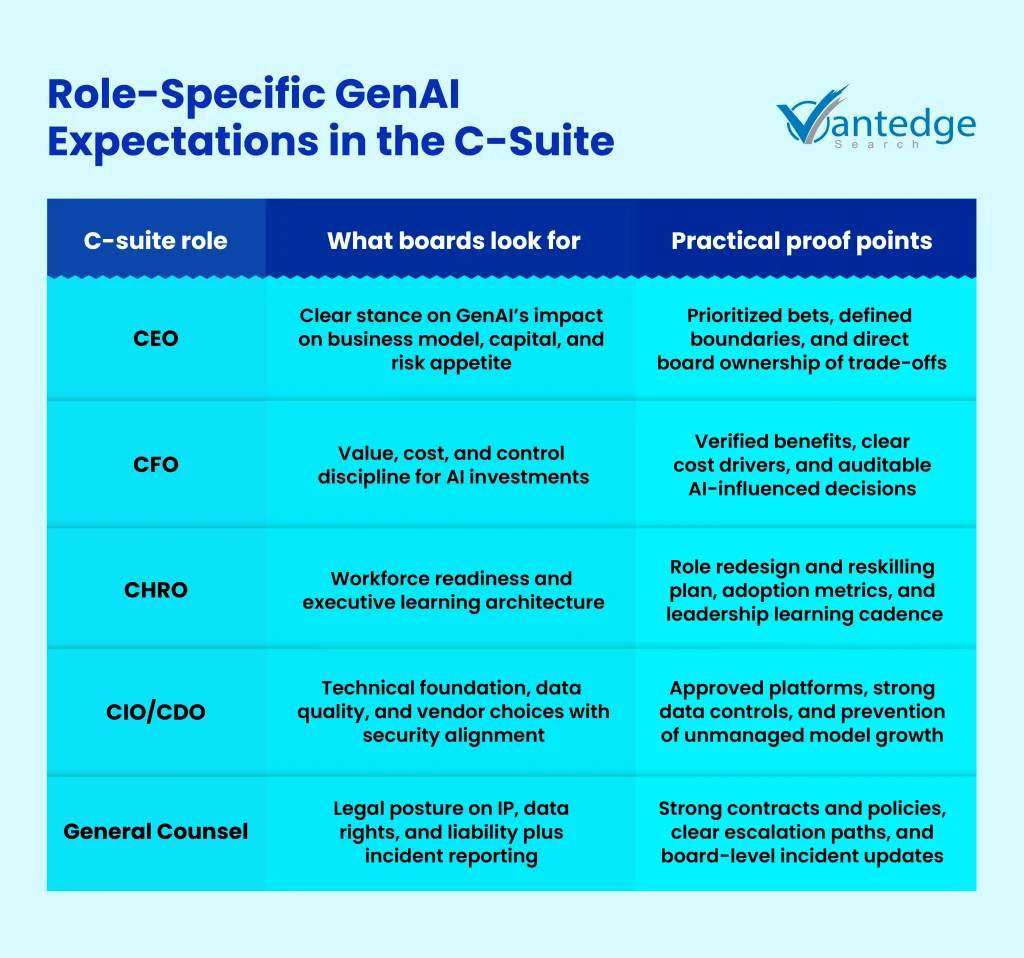
Role-Specific Expectations: CEO, CFO, CHRO, CIO/CDO, General Counsel
Beyond the baseline, each role carries distinct burdens in the AI governance framework for 2026.
- CEO: The Chief Executive must articulate a clear, defensible stance on how GenAI alters the business model, capital allocation, and risk appetite. They must engage the board directly on these topics, demonstrating ownership rather than over-relying on external advisors or technical delegates.
- CFO: The Finance chief needs to read AI projects through a rigorous value, cost, and control lens. This means understanding the unique economics of model inference costs, validating productivity claims before booking them, and ensuring that AI-driven financial decisions remain auditable.
- CHRO: The HR leader is responsible for the workforce’s AI readiness, from job design and displacement strategies to the architecture of executive learning itself. They must lead the reskilling agenda to ensure human talent amplifies rather than competes with AI agents.
- CIO/CDO: These technical leaders are accountable for the underlying architecture, data quality, and vendor selection. In 2026, their role will likely expand to ensuring integration with security protocols and preventing “model sprawl” that creates technical debt.
- General Counsel: The legal lead drives the response on IP rights, data ownership, and third-party liability. They are the primary guardian against regulatory breaches and must lead the reporting on AI incidents to the board and regulators.
Behavioral Signals Boards Watch For
Boards tend to rely on simple behavioral indicators because they are hard to fake.
Positive signals include CXOs who sponsor a GenAI initiative, attend key reviews, ask precise questions about risk and human review, and can describe what changed after a pilot revealed limits.
Red flags often include broad claims without ownership, reliance on buzzwords, and a leadership team that cannot explain its own AI governance framework without referring everything to a technical subgroup. These behaviors often become the board’s proxy for GenAI literacy and AI leadership.
How Boards Are Likely to Test CXO Readiness in 2026
As 2026 gets underway, many boards are sharpening how they evaluate GenAI readiness, not by asking for bigger roadmaps, but by testing decision quality. The conversation often starts with a simple premise: if GenAI is touching core workflows, then leadership must be able to explain priorities, controls, and talent readiness without relying on slogans.
Questions on Strategy and Value Creation
Boards often start by narrowing the field. They may ask management to identify a small set of GenAI priorities rather than present a long catalogue of activity. Questions commonly focus on:
- Where GenAI is in use today, and why those use cases matter.
- What changed in operating performance because of GenAI, and what is still uncertain.
- Which initiatives are top priority for the next 12 to 24 months, and who owns them.
Strong answers show clear ownership, a defined value mechanism, and candor about constraints. This is where GenAI literacy reads as executive judgment, not technical fluency.
Questions on Risk, Controls, and Accountability
Boards commonly ask questions that reveal whether controls are real and operational:
- Who approves high-impact GenAI use cases, and what triggers escalation.
- Which workflows require human review, and how that rule is enforced.
- What monitoring exists for data exposure, output risk, and vendor concentration.
Strong answers avoid long policy recitations. Instead, management explains how the AI governance framework functions in daily work: approval steps, exception handling, incident reporting, and the cadence of board reporting.
This is also where executive AI training matters. Leaders who have been through role-based training often communicate risk and controls clearly, without drifting into either technical detail or vague reassurance.
Questions on Talent, Vendors, and Operating Model
Boards often connect GenAI outcomes to operating capacity. In 2026, directors may ask:
- What is the plan for GenAI upskilling for CXOs and other critical roles.
- Which vendors and platforms are essential, and what safeguards exist around data rights and concentration risk.
- How decision rights are changing as GenAI spreads into more functions.
These questions link directly to AI in the workforce. GenAI changes how work is reviewed, how quality is measured, and how managers coach performance.
Secure GenAI-ready leaders who meet board-level scrutiny.
Building a GenAI Upskilling Plan for the C-Suite
Once expectations are clear, leadership teams need a plan for GenAI upskilling for CXOs that is practical, visible and tied to decisions.
Start with an Honest Skills and Use-Case Map
The starting point is clarity, not content volume. Before booking any courses, the CEO, CHRO and CIO should agree on two simple diagnostics.
First, a skills view. Each CXO should complete a short, structured assessment that probes three areas: understanding of GenAI concepts, ability to question AI-driven business cases and comfort discussing AI governance in 2026 with the board. This can be gathered through self-assessment, a short interview, and light input from the chair or lead director. The tone should be developmental and candid, not punitive.
Second, a use-case view. The CIO or CDO should assemble a single page that lists active GenAI initiatives and serious candidates, sorted by business function and level of risk. For each use case, they should identify the sponsor, the decisions the system supports and any board interest.
Blending External Programs, In-House Sessions, and Peer Learning
Once the gaps are visible, the CHRO and CEO can assemble a simple but serious learning architecture. This should include three elements:
- External executive programs
Select short GenAI or AI governance programs from credible providers that target senior leaders. The criteria should be clear: board-level content, sessions on AI governance framework topics, risk and controls, and practical case work. - In-house sessions
Internal briefings should be short, regular and focused on live issues. The CIO, CDO, General Counsel and Chief Risk Officer can lead sessions on topics such as data protection, vendor contracts, AI in leadership development and incident response. - Peer learning
Closed-door discussions among CXOs, and with trusted external board members or advisers, are essential. These sessions are where leaders share missteps, such as pilots that under-delivered or adoption that stalled. Peer learning makes GenAI literacy part of the leadership culture, not just a training calendar item.
Practice, Not Theory: Labs, Pilots, and Board-Ready Storylines
GenAI literacy becomes visible when CXOs work with real tools and real risks. At least one GenAI use case in each major function should have a named CXO sponsor who attends key design sessions, reviews metrics and participates in post-mortems.
The objective is simple. By the time the board meets mid-year, every core CXO should be able to present one GenAI initiative to the board in three parts: what the initiative set out to do, what actually happened and what it revealed about the company’s evolving AI governance.
Implications for Boards, CEOs, HR Leaders, and Investors
When boards raise the bar on GenAI governance, expectations ripple through every part of the capital stack. Directors want credible oversight. CEOs need a C-suite that can carry that oversight in daily decisions. HR leaders must design C-suite training and AI talent strategy that keep pace with AI in the workforce. Investors, in turn, are beginning to price leadership quality on GenAI governance as a factor in long-term value.
Board Chairs and Committee Leaders
For board leaders, the practical question is how to anchor GenAI governance without overstepping into management. A concise approach is to:
- Assign clear responsibility for GenAI oversight across existing committees, typically audit, risk and technology, and capture that in charters and annual calendars.
- Request a simple AI governance framework from management that defines critical use cases, risk categories, escalation paths and reporting cadence. Deloitte’s AI Governance Roadmap provides a useful reference structure for this type of request.
- Ask management for an annual plan that covers board education and GenAI upskilling for CXOs, and schedule at least one in-depth GenAI session each year.
The tone from the chair matters. The goal is not to run the AI program from the boardroom, but to make it clear that GenAI literacy at the top is a standing governance topic.
CEOs and CHROs: Linking Executive Learning to Outcomes
For CEOs and CHROs, the main task is to connect executive AI training to outcomes the board recognizes.
GenAI upskilling for CXOs should be treated as part of performance, not optional learning. Individual goals should connect directly to specific board concerns, such as model risk, regulatory readiness, customer impact or workforce change. AI in leadership development should be explicit in succession criteria for key roles.
Deloitte’s work on AI and boards highlights that leadership capability often lags the pace of AI adoption, which can hold back progress even when technology is available. HR and technology leaders also need to align AI in the workforce with AI governance so that role design and performance measures match the priorities that appear in board reporting.
PE, VC, and Other Investors
Financial sponsors and public market investors can reinforce these expectations.
They can embed questions on GenAI governance, AI governance framework maturity and GenAI upskilling for CXOs into due diligence, investment committee material and portfolio reviews. A simple scorecard that rates each portfolio company on board oversight, C-suite training coverage, AI talent strategy and disclosure quality sends a clear signal that AI leadership quality is part of the value story, not a side topic for the technology function alone.
Conclusion: GenAI Fluency as a Condition for Trust
Boards are no longer debating whether GenAI matters. They are judging management on whether GenAI is being applied with discipline, measured with integrity, and governed with clear accountability. For the C-suite, this is not a technical literacy contest. It is a credibility test.
Boards will expect leadership teams to set a clear AI posture, align oversight to that posture, and take practical actions that match the company’s risk appetite and ambition.
That expectation cannot be carried by one executive alone. It requires shared GenAI literacy, a working AI governance framework, and visible AI leadership across the top team. The most trusted teams will pair GenAI upskilling for CXOs with role-based C-suite training, while upgrading talent where needed through executive hiring and succession planning.
If your next step is leadership readiness, not more slides, connect with Vantedge Search for confidential advisory and executive search support.
FAQs
GenAI upskilling for CXOs is a structured, role-based approach to build GenAI literacy across the CEO and top team. It focuses on decision quality, risk awareness, and value framing, not technical depth.
AI literacy is becoming a board concern because GenAI is entering core workflows and public disclosure narratives. Boards must oversee strategy and enterprise risk, and GenAI changes both. Directors want management that can explain where GenAI is used, what could go wrong, who owns controls, and how the company avoids overstatement to investors and regulators.
CXOs can improve GenAI literacy quickly by pairing targeted Executive AI training with hands-on work. They can start with a short diagnostic, then assign each leader one high-impact GenAI initiative to sponsor. Also, they can use tight sessions on value measurement, data risk, and human review rules, followed by regular board-ready updates.
Boards expect CXOs to show ownership of GenAI use, not just enthusiasm. They look for a short set of priorities tied to measurable outcomes, clear decision rights, and an AI governance framework that works in day-to-day operations.
A practical first step is to create a one-page map of current and planned GenAI use cases, each with a CXO sponsor, risk level, and decision checkpoints. The CEO and chair can align on the board questions that matter most, then set two to three GenAI literacy objectives per executive.
Leave a Reply