


How the C-Suite Can Deal with the Middle-Management Crisis: Closing the Strategy-to-Execution Gap
Table of Content
- In 2026, boards are increasingly expected to treat the middle management crisis as a strategy-to-execution risk driven by delayering, wider spans of control, and burnout.
- The strategy-to-execution gap forms when strategy translation weakens, decision rights become unclear and create bottlenecks, and coaching time is squeezed by wider spans of control.
- Directors should track rising spans without support, slower decisions with more rework, fewer meaningful 1-to-1s and lower internal mobility, higher regrettable attrition, and repeated ownership debates.
- The strongest response is an operating design that resets spans and decision rights; protects coaching standards; clarifies roles where people leadership and work leadership must split; tightens communication routines; and rebuilds manager selection, rewards, and career paths.
Opening: The “manager squeeze” has become a board problem
As 2026 moves ahead, boards are increasingly expected to treat the middle management crisis as a core execution risk rather than a simple “HR issue.”
Over recent years, organizational delayering has removed layers of supervision and widened spans of control in the name of speed and cost. A 2025 Forbes report describes the “Great Flattening” as a trend where companies cut middle management roles and push decisions downward, only to find remaining managers overwhelmed, more prone to burnout, and less available for meaningful coaching.
The role of the manager is not disappearing. A 2025 Deloitte report on middle managers notes that strong management capability is linked to higher financial performance, and that attempts to thin out the middle without redesign often drive more control and decision-making back to the top.
In practice, this uneven reshaping of the middle layer opens an execution gap strategy, with decision rights blurring, priorities drifting, and C-suite leadership spending more time on escalations that should be resolved closer to customers and teams.
In the sections that follow, we will look at the early warning signals leaders can expect to see in 2026, how the strategy-to-execution gap forms when the middle thins, and five C-suite strategies to reset spans and decision rights, protect coaching, clarify roles, build a stronger communication circuit, and repair the manager talent market.
What Boards Are Expected to See in 2026
Through the rest of 2026, the middle management crisis is expected to show up less as an org chart question and more as a strategy-to-execution problem, with delivery risk rising as coordination and coaching work is pushed into roles that have no capacity to absorb it.
Research by Gartner predicts that in 2026, 20% of organizations will use AI to flatten structures, eliminating more than half of current middle management positions. Even when reductions are selective, the operating risk tends to be consistent, more work moves upward, sideways, and into informal leadership, and the enterprise pays in decision drag and weakened talent development.
Early Warning Signals Directors Should Treat as Operational Risk
Boards must track signals that reveal hidden friction in the management system rather than short-term variance in output, such as:
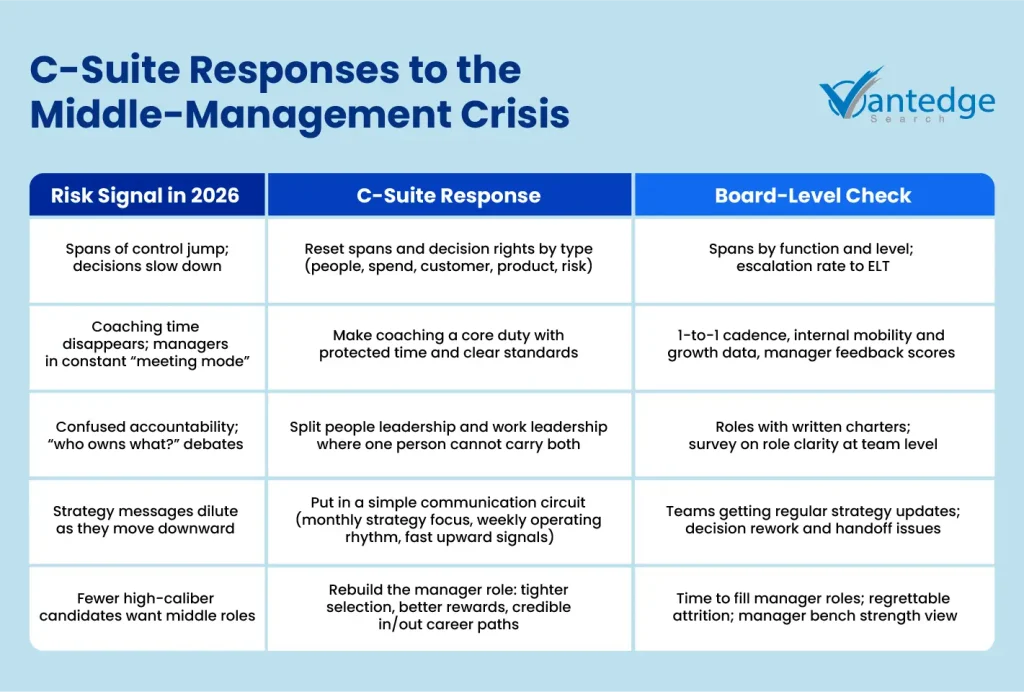
- Rapid rise in spans of control, with little added support for managers.
- Longer decision cycle time with more rework, escalation, and meeting inflation.
- Weaker coaching, with fewer meaningful 1-to-1s, fewer growth plans and lower internal mobility.
- Rise in regrettable attrition among team leads and first-line managers, including quiet exits into specialist tracks.
- Decline in role clarity, visible in repeated “who owns this?” debates and meeting proliferation to compensate.
Where the Strategy-to-Execution Gap Forms When the Middle Thins
When organizational delayering reduces layers or widens spans without clear redesign, the middle management crisis often shows up as a widening strategy-to-execution gap inside the operating rhythm. It is not a question of effort, it is a question of translation, decision flow, and sustained people leadership under pressure. In 2026, C-suite leadership teams will be judged less on the ambition of strategy and more on whether day–to–day operating mechanics still work at scale.
Strategy Translation Breaks at the Last Responsible Layer
As the middle thins, strategy often stays abstract, and teams struggle to convert it into weekly tradeoffs on scope, sequence, and resourcing. KPIs then drift from enterprise outcomes to local activity metrics, which can look busy while compounding delivery risk. This is where leadership failure becomes visible, not in intent, but in the absence of a practical cadence that turns priorities into executable work.
Decision Rights Blur, then Bottleneck
When roles change faster than decision rights, uncertainty rises around who decides on people moves, spend, customer exceptions, and product choices. Teams add meetings to compensate. Escalations rise. Senior leaders become the default decision sink, which slows operating tempo and weakens accountability.
Coaching and Development Collapse Under Span Pressure
A 2025 Deloitte report highlights that as spans grow, day-to-day delivery can continue, but coaching, feedback, and development time often declines. That pattern increases middle management burnout, weakens bench strength, and can appear as leadership failure in the pipeline. The next section outlines C-suite strategies boards can expect leaders to use to restore clarity, coaching, and decision speed.
Speak with Vantedge Search for board-level hiring support.
Five C-suite Strategies Boards Can Expect in 2026
The middle management crisis is not going to be solved by simply hiring more managers. It can only be solved by redesigning the role to match the operating reality. In 2026, boards and C-suite leaders must focus on structural repairs that close the execution gap.
Strategy 1: Reset Spans of Control and Decision Rights
Spans of control should be treated as a risk variable, not just a finance ratio. When spans are too wide, decision quality drops and escalation rises. Leaders can reset this balance by formalizing who owns which call.
- Executive teams need to clearly categorize decisions: Leaders must group decisions into people, spend, customer, and risk buckets, then assign specific owners to stop upward delegation.
- Boards must establish “escalation rules”: Executives cannot function as the default decision sink. Leadership teams need to set thresholds for what must come up versus what must stay down to force resolution at the right level.
- Organizations should add capacity where spans expanded: If a manager has too many direct reports, operations leaders need to provide administrative relief, or analytics support to free up decision bandwidth.
Strategy 2: Make Coaching a Measurable Operating Requirement
If development fails, delivery eventually fails. In 2026, capability building is likely to be treated even more as an execution control, and not as a “nice-to-have” soft skill. To make this shift real, organizations must move from vague expectations to specific commitments.
- HR leaders must specify minimum standards: Teams need to define the cadence and output of mentorship, such as monthly growth plans or quarterly skill reviews, so it becomes a visible work stream. If it is not tracked, it will not happen.
- Operations heads need to protect manager time: The organization must create a “time budget” that defends development hours from meeting sprawl. This might look like “no-meeting Fridays” or blocked development hours.
- Leaders should use evidence-backed points: Deloitte’s research confirms that when managers have the capacity to mentor, engagement and retention improve. But this only holds true if the span of control allows it.
Strategy 3: Clarify Roles by Splitting “People Leadership” from “Work Leadership” Where Needed
When spans jump, one person can rarely handle both deep technical oversight and high-touch people management. Organizations can solve this by decoupling these two distinct responsibilities.
- Companies can implement two-track leadership: Where feasible, organizations should split the role into “people leaders” (career, growth, culture) and “work leaders” (delivery, quality, technical review). This allows for focus and reduces the cognitive load on a single individual.
- Teams need to write concrete charters: Leadership must write down exactly what each role owns to prevent the “shadow leader” confusion. Clarity here prevents the friction of overlapping mandates.
This separation allows technical experts to advance without being forced into people management roles they do not want.
Strategy 4: Build a Communication Circuit that Replaces the Missing Layer
Delayering often breaks the “cascade” of information. Leaders must replace the missing human layer with a systemic one to guarantee strategy travels all the way to the front line.
- Executive committees should move to monthly strategy translation: Leaders need to shift from vague town halls to specific sessions where they translate strategy into local tradeoffs for line leaders. This makes the connection explicit.
- Managers need to shift to input/output operating reviews: Teams must move from status updates to reviews that identify blocks quickly. The focus should be on unblocking execution rather than reporting on it.
- Leaders must establish fast signal channels: The organization needs a named owner for upward feedback so frontline signals reach the C-suite without getting stuck in the middle.
Strategy 5: Repair the Manager Talent Market
Fewer high-potential employees want middle management roles because the stress-reward calculation is visibly broken. To fix the pipeline, companies must change the value proposition of the role itself.
- Hiring committees need to raise the bar on selection: Organizations should move away from tenure-based promotion to selection based on leadership capability. High performers are not always high-potential leaders.
- Reward systems must value retention: Compensation structures need to reward retention and development outcomes, not just delivery speed. This reflects the long-term value of building teams.
- Organizations should create credible career paths: Leaders must build “step on / step off” paths so taking a manager role does not feel like a permanent trap. Talent needs the ability to move between individual contributor and leadership tracks.
How Executive Operating Discipline Turns These Strategies into Results
These strategies are incomplete without executive operating discipline. When senior leaders actively constrain demand, absorb ambiguity, and model decision-focused operating rhythms, the same strategies that often stall begin to compound. Fixing the middle is less about asking managers to stretch further and more about redesigning how the top of the organization works so execution can stabilize below it.
The first shift is to manage strategic demand as deliberately as supply. In most enterprises, priorities accumulate faster than they are retired. New initiatives, reviews, and transformation efforts are added on top of existing work, quietly increasing coordination and decision load in the middle. Organizations that make progress force explicit trade-offs at the top: new priorities replace existing ones rather than piling on. This discipline prevents overload before it reaches managers and creates the capacity required for spans, coaching, and decision rights to function as designed.
The second shift is to resolve ambiguity at the top instead of passing it downward. Execution improves when senior leaders take ownership of recurring decision ambiguity rather than allowing it to circulate through the organization. Clear, durable ownership for the decisions that escalate most often, paired with escalation rules that encourage resolution at the right level, reduces rework and restores pace. Middle managers gain speed not because they are empowered to decide everything, but because fewer unresolved questions land on their desks.
The third shift is to align executive behavior with the operating model the organization is expected to follow. When leadership time is dominated by reviews, approvals, and escalations, the organization learns to manage upward rather than execute laterally. Redesigning executive time around decisions with closure, strategy translation tied to near-term trade-offs, and talent discussions that treat managers as system assets creates a powerful signal. When the top operates with discipline, structural fixes in the middle become durable instead of episodic.
Taken together, these shifts explain why closing the strategy-to-execution gap is ultimately a leadership design challenge, not a middle-management fix. When executive teams manage demand, resolve ambiguity, and model disciplined operating rhythms, the organization regains stability without adding layers or burning out managers. The middle stops acting as a shock absorber for unresolved tension and starts functioning as a true execution engine. At that point, the question is no longer whether middle management can cope, but whether the organization has been designed to let it succeed.
Conclusion
The middle management crisis is not a personnel issue. It is a structural defect in how organizations are trying to scale. When boards and CEOs treat middle management as a cost layer to be thinned rather than an execution engine to be maintained, the result is a strategy-to-execution gap that no amount of top-down communication can close.
For executive leaders, the move is clear. Organizations must stop treating the symptoms of burnout with wellness perks and start treating the cause with operating design. The organizations that win in 2026 will be those that rebuild the middle not as a layer of bureaucracy, but as a layer of translation. This is where strategy becomes action, talent becomes capability, and decisions find their rightful owners.
At Vantedge Search, we understand that securing the right leadership is about more than filling a seat. It is about confirming your organization has the structural integrity to deliver on its vision.
If you need leadership that strengthens execution and reduces leadership failure risk, connect with Vantedge Search today.
FAQs
The middle management crisis is rising strain on managers after delayering, with wider spans of control, higher workload, weaker coaching capacity, and growing risk of middle management burnout and leadership failure.
It weakens strategy execution when strategy translation becomes vague, decision rights blur, escalations increase, and managers have too little time to coach teams or manage tradeoffs, widening the execution gap strategy.
It is a board-level concern because stressed, overloaded managers increase operational risk, damage retention, weaken succession pipelines, and create a visible gap between stated strategy and what actually happens in day-to-day delivery.
Delayering can help if spans, decision rights, and support are redesigned together. If layers are cut without redesign, efficiency gains are temporary and execution quality, coaching, and accountability usually deteriorate.
C-suite leadership can close the strategy to execution gap by resetting spans and decision rights, protecting coaching time, clarifying roles, building clear communication routines, and repairing the manager talent market with better selection and rewards.
Leave a Reply