


The Executive Mentoring Stack for 2026: Coaching, Peer Pods, and Digital Learning That Will Actually Stick
Table of Content
- Introduction: 2026 is Set to Raise the Cost of “Unconverted Insight”
- Why the Mentoring Stack May Gain Strategic Weight in 2026
- Design Shift #1: From “Programs for Levels” to Stacks for Critical Roles
- Design Shift #2: From “Mentor-As-Sage” to Cross-pressure Peer Architecture
- Design Shift #3: Add a Decision Ledger Beneath Coaching, Pods, and Digital
- Governance and Discretion: Making a Sharper Stack Safe to Use
- What “Growing Significance” May Look Like in Board and Investor Conversations
- Conclusion: A Different Question For 2026
- FAQs
Key Takeaways
- The Conversion Challenge: As 2026 unfolds, the C-suite’s success will be defined by “conversion”, the ability to turn abundant market insights into steady, reliable decisions under pressure.
- The Critical-Role Pivot: Executive development is set to move away from broad, level-based programs toward a “Mentoring Stack” built specifically around high-consequence roles where failure is costliest.
- Decision Rehearsal Rooms: Traditional mentoring is expected to evolve into “cross-pressure” peer pods and decision ledgers, allowing leaders to stress-test their judgment before it reaches the board or the market.
- Mentoring as Risk Insurance: For the remainder of the year, boards and investors will increasingly view executive coaching not as a talent benefit, but as disciplined risk insurance for strategic execution.
Introduction: 2026 is Set to Raise the Cost of “Unconverted Insight”
As we move deeper into 2026, a clear pattern is expected to intensify in the C-suite. Senior leaders are rarely constrained by a lack of input. Advisors, courses, and market signals remain abundant. The limiting factor is conversion, insight that reliably shows up in decisions, alignment, and responses under pressure.
This gap can be described as the rising cost of “unconverted insight.” A leader may understand how to manage a merger or reset operating cadence, yet without reinforcement that holds in real time, theoretical understanding often fails to surface in the moments that define outcomes. This is where leadership risk management becomes material.
In response, executive development is expected to move away from stand-alone initiatives toward a more deliberate build: the Executive Mentoring Stack. This is not simply a new name for mentoring programs. It is an intentional combination of executive coaching, structured peer-to-peer coaching pods, and digital reinforcement designed to support executive learning when stakes are highest.
The purpose of mentoring is changing. In the past, it was often seen as a way to support engagement and retention. In 2026, it is more likely to be viewed as quiet risk insurance for a few high-stakes roles. In those positions, one poor decision, slow response, or early departure can significantly affect the company’s direction.
Recent research from Gartner has noted rising complexity in senior roles, reinforcing the need for tighter executive decision skill development. The question is no longer whether mentoring exists, but where the stack reduces risk.
Why the Mentoring Stack May Gain Strategic Weight in 2026
Executive mentoring is expected to carry more strategic weight in 2026 because the cost of leadership error is rising, and the time available to correct course is shrinking. Deloitte’s 2025 Global Human Capital Trends research frames growing tensions across business and human outcomes, with AI reshaping work and accelerating change pressures that leaders will need to address.
A clear signal in Deloitte’s coverage is an “experience gap,” including the finding that two-thirds of executives say most recent hires are not fully prepared. That dynamic is set to increase scrutiny on leadership development, particularly when critical roles must perform quickly under ambiguous conditions.
McKinsey’s 2025 research on growth mindsets suggests many leaders struggle to turn long-term growth goals into day-to-day action. Respondents report spending only 22% of their time on long-term initiatives, which is why decision skill development matters so leaders can protect strategic priorities when urgent work piles up.
In this context, mentoring programs are expected to shift from “benefit framing” to “risk framing.” The aim becomes cleaner alignment on trade-offs and faster correction when assumptions break.
Secure leadership Roles with Vantedge Search.
Design Shift #1: From “Programs for Levels” to Stacks for Critical Roles
The first design shift addresses the unit of design. Rather than building programs by level, the stack is increasingly set to be built around a short list of critical roles where failure carries disproportionate cost.
Many programs still follow a tiered pattern with one design for VPs, another for Directors. In 2026, that structure may appear increasingly blunt because leadership risk concentrates unevenly.
A critical role is best defined by consequence, not title. Common examples include:
- Post-merger integration leads
- New country heads
- Turnaround CEOs
- First-time enterprise leaders with cross-functional dependencies
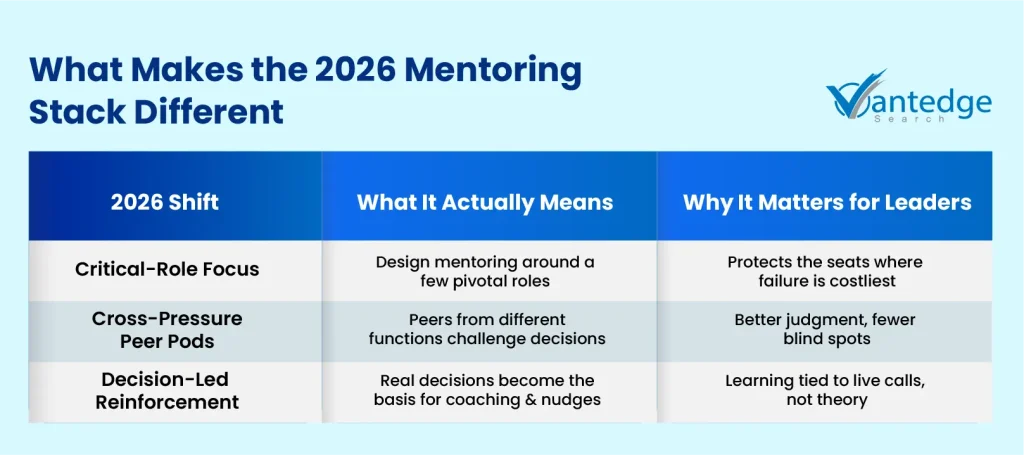
When mentoring is role-led, the stack typically shifts in three ways:
1. Mandate-Anchored Coaching: Focusing on decision bottlenecks unique to that seat, such as escalation timing and stakeholder sequencing.
2. Structured Peer Pods: Built for cross-pressure, not similarity.
3. Live-Call Learning: More tied to real-time scenarios, with reinforcement that supports repetition under pressure.
This design is expected to change the measurement discipline. Meeting counts and satisfaction scores will likely become less persuasive than operational signals: faster alignment on trade-offs and fewer decision reversals.
Design Shift #2: From “Mentor-As-Sage” to Cross-pressure Peer Architecture
The “mentor-as-sage” model can support long-range pattern work. But in 2026, leaders need better judgment that considers multiple perspectives. Cross-functional dependency and shifting operating models can often outpace what one mentor or coach can see.
Cross-pressure peer architecture addresses that gap by treating coaching pods as decision rehearsal rooms. The aim is structured, dissent-capable challenge on live decisions before those decisions become fixed and hard to change.
A high-integrity peer-to-peer coaching design typically includes:
- Pods of 4–6 leaders drawn from different functions, markets, or incentive structures.
- An explicit “risk voice” rotation so second-order effects are named without social penalty.
- A decision agenda tied to real calls in motion, not abstract case discussion.
In 2026, the strategic value of coaching pods is set to extend beyond support. Properly built, they will become a repeatable method for stress-testing judgment before decisions reach board discussion or market exposure.
Design Shift #3: Add a Decision Ledger Beneath Coaching, Pods, and Digital
A recurring weakness in mentoring is that development effort is not consistently anchored to real decisions. A Decision Ledger offers a lightweight corrective: a confidential record of material decisions that becomes the working material for the stack.
A decision ledger can remain intentionally simple:
- Context and constraints
- Choice made and rationale
- Core assumptions
- Foreseeable risks and mitigation
This mechanism supports decision skill development without turning mentoring into monitoring. It will create the conditions for pattern recognition, identifying recurring blind spots like delayed escalation or over-confidence under time pressure.
Governance and Discretion: Making a Sharper Stack Safe to Use
As the executive mentoring stack moves closer to real decisions, governance becomes a precondition for candor. Without clear boundaries, participation can narrow, and conversations can become safer and less useful.
Practical safeguards include:
- Ownership: Ledgers remain controlled by the leader and coach; only aggregate themes are shared.
- Non-Attribution: Peer pods operate under strict confidentiality, with narrow exceptions for legal/ethical risks.
- Pattern-Based Reporting: Feedback to boards stays role-based, not person-based.
These guardrails make it more plausible that the stack remains trusted in the very seats that face the highest scrutiny.
What “Growing Significance” May Look Like in Board and Investor Conversations
Board and investor attention tends to show up first in language and routines, not in new labels. As executive mentoring becomes tied to mandate outcomes, board-level discussion is likely to reference readiness and risk signals rather than participation in executive mentoring programs.
The 2025 McKinsey-reported time split—22% of time is said to be spent on long-term growth initiatives—supports the view that boards may place more emphasis on operating mechanisms that protect strategic execution. A stack that links executive coaching and mentoring, peer-to-peer coaching, and digital reinforcement to real decisions can be positioned as such a mechanism.
Signals that could credibly surface without compromising discretion include:
- Major people and capital decisions being pressure-tested through structured peer-to-peer coaching, in addition to line review.
- Critical-role leaders showing stronger consistency between stated strategy and day-to-day trade-offs.
- Executive coaching and mentoring anchored to decision patterns; themes tracked in aggregate.
- Critical Role Succession discussions including decision maturity signals, not only delivery history.
At this point, it becomes easier to explain executive development as a way to reduce leadership risk in key roles. It is not just a development program, it is protection for the seats that matter most.
Conclusion: A Different Question For 2026
In 2026, leadership development for executives is set to be judged by conversion, not access. The test is whether insight becomes steadier decisions in critical roles.
The executive mentoring stack relies on familiar components, executive coaching and mentoring, peer-to-peer coaching via coaching pods, and digital reinforcement. What changes is the organizing logic: critical-role focus, cross-pressure challenge, and a confidential decision ledger that ties executive learning to live calls.
The most useful question remains specific and testable: where does executive mentoring reduce leadership risk management exposure in critical roles, and where does activity fail to change decisions?
If you are evaluating critical roles where leadership risk cannot be left to chance, start by securing the right leaders and then accelerating early execution. Partner with Vantedge Search to secure high-performance executives and C-suite leaders who align with your strategic mandate and drive immediate impact.
FAQs
In 2026, executive mentoring is expected to shift from a general retention perk to a strategic tool for leadership risk management. It will focus on helping leaders convert insight into better decisions during high-stakes moments like mergers, turnarounds, or new market entries.
While executive coaching often focuses on individual skill building and behavioral shifts, executive mentoring in this context emphasizes long-term pattern recognition and navigating complex stakeholder dynamics.
Critical roles are positions where a single wrong decision or slow adaptation can significantly alter the business trajectory or financial outcomes. Mentoring provides a necessary “rehearsal room” for leaders to pressure-test trade-offs and clarify their judgment before making irreversible commitments.
The executive mentoring stack is an intentional system that combines executive coaching, structured peer-to-peer coaching pods, and digital reinforcement into one unified workflow.
It moves succession criteria beyond simple delivery history by generating data on a leader’s decision maturity and ability to handle cross-pressure. This approach helps boards and investors judge readiness by looking at how future leaders handle real strategic trade-offs. It goes beyond past operating results alone.
Leave a Reply