


The New Leadership Bar for 2026: CEO Turnover Trends and What They Signal for the C-Suite
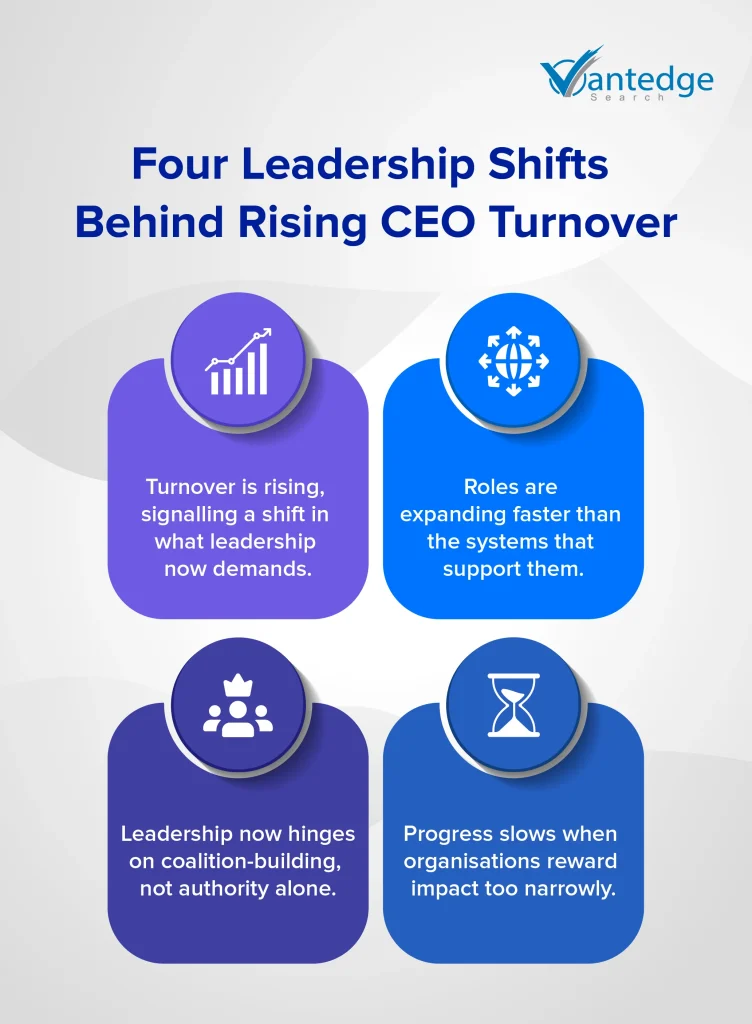
As we step into 2026, a clear pattern is emerging: CEO turnover is rising. This shift signals that expectations of CEO leadership and executive leadership have evolved faster than many realize. Performance is no longer the sole marker of staying power; adaptability, foresight, and the ability to navigate disruption now define executive impact. In the context of executive transitions and C-suite challenges, this moment is an invitation to recalibrate what leadership must look like in a more complex, accelerated environment.
A Closer Look at CEO Turnover Trends—and What’s Driving Them
The backdrop to this moment is captured in a recent analysis from The Conference Board—Report: CEO Departures Are Rising, Even at Strong-Performing Companies (24 November 2025, Press Release)—drawing on SEC filings and additional insights from governance and executive leadership organizations.
The data shows a clear pattern: CEO turnover is increasing across the performance spectrum. In the S&P 500, CEO changes among high-performing companies increased from 7% in 2024 to 12% in 2025, bringing them much closer to the 14% turnover seen in lower-performing firms. According to The Conference Board, many of these transitions reflect strategic realignment and long-term succession planning that had been postponed during recent volatility. This shift is also evident in the pace of announcements, with the S&P 500 on track for a 13% succession rate in 2025, well above the 10% recorded the previous year, while the Russell 3000 holds steady at 11%.
The report also highlights a notable rise in external appointments. In the S&P 500, external CEO appointments jumped from 18% in 2024 to 33% in 2025, pushing internal promotions below 70% for the first time in eight years. Industry observers point to a growing appetite for fresh perspectives and transformation-driven leadership. Tenure patterns also point to a broader reset: departing S&P 500 CEOs averaged nine years in the role, compared with seven the year before. Yet, even with this leadership reshaping, progress on gender diversity has stalled. The number of women leading S&P 500 companies remained unchanged at 48 between 2024 and 2025, while the Russell 3000 saw only a marginal increase from 7.6% to 7.7%. After years of steady improvement, this plateau underscores a critical inflection point for leadership pipelines in 2026.
What Rising CEO Turnover Means for Today’s C-Suite
What stands out is that executive leadership itself seems to be changing shape faster than the roles built to contain it. CEO transitions rising across both strong and lagging performers, coupled with the sharp increase in external CEO hires, suggest that expectations around senior roles are evolving in ways we can’t afford to overlook. Stability and CEO performance will always matter, of course, but they no longer capture the full arc of what these roles now demand as organizations navigate ongoing leadership and organizational change. The numbers tell us what is moving; the lived experience of the C-suite is what reminds us why those movements matter.
1. Turnover raises more questions than answers — and perhaps that’s the point
As executive leadership evolves faster than many leadership roles were designed to, it’s tempting to search for a single explanation when CEO departures rise even in well-performing organizations. Are organizations accelerating change because their priorities have shifted? Are boards finally acting on leadership succession planning delayed during recent volatility? Or are some leaders themselves choosing to step away from roles that have grown heavier, broader, and more exposed than ever before? The data itself offers no definitive answer. It simply signals that something beneath the surface is changing, and that it deserves closer attention.
For many in senior roles, the more valuable exercise may be to sit with what this moment implies rather than rush to interpret it. If leadership cycles are tightening, what does that mean for how we sequence our agendas? If expectations around executive roles have expanded faster than the roles themselves, do we need to rethink how we prioritize time, energy, and focus? And if some leaders are stepping down by choice, what does that suggest about the long-term sustainability of the leadership models we’ve normalized?
It may be worth asking:
- Has my role evolved in ways I haven’t fully acknowledged?
- Is the impact I want to make aligned with what the organization now needs?
- Am I leading a chapter I believe in, or sustaining one that has quietly run its course?
- If continuity is becoming more fluid, what does readiness really look like this year?
- And before I make my next leadership decision – stay, stretch, shift – what perspective am I missing?
What turnover gives us is an opening. And the leaders who choose to explore that opening with curiosity, not defensiveness, may find themselves far better placed to navigate the year ahead.
2. Leadership roles are stretching faster than leadership support systems — and the C-suite is feeling the strain
Industry conversations with leaders indicate a growing sense that the organizations around them are still built for a slower, more predictable era than the one they are now operating in. Expectations tied to executive leadership have multiplied — public visibility, cultural stewardship, digital fluency, transformation velocity — but the support structures surrounding senior roles have not evolved at the same pace. The result is a subtle but persistent form of strain: not burnout, not misalignment, but a widening gap between the speed at which leaders are expected to act and the pace at which their organizations can realistically absorb or enable that action.
This gap raises a different kind of C-suite challenge, one that rarely surfaces in formal reports or dashboards. How do we redesign senior roles so that leaders can actually thrive within them, rather than simply endure them? How do we create space for judgment and reflection, instead of forcing every decision through an always-on, compressed cycle? And as the scope of executive roles continues to expand, how do we ensure it doesn’t unintentionally narrow the pool of leaders willing, or able, to step into them?
For many CXOs, the more relevant questions now might be:
- What do I need around me—not just within me—to lead well in this chapter?
- Am I being realistic about the load I’m carrying, or normalizing a pace that isn’t sustainable?
- Is the system enabling my judgment, or consuming it?
- And if leadership roles keep expanding, how do we ensure they remain aspirational, not extractive?
If turnover is rising, part of the story may be organizational readiness, but part of it may simply be that the cadence of leadership has accelerated while the cadence of organizational support has not.
3. Leadership today relies less on authority and more on coalition—and not every leader wants to build coalitions at this pace
If the previous point was about a mismatch in pace, another shift comes into focus when you look at how leaders actually get things done today: executive leadership has become far more coalition-driven than it used to be. The modern CEO is no longer just leading teams or businesses; they are navigating investors, regulators, partners, digital communities, internal cultures, and an increasingly opinionated external ecosystem. Influence has become more distributed. Authority has become negotiated. And much of a leader’s effectiveness now depends on the coalitions they can build across groups that don’t always share priorities, timelines, or tolerance for risk.
This is ultimately a question of appetite as much as capability. Some leaders thrive in this environment; they enjoy operating through networks, shaping consensus, and managing multiple centers of power as part of today’s CEO leadership reality. Others find that the role they stepped into years ago has quietly morphed into something that demands a different kind of emotional and relational bandwidth, one that was never explicit in the original CEO expectations attached to the role.
For the C-suite, the real reflection may then not be about succession or readiness, but about coalition capacity:
- Whose alignment does my role now depend on, and how much of that is within my influence?
- Am I leading through authority, or stitching together alignment in ways the organization doesn’t always see?
- Which coalitions energize me—and which deplete me?
- And if leadership today requires influencing circles I never anticipated, what does that mean for how I show up, negotiate, and hold my ground?
Turnover, in this context, may say less about performance and more about the growing complexity of building alignment in a world where every stakeholder has a voice. And not every leader wants to spend their energy negotiating influence across an expanding constellation of demands.
4. Progress at the top often stalls when organizations reward impact in narrow, inherited ways
If coalition-led leadership is widening the circles of influence, another tension becomes visible: many organizations still define impact through a surprisingly narrow lens. Not intentionally, but through habit—the kinds of work that are labeled as pivotal, the assignments seen as career-making, the rooms in which influence is acknowledged, and the stories we tell about what executive leadership “looks like” when it’s working well. When organizations continue to reward leadership the way they always have, while expecting leaders to operate in new ways, progress at the top inevitably slows, even in the midst of change.
For the C-suite, this moment raises a different question, not about capability, but about how executive leadership impact is recognized:
- What kinds of impact do we consistently reward—and what kinds do we overlook without meaning to?
- Whose contributions shape the organization’s future, even if they don’t fit the traditional leadership template?
- How many high-potential leaders stay invisible simply because their work doesn’t carry legacy labels like “critical” or “transformational”?
- And if our definition of impact expanded even slightly, how many new leaders would suddenly come into view?
The stall at the top isn’t a commentary on talent. It’s a reminder that the stories we tell about impact, and the way we recognize it, shape who rises. When those stories evolve, the leadership bench often does too.
Conclusion
Perhaps the most useful way to look at rising CEO turnover is not through the narrow lens of succession, but through the changing psychology of executive leadership itself. As the arc of senior roles shortens, expectations stretch, and the definition of impact continues to shift, leaders may need to rethink what they are actually optimizing for: continuity, velocity, influence, or meaning.
The question, then, is not how to hold on to a role for longer, but how to hold it with greater clarity: about why you are in it, what you want from it, and what version of leadership the moment is asking you to step into. In that context, CEO succession planning becomes less about replacement and more about readiness: for leaders, boards, and organizations navigating ongoing leadership transition. If 2026 offers anything to the C-suite, it is an opportunity to examine not just the roles leaders occupy, but the relationship they have with leadership itself.
Source: Report: CEO Departures Are Rising, Even at Strong-Performing Companies
If 2026 marks a new chapter for leadership, it’s worth asking what kind of leader your organization—and your future—now require.
At Vantedge Search, we help executive leadership navigate these inflection points with clarity, discretion, and strategic foresight.
Partner with us. Let’s start the conversation.
FAQs
CEO turnover in 2026 is being driven less by short-term performance issues and more by a structural shift in leadership expectations. As organizations face sustained disruption, boards are reassessing whether current leadership is positioned for what comes next—not just what has worked in the past. This has accelerated leadership changes across industries, even where companies are performing well.
In many high-performing organizations, rising CEO turnover reflects strategic realignment rather than failure. Boards are increasingly prioritizing future readiness—such as adaptability, transformation capability, and stakeholder navigation—over stability alone. As a result, strong financial results no longer guarantee continuity if leadership is perceived as misaligned with the organization’s next chapter.
Rising CEO turnover has implications well beyond the CEO role itself. For the broader C-suite, it signals tighter leadership cycles, increased scrutiny, and evolving expectations around scope and impact. Senior leaders are being asked to operate across strategy, culture, transformation, and external influence simultaneously—often with less time to grow into expanded mandates.
It signals a shift from authority-based leadership toward influence-based leadership. Today’s CEOs are expected to build coalitions across boards, investors, employees, regulators, and broader ecosystems. Leadership effectiveness is increasingly defined by the ability to navigate complexity, sustain alignment, and adapt continuously—rather than by tenure or operational success alone.
In 2026, some organizations may be more open to considering external CEO appointments alongside internal succession options. This reflects a broader reassessment of leadership fit as roles expand and business contexts become more complex. Rather than signaling a preference for external hires, it indicates that boards are weighing a wider range of leadership profiles to address specific strategic needs.
Leave a Reply