


2026 Financial Governance: 5 Questions Boards Should Ask Their CFO
Four Key Takeaways
- Financial governance in 2026 appears to matter more at the point of decision, as finance becomes more digital, more AI-supported, and more exposed to board-level scrutiny.
- Boards may need to ask more pointed questions about decision guardrails, AI model governance, and finance ecosystem resilience as CFO mandates become more digital and cross-functional.
- The stronger CFOs may be those who can show clear ownership, proof artifacts, and scenario-based decision logic across value capture and balance sheet choices.
- For boards, these five questions can serve as a practical lens for assessing whether financial leadership is ready for a wider governance role in 2026 and beyond.
Why “Financial Governance” Needs a Reset in 2026
Most organizations already have reporting cycles, audit disciplines, and budgeting frameworks in place. These remain necessary. But the governance conversation heading into 2026 appears to be shifting in a more consequential direction: toward the quality of the decision system itself, not just the outputs it produces.
What may be more notable about 2026 is the pace of change sitting underneath finance. Deloitte’s Q4 2025 CFO Signals Survey found that technology transformation had moved into the top position for CFO priorities, with 50% naming the digital transformation of finance as their primary concern. That is a meaningful contrast from 2025, when enterprise risk management held the top spot. It suggests that the decisions boards may need to probe are more model-driven, more dependent on third-party platforms, and more cross-functional than before.
PwC’s 2026 corporate governance trends report notes that AI protocols and decision accountability are among the top board priorities entering the year. These signals suggest that financial governance may increasingly be judged not only by what is reported, but by how management is making decisions behind those reports.
In our view, as finance becomes more model-enabled, system-mediated, and cross-functional, the quality of outcomes is increasingly set upstream—at the point where decisions are framed, validated, and executed. Whether it is pricing adjustments, capital allocation calls, or forecasting assumptions, the outcome is largely determined before it reaches a reporting cycle—by how the decision was constructed and governed at source. This places greater emphasis on understanding how decisions are made, not just how results are reported.The five questions below are offered as a starting point for boards that want to assess whether CFO strategy is governing a decision system, not merely a finance function.
How Boards Should Use These Questions
These are governance questions, not operational inspections. A board using them well is not auditing management; it is testing whether the decision system is likely to hold up under pressure.
Each question may be more useful when it produces four things: a short verifiable answer, a named owner or decision forum, a proof artifact the board can revisit quarterly, and a remediation path where gaps are visible. Harvard’s 2025 Board Effectiveness research points to this directly: when executives and directors are not clearly aligned on decision authority, governance performance tends to suffer.
Boards should listen for precision over polish. Clarity on who decides, what guardrails exist, and where the system is weakest may be more revealing than a well-structured presentation.
Find C-suite talent that drives results with Vantedge Search
The 5 Questions Boards Should Ask
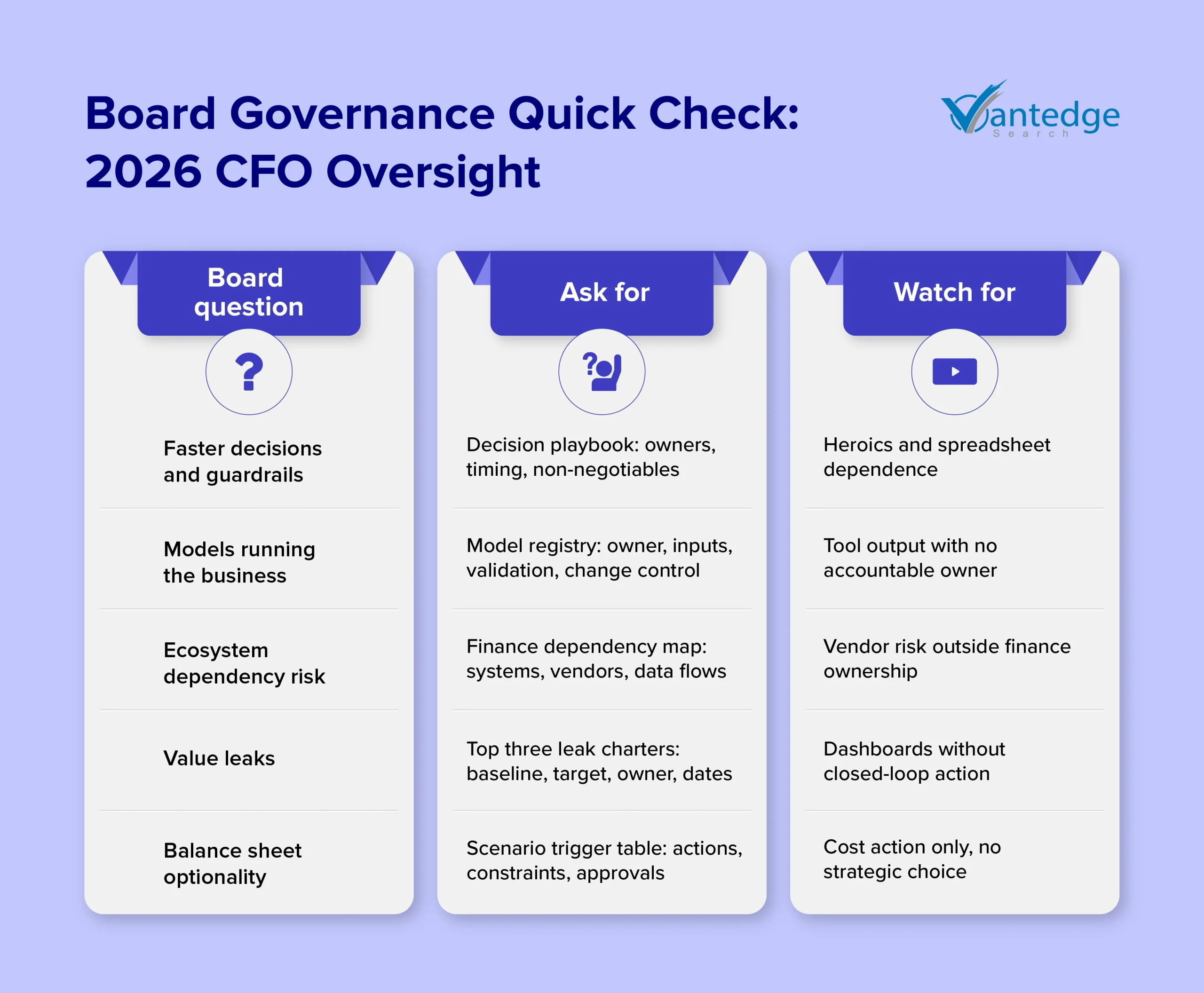
These questions are not new in concept. What may be more relevant in 2026 is the context around each one: faster decision cycles, more AI-influenced outputs, more concentrated dependencies, and a wider CFO board mandate than most organizations have formally recognized.
Question 1: “Which decisions must be made faster, and what guardrails keep them defensible?”
What the board is really testing:
Whether the CFO has mapped the decisions that most shape performance under pressure, such as pricing changes, capital allocation, restructuring moves, and discretionary spend, and whether those decisions have defined owners, minimum data thresholds, and non-negotiable controls.
In previous years, many boards were more focused on reviewing how past decisions had played out. In 2026, the more productive question may be whether the decision structure itself is strong enough to absorb speed without sacrificing defensibility. Gartner’s 2025 CFO and Finance Executive Conference highlighted that agility in finance should reflect sustainable responsiveness, not the removal of operating discipline.
What strong looks like:
A CFO with a well-governed decision architecture may be able to produce a map of high-velocity decisions, each with a named owner, a minimum data requirement, and escalation logic. Gartner’s “Agility Without Chaos” framing suggests that decentralized decisions tend to work better when operating models are intentionally designed to absorb speed without creating instability.
Red flags to watch for:
Reliance on heroics at period-end, controls discussed only in audit language, and no distinction between decision-grade and directional data may all suggest that financial decision making is less structured than boards might assume.
Question 2: “Which models materially influence revenue, margin, risk, or reporting, and how are they governed?”
What the board is really testing:
Whether management can account for the models shaping commercial and financial outcomes, including any AI or machine learning components. This question carries greater weight in 2026 as AI adoption across finance has moved from experimentation to active use. Gartner’s 2025 AI in Finance data found that 59% of CFOs report active AI use across finance teams, up from 37% in 2023. AI model governance is no longer a peripheral concern for the CFO board conversation.
What strong looks like:
A prudent approach would likely include a model registry for the highest-impact models, covering business and technical ownership, data inputs, known limitations, validation methods, change control steps, and defined thresholds for human review. Gartner has suggested that CFOs approach AI investment with a proof-of-concept discipline, assessing whether model-driven decisions are producing intended outcomes and adjusting accordingly.
Red flags to watch for:
Deloitte’s 2025 EMEA Model Risk Management Survey found that governance gaps tend to widen fastest in organizations where model ownership has not been formally assigned. “The system says so” with no accountable owner is a key governance red flag for boards.
Question 3: “Where are we exposed across the finance ecosystem: systems, vendors, data partners? What is the resilience plan?”
What the board is really testing:
Whether critical finance processes, including order-to-cash, procure-to-pay, record-to-report, and treasury, are likely to remain functional when dependent systems, vendors, or data sources come under strain. Finance ecosystem resilience is becoming a board-level concern as critical finance processes are increasingly dependent on a concentrated set of shared platforms, outsourced services, and payment infrastructure.
McKinsey’s 2025 operational resilience research suggests that stronger organizations are shifting toward impact-driven models that treat third-party dependencies as part of their critical service map, rather than a separate IT risk register.
What strong looks like:
A dependency map across finance-critical flows, identifying key vendors, single points of failure, workaround readiness, and ownership for incident escalation, may give boards a clearer picture than a generalized risk summary. PwC’s 2025 Third-Party Risk Management analysis noted that liability for vendor failures increasingly rests with the organization, not the vendor alone.
Red flags to watch for:
Vendor risk treated as a procurement or IT issue with no finance ownership, and an inability to describe operational workarounds, may suggest that finance ecosystem resilience has not yet been treated as a board-level governance matter.
Question 4: “What are the top value leaks, and who owns closing them end-to-end?”
What the board is really testing:
Whether CFO strategy extends beyond variance commentary into measurable, owned value recovery. BCG’s 2025 research on corporate performance suggests that organizations with disciplined value tracking, where the gap between gross initiatives and net financial impact is actively managed, tend to show results that are more visible in the P&L.
A more consequential shift is in ownership. Value leaks involving pricing drift, contract leakage, billing errors, and slow collections are often cross-functional in origin. A finance team carrying the problem alone is likely to see limited traction.
What strong looks like:
A shortlist of three to five quantified leaks, each with a named business owner outside finance where applicable, a governance cadence, and leading indicators tied to financial outcomes, may be more useful to a board than a longer initiative list with unclear accountability. Common leak categories worth probing include pricing and discount drift, contract leakage, billing accuracy failures, margin erosion from procurement noncompliance, and cash leakage from avoidable write-offs.
Red flags to watch for:
Many initiatives with no ownership or timelines, a new system named as the primary plan, and finance as the sole function carrying a cross-functional problem may all suggest that value capture discipline is still developing.
Question 5: “How is the balance sheet being managed as strategic optionality with triggers and decision rights?”
What the board is really testing:
Whether liquidity, working capital, and capital allocation are governed with pre-agreed triggers, so management can act with speed when conditions shift. Deloitte’s Q4 2025 CFO Signals Survey suggests that CFOs are entering 2026 with a stronger risk appetite than in prior periods, which may make the governance of that confidence more, not less, important to boards.
BCG’s 2025 balance sheet research found that active management of balance sheet levers may improve earnings by around 5% on average, and more in some cases. That finding implies the balance sheet may be worth treating as a source of strategic choice rather than a reporting output.
What strong looks like:
A scenario-linked plan covering liquidity headroom, working capital levers with cross-functional owners, capital allocation rules tied to specific conditions, and pre-defined board notification triggers may give directors more confidence than a static treasury summary.
Red flags to watch for:
A plan limited to cost actions, optimism not tested against covenants or refinancing windows, and weak operational ownership of working capital may indicate that balance sheet governance is still more reactive than boards might prefer.
What These Questions Reveal About CFO Readiness
These five questions are not new in isolation. What may be more significant in 2026 is how they connect. Together, they outline a governance mandate that is wider than the one most CFOs have historically carried: decision architecture, AI model governance, finance ecosystem resilience, value capture discipline, and balance sheet optionality.
Gartner’s 2025 Leadership Vision for CFOs estimates that financially unsound operating decisions cost organizations approximately 3% of EBITDA on average. That figure may carry more weight now, because the decisions driving those costs are more model-assisted, faster, and more cross-functional than in previous cycles.
For boards considering CFO succession or assessing whether the current role is appropriately scoped, these questions may serve as a practical evaluation lens for strategic financial leadership. Gartner’s 2025 CFO Leadership Perspectives survey noted that enterprise growth strategy had moved to the second-highest CFO priority, suggesting the board-CFO relationship may need to be more explicitly strategic going forward.
Board-ready CFO signals worth noting:
- Clarity: plain-language answers grounded in documented evidence
- Artifacts: documents that exist today, not stated as in progress
- Cadence: governance rhythms already operational, not being planned
- Tradeoffs: honest acknowledgment of constraints and competing priorities
- Candor: proactive identification of gaps with a dated remediation plan
The governance questions a board asks of its CFO do not exist in isolation. They sit within a wider leadership dynamic, one where the quality of judgment under pressure, at the executive level, shapes how well those governance structures actually hold. (For boards thinking about how senior leaders perform when decisions carry real weight, read our blog Leadership Without Noise: CEO Leadership Trends and Decision-Making Under Pressure which offers a relevant perspective on what steady, grounded leadership looks like when the stakes are high.)
Closing: A Practical Takeaway
Strong financial governance in 2026 is less likely to be measured by reporting volume and more likely to be judged by the quality of the decision system behind it. What has shifted is not the importance of controls, but where they may need to operate: at the point of decision, across the model layer, through third-party dependencies, and within capital choices that may need to be made quickly.
Boards that ask for proof artifacts, named owners, and candid gap assessments may find that oversight quality rises without adding process overhead. The five questions above are a starting point for that conversation.
The right CFO leads financial strategy, manages resources, and holds the organization to the highest standards of compliance and fiscal integrity. Connect with Vantedge Search to place a leader built for that mandate.
FAQs
Financial governance refers to the system of rules, processes, and controls through which an organization manages, monitors, and maintains accountability over its financial decisions and reporting.
Boards carry ultimate financial stewardship responsibility. Strong financial governance helps protect long-term stability; build stakeholder confidence; and ensure management decisions remain transparent, auditable, and aligned with strategy.
Boards should consider asking about decision guardrails, model accountability, third-party dependencies, value leak ownership, and how the balance sheet is being managed as a strategic asset.
The CFO must serve as both financial administrator and strategic governance leader, overseeing risk management, internal controls, capital allocation, and the integrity of financial reporting across the organization.
Companies should strengthen financial governance by assigning clear decision ownership, formalizing model oversight, mapping third-party dependencies, and building scenario-linked capital allocation disciplines with board-level visibility.
Leave a Reply