


The COO as Execution Architect: Why the Best Operators No Longer “Run Ops”
Table of Content
- Introduction: The COO Remit is Expanding Beyond Operational Control
- Why Execution Now Rewards Architecture More Than Oversight
- From Running Operations to Engineering Execution
- Expansion Area One: Automation Layers as Operating Infrastructure
- Expansion Area Two: Decision Velocity as A Design Responsibility
- Expansion Area Three: Org Design Over Process Layering
- Where This Expansion Is Already Visible: Two Bounded COO Examples
- Conclusion: The Role Will Keep Expanding Where Execution Grows More Complex
- FAQs
Four Key Takeaways
- The COO mandate is expanding into execution system design because operational oversight alone can no longer keep pace with cross-functional complexity and the cost of unclear accountability.
- Automation layers, decision velocity, and org structure are now active COO responsibilities because most execution failures trace back to design gaps, not performance gaps.
- The best COOs are increasingly evaluated on their ability to reduce structural friction and improve decision flow as execution speed is now a direct function of how well the operating model is built.
- Boards and CEOs must prioritize systems thinking and decision architecture in COO hiring as the ability to build a high-performing operating model now outweighs the ability to manage one.
Introduction: The COO Remit is Expanding Beyond Operational Control
The chief operating officer role is no longer defined by what it oversees. It is defined by what it builds.
According to McKinsey’s 2026 COO Excellence report, 40% of new CEOs in 2024 had previously held COO or president titles, signaling how central this position has become to enterprise leadership. The same research identifies organizational design and decision-making infrastructure as the areas where today’s most effective COOs spend the majority of their time, well beyond the boundaries of traditional operational management.
The COO’s brief is expanding majorly across three distinct territories: systems that reduce manual coordination, decision pathways that shorten approval delays, and org structures that make accountability clearer. These are not peripheral additions to COO roles and responsibilities. They are increasingly central to how a business performs at scale.
From our perspective, the most useful way to understand the COO role today is not to ask whether it still owns operations, but to look at where its influence is expanding. The more execution depends on system design, cross-functional clarity, and decision speed, the more the COO becomes the executive shaping the conditions under which the business can perform consistently.
The best COOs don’t manage execution. They engineer it.
Why Execution Now Rewards Architecture More Than Oversight
The operating context for most businesses has grown considerably more complex. Teams are more cross-functional, approval cycles have multiplied, and the cost of unclear ownership is now directly traceable to performance. McKinsey’s 2025 research on how COOs deliver strategy found that high-performing operators consistently focus on translating priorities into operational mechanisms rather than monitoring activity closely. That distinction matters more as organizational complexity grows.
Execution delays in high-complexity businesses are rarely caused by a lack of effort. They are caused by how the operating model is designed. When accountability is spread too thin and coordination depends on manual follow-through, execution quality becomes inconsistent regardless of the caliber of individuals involved.
McKinsey’s Race to Rewire Operations further reinforces this point, noting that organizations which build stronger operational systems, rather than adding management oversight, are better positioned to sustain performance at scale. The companies that close the execution gap do so through structural design, not supervision.
This is why COO strategy and scaling business operations increasingly demand architectural judgment, not stronger management routines alone.
From Running Operations to Engineering Execution
The term execution architect describes a COO whose primary contribution is not daily operational continuity but the design of systems that make execution reliable across the organization. The distinction is consequential. An operator manages what exists. An execution architect builds what the business needs in order to perform consistently, at scale, without depending on constant intervention.
In practice, this means translating strategic priorities into repeatable mechanisms rather than one-time directives. It means identifying where cross-functional friction slows delivery and addressing it at the structural level. It means designing coordination pathways that do not require senior involvement at every stage. And it means embedding accountability directly into the operating architecture, so that ownership is clear before problems surface, not after.
McKinsey’s 2026 COO Excellence research identifies this shift explicitly, noting that the most effective COOs spend significantly more time on organizational design and decision-making infrastructure than their peers, and considerably less time on day-to-day operational management.
This repositioning is not a departure from COO roles and responsibilities. It is a maturation of them. As execution grows more dependent on how the business is structured to operate, the COO increasingly becomes the executive responsible for the logic behind performance, not only its continuity.
Secure executive talent that scales with Vantedge Search.
Expansion Area One: Automation Layers as Operating Infrastructure
Automation is increasingly part of how the chief operating officer role is exercised, not as a technology ownership question, but as an operating design decision. The COO’s remit here is not to select tools. It is to determine where automation reduces routine coordination load and builds more reliable execution infrastructure across the business.
In practice, this means making deliberate design decisions across several operating layers:
- Workflow orchestration: Removing the need for manual handoffs between teams so that work moves forward without depending on individual follow-through.
- Reporting and visibility layers: Giving leadership accurate, real-time signals without requiring manual data aggregation across functions.
- Escalation triggers: Ensuring that exceptions surface to the right level of the organization without delay or ambiguity.
- Repeatable handoff systems: Reducing reliance on informal communication or individual memory to keep cross-functional work moving.
Gartner’s 2025 research found that organizations with well-designed automation frameworks reduce unplanned operational escalations by nearly 30%, a result driven not by technology alone but by how workflows are structured around it. The design layer matters as much as the tool itself.
For the COO, business architecture now includes deciding where automation sits within the operating model, how it connects across functions, and what friction it is specifically designed to remove. That is an operating infrastructure decision, not a technology one.
Expansion Area Two: Decision Velocity as A Design Responsibility
Many execution delays are, at their core, decision delays. Work stalls not because teams lack capability but because the pathway for a decision is unclear, ownership is contested, or approvals require more coordination than the situation warrants. This is an organizational design problem, and it sits squarely within the expanding chief operating officer requirements.
The COO’s role here is to shape the structure around decisions, not to make more decisions personally. That means addressing the following:
- Decision rights: Defining which level of the organization acts on which type of decision, without unnecessary escalation.
- Approval pathways: Designing approvals that reflect the actual risk profile of a decision, not outdated organizational precedent.
- Escalation routes: Building predictable escalation structures that resolve exceptions quickly without creating bottlenecks at the executive level.
- Cross-functional decision flow: Clarifying ownership at the interface between functions, where ambiguity most commonly slows delivery.
McKinsey’s productivity research identifies decision-making speed as one of the most significant differentiators between high-performing and average-performing organizations, with top-performing companies far more likely to have clearly defined decision authorities at every level.
Where multiple functions share ownership of an outcome, the COO increasingly acts as the executive who removes ambiguity and keeps execution moving. That is COO strategy applied at the organizational level.
Expansion Area Three: Org Design Over Process Layering
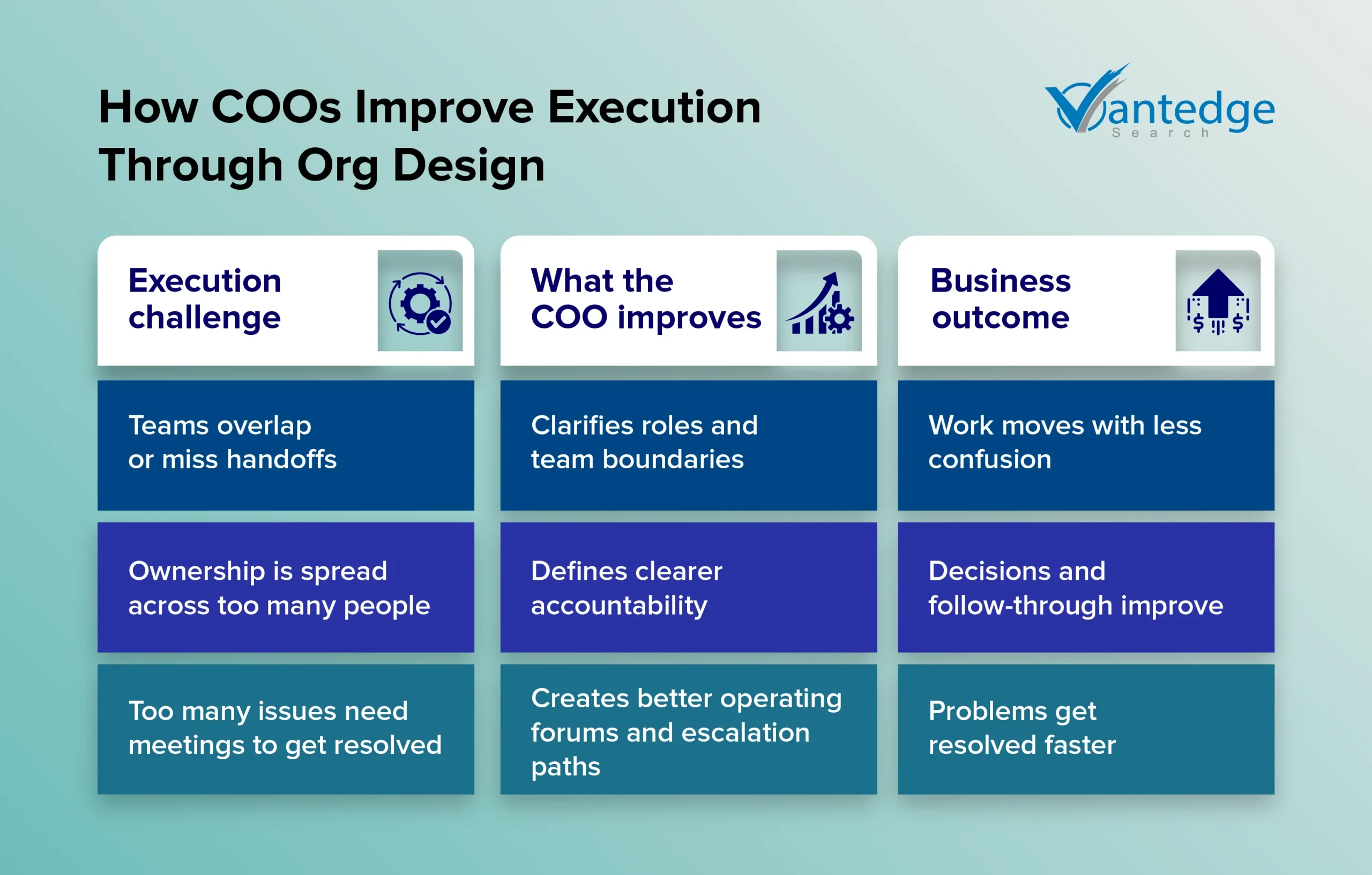
When execution breaks down, the instinctive response is to add process. More checkpoints, more reporting requirements, more coordination meetings. In most cases, this compounds the problem rather than resolving it. The more productive intervention is structural, and that is where the COO’s judgment becomes most valuable.
Business architecture at the organizational level means addressing friction at its source rather than managing its symptoms. That requires attention to:
- Role clarity: Ensuring individuals and teams understand where their accountability begins and ends, reducing overlap and missed handoffs.
- Team interfaces: Designing how functions connect and coordinate, so that work moves across boundaries without requiring constant senior involvement.
- Accountability design: Building ownership into the operating model directly, rather than relying on management routines to assign it.
- Reporting lines: Structuring authority in ways that reflect how work actually flows, not how the organization was historically arranged.
- Operating forums: Creating the right cadence of alignment and escalation mechanisms so that issues are addressed at the appropriate level.
BCG’s 2025 research on long-term value creation found that organizations with cleaner structural design consistently outperform peers on execution speed and strategic alignment.
Where This Expansion Is Already Visible: Two Bounded COO Examples
The shift toward execution architecture is not theoretical. It is already visible in how senior COO mandates are being defined and expanded across industries.
Tim Kessler, LaSalle Investment Management
LaSalle Investment Management’s December 2025 leadership announcement positions the COO role in direct proximity to enterprise strategy execution. With Tim Kessler elevated to President while continuing as Global COO, the mandate explicitly includes working closely with the incoming CEO to “develop and execute LaSalle’s global strategy.” This framing places the COO alongside the CEO in translating strategic direction into enterprise-level outcomes, rather than limiting the role to operational oversight alone.
The expansion of Kessler’s role, combined with the emphasis on his “comprehensive knowledge of the business” and collaborative leadership approach, reflects how the COO function is being leveraged at the center of organizational continuity and execution. The announcement underscores execution, operational excellence, and sustained growth as shared leadership priorities, indicating that the COO’s contribution is closely tied to how effectively the organization delivers on its strategic agenda at scale.
Brad Lightcap, OpenAI
At OpenAI, Brad Lightcap’s role was formally expanded in March 2025 to include business strategy, partnerships, infrastructure, and operational excellence alongside his existing responsibilities. The expansion reflected a deliberate organizational decision to extend the COO’s remit into scaled execution design, covering how the business grows, connects externally, and performs reliably under significant operational pressure.
Both examples illustrate how chief operating officer requirements at the highest levels now extend well beyond managing internal operations.
(For ongoing perspectives on leadership transitions and how C-suite roles are evolving in practice, explore our monthly newsletter: https://www.vantedgesearch.com/newsletters/).
What This Means for Boards, CEOs, And Hiring Leaders
As the COO mandate expands, the criteria used to evaluate and appoint candidates must expand accordingly. Organizations that continue to hire for operational control alone will find themselves with an executive whose capability stops precisely where complexity begins.
McKinsey’s COO Excellence research highlights that the most effective COOs are distinguished not by functional expertise alone, but by their ability to design the conditions under which the business executes well consistently. That requires a different evaluation lens.
When assessing candidates for the chief operating officer role, boards, CEOs, and hiring leaders should place increasing weight on:
- Systems thinking: The ability to see how decisions, structures, and workflows connect across the business, not just within a single function
- Decision architecture: Demonstrated experience in designing decision rights, approval frameworks, and escalation structures that improve execution speed
- Organizational judgment: The capacity to diagnose structural friction and address it through design rather than additional process
- Scalability of execution: Evidence of building operating models that perform reliably as the business grows, without proportionate increases in management overhead
This is what strategic leadership development at the COO level looks like in practice. The question for leadership teams is no longer whether a candidate can run operations. It is whether the candidate can architect the operating model that makes the entire business perform.
The shift in the COO mandate reflects a broader pattern across the C-suite, where leadership roles are increasingly designed to signal and deliver strategic intent. (For a broader perspective, see our piece on how C-suite appointments are shaping enterprise direction – Leadership Strategy: How C-Suite Appointments Signal More Than Succession.)
Conclusion: The Role Will Keep Expanding Where Execution Grows More Complex
The chief operating officer role will not settle into a single fixed template. Its boundaries will continue to shift wherever execution grows more dependent on stronger systems, faster decisions, and cleaner organizational design. That is not a prediction about one industry or one type of business. It is a reflection of the direction in which organizational complexity is moving across sectors.
What this means for leadership teams is that the COO’s value will increasingly be measured not by how well operations run day to day, but by how well the business is designed to execute without constant intervention. The strongest candidates will be those who bring both the judgment to diagnose structural friction and the capability to address it at the right level.
For boards and CEOs, that shift in value requires a corresponding shift in how the role is scoped, supported, and evaluated. Organizations that recognize this early will build operating models that scale more cleanly, make decisions more quickly, and perform more consistently under pressure.
The COO roles and responsibilities of the next generation will be defined by this capacity above all others.
If your organization is redefining its COO mandate, connect with Vantedge Search today for executive search expertise that identifies leaders built to architect execution at scale.
FAQs
The chief operating officer role sits at the intersection of strategy and execution. The COO translates the organization’s strategic priorities into operational reality, overseeing how the business is structured to perform day to day. Increasingly, the role extends into system design, decision architecture, and organizational design to build scalable, reliable execution capacity.
COO roles and responsibilities typically span operational oversight, cross-functional coordination, and performance management. At a higher level of maturity, they include designing decision rights, building automation layers, clarifying accountability structures, and shaping the operating forums through which the business aligns and executes. The strongest COOs balance continuity with the structural improvements that make execution more consistent.
Scaling business operations depends on more than effort and oversight. The COO is the executive who ensures that how the business is designed to operate matches the demands placed on it. By removing structural friction, clarifying ownership, and improving decision flow, the COO directly shapes whether the organization can execute with speed and consistency at scale.
An execution architect is a COO who focuses not only on managing existing operations but on designing the systems, structures, and decision pathways that make execution reliable without constant intervention. Rather than supervising work closely, this COO builds the operating architecture that allows teams to perform, coordinate, and resolve issues independently and at pace.
A COO improves operational efficiency by addressing its structural causes rather than its symptoms. This includes defining clearer COO strategy around accountability, reducing manual coordination through well-designed automation layers, shortening decision cycles by clarifying decision rights, and designing team interfaces that prevent handoff failures. The result is an operating model that performs more consistently with less management overhead.
Leave a Reply