



As AI continues to reshape industries, the conversation is increasingly moving beyond technology itself and toward its impact on organizational capability. This edition of The Vantedge Point explores a question that is becoming more relevant with each passing quarter: what happens when workforce structures evolve faster than traditional pathways for developing talent and leadership? While layoffs and workforce reductions dominate headlines, the more consequential shift may be occurring beneath the surface, in how organizations define work, build expertise, and prepare future leaders.
The themes explored throughout this issue point to a broader recalibration underway. From the growing integration of AI into workforce planning and career development to the leadership transitions unfolding across sectors, organizations are placing greater emphasis on execution, adaptability, and long-term resilience. The challenge facing leaders today is not simply managing technological change, but ensuring that capability, judgment, and institutional knowledge continue to develop alongside it. As always, our objective is to look beyond the visible signals and examine the deeper structural shifts shaping leadership, talent, and organizational performance in the years ahead.

The tech sector has already shed over 90,000 roles this year, as companies cut costs and redirect capital toward artificial intelligence. For many leaders, this has become the most visible signal of how quickly the operating environment is changing. Workforce reduction, in this context, appears both rational and necessary, an adjustment to new economics shaped by automation, efficiency, and investment priorities.
But focusing only on job loss risks missing a broader shift that is unfolding alongside it.
What appears, at first glance, as a familiar cycle of restructuring may, in fact, reflect something more structural: a gradual reconfiguration of how work itself is defined, distributed, and valued within organizations.
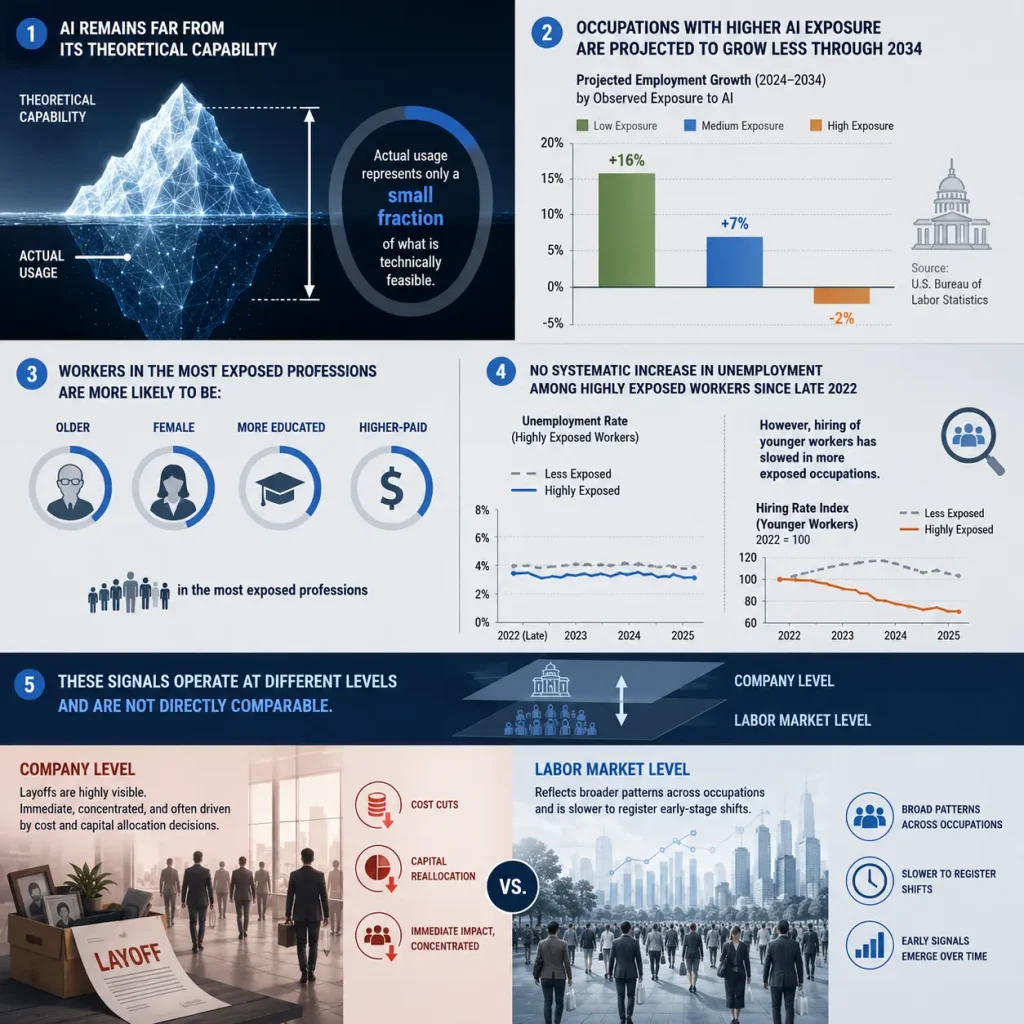
Recent research, including the March 2026 study by Anthropic, “Labor Market Impacts of AI: A New Measure and Early Evidence”, introduces a new way to assess AI displacement risk, referred to as “observed exposure.”
This measure combines theoretical large language model capability with real-world usage data, placing greater weight on automated, work-related uses.
The study finds that AI remains far from reaching its theoretical capability, with actual usage representing only a fraction of what is technically feasible.
It also notes that occupations with higher observed exposure to AI are projected by the U.S. Bureau of Labor Statistics to grow less through 2034.
In terms of workforce characteristics, the report finds that workers in the most exposed professions are more likely to be older, female, more educated, and higher-paid.
At the same time, the study does not find a systematic increase in unemployment among highly exposed workers since late 2022. However, it does identify suggestive evidence that hiring of younger workers has slowed in more exposed occupations.
These signals operate at different levels and are not directly comparable.
Layoffs are highly visible at the company level. They are immediate, concentrated, and often driven by cost and capital allocation decisions. The labor market data, by contrast, reflects broader patterns across occupations and is slower to register early-stage shifts.
Taken together, they point to a transition that is unfolding unevenly: visible in some places, and beginning to appear in others.
For CEOs, this creates a different kind of challenge.
The study finds that AI remains far from reaching its theoretical capability, with actual usage representing only a fraction of what is technically feasible.
It also notes that occupations with higher observed exposure to AI are projected by the U.S. Bureau of Labor Statistics to grow less through 2034.
In terms of workforce characteristics, the report finds that workers in the most exposed professions are more likely to be older, female, more educated, and higher-paid.
At the same time, the study does not find a systematic increase in unemployment among highly exposed workers since late 2022. However, it does identify suggestive evidence that hiring of younger workers has slowed in more exposed occupations.
These signals operate at different levels and are not directly comparable.
Layoffs are highly visible at the company level. They are immediate, concentrated, and often driven by cost and capital allocation decisions. The labor market data, by contrast, reflects broader patterns across occupations and is slower to register early-stage shifts.

Taken together, they point to a transition that is unfolding unevenly: visible in some places, and beginning to appear in others.
For CEOs, this creates a different kind of challenge.
The immediate pressure may be financial: how to manage costs, improve efficiency, and allocate capital toward emerging capabilities. But the underlying question is increasingly about structure: how work gets done, where value is created, and how the workforce needs to evolve in response.
In that sense, workforce decisions are no longer only about scale. They are about composition.
A stable headcount can mask meaningful shifts in capability. Reduced hiring at the entry level today may reshape leadership depth tomorrow. The selective exit of experienced workers—whether through layoffs or voluntary programs—can alter institutional knowledge and execution capacity in ways that are not immediately visible.
At the same time, the roles most exposed to AI are not necessarily those traditionally associated with automation risk. The same study finds that higher exposure is more common among more educated, higher-paid, and knowledge-intensive professions. This suggests that the impact is not confined to routine work but extends into areas that have historically been considered more resilient.
These dynamics point to a transition that is uneven, evolving, and still difficult to measure in full.
Job loss linked to AI is real and increasingly visible. But it does not, on its own, fully explain how work is changing. Nor does it capture the ways in which organizations are adapting—through hiring decisions, role redesign, and shifts in capability expectations.
The question, then, is not whether AI is affecting the workforce. That is already evident.
The more relevant question for leadership is how that impact is unfolding—where it is appearing first, and how it is reshaping the organization beneath the surface.
Because what is being redefined is not just the number of jobs—but the structure of work itself.
As organizations rethink workforce structure in response to AI, leadership conversations are increasingly shifting from short-term cost reduction to longer-term questions around capability, alignment, and the future of work. The following perspectives from executives and industry experts offer insight into how companies are interpreting—and responding to—this transition in practice.

Amy Coleman, Chief People Officer, Microsoft
Microsoft has announced plans to reduce its workforce through its first large-scale voluntary separation program for experienced employees, offering buyouts to approximately 7% of its U.S. workforce—over 8,500 employees—based on a combination of age and tenure. This follows around 15,000 job cuts last year and comes at a time when the company is significantly increasing investment in artificial intelligence, as part of a broader shift in capital allocation across the tech sector.
Two distinct perspectives help explain how this move is being understood.
From an internal leadership standpoint, Amy Coleman, Chief People Officer at Microsoft, frames the program as a structured and employee-led transition, rather than a forced exit. Her emphasis is on giving employees the option to leave “on their own terms,” with support. In simple terms, the company is positioning the move not as a performance-driven layoff, but as a managed and more dignified way of reducing workforce size while aligning with future priorities.
From an external perspective, Domenique Camacho Moran, Partner at Farrell Fritz and employment lawyer, interprets this differently. She explains that voluntary buyouts are a practical tool for companies that need to reduce headcount but want to avoid the complexity and risks associated with layoffs. In her view, these programs allow organizations to become leaner and more cost-efficient, particularly when some roles may no longer justify their cost in a changing business environment.
Taken together, these perspectives highlight an important shift: workforce reduction is not just about how many roles are cut, but increasingly about how those reductions are executed and communicated.

Nick Fox, Senior Vice President, Google
Google has taken a more explicit stance on workforce adjustment through its voluntary exit program, positioning it not just as a restructuring tool but as a filter for alignment and performance. As Nick Fox, Senior Vice President at Google, made clear in a memo to employees, high-performing and motivated individuals are encouraged to stay, while the program offers a structured exit for those who feel less aligned with the company’s direction or are struggling to meet expectations. In effect, the approach signals a more direct articulation of workforce change—where reduction is not only about cost or scale, but about ensuring that the organization is increasingly composed of individuals aligned with its strategic priorities.

Clara Shih, Founder, New Work Foundation | Advisor & Founder of Business AI at Meta
From a more forward-looking perspective, Clara Shih, former Head of Business AI at Meta and now advisor, points to a deeper structural shift already underway. Drawing on firsthand experience, she describes a moment when AI agents matched—and in some cases surpassed—top-performing employees across multiple tasks, reinforcing her view that “every job is an AI job now.” Acting on this conviction, she has launched the New Work Foundation, a nonprofit focused on equipping Gen Z with AI tools and capabilities to navigate an increasingly automated workplace. In practical terms, her message is clear: the boundary between human work and AI-assisted work is rapidly dissolving. Rather than viewing AI as a separate capability, Shih argues that future employability will depend on how effectively individuals integrate AI into their work—particularly as traditional approaches to skill-building struggle to keep pace with the speed of AI advancement.
CXO Movements
PPG
PPG has appointed Jamie A. Beggs as senior vice president and chief financial officer, effective July 6, succeeding longtime CFO Vincent J. Morales, who is retiring after 41 years with the company. Beggs joins from Avient Corporation, where she has served as CFO since 2020, bringing more than 25 years of financial leadership experience across specialty materials and industrial sectors. In her new role, she will also oversee corporate development and information technology, joining PPG’s executive and operating committees. The appointment comes as PPG looks to accelerate its growth strategy and strengthen long-term value creation.
Occidental Petroleum
Occidental Petroleum has named Richard Jackson as its next president and CEO, effective June 1, succeeding Vicki Hollub, who will retire after nearly a decade at the helm. Hollub, the first woman to lead a major U.S. oil company, oversaw Occidental’s transformation through the high-profile Anadarko acquisition, subsequent debt reduction efforts, and a renewed focus on core oil and gas operations. Jackson, currently COO, has spent more than two decades at Occidental in roles spanning U.S. onshore operations, low-carbon technologies, and the Permian Basin. The leadership transition comes as the company positions itself for its next phase of strategic growth and operational execution.
Source: Occidental Petroleum names Richard Jackson as new CEO
Deere & Company
Deere & Company has appointed Brent Norwood as senior vice president and chief financial officer, effective May 1, following what the company described as a rigorous internal and external search process. Norwood brings more than 20 years of experience across Deere’s finance, business development, investor relations, and strategic planning functions, most recently serving as finance director for its Construction and Forestry division and John Deere Power Systems. He also played key roles in the company’s acquisitions of Wirtgen and Blue River Technology, as well as the development of Deere’s Smart Industrial strategy. The appointment underscores Deere’s focus on disciplined capital allocation and long-term shareholder value creation.
Source: Deere & Company Board Elects Brent Norwood as Chief Financial Officer
Booz Allen Hamilton
Booz Allen Hamilton has announced a series of senior leadership appointments aimed at strengthening its position in advanced technology and federal markets. Troy Lahr has been named executive vice president and chief financial officer, effective May 4, bringing experience from Sierra Space and Boeing. Meanwhile, COO Kristine Martin Anderson will also assume the role of president, reflecting her expanded operational leadership as the company accelerates its technology transformation strategy. Booz Allen also elevated Shannon Fitzgerald to president of the Civil Sector and appointed Richard Crowe as chief growth officer as part of the broader management reshuffle.
General Mills
General Mills has promoted Dana McNabb to chief operating officer, effective June 1, expanding her remit across all operating segments and key operational functions. McNabb, who currently leads North America Retail and North America Pet, will now oversee international operations as well as teams spanning supply chain, strategy, innovation, and digital technology. CEO Jeff Harmening said the move supports the company’s push to reinvigorate its brands and restore profitable growth. A General Mills veteran since 1999, McNabb has held senior leadership roles across strategy, marketing, cereals, and international operations.
Source: General Mills Names Dana McNabb Chief Operating Officer
Post Holdings
Post Holdings has announced a leadership transition under which Chairman and CEO Robert Vitale will become executive chairman on October 1, while COO Nicolas Catoggio assumes the role of president and CEO. Vitale, who led Post through significant expansion across categories, international markets, and more than 50 capital markets and M&A transactions, will continue to advise on strategic capital allocation. Catoggio, appointed COO earlier this year, previously led Post Consumer Brands and brings experience in acquisition integration and portfolio strategy. The succession plan signals continuity as the company focuses on long-term growth and shareholder value creation.
Source: Post Holdings Announces Executive Transition
BD
BD has appointed Vitor Roque as executive vice president and chief financial officer, effective immediately, after he served as interim CFO since December 2025. A more than 25-year veteran of the company, Roque previously led corporate financial planning and analysis and played a key role in advancing BD’s “New BD” transformation strategy, including the accelerated separation of its Biosciences & Diagnostic Solutions business. CEO Tom Polen cited Roque’s deep operational knowledge and global leadership experience as central to driving the company’s next phase of growth. The appointment underscores BD’s focus on disciplined execution, financial performance, and long-term shareholder value creation.
Source: BD Appoints Vitor Roque Chief Financial Officer
Gulfport Energy
Gulfport Energy has appointed Domenic J. Dell’Osso, Jr. as President and CEO, effective May 28, 2026, marking a major leadership transition for the natural gas producer. The company’s board highlighted his deep industry expertise, financial discipline, and proven track record in navigating complex energy cycles.
Dell’Osso previously led Expand Energy, where he helped scale the company into the largest natural gas producer in the U.S. while driving EBITDA growth, free cash flow expansion, and shareholder returns. His appointment signals Gulfport’s ambition to capitalize on rising natural gas demand and strengthen its position across the Appalachia and Anadarko basins.
Quantum Space
Quantum Space has named former NASA Administrator Jim Bridenstine as its new CEO, signaling a major push into national security and advanced space operations. Bridenstine will lead the company as it scales development of its “Ranger” spacecraft platform designed for maneuverable, long-duration missions across multiple orbital environments.
Bridenstine, who led NASA from 2018 to 2021 and launched the Artemis lunar program, brings deep expertise in government space policy and defense strategy. Backed by fresh funding and upcoming 2027 launch plans, Quantum Space is positioning itself as a key player in next-generation defense, satellite servicing, and space mobility technologies.
Source: Quantum Space Names Former NASA Administrator Jim Bridenstine as Chief Executive Officer
The executive movements suggest that companies across sectors are entering a more selective phase of corporate strategy—one focused less on expansion at any cost and more on building organizations capable of navigating volatility, technological transition, and longer investment cycles.
While the industries differ, the leadership choices reveal several underlying priorities beginning to converge across the corporate sector.
Many of the appointments favor leaders with operational, financial, and restructuring experience rather than purely expansion-oriented backgrounds. The signal is clear: companies increasingly value executives who can improve efficiency, allocate capital carefully, and execute consistently in uncertain markets.
Several transitions indicate that companies are planning beyond short-term quarterly performance and positioning for multi-year industry shifts. Whether in energy, manufacturing, healthcare, or aerospace, leadership choices reflect a growing focus on endurance, stability, and long-horizon competitiveness.
A large share of appointments involve executives who already understand the company’s operations, culture, and strategic priorities. This suggests boards are placing greater value on organizational familiarity at a time when external conditions are becoming harder to predict and execute against.
The increased prominence of leadership tied to aerospace, energy, defense, and infrastructure reflects how geopolitical priorities are increasingly shaping corporate strategy. Companies operating near critical national capabilities appear to be aligning themselves more closely with long-term government and security-related demand.
The emphasis on technology integration, operational modernization, and strategic repositioning across industrial, consumer, healthcare, and consulting companies suggests that transformation pressures are spreading – fast. Even historically stable sectors are restructuring around new competitive realities.
Many of the executives stepping into larger roles bring experience across multiple domains: finance, operations, M&A, technology, strategy, and organizational transformation. This points to a broader shift in leadership expectations. Companies increasingly need executives who can connect functions, not just manage them independently.
Conclusion
Taken together, these moves point to a broader corporate recalibration. Organizations are not simply replacing executives—they are redesigning leadership structures around resilience, operational adaptability, and long-term strategic execution. Beneath the individual appointments lies a consistent message: companies are preparing for a business environment where complexity, technological disruption, and strategic endurance are becoming permanent management conditions.
For decades, large organizations produced leaders through accumulation: early-career repetition, operational exposure, managerial progression, and institutional learning over time. But as AI absorbs more foundational work and organizations become structurally leaner, some of the traditional pathways through which executives develop judgment and leadership depth may begin to weaken. The challenge for today’s leaders is therefore not only staying relevant in an AI economy—but ensuring they continue developing capabilities that organizations may unintentionally stop cultivating at scale.
Many of the tasks that historically trained younger professionals—analysis, synthesis, drafting, and coordination—are increasingly vulnerable to automation. Future leaders may need to pursue difficult operational exposure more intentionally rather than assuming experience will accumulate naturally over time.
AI dramatically expands access to knowledge and recommendations. But executive judgment is formed through ambiguity, accountability, trade-offs, and consequences—conditions technology cannot fully replicate.
Leadership influence is still built through navigating incentives, conflict, trust, and internal dynamics. As organizations flatten and automate, future executives may receive fewer opportunities to observe how real decisions are made inside institutions.
As specialized expertise becomes increasingly augmented by AI, leaders who can connect signals across finance, operations, technology, workforce strategy, and culture may become disproportionately valuable.
AI can accelerate analysis, but it may also increase the speed and frequency of organizational decisions. Leaders who can maintain clarity, consistency, and strategic discipline under continuous pressure may emerge as stronger long-term operators.
Organizations focused heavily on optimization may unintentionally weaken the developmental layers that produce future executives. Strong leaders will pay attention not only to performance metrics, but also to whether their organizations still create environments where managerial and strategic capability can mature.