


Executive Assessment After a Carve-Out What Changes for the Leadership Team
Table of Content
- A Transferred Leadership Team May Not Be Ready for Standalone Accountability
- Boards Need to Map Parent-Company Support Before Leadership Assessment
- Executive Assessment Should Test the Inherited Team Against New Responsibilities
- CEO and CFO Roles Often Show the Clearest Accountability Shift
- Boards Have Four Leadership Responses
- Real-World Evidence: Aligning Appointments with Standalone Mandates
- Conclusion: Leadership Assessment Should Come Before Executive Search
- FAQs
Four Key Takeaways
- A carve-out can change executive accountability without changing job titles. Boards need to reassess what each leader will personally own once the business operates independently.
- Parent-company dependencies should be mapped before judging the leadership team. Missing systems, specialist capability, and leadership ownership are different problems and should not trigger the same response.
- Executive assessment should compare past responsibility with the standalone mandate. The key question is what each executive has already proved, what remains unproved, and how quickly any gap can be addressed.
- Executive search should follow a confirmed leadership gap. Retention, a broader remit, temporary support, or external hiring should depend on the role requirements, timing, and business risk.
A Transferred Leadership Team May Not Be Ready for Standalone Accountability
Divestiture activity expanded significantly in early 2026. According to Deloitte, divestiture volume increased from 454 transactions in Q4 2025 to 503 in Q1 2026, accounting for 25 percent of all US M&A activity. As corporate separations accelerate, private equity sponsors and corporate boards face an immediate management question when carving out an independent business unit.
An operating unit often moves to independence with its incumbent management team intact. Executives keep their functional titles, but the authority, shared services, and specialist capabilities previously supplied by the corporate center stay behind. Past divisional success does not confirm readiness for standalone company leadership.
This reality is not an argument against retaining the inherited team. Many executives possess the capability to carry a broader remit, yet lack the organizational mandate to prove it under the parent structure. A carve-out demands an intentional executive assessment, avoiding any reflexive choice to keep or replace the incumbent team without verified evidence.
Boards Need to Map Parent-Company Support Before Leadership Assessment
Before evaluating individual executives, the board must define what the business unit historically received from parent headquarters. These centralized dependencies generally fall into four operational clusters: finance and treasury; people, legal, and compliance; technology and cybersecurity; and shared corporate capabilities such as procurement, strategy, and external communications.
While temporary service agreements maintain select functions during the transition, the board must establish what ceases immediately, what continues temporarily, what must be built internally, and what demands direct executive ownership. Conducting an executive assessment requires separating corporate support from individual competence through three distinct categories:
- Infrastructure gap: A physical system, operating process, or administrative team is absent.
- Capability gap: The business lacks specific technical knowledge or specialized functional expertise.
- Leadership gap: No incumbent executive has verified readiness, decision authority, or evidence to own a critical standalone mandate.
Treating an infrastructure or capability gap as a leadership gap produces misdiagnosed personnel decisions. A missing corporate treasury desk or cybersecurity architecture does not mean the inherited finance or technology leader lacks the competence to govern it.
Deloitte’s 2026 Global Divestiture Survey highlights separation readiness and leadership alignment as persistent execution obstacles. Boards must address operational readiness and executive team assessment in parallel, recognizing that a missing corporate tool is fundamentally different from a deficient leader.
Executive Assessment Should Test the Inherited Team Against New Responsibilities
A rigorous leadership assessment during a carve-out evaluates inherited executives against new standalone requirements rather than past divisional history. Boards, private equity operating partners, and human resources leaders must evaluate each manager through five structured questions:
- What did the executive actually control within the parent company? Separate formal titles from true operational authority, capital allocation, and final sign-off power.
- Which critical decisions sat elsewhere? Identify choices historically governed by centralized parent functions, regional committees, or corporate headquarters.
- What shifts to the executive after separation? Focus strictly on newly assigned accountabilities that the individual must govern directly once the business stands independent.
- What evidence confirms the executive can assume it? Look for verified past actions, direct ownership of commercial outcomes, and demonstrated judgment rather than tenure or title.
- Can identified gaps be resolved in the required timeframe? A standard development path fails if standalone operational execution requires immediate, independent control within six months.
This executive assessment method classifies documented proof into three objective categories:
- Strong evidence: The individual has carried comparable enterprise responsibility with documented, repeatable results.
- Partial evidence: Relevant functional experience exists, but under different operating conditions, smaller budgets, or parent oversight.
- Evidence missing: The executive has not yet had the opportunity to demonstrate readiness for the required mandate.
Boards gather this objective validation through structured, decision-based interviews, referenced case studies from previous roles, and cross-functional performance reviews during realistic operating scenarios. Prior exposure to corporate reorganizations, business launches, or ownership transitions offers supplementary proof of adaptability.
Crucially, an absence of previous exposure does not demonstrate an absence of personal capability. Corporate operating environments frequently prevent talented divisional leaders from exercising enterprise authority. That dynamic produces an evidence gap, which remains fundamentally distinct from confirmed inability. Conducting this structured executive leadership assessment establishes baseline clarity across the bench before determining changes.
CEO and CFO Roles Often Show the Clearest Accountability Shift
While this evaluation methodology applies across all functional heads, CEO and CFO responsibilities make the shift particularly visible. Both roles pivot rapidly from internal divisional execution toward external stakeholder governance and total enterprise accountability.
CEO Assessment: From Division Leadership to Enterprise Accountability
A rigorous CEO assessment for a carve-out requires examining whether a division head can carry ultimate enterprise authority. Boards must distinguish between an executive who contributed to corporate strategy and one who held final accountability for capital allocation, portfolio choices, and standalone governance.
Under standalone company leadership, the mandate demands direct governance of board interactions, lender negotiations, investor reporting, and executive team construction. Separation execution and ongoing commercial performance must proceed concurrently under the chief executive’s direct accountability, testing the leader across unfamiliar external environments.
The essential question is what critical decisions fall to the executive for the first time. A major warning sign appears when sustained divisional operational success lacks documented evidence in capital allocation, board stewardship, or corporate capability building. An objective executive assessment confirms whether the leader can translate the ownership thesis into operational priorities without corporate oversight.
CFO Assessment: From Divisional Finance to Full Financial Accountability
Conducting a CFO assessment for a carve-out addresses a position where shared corporate services often mask functional gaps. A divisional finance director frequently possesses deep commercial budgeting experience while having zero exposure to treasury management, debt covenants, tax structures, or independent external audit.
The board must evaluate whether the candidate has governed standalone liquidity, capital structure, lender communications, and the creation of an autonomous accounting department. Unfamiliarity with corporate treasury does not automatically disqualify an inherited leader. Instead, the leadership assessment must establish which capabilities can be supported by external specialists, which can be acquired quickly, and which are too fundamental to leave unproven.
The decisive assessment question is not whether the executive has held a CFO title, but whether the individual has owned the specific financial decisions required by the independent entity. A critical warning sign surfaces when the executive cannot clearly distinguish between tasks personally managed and duties historically absorbed by the parent corporate center.
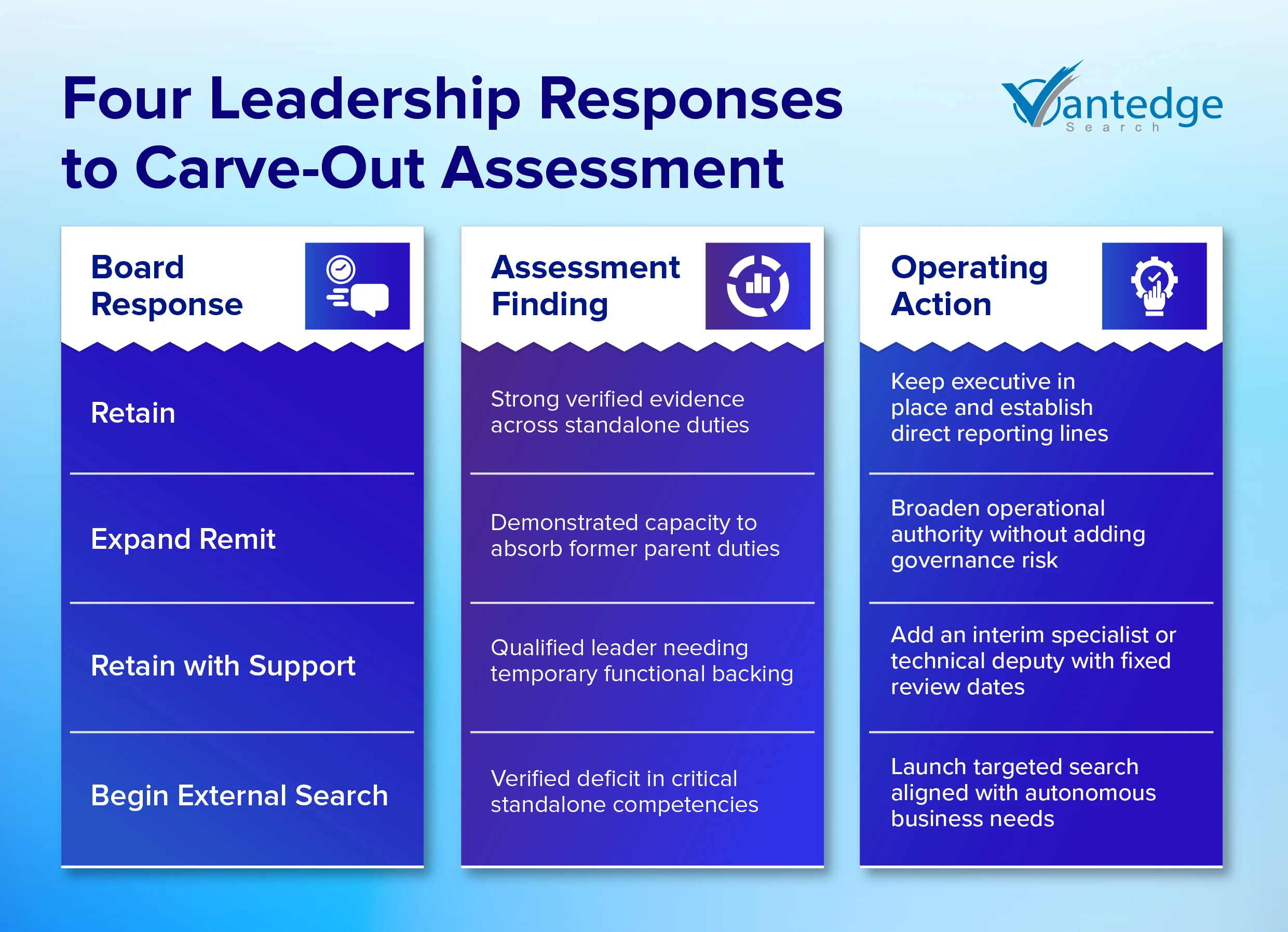
Boards Have Four Leadership Responses
Once an executive assessment separates infrastructure gaps from leadership capabilities, boards and sponsors must choose a path. A structured evaluation should lead to four clear options rather than an automatic rush to hire externally:
- Retain: The executive demonstrates strong verified evidence across standalone company leadership responsibilities. Operating work remains, but no material mismatch exists.
- Expand the remit: The individual exhibits clear aptitude and proven capacity to absorb accountabilities previously handled by parent headquarters without creating unacceptable governance exposure.
- Retain with defined support: The executive remains well-suited for the mandate, but a discrete capability requires temporary reinforcement. Support can include a specialist deputy, an interim technical resource, or targeted external functional expertise. This support must feature clear deliverables, defined ownership limits, and a firm review milestone. It should never serve as a permanent crutch for unverified core competence.
- Begin external search: Initiating private equity executive search is justified when a core capability is missing, urgent responsibilities leave no time for development, or the standalone business exceeds the leader’s proven experience.
The distinction between expanding a remit and introducing defined support is critical. An expanded remit entrusts the incumbent with direct ownership, whereas defined support surrounds an effective leader with temporary specialized bandwidth.
Boards must evaluate each role independently. Retaining a chief executive does not require keeping every functional vice president, and identifying one external replacement does not mean the broader inherited carve-out leadership team is deficient.
Partner with Vantedge Search to strengthen CEO succession.
External Search Should Reflect the Standalone Company's Actual Needs
When an executive assessment confirms a genuine leadership deficit, initiating an executive search for carve-out companies must reflect the operational realities of an independent business. Searches fail when boards merely copy the parent company’s legacy job description. That specification was written for an executive operating within a centralized corporate apparatus, whereas standalone company leadership requires direct accountability under distinct governance constraints.
The role specification must center on six core factors: the standalone business strategy, the ownership model, value-creation milestones, newly assigned decision responsibilities, capabilities already present across the management bench, and the schedule to operate independently. Expectations from the board, investors, and credit providers should be integrated directly into these operational criteria rather than treated as secondary preferences.
Prior carve-out experience is helpful, but it should not become a rigid prerequisite. Relevant evidence can stem from building a corporate function from scratch, managing a restructuring, or transitioning from divisional management to full enterprise accountability within a private equity setting. Candidates must demonstrate readiness across three specific milestones: at transaction closing, during temporary parent support, and at complete operational independence.
Hiring criteria must track this transition timeline. A candidate capable of managing a mature function will fail if critical accountabilities transfer before that individual can establish baseline controls. Disciplined boards sequence their work methodically: define standalone requirements, map corporate dependencies, execute an executive team assessment, isolate confirmed leadership gaps, and launch targeted searches only where unresolvable gaps exist.
Real-World Evidence: Aligning Appointments with Standalone Mandates
Recent corporate separations demonstrate that boards evaluate talent seat by seat rather than taking an all-or-nothing stance on inherited management.
For its planned Q4 2026 separation, Corteva named former Albemarle CEO Luke Kissam as CEO of New Corteva, its future standalone crop protection company. Several current Corteva executives were appointed to leadership roles, while the chief legal officer and chief people officer positions remained open to internal and external searches.
Honeywell Aerospace followed a similarly mixed pattern: Jim Currier, who had already led the aerospace business, became CEO, while the leadership team combined executives with prior Honeywell experience and appointments from outside the company. Honeywell Aerospace completed its separation on June 29, 2026.
What is useful about these examples is not that they prove one approach to leadership assessment is better than another. They show that a separation need not produce a single verdict on the inherited management team. Different roles can lead to different decisions: continuity in some seats, external appointments in others, and an open search where the eventual choice has not yet been made. That is consistent with a role-by-role approach to assessment—although the public announcements do not tell us what assessment process either company used to reach those decision
(For a broader view of how leadership context should shape hiring decisions, readers can refer to our blog: Why Executive Hiring Process Now Requires More Than Traditional Due Diligence on the executive hiring process and leadership context).
Conclusion: Leadership Assessment Should Come Before Executive Search
A carve-out often leaves executive titles intact while fundamentally shifting the operational authority behind them. Boards and private equity sponsors must first clarify what the parent corporation historically absorbed, map what the standalone business now demands, and evaluate what each leader has genuinely proven under direct accountability. Retaining incumbents, expanding remits, providing structured support, and initiating external recruitment all represent sound operational responses.
External executive search should begin only after an objective executive assessment confirms a genuine leadership gap, particularly where temporary measures, such as interim specialists or functional deputies, cannot substitute for permanent executive ownership. Standalone company leadership depends on verified decision ownership rather than legacy corporate reputation. Letting documented evidence guide talent decisions prevents premature hiring while ensuring critical responsibilities are reliably covered.
Building an independent organization ultimately hinges on recognizing that standalone leadership is defined by decision ownership rather than corporate heritage. When boards replace assumptions with objective executive assessment, they preserve operational stability while securing the exact leadership capabilities required for genuine autonomy.
If your company is moving toward standalone operation, connect with Vantedge Search for targeted executive search and leadership hiring support.
FAQs
Executive assessment evaluates a leader’s proven capabilities, decision track record, and readiness against specific business demands. It examines documented evidence of performance rather than relying on titles, past tenure, or subjective impressions.
It isolates whether an inherited leader can manage newly acquired standalone responsibilities without parent support. The process prevents boards from confusing missing corporate infrastructure with an executive capability deficit.
Map parent company dependencies first to separate missing systems from leadership competence. Then evaluate each executive against new standalone accountabilities using structured, decision-based interviews, validated historical performance, and referenced operating scenarios.
Search is warranted when assessment confirms a critical standalone capability is missing, the expanded mandate exceeds demonstrated capacity, and targeted temporary support cannot adequately protect the company within required timeframes.
It must test evidence of enterprise ownership rather than divisional execution. Key areas include standalone strategy, capital allocation, board relations, investor and lender communications, and the direct construction of an independent executive team.
Leave a Reply