


5 Signals That Boards Aren’t Missing Talent, They’re Filtering It Out
Table of Content
- Introduction: The Talent Gap May Be a Filtering Problem
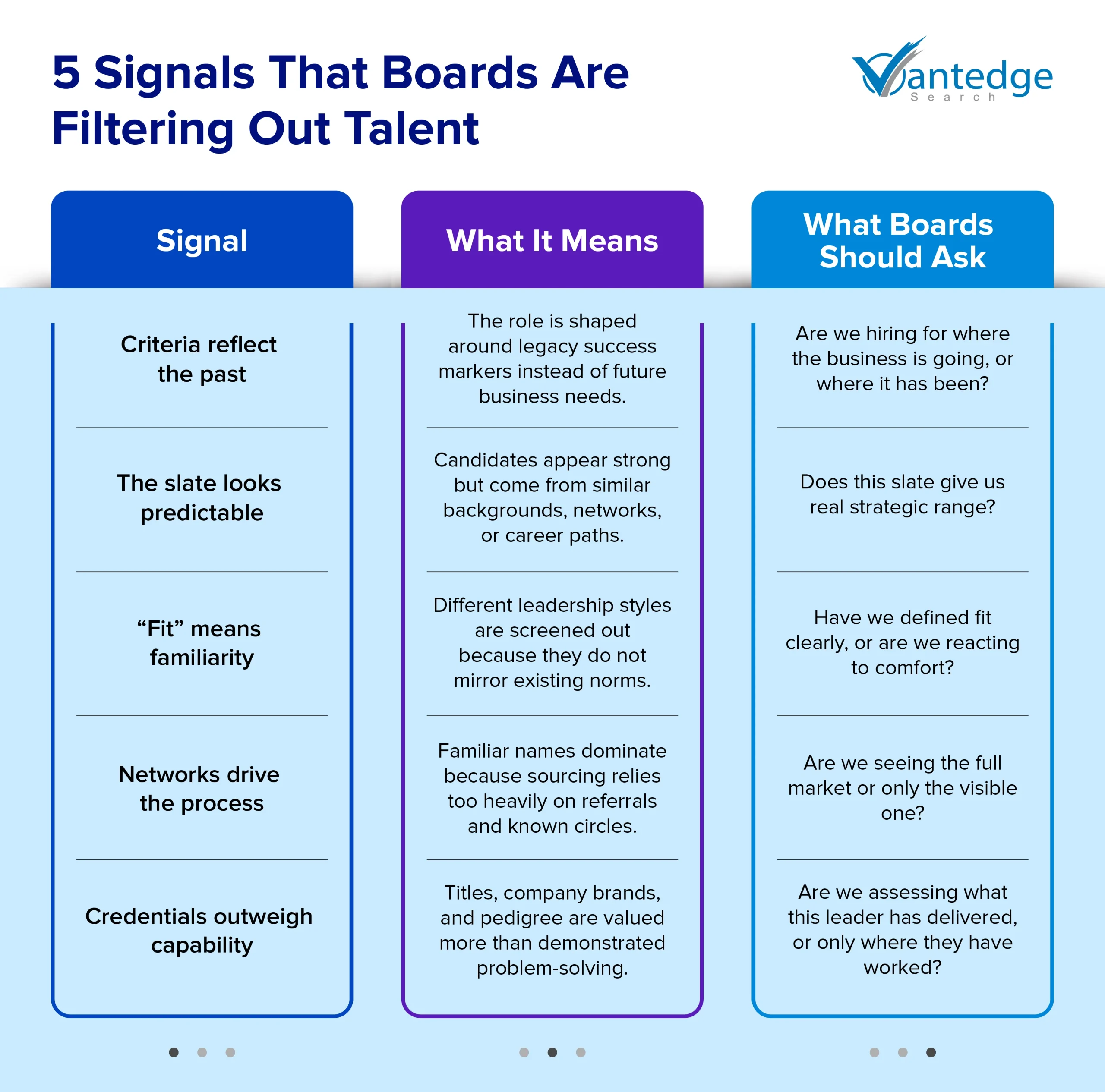
- Signal 1: The Criteria Reflect the Past More Than the Future
- Signal 2: The Slate Looks Strong but Predictable
- Signal 3: “Fit” Becomes a Proxy for Familiarity
- Signal 4: The Process Depends Too Heavily on Existing Networks
- Signal 5: Assessment Rewards Credentials More Than Capability
- What Boards Should Do Differently
- Where Narrow Filtering Has a Real Cost: Two Leadership Appointments Worth Noting
- Conclusion: The Strongest Candidate May Already Be Outside the Filter
- FAQs
Four Key Takeaways
- Boards facing leadership hiring challenges frequently attribute the difficulty to a thin market. In most cases, the more accurate diagnosis is a process that filters out capable leaders before their full capability is ever evaluated.
- Five specific signals indicate when a board’s own criteria, sourcing logic, fit assumptions, network dependence, and credentials-first assessment are narrowing the leadership slate rather than strengthening it.
- The quality of an executive appointment is determined as much by the rigor of the process as by the depth of the market. Boards that pressure-test their mandate, expand their sourcing range, and assess demonstrated capability over pedigree consistently access stronger leadership options.
- Improving executive leadership hiring outcomes is not a matter of searching harder. It is a matter of designing a process that does not quietly disqualify the strongest candidates before the decision begins.
Introduction: The Talent Gap May Be a Filtering Problem
When boards describe difficulty finding the right leadership candidate, the conversation almost always circles back to the same conclusion: the market is thin. Qualified leaders are scarce. The right profile simply does not exist in sufficient numbers. That framing, however convincing, deserves closer examination.
In many cases, the issue is not a shortage of capable leaders. It is how leadership capability is being defined, sourced, screened, and ultimately judged. According to PwC’s 2025 Annual Corporate Directors Survey, 72% of directors now treat talent management as a boardroom-level priority discussed at every meeting. Yet despite that attention, boards continue to rely on role specifications and assessment logic that quietly eliminate strong candidates before serious evaluation begins.
This is, at its core, a decision-quality problem. The filters boards apply, whether through rigid criteria, predictable sourcing, or vague notions of cultural fit, shape who reaches the table and who does not. When those filters are built on past success patterns rather than future business needs, the outcome is a narrowed leadership lens at precisely the moment when a broader strategic range is required.
A 2025 survey by Corporate Board Member, Diligent Institute, and FTI Consulting found that over a third of U.S. public company directors identified CEO and C-suite succession planning as a top company priority, yet only 1 in 5 rated their own succession process as excellent. The gap between intent and process quality is where leadership talent is most often lost.
The strongest boards are now asking a harder question: not whether the right leaders exist, but whether their process is designed to find them. The five signals below identify exactly where that filtering happens in executive leadership hiring, and what boards can do to correct it.
Signal 1: The Criteria Reflect the Past More Than the Future
The most consequential point in executive leadership hiring is often where the role specification is written.
Boards tend to begin with a straightforward question: what made the last leader successful? That is not an unreasonable starting point, but when it becomes the dominant frame, the mandate is quietly designed for a leader the organization has already had, not the one it needs next.
This creates a direct board leadership hiring risk. A board may articulate a clear strategic need, whether for growth acceleration, operational resilience, or stakeholder complexity management. Yet the role criteria may still center on prior title equivalence, sector tenure, company pedigree, or linear career progression.
According to McKinsey’s State of Organizations 2026 report, organizations that anchor leadership criteria to historical success patterns consistently struggle to build future-ready leadership pipelines capable of meeting new business demands.
The mismatch between stated ambition and actual criteria is where capable candidates are quietly screened out. What this looks like in practice:
- Overweighting exact industry experience when the challenge demands transferable judgment.
- Treating prior title equivalence as a reliable measure of leadership capability assessment.
- Viewing non-linear career histories as inherently higher risk.
- Equating company-name recognition with strategic readiness.
Strategic correction begins here. Boards strengthening their board recruitment strategies must pressure-test every criterion against one question: does this reflect where the business is going, or only where it has been?
Signal 2: The Slate Looks Strong but Predictable
A candidate slate can appear polished, senior, and credible while still being strategically insufficient. The issue is rarely whether individual candidates are qualified. The issue is whether the slate gives the board genuine decision quality in hiring, a real range of strategic choice rather than variations of the same profile.
Deloitte’s 2026 Global Human Capital Trends research found that 7 in 10 business leaders identify speed and agility as their primary competitive strategy over the next three years, and that adaptability combined with faster orchestration of people and resources are the key drivers of success ahead.
In that context, a slate made up of leaders from the same sector, company type, and network may appear strong on paper. In practice, it gives the board very little room to choose differently, because every candidate on it reflects the same assumptions, the same career logic, and the same version of what leadership should look like.
What a predictable slate typically looks like in board recruitment strategies:
- Candidates drawn from the same sector or company type.
- Similar functional, geographic, or educational backgrounds across the shortlist.
- Repeated reliance on the same visible leadership circles.
- Profiles that differ in personality but not in strategic perspective or problem-solving orientation.
- Less visible leaders from adjacent industries or non-linear paths absent from consideration.
The practical test is direct: does this slate widen the board’s view of what strong future-ready leadership looks like for this specific mandate, or does it simply validate what the board already expected to see?
Signal 3: “Fit” Becomes a Proxy for Familiarity
In executive leadership hiring, “cultural fit” often has a big influence without being closely examined. When it is clearly defined and linked to measurable leadership results, it can be a useful factor. But when it is vague, people tend to favor candidates who feel familiar or similar to current leaders, instead of choosing those who might be better equipped to lead the organization into the future.
Forbes noted in early 2026 that what organizations describe as a leadership shortage is, in many cases, a shortage of acceptable risk and that boards exercising undefined fit criteria are among the primary contributors to that risk aversion.
The candidate who communicates differently, leads from a different professional tradition, or carries a less conventional background is often screened out not because their capability is insufficient, but because their presence is unfamiliar.
This pattern directly undermines rigorous executive leadership assessment. What it typically looks like at the board level:
- Candidates described as “not quite right” without specific, role-linked evidence.
- Strong operators overlooked because their style does not mirror existing leadership norms.
- Different communication approaches interpreted as lower executive readiness.
- Preference for presentation polish and pedigree over demonstrated problem-solving.
- Undefined fit used as a final veto with no accountability to the business case.
The strategic distinction matters: leadership capability assessment should separate “fit with the current culture” from “ability to lead the culture forward.” Gartner’s 2025 CEO Survey identified adaptability and dynamic capacity as the key leadership requirements for the future. When fit is judged by how current leadership looks and operates, candidates who think differently or bring stronger adaptability may be screened out at the very moment businesses need them most.
Fit must be defined against the business challenge, not against the board’s comfort level.
Find leaders beyond the filter with Vantedge Search.
Signal 4: The Process Depends Too Heavily on Existing Networks
Networks are a legitimate asset in executive leadership recruitment. They provide access, context, and efficiency. But when a board’s search process depends primarily on referrals, familiar names, and historically visible candidates, networks stop being an advantage and start being a boundary. The result is a process that feels thorough while systematically missing leaders who sit outside the board’s immediate field of view.
This is one of the more consequential board leadership hiring risks precisely because it is invisible. Relationship-led sourcing creates a genuine sense of market coverage while leaving large portions of the relevant leadership market unexamined.
HBR’s 2026 analysis of board-management engagement noted that the strongest boards actively challenge their own assumptions about where leadership capability resides, rather than defaulting to the candidates they already know or can quickly reach.
The pattern shows up consistently across leadership succession planning processes:
- The same senior names circulating across multiple searches because visibility is mistaken for best fit.
- Sourcing logic built around “who do we already know” rather than structured market mapping.
- Limited outreach to leaders from founder-led businesses, private companies, emerging markets, or non-linear career paths.
- Candidates favored because they are well-referred, not because they are well-matched.
- Less visible leaders with directly relevant achievements absent from consideration entirely.
Deloitte’s 2026 Global Human Capital Trends report highlights that organizations with the strongest senior leadership development outcomes are those that systematically expand their talent aperture rather than refine a familiar pool.
Boards should expect the process to test the full market deeply, not merely assemble a recognizable shortlist.
When searches rely too heavily on familiar names, boards may mistake visibility for market coverage. (For a practical view on talent mapping in executive search, read our blog: Data-Powered Search: A Playbook for Executive Compensation Benchmarking and Talent Mapping).
Signal 5: Assessment Rewards Credentials More Than Capability
Credentials are measurable. Capability is not. That asymmetry is at the root of one of the most persistent board leadership hiring risks in executive appointments: the systematic overvaluation of company brand, title, tenure, and institutional pedigree over what a candidate has actually built, solved, or led through.
The logic feels sound on the surface. A candidate who has held a recognized title at a well-known organization carries a visible track record. But that visibility can obscure more than it reveals.
McKinsey’s evaluation of high-performing CEOs found that the most consistent differentiator among top-tier leaders was not pedigree or institutional background, but learning velocity and the capacity to lead through high-ambiguity conditions. Neither of those qualities appears reliably on a résumé.
Modern executive leadership assessment must account for what a candidate has actually delivered in context. That means examining the complexity of the environment they operated in, the constraints they managed, and the quality of judgment they exercised, not simply the brand name above their role.
What credentials-first assessment looks like in practice:
- Favoring a candidate from a large, recognized company over one who led through greater operational complexity elsewhere.
- Undervaluing transformation experience because it occurred outside a blue-chip setting.
- Prioritizing what a candidate has been called over what they have actually delivered.
- Giving disproportionate weight to institutional prestige and too little to evidence of decision quality in hiring contexts.
A rigorous executive assessment process evaluates demonstrated capability against the specific business context the incoming leader will face, not against the comfort of a familiar résumé.
What Boards Should Do Differently
Identifying the signals is only half the work. The more important question for boards is how to correct the process before a critical appointment is compromised. Stronger executive leadership hiring outcomes begin with deliberate changes to how mandates are defined, how slates are built, and how candidates are ultimately judged.
The five corrections below are not procedural checkboxes. Each one targets a specific point where board leadership hiring risks most commonly take hold.
- Redefine the mandate around future business needs
Begin with the strategic problem the incoming leader must solve, not the profile of the leader who last held the role. Every element of the role specification should be traceable to a specific business challenge or capability gap. This is the foundation of sound leadership succession planning and the first point at which narrow filters are either introduced or prevented.
- Separate non-negotiables from preferences
Boards should draw an explicit line between true requirements and familiar markers of comfort. Not every preferred credential represents a necessary condition for success. When preferences are treated as requirements, capable candidates are eliminated on grounds that were never genuinely relevant to the mandate.
- Pressure-test the slate for strategic range
A strong slate offers meaningful differences in experience, context, perspective, and problem-solving orientation. The standard for board recruitment strategies should not be whether all candidates are impressive, but whether the board’s decision range is genuinely wide. The goal is not variety for its own sake — it is better decision quality in hiring at the most consequential level of the organization.
- Make “fit” measurable
Fit should be defined against leadership outcomes, organizational values, business context, and the specific demands of the role ahead. When fit criteria are written down and tested against the mandate, they become a useful screen. When they remain undefined, they function as an unaccountable veto that disproportionately removes capable candidates from consideration.
- Challenge the obvious market
A rigorous executive assessment process should actively test assumptions about where relevant future-ready leadership capability sits. Less visible candidates, those from adjacent industries, private companies, high-growth environments, or non-linear career paths, may carry stronger alignment with the actual mandate than the names that surface first. Boards should expect that depth of market examination as a standard, not an exception.
The goal of each of these corrections is the same: to ensure the board is seeing the full range of relevant senior leadership development capability before a decision is made, rather than a filtered version of it shaped by habit and familiarity.
Where Narrow Filtering Has a Real Cost: Two Leadership Appointments Worth Noting
The risk of narrow filtering becomes clearer when viewed against recent executive appointments. In both cases, the role mandate points beyond traditional title-based assumptions and toward capability, scope, and business context.
Firdaus Bhathena, S&P Global
S&P Global appointed Firdaus Bhathena as Executive Vice President and its first Chief Technology and Transformation Officer in March 2026. The newly created role brings enterprise technology, AI adoption, productivity, and company-wide transformation under a unified leadership mandate, with Bhathena reporting directly to President and CEO Martina Cheung.
Bhathena joins from FIS Global, where he served as Global CTO, with a career spanning financial services, digital health, and enterprise SaaS. The appointment reflects how some organizations are now defining leadership roles around the work the business requires, rather than around a legacy role template. It is the kind of capability pattern that a criteria-first, title-led executive leadership hiring process may not have surfaced.
Franziska Bell, The Home Depot
The Home Depot appointed Franziska Bell as Executive Vice President and Chief Technology Officer in March 2026. Her remit includes technology strategy, product management, data, and AI, with a direct connection to enterprise-wide digital priorities.
Bell’s background spans Ford, BP, Uber, and Toyota, demonstrating how leadership relevance can come from adjacent sectors and different operating contexts. For boards, this is precisely where rigid board recruitment strategies can become limiting. If exact sector match or linear career progression dominates the executive assessment process, candidates with directly relevant capability may never receive full consideration.
Together, these appointments reflect a broader shift in how the most forward-thinking organizations are approaching senior leadership development and succession. The stronger question for boards is not whether familiar signals are present, but whether the process is designed to recognize the capability the next chapter actually demands.
Conclusion: The Strongest Candidate May Already Be Outside the Filter
The leadership market is broader than most board processes reveal. When executive leadership hiring relies on legacy criteria, relationship-driven sourcing, and undefined notions of fit, the process quietly reduces the board’s own access to the capability it is seeking. The issue, in most cases, is not talent scarcity. It is process design.
Narrow filters remove strong leaders before serious consideration begins. That weakens strategic optionality at precisely the moment when the quality of a single appointment can shape the organization’s next several years. Boards that invest in how they define, source, and conduct executive leadership assessment are better positioned to identify the leaders their next chapter demands.
The question for boards is not only whether they are finding the right talent. It is whether their process is designed to allow the right talent to be seen.
Your next critical appointment deserves a process built for the full market, not just the familiar one. Partner with Vantedge Search to ensure the right leaders are never filtered out before they are seen.
FAQs
Boards often struggle not because capable leaders are absent from the market, but because their process filters talent through legacy criteria, familiar networks, and undefined notions of fit that were never designed for the business challenge ahead. The result is a search that feels rigorous but operates within a narrow band of profiles, limiting the board’s access to the full range of relevant leadership capability.
The biggest risk in executive leadership hiring is mistaking process confidence for market coverage, assuming a familiar shortlist represents the strongest available candidates when it may simply reflect the most visible ones. When boards conflate comfort with quality, capable leaders are eliminated before serious evaluation begins, weakening the strategic optionality of the final appointment.
Effective leadership succession planning begins with defining the future business challenge the role must address, rather than replicating the profile of the last successful leader in that position. Boards that separate non-negotiable capability requirements from familiar preferences, and that systematically map the broader market, consistently build stronger and more strategically relevant candidate slates.
Credentials signal where a leader has been; capability reveals what they can actually deliver in the specific context, complexity, and conditions the role demands. Boards that over-index on institutional pedigree and title equivalence risk overlooking leaders who have built stronger, more relevant problem-solving ability in less conventional or less visible environments.
An effective executive hiring strategy is one that begins with a forward-looking mandate, tests the full market beyond known networks, and applies a clearly defined assessment framework that evaluates demonstrated capability rather than résumé signals alone. When each stage of the process is aligned to the actual business challenge rather than historical comfort, the board’s decision quality improves materially at every level.
Leave a Reply