


Interim Leadership as a Strategic Lever: The New Trigger Is Execution Risk, Not Empty Seats
Table of Content
- Where Interim Leadership Is Expanding First
- What This Broader Mandate Actually Looks Like
- Why Companies Are Being More Deliberate About the Interim Mandate
- Why This Is Not a Replacement for Permanent Leadership
- What the Role May Look Like Beyond Today
- Where This Expansion Is Already Visible: Two Real-World Interim CEO Examples
- Conclusion
- FAQs
Four Key Takeaways
- The trigger for interim executive leadership is changing. Organizations are no longer calling on interim capacity only when a seat goes empty. They are using it when execution is at risk and permanent structure cannot move fast enough to respond.
- Operating-model redesigns, enterprise transformation programs, digital and AI-led change, and portfolio reshaping are the environments where interim management strategy is delivering the most concentrated and measurable value right now.
- A well-scoped interim mandate delivers four specific outcomes: ownership clarity where decisions have stalled, a decision rhythm where accountability has drifted, momentum protection at the highest-risk transition points, and a cleaner handoff that strengthens the permanent appointment that follows.
- The most forward-thinking organizations are treating interim leadership as a planned component of their executive talent model, not a contingency reserved for crisis. The discipline lies in designing the mandate before the pressure arrives.
For most of its history, interim executive leadership was associated with one specific moment: a seat had gone empty, and someone needed to keep the lights on until a permanent hire was made. That framing still holds in many organizations. But it is no longer the complete picture.
What is shifting is the trigger. More companies are calling on interim executive services not because a position is vacant, but because execution is at risk. Operating-model redesigns are stalling. Transformation programs are losing coordination. Digital and AI-led initiatives are falling short of their intended outcomes.
Gartner reported that 94 percent of CIOs expect major plan changes within 24 months, while only 48 percent of digital initiatives meet or exceed business targets. McKinsey’s 2025 operating-model research confirms that failure rates in redesign remain high, and that the organizations most likely to succeed are those that invest in four areas: leader alignment, rewiring core processes, developing people, and building a performance-oriented culture.
These are not gaps on an org chart. They are gaps in execution capacity. And that is precisely where interim management strategy is expanding its remit. The question organizations are beginning to ask is not just “who is covering this role?” but “who is carrying this through?”
Where Interim Leadership Is Expanding First
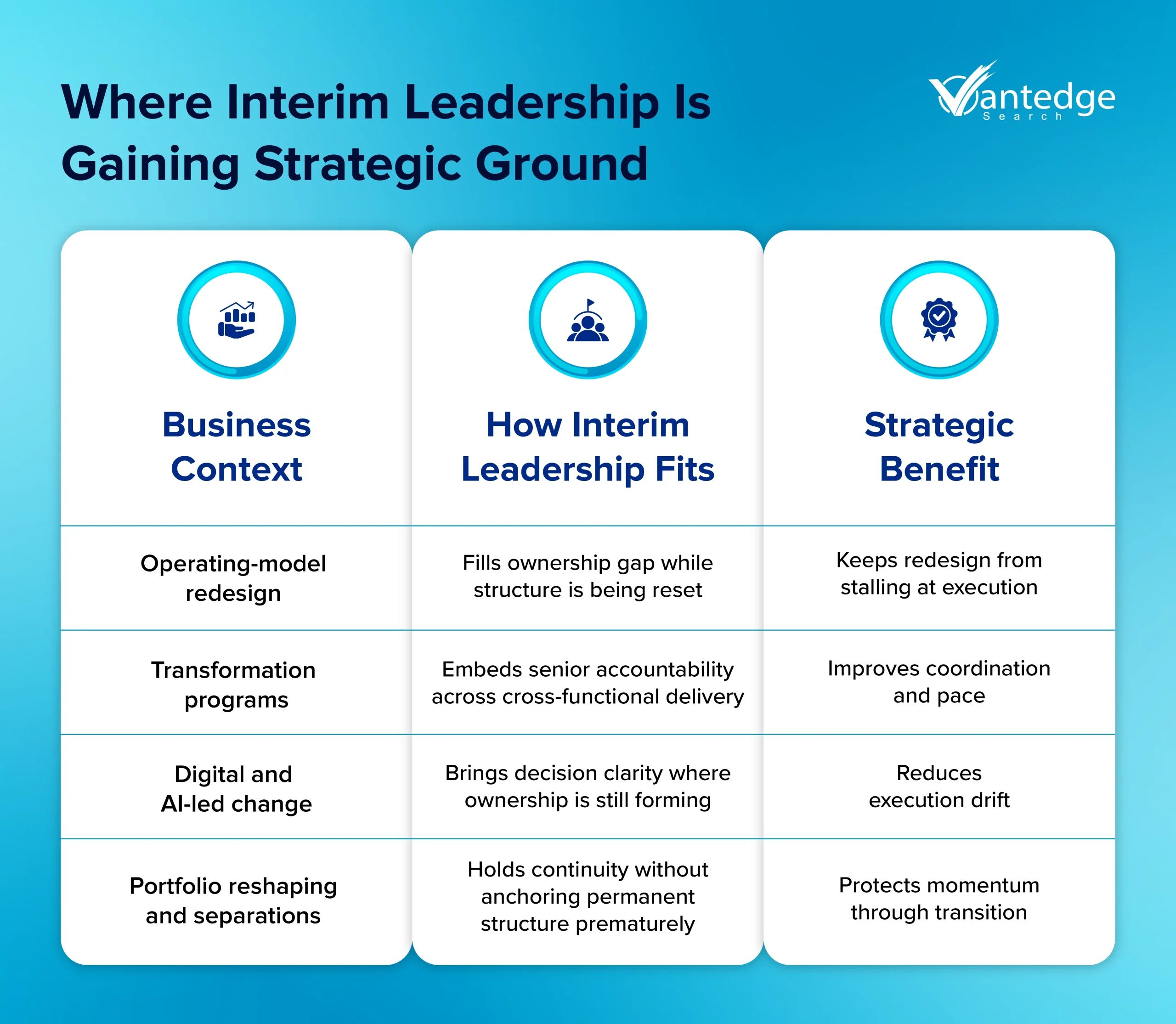
Not every transition creates an equal need for interim executive leadership. The environments where interim management strategy is gaining the most traction share a common characteristic: execution must continue while structure, ownership, and permanent decisions are still being worked through.
When the Org Chart Is Being Redrawn
Operating model transformation puts execution at the greatest risk because it questions existing ownership while the new model is not yet in place. McKinsey’s 2025 research confirms that only 24% of companies achieve full redesign objectives, with breakdowns occurring almost always at the execution layer, not the strategy layer. Interim executive leadership fills that ownership gap without pre-empting the permanent model.
When a Program Needs a Senior Owner, Not Just a Manager
Large-scale transformation programs rarely fail for lack of a plan. They fail because no single senior voice is accountable for cross-functional delivery. Business transformation leadership in an interim capacity addresses exactly that gap. Deloitte’s 2025 Chief Transformation Officer Study identifies the inability to drive and sustain change as one of the most cited execution challenges across large organizations. Senior accountability built in from the outset is precisely the function interim executive services are designed to provide.
When Digital and AI Priorities Are Still Being Settled
Leadership in digital transformation creates concentrated execution pressure because ownership is often contested and priorities shift quickly. McKinsey’s Global Tech Agenda 2026 confirms that senior leaders are actively reshaping operating models around AI and data integration, creating sustained demand for experienced execution capacity in roles that are not yet fully permanent in nature.
When a Business Is Being Reshaped at the Portfolio Level
For PE-backed businesses and corporates undergoing portfolio restructuring or separation activity, the leadership requirement is precise: someone who can hold decision-making authority without locking in permanent structure too early. PwC’s research highlights that leadership continuity during separation and carve-out periods is one of the most consistently underestimated risk factors in portfolio transactions.
What This Broader Mandate Actually Looks Like
Strategic interim leadership is not about presence. It is about function. When a business brings in an interim executive to carry execution through a high-stakes transition, the value delivered is practical and specific. Understanding what that looks like separates a well-designed interim mandate from one that simply fills a calendar slot.
Clarifying Who Owns What
In complex transitions, ownership ambiguity is one of the earliest and most damaging execution risks. Permanent teams are often stretched or mid-restructure, and decisions go unclaimed. McKinsey’s 2025 operating-model research identifies four areas where successful redesigns consistently invest: leader alignment, rewiring core processes, developing people, and building a performance-oriented culture. Ownership clarity sits at the heart of all four, and an experienced interim executive steps in to resolve that ambiguity before it compounds.
In practice, this means:
- Mapping decision rights within the first week of the mandate.
- Identifying which cross-functional decisions are stalled and who has the authority to move them.
Protecting Momentum Through Transition
The periods of highest execution risk are the transitions themselves: when a program moves from design to delivery, or when a leadership change creates a brief but consequential authority gap. Business transformation leadership in an interim capacity is specifically designed for these inflection points. The goal is not to accelerate. It is to ensure nothing critical loses ground.
Preparing a Cleaner Handoff
A well-scoped interim mandate prepares the ground for whoever comes next. Decisions are made. Contested priorities are resolved. The incoming permanent leader inherits forward momentum rather than a backlog of deferred choices.
Design Your Interim Leadership Strategy With Vantedge Search Today
Why Companies Are Being More Deliberate About the Interim Mandate
Expanding the remit of interim leadership only delivers value when the mandate is designed with precision. An under-defined interim role carries its own execution risk: unclear authority, contested decisions, and a leader without the standing to act. The organizations getting the most out of interim executive services are those that treat mandate design as seriously as candidate selection.
Define the Business Outcome at Risk
The starting point is not the role. It is the risk. Deloitte’s 2025 Chief Transformation Officer Study shows that companies face their greatest challenges during execution rather than in design or planning. Three of the top five challenges relate to getting things done, managing people, and driving change, while the remaining two involve planning and structural complexity, underscoring that execution is where transformation efforts are most vulnerable.
Before any interim appointment, the business must answer one question clearly: what specific outcome is at stake if senior execution capacity is not added now?
To define this well, organizations should identify:
- The initiative or transition most at risk of losing momentum or accountability.
- The decision-making gaps that cannot be absorbed by existing permanent leadership.
Establish Authority Early
An interim executive without decision-making authority is a senior observer. Deloitte’s study confirms that companies appointing experienced, full-time leaders to transformation programs see measurably better outcomes, with more than 80 percent of well-governed programs on track to meet or exceed targets.
Authority must be:
- Defined in scope before the mandate begins, not negotiated after.
- Communicated explicitly at board or C-suite level to remove ambiguity for the wider organization.
Separate Decisions to Act on Now from Those to Defer
Not every decision within scope belongs to the interim leader. A well-designed mandate distinguishes between decisions that must be made now to protect momentum, and decisions that should be deferred to the incoming permanent leader.
Without that distinction, interim executives risk either overstepping into territory that should be left for permanent leadership or under-delivering by treating too much as out of scope.
A practical way to draw that line:
- Decisions that directly affect delivery pace or program continuity belong to the interim mandate.
- Decisions that shape long-term organizational structure or culture should be deferred and documented for the permanent leader.
Define What Success Looks Like at Handoff
A mandate without a defined endpoint becomes a permanent arrangement by default. The clearest measure of a successful interim executive engagement is the quality of the handoff: what has been resolved, what momentum has been protected, and what the incoming permanent leader inherits.
Why This Is Not a Replacement for Permanent Leadership
As interim executive leadership expands its remit, one distinction must remain clear. Interim management strategy is a tool for sequencing, not substitution. The growing use of interim capacity does not signal a reduced belief in permanent leadership. It signals a more deliberate approach to when each type of leadership is most appropriate.
The Question Is Timing, Not Preference
Permanent leadership is irreplaceable where long-term cultural alignment, sustained team development, and enterprise-wide ownership are required. Interim leadership is most valuable in the period before those requirements can be met with confidence. The two are not in competition. They serve different purposes at different points in an organization’s trajectory.
Interim Leadership Creates the Conditions for Better Permanent Decisions
One of the least visible but most consequential benefits of a well-run interim mandate is what it leaves behind. When an interim executive resolves ownership ambiguity, stabilizes delivery, and documents deferred decisions, the incoming permanent leader inherits a cleaner, better-defined role. That is a materially stronger starting position than stepping into an unresolved transition with no established rhythm or clarity.
Sequencing Is the Strategic Discipline
The question is rarely whether to use interim or permanent leadership. It is which comes first, and why. In execution-heavy transitions where structure is still forming, bringing in permanent leadership prematurely risks locking in decisions before the organization has enough clarity to make them well. Interim leadership holds that space deliberately and then hands it over at the right moment.
What the Role May Look Like Beyond Today
The trajectory for interim executive leadership points in one direction: a more repeatable, more deliberately scoped role in the execution architecture of complex organizations. The signals are already visible in how boards and CEOs are structuring leadership through transitions in 2026.
From Emergency Response to Planned Execution Capacity
The “emergency backfill” framing of interim leadership is giving way to something more considered. McKinsey’s Global Tech Agenda 2026 highlights that top CIOs are actively reshaping operating models around AI and data integration. That reshaping is happening faster than permanent org design can keep pace with. New roles are being created, existing ones are being redefined, and accountability for AI-led delivery is still being assigned.
These are precisely the conditions that create execution gaps which permanent hiring alone cannot close quickly enough. Interim executive leadership steps into that window with a defined mandate, established authority, and the ability to act immediately while the permanent structure catches up.
Organizations are beginning to factor interim leadership into their planning architecture, not just their contingency plans.
A Mainstream Shift in Executive Staffing Models
The numbers reflect a structural change, not a short-term trend.
Deloitte’s research shows that 71% of companies expect to increase their use of interim executive capacity as part of future leadership models. That is not contingency planning. That is a deliberate shift in how senior execution capacity is being sourced.
The Future Use Case Is Targeted, Not Transitional
What distinguishes the forward view of interim management strategy is specificity. The future use case is less “someone to hold the seat” and more “a senior executive with a defined mandate, a clear time horizon, and a specific outcome to deliver.”
Deloitte’s 2025 CEO and boardroom research confirms that organizational resilience and execution performance are now the primary leadership priorities for boards. Interim leadership, when designed well, is one of the most targeted tools available to meet both demands simultaneously.
Execution risk is ultimately a leadership design problem. Addressing it well means thinking about interim capacity before the pressure arrives, not during it. (For a closer look at where interim leadership fits within a broader executive hiring framework, read our blog on Why Interim Leadership Should Be Part Of Your Hiring Strategy).
Where This Expansion Is Already Visible: Two Real-World Interim CEO Examples
The shift toward interim leadership as a strategic execution tool is not theoretical; it is already playing out across industries.
Nik Jhangiani, Diageo
When Diageo’s CEO departed in July 2025, the board did not pause operations. CFO Nik Jhangiani stepped in as Interim CEO, taking charge during a turnaround focused on cost reduction, debt management, and performance recovery. His appointment was not a holding measure but a delivery mandate, helping the business bridge leadership transition without disrupting strategic execution.
He later returned to his CFO role when Sir Dave Lewis became Chief Executive Officer on 1 January 2026.
Mike Stuart, Blue Shield of California
At Blue Shield of California, CFO Mike Stuart was appointed Interim CEO in March 2025 to maintain continuity across a health plan serving 6 million members while the board conducted a formal search. Stuart performed strongly enough in the interim role that the board appointed him permanent CEO in August 2025, showing how interim leadership can create confidence as well as stability.
He now serves as President and Chief Executive Officer of Blue Shield of California.
Both appointments reflect the same principle: interim leadership can be deployed with a clear execution mandate, allowing organizations to preserve momentum while making permanent succession decisions with greater precision and less urgency.
Conclusion
Interim leadership is not moving away from its original purpose. It is expanding beyond it. The business conditions shaping 2026, persistent redesign difficulty, high transformation failure rates, and execution volatility in digital and AI-led change, are creating more situations where a well-designed interim mandate delivers measurable value. Not to cover absence, but to carry momentum through transition.
The organizations that will benefit most are those that approach interim executive leadership as a strategic decision, not a stopgap. That means defining the outcome at risk, establishing authority clearly, and designing the handoff with as much care as the appointment itself.
Interim leadership strategy, applied with that level of deliberateness, is one of the most precise tools available to boards, CEOs, and leadership teams when execution cannot wait for permanent structure to catch up.
If your organization needs senior leadership capacity that can move with precision and purpose, connect with Vantedge Search to explore how our interim and fractional executive leadership solutions are designed to protect momentum and deliver results at the right moment.
FAQs
Interim leadership strategy is the deliberate use of experienced senior executives on a time-bound mandate to address a specific business outcome, rather than simply filling a vacant seat. It involves defining the risk to be managed, the authority required, the time horizon, and the conditions for a successful handoff.
Interim executives enter with a defined mandate and the authority to act immediately, resolving ownership ambiguity and maintaining delivery momentum during periods when permanent structure is still being defined. They establish decision-making cadence and ensure nothing business-critical loses ground during a transition.
Interim leadership is most appropriate when the business needs senior execution capacity immediately, but the long-term scope of the role is not yet fully defined. In most execution-heavy transitions, interim leadership creates the conditions for a stronger permanent appointment rather than replacing it.
No. While vacancy coverage remains a valid use case, it is no longer the primary one. A growing number of organizations are deploying interim executive leadership specifically to add senior execution capacity during high-stakes transformation programs where momentum, coordination, and accountability are at risk.
The highest demand is concentrated in sectors facing significant transformation pressure, including technology, healthcare, financial services, and investor-backed businesses. In PE-backed organizations, interim leadership is increasingly built into value-creation plans from the outset rather than reserved for unexpected departures.
Interim leadership is moving toward becoming a structural component of executive talent models, not an exception to them. The forward use case is a senior executive with a defined mandate, a clear time horizon, and a specific outcome to deliver, applied with the same deliberateness as any permanent appointment.
Leave a Reply