


5 Questions Boards and CEOs Should Be Asking Their CHRO in 2026
Table of Content
- Introduction: Why the Board–CHRO Conversation Has Changed
- Question 1: Where Will Our Current Leadership Model Fail in the Next 3–5 Years?
- Question 2: Which Roles Create Disproportionate Value—and Do We Really Understand Them?
- Question 3: If We Had to Redeploy 30% of Our Workforce in 18 Months, Could We?
- Question 4: What Organizational Risks are Emerging Below the Executive Level that Leadership May Not Yet See?
- Question 5: Do We Have a Workforce Strategy—or Just a Hiring Plan?
- What Separates a Strategic CHRO From an Operational One in 2026
- Conclusion: What Boards Should Expect from The CHRO Now
- FAQs
Four Key Takeaways
- Talent, leadership capability, and workforce design are no longer HR concerns. They are board-level execution risks, and the strategic CHRO is now central to how organizations manage them.
- Most organizations assess leadership through succession alone, manage talent uniformly, and plan workforces reactively, leaving significant gaps in readiness that boards rarely see until it is too late.
- The five questions in this piece test whether a CHRO is operating at enterprise level: from diagnosing leadership model failure and identifying high-value roles, to building redeployment capacity and connecting workforce design to business strategy.
- Boards that treat the CHRO as a functional head are leaving critical enterprise intelligence underused at precisely the moment when organizational adaptability determines competitive advantage.
Introduction: Why the Board–CHRO Conversation Has Changed
The agenda in the boardroom has shifted in ways that cannot be addressed with a standard HR update. Talent, leadership capability, and workforce design are no longer functional concerns sitting in an HR silo. They are execution risks at the center of every strategic decision a board oversees.
The role of CHRO in modern organizations has expanded well beyond people programs and policy governance. Today’s strategic CHRO sits at the intersection of leadership readiness, workforce agility, operating model design, and organizational risk, making this one of the most consequential roles in the C-suite. Yet most board conversations with the CHRO remain anchored in the operational: hiring progress, attrition rates, and engagement scores.
That is no longer enough. Gartner’s 2026 HR Priorities Survey confirms what the most forward-thinking boards already sense. AI-driven role substitution, pressure to balance growth with efficiency, and accelerating uncertainty are collectively redefining what strategic HR leadership must deliver.
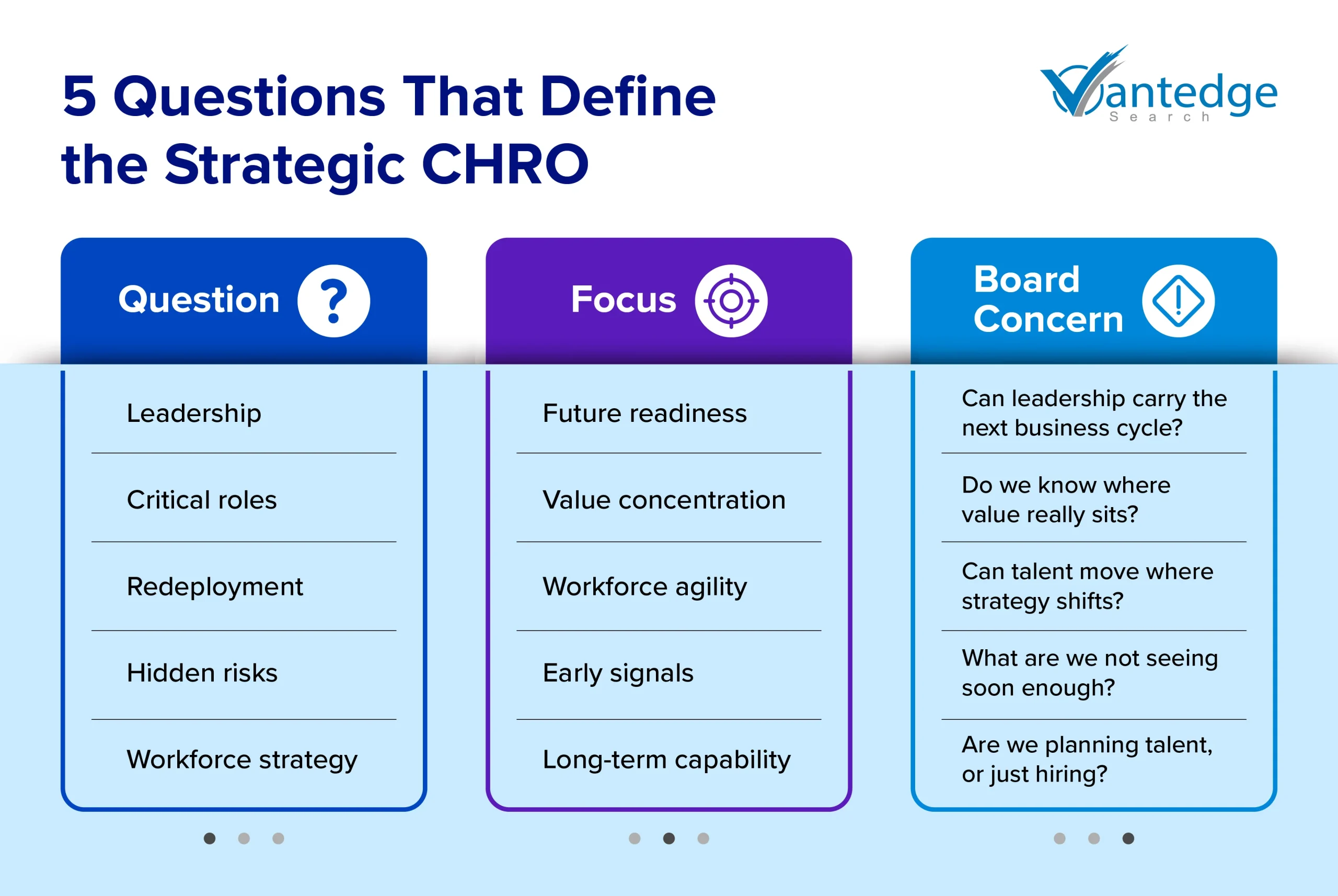
The five questions in this blog are not HR questions. They are enterprise questions. They test whether an organization’s leadership model is built for what is ahead, whether value is concentrated in the right roles, whether the workforce can move at the speed strategy demands, whether risk is being detected before it surfaces as a crisis, and whether the company has a real workforce strategy or simply a hiring plan dressed up as one.
The best boards are not asking their CHRO for program updates. They are asking whether the organization can execute through disruption. These are the five questions that define that conversation.
Question 1: Where Will Our Current Leadership Model Fail in the Next 3–5 Years?
Most boards approach leadership risk through a succession lens: who is ready now, who is two years away, and whether the pipeline is deep enough. That framing, while necessary, is no longer sufficient.
The more consequential question is structural. Most leadership models in operation today were built for environments of relative stability, predictable competition, and linear cause-and-effect. Those assumptions are already under strain.
The Gap Between Today's Leaders and Tomorrow's Demands
According to Forbes, between 40% and 50% of newly appointed leaders do not succeed within their first 18 months, not because of capability gaps in intelligence or effort, but because of a lack of the competencies required to manage complexity, ambiguity, and diverse operating contexts.
The conditions ahead will not make this easier. AI integration, compressed strategy cycles, geopolitical instability, and cross-functional operating models are collectively rewiring what effective leadership looks like. Leaders who excelled in more stable conditions will face a different and harder test.
From Individual Strength to System Fitness
Leadership capability assessment at the board level must move from evaluating individual leaders to evaluating the leadership system itself. The right question is not whether a specific leader is strong. It is whether the leadership model, as designed, is fit for the business conditions ahead.
A future-ready CHRO should be able to diagnose not just leadership strength, but where the leadership model itself is misaligned with the business ahead. That diagnostic spans five dimensions:
- Decision speed under time pressure and incomplete information.
- Cross-functional judgment across blurred organizational boundaries.
- Comfort with ambiguity in volatile, non-linear operating environments.
- Ability to lead human + AI work as automation reshapes roles and workflows.
- Resilience under continuous, compounding change.
CHRO responsibilities in this context go beyond managing succession charts. The strategic CHRO brings a system-level view of where leadership, as a model and not just as a talent pool, will face its next points of failure.
Question 2: Which Roles Create Disproportionate Value—and Do We Really Understand Them?
Most organizations know that not all roles carry equal weight. Far fewer have the discipline to act on that knowledge with consistency at the board level.
The issue is not whether all roles matter. It is whether leadership teams know which roles matter disproportionately, and whether the talent strategy actually reflects that clarity.
When Value Concentrates, Uniform Talent Management Fails
As AI continues to reshape workflows, value is concentrating in a narrower set of human roles requiring judgment, cross-functional influence, and strategic execution. Gartner’s 2026 HR Priorities Survey identifies leader and manager development as the single top priority for HR leaders, precisely because the demand for capability in critical roles now outpaces supply.
Deloitte’s 2025 Global Human Capital Trends report reinforces this: AI is shrinking entry-level roles and accelerating change, which means the roles that remain human-dependent are carrying greater organizational weight than before. Yet many organizations still manage talent uniformly, without clear differentiation between roles that sustain operations and roles that actually drive enterprise value.
CHRO responsibilities in this space go beyond filling vacancies. A strategic CHRO must define mission-critical roles by their business impact, not their position on an org chart, and align the entire talent system around them.
That means addressing four specific dimensions:
- Role-level ROI: Which positions have an outsized effect on growth, innovation, customer outcomes, or AI enablement?
- Talent density in pivotal roles: Are the right capabilities concentrated where value is actually being created?
- Build, buy, borrow, or retain decisions: Are those choices being made with role-level precision or portfolio-level generality?
- Rewards and development alignment: Do compensation, succession, and investment reflect actual enterprise value, or inherited hierarchy?
Recruitment and retention strategies at the senior level demand this precision. Without it, even the best hiring decisions can misalign with where the business actually needs to go.
Find Your Next Strategic CHRO With Vantedge Search.
Question 3: If We Had to Redeploy 30% of Our Workforce in 18 Months, Could We?
This is the acid test of workforce strategy. Not a hypothetical, but a pressure question that every board should put to their CHRO with full seriousness.
Most organizations can restructure reporting lines faster than they can move capability. That gap between structural agility and talent agility is where execution risk quietly accumulates.
Why Hiring Plans Are Not the Same as Workforce Strategy
A workforce strategy is only strategic if the organization can reallocate talent at the speed disruption demands. Hiring plans address external supply. Redeployment capacity is internal proof of adaptability, and it is far harder to build on short notice.
McKinsey’s HR Monitor 2025, drawing on insights from over 1,900 companies across Europe and the United States, found that while 73% of organizations conduct operational workforce planning, only 12% of HR leaders in the United States report doing strategic workforce planning with at least a three-year focus. That is a redeployment liability, not a workforce strategy.
What Redeployment Readiness Actually Requires
CHROs who can answer this question confidently have five capabilities already embedded in the operating model:
- Skills visibility: A current, accessible inventory of employee capabilities, including adjacent skills that do not appear in job titles or formal credentials.
- Internal labor market strength: Active internal mobility infrastructure with clear pathways, not just an intranet jobs board.
- Reskilling speed: The ability to retrain employees for adjacent roles in weeks, not quarters, aligned to a known skills gap map.
- Workforce planning maturity: Scenario-based planning that accounts for business pivots, not just annual headcount budgeting.
- Change absorption capacity: Manager readiness and team structures that can absorb transitions without losing output.
Boards should expect their CHRO to have direct answers across all five, not aspirational program plans. The organizations that built these capabilities before disruption hit are the ones that moved quickly when it arrived.
Question 4: What Organizational Risks are Emerging Below the Executive Level that Leadership May Not Yet See?
Execution risk often appears below the dashboard before it reaches the board pack. By the time a workforce problem surfaces in a quarterly report, it has usually been building for months at the layers leadership is least likely to examine closely.
The CHRO’s value is increasingly tied to signal detection, not just program management.
The Middle Manager Problem Nobody Is Pricing In
The strain on middle managers is one of the most consequential and underpriced organizational risks in business right now. Deloitte’s 2025 Global Human Capital Trends survey found that managers spend nearly 40% of their time solving immediate problems and handling administrative tasks, with only 13% of their time spent developing the people who work for them.
The managers who remain are carrying more people leadership pressure than the role was designed to handle, with support structures failing to keep pace with what is being asked of them.
When this layer cracks, the consequences move fast. Execution slows, culture weakens, and leadership pipelines thin out precisely when they are needed most.
What Is Not Appearing in the Board Pack
Silent attrition, trust erosion, and capability fragility rarely appear in formal reporting until they become visible as turnover spikes or missed targets. Boards should expect the strategic CHRO to bring both qualitative and quantitative insight, not HR metrics alone.
That means monitoring:
- Early-warning indicators: Engagement signals, manager stress data, and skip-level feedback that precede formal attrition.
- Middle-manager strain: Role overload, span of control misalignment, and capability gaps at the execution layer.
- Hidden capability fragility: Skills dependencies concentrated in too few people or teams.
- Employee trust and adoption risks: Resistance to AI-enabled workflows and organizational change that sits below formal survey data.
- The difference between reported stability and real operating health: What the dashboard shows versus what the CHRO hears through direct organizational intelligence.
The CHRO should not only report what has happened in the workforce. The strategic CHRO should help leadership see what is about to happen.
Question 5: Do We Have a Workforce Strategy—or Just a Hiring Plan?
This is the most important question in the piece. And for most organizations, the honest answer is harder to give than it appears.
Reactive hiring logic, dressed up as strategy, is widespread. Annual headcount plans, approved requisitions, and talent pipelines are necessary, but they are not a workforce strategy.
The Gap Between Planning and Strategy
Gartner research reveals that only 15% of organizations are engaging in true strategic workforce planning, while 61% of HR managers report planning only for the headcount needed in the coming year. That is not a workforce strategy. That is vacancy management at scale.
McKinsey’s analysis reinforces this: 87% of executives report facing significant workforce gaps or expect them within five years, yet fewer than half have a structured strategy in place to address them. The gap between awareness and action is precisely where boards should be pressing their CHRO for answers.
What a Real Workforce Strategy Requires
Deloitte’s 2026 Global Human Capital Trends report positions competitive advantage as directly dependent on an organization’s ability to build speed and adaptability into its talent model, not just its hiring pipeline. That requires connecting workforce decisions to business priorities in five specific ways:
- Future capabilities required by the strategy: What skills, roles, and behaviors does the business need in three to five years, and how does the current workforce map against that?
- Where automation changes role design: BCG’s 2026 research confirms that AI transformation is fundamentally a workforce transformation, with future-built companies five times more likely to do strategic workforce planning than laggards.
- Build, buy, borrow, bot, or redeploy: Each decision carries a different cost, timeline, and risk profile. A real workforce strategy makes these trade-offs explicit.
- Governance of workforce trade-offs: Who owns the decision when automation displaces a team, or when a strategic bet requires capability that does not yet exist internally?
- Whether the workforce plan actually changes business choices: Harvard Kennedy School research highlights that AI’s impact on work depends less on the technology itself and more on whether leadership chooses to redesign workflows around human potential or simply automate what already exists.
If the workforce plan does not influence capital allocation, operating design, or strategic bets, it is not a workforce strategy. The strategic CHRO must be able to make that case in the boardroom, with clarity and with evidence.
What Separates a Strategic CHRO From an Operational One in 2026
The operational CHRO answers with programs, dashboards, and hiring updates. That work is necessary, but it is not what boards need most right now.
The strategic CHRO answers with scenarios, trade-offs, capability risk, redeployment logic, and enterprise implications. As Deloitte notes, CHROs increasingly partner with CEOs and CFOs to align human capital strategies with financial and operational goals, moving decisively from function management to enterprise co-ownership.
As this discussion shows, workforce strategy is closely tied to long-term capability building. (To understand how these strategic questions translate into on-the-ground workforce capability challenges, it helps to look at how organizations are actively addressing the talent gap in high-growth industries. Read our blog How to Address the Talent Gap in High-Growth Industries.)
Conclusion: What Boards Should Expect from The CHRO Now
The questions in this piece are not a checklist. They are a standard. They reflect what separates organizations that will execute well through the next cycle of disruption from those that will react to it late.
The CHRO role is expanding because organizational performance now depends on leadership adaptability, workforce agility, and the active redesign of how work gets done. Boards that continue to treat the CHRO as a functional head are leaving one of their most critical sources of enterprise intelligence underused.
The strongest CHROs are not waiting for permission to operate at this level. They are already bringing scenarios, trade-offs, and capability risk to the table before the board forms the question.
If your board is ready to have this conversation, the quality of your CHRO is where it starts. Partner with Vantedge Search to identify and secure a senior HR leader who brings enterprise thinking, not just functional expertise, to the table.
FAQs
A strategic CHRO is a senior executive who connects leadership capability, workforce design, and organizational risk directly to business strategy. Unlike an operational HR leader who manages programs and processes, a strategic CHRO advises the board on whether the organization has the talent, structure, and adaptability to execute its ambitions.
The role of CHRO in modern organizations has expanded well beyond HR policy and people operations. Today’s CHRO is responsible for diagnosing leadership risk, identifying mission-critical roles, building workforce agility, and ensuring that talent decisions are aligned with the organization’s long-term strategic direction.
As AI reshapes work, talent becomes a primary lever of competitive advantage, and workforce decisions carry direct financial and operational consequences. CEOs increasingly rely on CHROs to translate people risk into business risk, making the CHRO one of the most influential voices in the C-suite conversation.
CHROs contribute to workforce strategy by connecting business priorities to build, buy, borrow, bot, and redeploy decisions, identifying future capability requirements, and ensuring the organization can reallocate talent at the speed disruption demands.
Boards should ask whether the current leadership model is built for the business conditions ahead, which roles create disproportionate value, whether the organization can redeploy a significant portion of its workforce rapidly, what risks are building below the executive level, and whether the company has a genuine workforce strategy or simply a hiring plan.
Leave a Reply