


The Three Leadership Disciplines Shaping CEO Strategy in 2026
Why disciplined leadership, structured execution, and cognitive resilience define CEO strategy this year.
Three Key Takeaways
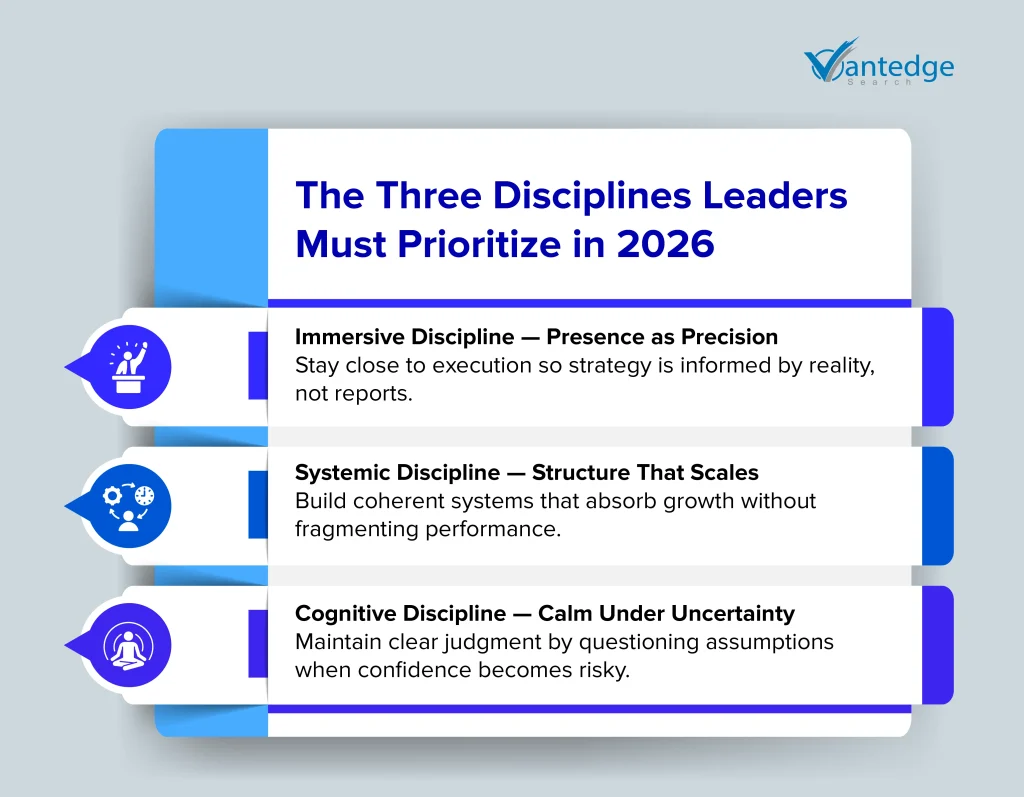
- Focus beats force: Immersive discipline keeps leaders close to execution, ensuring priorities stay grounded in reality.
- Structure sustains scale: Systemic discipline prevents complexity from eroding performance as organizations grow.
- Calm is a competitive edge: Cognitive discipline enables better decisions when certainty collapses and data alone is insufficient.
Introduction
Executive leadership in 2026 is entering a quieter but sharper phase. Boards and chief executives are less preoccupied with reinvention and more focused on rhythm: how consistently their organizations can think, decide, and deliver amid unrelenting change. What distinguishes leaders is effective leadership discipline: focus that resists distraction, execution that holds its line, and executive decision-making guided by calm when the pace around it refuses to slow. In current CEO strategy, leadership resilience and organizational focus have become the defining markers of long-term success.
Background: Leadership Discipline Behind the New Corporate Mood
By late 2025, the tone of executive leadership seemed to have changed. The ambition to expand at all costs appears to have given way to a sharper kind of pragmatism—growth defined by discipline. The Fall 2025 Fortune/Deloitte CEO Survey captured this shift clearly: 80% of CEOs said they plan to introduce cost-management measures, yet 63% intend to maintain current investment levels. It’s a telling balance between caution and conviction, a signal that leaders are recalibrating for stability, not contraction. Nearly 70% have already implemented AI usage policies, while over half are building ethical frameworks to guide adoption. Efficiency, governance, and responsible execution are now the organizing principles of growth. What was once a debate about how fast to move has evolved into one about how precisely to steer.
The 2025 MarginPLUS Global Cost Reduction and Transformation Study, published in April last year, reflects the same logic playing out at an operational level. With revenue projections subdued, executives are pivoting from spend optimization to hard-dollar cost reduction, focusing more on endurance. Competitive pressure, not crisis, is now the leading catalyst for transformation, driving sharper attention to digital infrastructure, governance, and measurable savings. Yet the report warns that too many programs “lose discipline in the middle,” as quick wins give way to fatigue and complexity. Others underinvest in program management or mistake automation for transformation. The lesson is unmistakable: in an environment where volatility no longer feels exceptional, endurance depends on discipline—on the consistency to follow through when momentum fades.
What these two studies make clear is that executive leadership in 2026 will be defined less by ambition and more by control. The data points to a corporate environment where confidence survives only when it is disciplined; when investment, technology, and transformation are guided by governance, focus, and endurance. As the narrative of growth pivots more toward precision, the idea of leadership discipline is strengthening not as restraint, but as a strategic advantage, one that now shapes how leaders think, decide, and sustain progress.
CEO Strategy in 2026: The Three Leadership Disciplines Every Leader Needs to Prioritize
What emerges from today’s boardroom data is not a new management trend but a pattern of behavior. Leaders who continue to deliver in uncertain markets share a particular way of working: measured, structured, and unsentimental about what no longer adds value. Discipline has become the defining texture of effective leadership. In 2026, leadership discipline shows up in three forms: the ability to stay focused on what matters most, to execute with consistency, and to think with clarity even when the environment refuses to settle.
1. Immersive Discipline: Presence as Precision
Immersive leadership discipline is about contact, not control. It’s the muscle memory of clarity, trained through repetition, refined through proof, and verified through outcomes. Leaders who practice it build trust through immersion, not delegation. They simplify under pressure, stripping complexity down to what can be acted on. They measure success not by how much they deliver, but by how well their message, mission, or model is understood.
Immersive discipline also demands leadership accountability and executional honesty: a refusal to overstate, overpromise, or hide behind abstraction. It’s the leadership equivalent of staying on the field: you don’t just watch the play; you move with it.
Ask yourself:
- When was the last time I verified a critical assumption by observing it in action, not in a report?
- Do I spend enough time with the teams who actually execute my top priorities to understand what slows them down?
- Which part of our customer experience have I personally tested — end to end — in the past year?
- How many of our key metrics reflect interpretation rather than first-hand data?
- Where in my organization could decisions be improved if leaders were required to see the process, not just approve it?
- Have I built feedback loops that bring unfiltered information from the ground directly to me — or is it polished before it arrives?
- When accountability breaks down, how quickly can I trace the cause to its operational source?
What would I learn about our strategy if I shadowed one frontline employee for a day?
2. Systemic Discipline: Building Structures That Don’t Break When You Scale
Every leader today is running a business that’s getting more complicated by the month: new markets, new data, new technologies, new partners. But the biggest threat is not the pace of change; it is the way complexity fragments the system. When one part moves faster than the rest, cracks appear: decisions lose context, priorities conflict, and execution slows.
Systemic leadership discipline is the ability to build structures that stay coherent as they grow. It starts with how leaders connect people, process, and timing. The best ones design sequence. They decide what must happen together and what can happen later. They don’t allow parallel projects to compete for oxygen. They make sure the system itself can absorb pressure before they add more weight.
This kind of discipline shows up in the way a company scales new markets, integrates technology, or demonstrates digital transformation leadership. It is not a project-management skill but an operating philosophy. Systemic discipline is what keeps complexity from turning into noise. It’s what allows a company to grow fast without coming apart.
Ask yourself:
- Where do our biggest initiatives overlap — and does that overlap create leverage or friction?
- Are we sequencing growth, or simply stacking priorities?
- How much of our speed today depends on people compensating for broken systems?
- When something goes wrong, how quickly can we see which connection failed?
- Do our partnerships operate by shared rules and cadence, or by goodwill and crisis management?
- Are we measuring coordination, or only completion?
- What parts of our organization could double in size tomorrow without breaking process integrity?
- If we paused every major initiative for a week, would the system still make sense when we turned it back on?
- When was the last time we borrowed a proven idea from outside our industry and made it our own?
- Do we have a system for scanning other sectors for structural patterns — or do we rely on consultants to tell us what’s changing?
- If a competitor from another industry entered our market tomorrow, which part of our system would they outperform first?
3. Cognitive Discipline: Thinking Straight When Certainty Collapses
In volatile markets, most leaders look for more data. The disciplined ones look for better judgment. Cognitive leadership discipline is the ability to stay analytical when confidence becomes dangerous: to keep questioning, even when the numbers agree. It’s not cynicism; it’s methodical doubt. Leaders who practice it treat skepticism as a management tool, not a mood. They assume their models are partly wrong and build systems to find where.
They start by stress-testing their own logic. Instead of asking, “What if this works?” they ask, “What breaks first?” Every plan has a failure point, and they make it visible early. They treat forecasting as a form of humility, constantly recalibrating rather than defending projections. They value observation over optimism, because they’ve seen what happens when data tells only half the story.
This kind of discipline turns foresight into an operating rhythm. Liquidity buffers, contingency plans, multiple scenarios — not as paperwork, but as reflexes. It also strengthens leadership accountability and team culture: hard questions are encouraged, not feared. The result is steadiness under pressure. When markets panic or systems fail, cognitively disciplined leaders slow the noise instead of joining it. They know that calm is a competitive edge.
Ask yourself:
- Where in our strategy have we confused confidence with evidence?
- Do we have a process to test our assumptions — or only celebrate them once confirmed?
- How many of our forecasts are built on conditions that no longer exist?
- When we model risk, do we identify where the model itself could fail?
- Do our teams feel free to question leadership logic before decisions are finalized?
- How often do we rehearse crisis scenarios that go beyond financial stress tests — like leadership succession, operational outage, or reputational shock?
- In a meeting, who usually spots what’s missing — and have we built systems to amplify that voice?
- If all external inputs stopped tomorrow, how long could we make sound decisions using only internal judgment and discipline?
The Leadership Aperture: Learning to See in More Than One Dimension
After discipline comes range. The most effective leaders in 2026 will move between vantage points faster than their competitors can react — because they know that every decision now lives in multiple realities. What looks efficient in the short term can hollow out leadership resilience in a year.
Multifocal thinking begins when leaders stop asking “What’s working?” and start asking “What’s hiding behind what’s working?” It’s the discipline of stepping back before you step forward, a hallmark of strong executive decision-making, and of examining whether efficiency is silently eroding resilience, or whether a celebrated success has become a structural blind spot. The real edge lies in asking uncomfortable questions at the right altitude: Are we growing, or are we just expanding? Is this partnership building capacity, or dependency? When we automate, do we also compress judgment?
Leaders who think in multiple exposures know that every clear answer casts a shadow. They probe it: what signal are we no longer hearing because we’ve tuned the system too tightly? Which decisions are optimized for the current market but fragile against the next shift? This is where disciplined executive decision-making sharpens strategic advantage by accounting for the unseen lag — between data and behavior, between intent and interpretation.
Multifocal discipline is about thinking in layers. The most adaptable leaders will toggle between the microscopic and the systemic, a defining strength of modern executive leadership, asking not “What’s next?” but “What might this connect to that I’m not yet seeing?”
And that will make the difference.
Conclusion
In 2026, executive leadership will be defined by strategic discipline, the ability to stay focused, structured, and accountable amid volatility. The most effective CEOs will lead with clarity and composure, grounding innovation in systems that scale and strategy implementation that endures. This next era of CEO strategy demands more than vision; it requires precision in execution, ethical governance, and leadership resilience. Organizations that cultivate disciplined leaders—those who combine analytical judgment with operational strength—will set the standard for sustainable growth and organizational focus in 2026 and beyond.
Our executive search practice helps organizations appoint leaders built for scale, complexity, and sustained performance.
Partner with Vantedge Search. Let’s start the conversation.
FAQs
CEO strategic discipline in 2026 refers to focused leadership, structured execution, and resilient decision-making that enable sustained performance amid volatility.
An effective executive leadership strategy aligns priorities, strengthens decision-making, and ensures disciplined strategy implementation across the organization.
Disciplined leadership enables CEOs to maintain clarity, accountability, and executional consistency while navigating complexity and market uncertainty.
CEOs can strengthen strategic execution through systemic alignment, clear sequencing of priorities, and governance structures that support accountable implementation.
Leadership in 2026 will be shaped by resilience, disciplined execution, digital transformation leadership, and sharper executive decision-making.
Leave a Reply