


Enterprise AI Is Redesigning the Operating System of the Firm
Enterprise AI Is Redesigning the Operating System of the Firm
Four structural shifts leaders are beginning to confront as AI moves from experimentation to enterprise deployment
As artificial intelligence moves from experimentation to enterprise AI deployment, many organizations are discovering that the real challenge is not the models themselves. It is the enterprise. Integrating AI in the enterprise exposes deeper constraints in enterprise data architecture, operational workflows, and decision processes that were never designed for machine intelligence. What initially appears to be a technology adoption problem increasingly reveals itself as something more structural: organizations must redesign the systems through which information flows and decisions are made. In this sense, the early phase of enterprise AI transformation is not simply about deploying new tools. It is about reconfiguring how the enterprise itself operates as part of a broader AI transformation strategy. A few emerging patterns illustrate how this shift is unfolding.
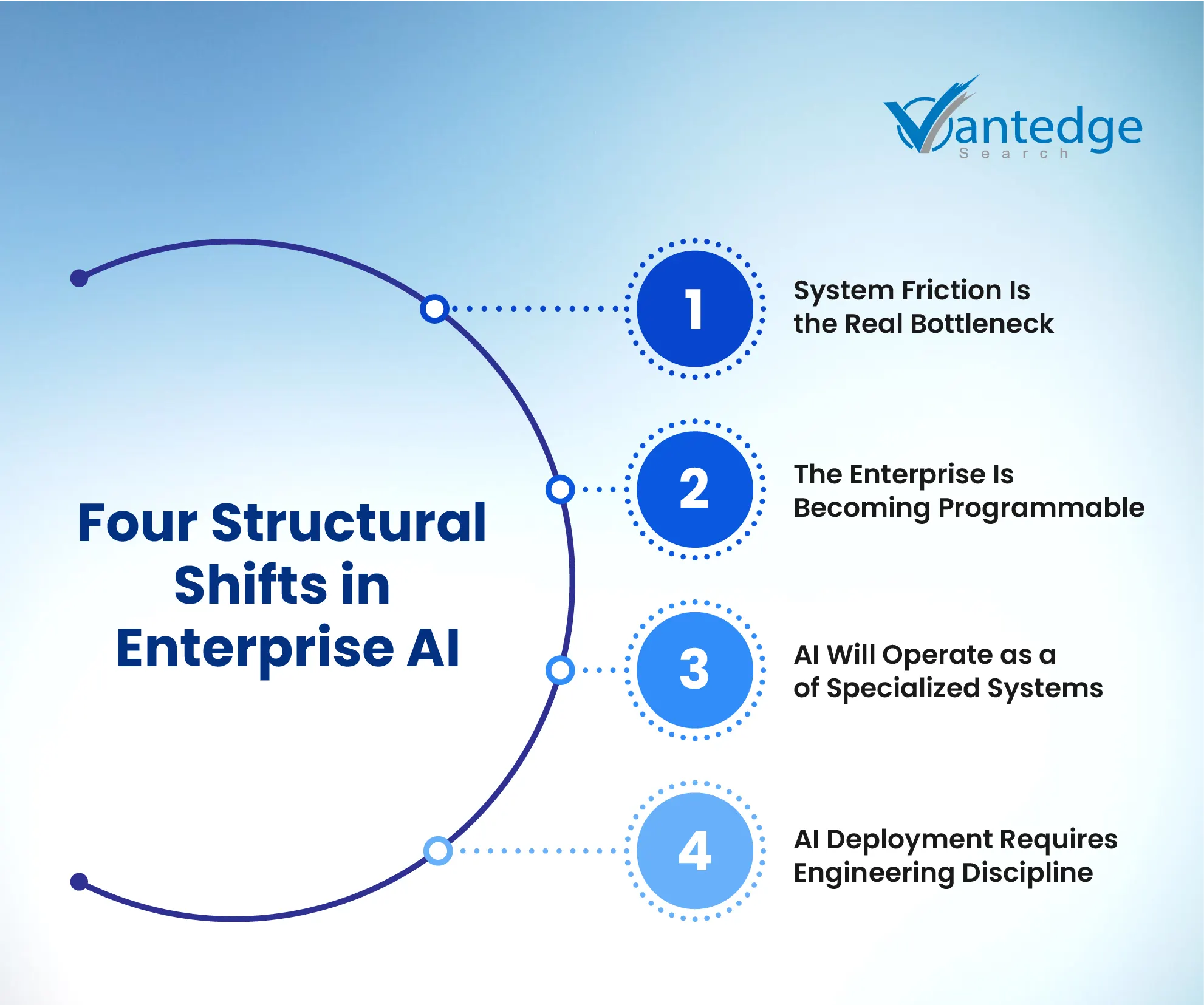
1. Enterprise AI Progress Is Constrained by System Friction, Not Model Capability in Enterprise AI Deployment
Technology leaders working closest to enterprise data platforms point to this challenge repeatedly. Sridhar Ramaswamy, CEO of Snowflake, emphasizes that successful AI initiatives often begin by defining clear operational outcomes and then testing systems rigorously to ensure the results are reliable. In practice, this discipline frequently exposes the deeper dependencies AI has on enterprise data infrastructure and governance frameworks.
The implication is significant. Scaling enterprise AI adoption increasingly depends on how effectively organizations modernize the systems surrounding the technology. Investments in data architecture, security practices, and workflow integration may ultimately determine whether AI remains confined to isolated pilots or becomes embedded across the enterprise.
In this sense, the early phase of enterprise AI transformation reveals a subtle shift: the bottleneck enterprise AI deployment is no longer the intelligence of the models, but the readiness of the enterprise systems that must absorb them.
2. AI Is Software-izing the Enterprise
For much of the past three decades, software has served as the infrastructure that supports enterprise operations. Financial systems record transactions, supply chain platforms track logistics, and customer management tools organize interactions. These systems structure information, but the underlying processes of the enterprise have remained largely human-driven.
The introduction of enterprise AI is beginning to shift that balance. As organizations deploy AI systems across operational environments, more aspects of enterprise activity are becoming observable, measurable, and programmable. This development begins to make the enterprise behave more like a software environment itself. Signals that once required human discovery can now be detected automatically. Workflows that once depended on manual coordination can increasingly be guided by machine-generated insights. Decision points within processes become visible, measurable, and potentially automated—reflecting how AI is redesigning business workflows and decision systems.
Technology leaders have started to recognize this shift. They emphasize successful AI deployment depends on disciplined data systems and rigorous testing, while the effectiveness of AI often hinges on the structure and accessibility of enterprise data infrastructure. Together, these observations point to a broader implication: scaling AI requires enterprises to treat their operational systems with the same discipline traditionally applied to software engineering, supported by stronger AI systems integration practices.
As AI capabilities expand across operational environments, organizations may increasingly find themselves redesigning workflows, data architectures, and governance structures so that machine intelligence can function reliably within them. In that sense, the enterprise AI transition is not simply about adopting new technology. It is about gradually transforming the enterprise itself into a more programmable, software-mediated system, marking the rise of the AI-powered enterprise.
3. Enterprise AI Architecture to Evolve as a Layer of Specialized Systems
Early conversations about artificial intelligence often assumed that progress would eventually converge around increasingly powerful general-purpose models capable of performing a wide range of tasks. While these models continue to advance, the way enterprise AI deployment is unfolding inside organizations suggests a different trajectory.
Enterprises, especially larger ones, operate through highly differentiated environments. Financial reporting systems, engineering workflows, supply chain platforms, and customer service operations each rely on distinct datasets, decision cycles, and regulatory constraints. Applying a single AI system uniformly across these environments can prove difficult because the context surrounding each workflow is fundamentally different. In practice, organizations are increasingly deploying AI capabilities that are optimized for specific operational domains.
This emerging pattern points toward an ecosystem for enterprise AI architecture. One model may support coding and software development, another may focus on document processing, while others specialize in anomaly detection, operational forecasting, or customer interaction. Each system is trained or configured for a particular type of data and decision environment, allowing it to operate more reliably within that context—an approach aligned with multi-model AI architecture in enterprises.
Technology leaders working on enterprise AI platforms describe a similar trajectory. Ali Ghodsi, CEO of Databricks, suggests that enterprises are unlikely to rely on a single model capable of performing every task. Instead, organizations may deploy multiple models optimized for specific objectives, each interacting with enterprise data systems and applications in different ways.
If this model of deployment continues, enterprise AI may increasingly resemble an architectural layer rather than a standalone tool. Different AI systems would operate across the enterprise—embedded in software development environments, operational monitoring systems, financial platforms, and customer engagement tools—each contributing specialized capabilities to a broader network of machine intelligence.
For enterprise leaders, this implies that the strategic challenge is not simply choosing the most advanced model. It is designing the architecture through which many AI systems interact reliably with enterprise data, workflows, and governance frameworks, supported by stronger AI systems integration. In that sense, the next phase of enterprise AI may depend less on model breakthroughs and more on how effectively organizations orchestrate these specialized capabilities across the firm.
4. AI Deployment Is Becoming an Engineering Discipline in Enterprise AI
As AI systems begin to influence production workflows, it is introducing a shift that many organizations are only beginning to confront: enterprise AI must be engineered, not merely deployed. AI systems require monitoring frameworks, evaluation pipelines, approval mechanisms, and governance structures that ensure outputs remain accurate and accountable over time. In practice, this begins to resemble the disciplines that govern large-scale software systems: version control, testing protocols, observability, and operational resilience. This highlighting why enterprise AI requires engineering discipline.
Leaders building enterprise AI platforms have pointed to this transition directly. AI systems require continuous testing and measurement as they scale; organizations should not underestimate the technical rigor required to operationalize AI reliably within enterprise environments. These constraints often emerge as challenges in scaling enterprise AI deployment, particularly when systems are not designed for continuous integration and monitoring at scale.
The implication is subtle but significant. The organizations that scale enterprise AI transformation successfully may not be those that experiment most aggressively with new models. They are more likely to be those that build the engineering discipline required to operate AI systems as part of the enterprise’s core digital infrastructure.
C-Suite AI Implementation: What Leaders Should Do Next
Given the shifts described above, the central leadership challenge is to prepare the enterprise to operate in an environment where machine intelligence is embedded across its systems. This makes C-suite AI implementation a core strategic priority.
The first step is recognizing that AI leadership is becoming a systems discipline. As organizations integrate AI into financial monitoring, operational workflows, and customer systems, the complexity of the underlying technology environment increases dramatically. For CEOs, this means leadership teams must develop deeper oversight of how data systems, security frameworks, and operational platforms interact. AI initiatives that appear purely technological often turn out to be exercises in managing complex enterprise infrastructure, requiring stronger AI leadership skills across the executive team.
Second, the AI transition demands clear strategic ownership at the top of the organization. Major technology inflection points historically reward companies with leadership capable of aligning product strategy, technology architecture, and organizational priorities around a coherent vision. As AI capabilities reshape enterprise software and operational systems, CEOs will increasingly need to define how AI fits into the firm’s long-term competitive positioning rather than treating it as a series of isolated technology projects. This raises the question of how to implement enterprise AI strategy successfully at scale.
Third, leaders must address what is emerging as the most persistent barrier to enterprise AI: reliable access to governed data. Many organizations have invested heavily in AI experimentation, yet scaling those initiatives often requires restructuring how enterprise data is organized, secured, and accessed across systems. For the C-suite, this elevates data architecture from a technical concern to a strategic capability that determines how effectively the enterprise can deploy AI across its operations.
As AI adoption accelerates, however, another governance challenge is becoming visible. AI systems increasingly execute actions across operational workflows rather than simply providing tools. In many organizations, AI agents already interact with multiple enterprise systems within a single automated process, shaping decisions and outcomes at machine speed. Yet governance structures were largely designed to approve software vendors, manage compliance, and monitor security, not to supervise how machine-driven actions unfold across the enterprise stack. The result is a widening oversight gap: many organizations can track which tools have been deployed, but far fewer can explain how AI systems are actually behaving inside operational workflows. This highlights the need for a more robust enterprise AI governance and risk management framework.
For the C-suite, this introduces a new leadership responsibility: governing the execution layer of AI—the prompts, permissions, workflows, and decision boundaries that determine how machine intelligence acts across the enterprise. Over time, this may require a new form of AI risk leadership, focused not only on model validation but on monitoring how machine-driven decisions interact with enterprise systems, financial exposure, and reputational risk. This shift is often described as enterprise AI execution layer governance, where oversight extends beyond models to how AI actually operates within business processes.
Organizations that build visibility and control over this execution layer will be better positioned to scale AI safely, while those that focus primarily on deployment may discover that machine intelligence has outpaced the structures meant to govern it.
Conclusion
As enterprise AI becomes embedded across operational systems, the more consequential question is who governs the intelligence now interacting with the enterprise’s data, workflows, and decisions. When AI agents operate across multiple systems and influence outcomes at machine speed, oversight must extend beyond technology adoption to the supervision of machine execution—reinforcing the need for stronger enterprise AI governance and risk management frameworks.
In that sense, the enterprise AI transition is not simply introducing new capabilities into the firm. It is redefining how the enterprise itself is governed, making C-suite AI implementation and leadership accountability central to how organizations scale and control AI effectively.
FAQs
Enterprise AI transformation goes beyond deploying models—it involves redesigning enterprise systems, data architecture, and decision workflows so AI can operate reliably at scale. In practice, it requires aligning technology, governance, and operating processes across the organization.
Most failures stem from system constraints, not model limitations. Fragmented data architecture, weak governance, and disconnected workflows create bottlenecks that prevent enterprise AI deployment from moving beyond pilots.
Scaling enterprise AI requires a coordinated approach: modernizing data infrastructure, strengthening AI systems integration, and embedding engineering discipline into how AI systems are deployed, monitored, and governed.
Enterprise data architecture is foundational to AI success. Without well-structured, accessible, and governed data, AI systems cannot operate reliably across workflows, making data architecture a strategic—not technical—priority.
As AI systems begin to execute decisions across business processes, governance must extend beyond tool approval to overseeing how AI behaves in production. This requires a structured enterprise AI governance and risk management framework at the leadership level.
C-suite AI implementation demands strong AI leadership skills, including the ability to align AI with business strategy, oversee complex enterprise systems, and manage the risks associated with AI-driven decision-making at scale.
Leave a Reply