


How AI Manages Data to Speed Up Decisions: Reducing Decision Cycle Time Without Losing Control
Table of Content
- Executive Context: Decision Cycle Time is Now a Performance Lever
- Where Time is Lost Between Insight and Action
- What “AI-managed Data Governance” Actually Means in 2026
- Four Building Blocks That Reduce Decision Cycle Time Without Losing Control
- Where Value Shows Up First: Prioritize Decision Flows, Not Departments
- Closing: The Strategic Takeaway for the C-suite
- FAQs
Four Key Takeaways
- Decision Cycle Time is a structural problem, not an analytics problem. Most delay sits between governance and execution, driven by trust gaps, approval congestion, and execution friction.
- AI-managed data governance shifts from documentation to decision support. When evidence, policy, and traceability are embedded at the point of decision, the governed path becomes the fastest path.
- Four operating disciplines reduce cycle time without weakening control. Decision-ready evidence, rules-based approvals, controlled execution, and built-in auditability shorten the full path from request to action.
- Leadership quality is the deciding factor. Execution leadership with cross-functional authority and a control mindset is what turns AI governance into measurable business performance.
Executive Context: Decision Cycle Time is Now a Performance Lever
In volatile markets, speed matters only when it leads to action. Many companies already have dashboards, models, and alerts, yet decisions still stall after insight appears. The real gap is not visibility. It is the delay between knowing what to do and getting the business to act.
That delay is why decision cycle time now matters at the top of the organization. It affects revenue timing, cost control, customer response, and risk handling in ways that senior leaders can see directly.
McKinsey’s 2025 work on AI decision making places attention on how AI supports full workflows, not only isolated tasks, while KPMG’s 2025 work shows that weak governance often slows action because leaders do not fully trust the data in front of them.
The real leadership question is straightforward. How can an organization reduce decision cycle time without weakening control?
The answer is not more dashboards alone. It sits in AI decision intelligence, enterprise AI governance, and execution leadership that connect evidence, approvals, and action in one operating path.
In the sections below, we will discuss what it takes to reduce decision cycle time without weakening oversight, and why that matters for leaders responsible for speed, risk, and execution.
Where Time is Lost Between Insight and Action
Most delays do not begin in analytics. They begin after the data is available, when leaders start checking whether the numbers are consistent, current, and tied to a trusted source. That is where trust gaps appear, and that is where many decisions lose momentum.
The next problem is approval congestion. Finance, risk, legal, and security teams often review too many items with the same level of scrutiny. Small requests and material exceptions get mixed together, so routine decisions wait in the same queue as high-risk ones.
Execution friction creates additional delays. Even after a decision is approved, action may still depend on emails, handoffs, tickets, or spreadsheet updates. The decision exists, but the business has not moved.
Then there is shadow workflow debt. Teams create side files, extracts, and ungoverned AI shortcuts to move faster. Those workarounds may save time in the moment, but they add audit risk, inconsistency, and clean-up work later. According to a report by KPMG, in 2025, shadow AI was increasingly described as a major enterprise risk, which reflects how quickly informal workarounds can weaken control.
The strategic takeaway is simple. Most lost time sits between governance and execution, not between data and insight.
What “AI-managed Data Governance” Actually Means in 2026
AI-managed data governance is not just a new label for old controls. It marks a shift from static policy documents and manual checks to governance that sits inside real decisions as they happen. KPMG’s 2025 work on data governance in the age of AI reflects this broader shift in enterprise thinking.
In practice, that means AI decision intelligence is used to package the evidence needed for action. A decision can arrive with source details, ownership, freshness, confidence, and policy context already attached. Instead of asking teams to search for proof after a recommendation appears, the proof is part of the recommendation.
It also means rules can be applied earlier. Low-risk actions can move through standard approval paths, while exceptions can be routed with the right context to the right decision-maker. As governance becomes more tied to AI-powered data discovery and operating workflows, the governed path becomes easier to follow than the unofficial one.
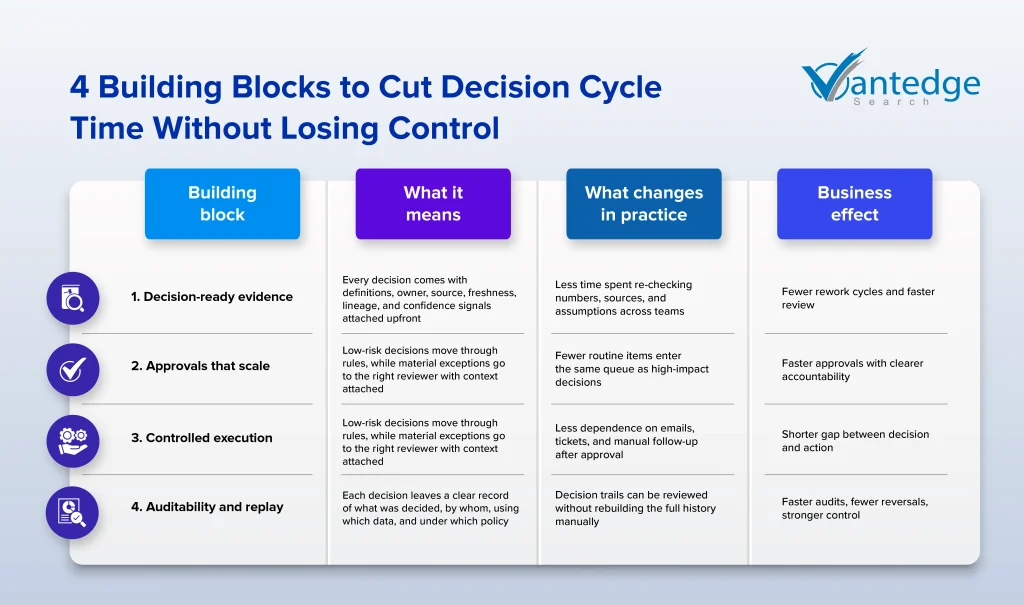
Four Building Blocks That Reduce Decision Cycle Time Without Losing Control
Reducing decision cycle time requires a small set of operating disciplines. The strongest models make evidence easier to trust, approvals easier to scale, execution easier to initiate, and reviews easier to reconstruct.
1. Decision-ready Evidence as a Default Output
AI-powered decision making moves faster when the evidence arrives with the recommendation, not after it. KPMG’s 2025 governance work places clear weight on metadata, lineage, access control, and policy enforcement because those elements help make enterprise data usable in a controlled AI setting.
In practical terms, each decision should come with a common evidence set. That usually includes the metric definition, data owner, source system, freshness, and a simple confidence signal.
This cuts down on repeated “prove it” debates across finance, operations, and commercial teams. When each group sees the same evidence format, fewer decisions go back for clarification.
A simple example is a forecast change request. If the request already includes source ownership, update timing, and the reason for the change, review becomes shorter and more disciplined.
2. Approvals That Scale: Rules Plus Exceptions
Approvals slow down when every request is treated as unique. McKinsey’s 2025 work argues that firms should classify decisions by risk and complexity, because low-risk decisions are better suited to automation while high-risk decisions still need human judgment.
That creates a better approval model. Routine actions can move through defined rules, while true exceptions can be routed for review with the right context already attached.
KPMG’s 2025 governance view also supports this direction through a model where common standards exist centrally, but execution can happen closer to the business. That keeps control in place without forcing every low-risk item into the same review queue as a material exception.
3. Controlled Execution: Decisions That Translate into System Actions
A decision is not complete when it is approved. It is complete when the business system changes in response.
McKinsey’s 2025 work places attention on decision design across end-to-end workflows rather than isolated tasks. That distinction matters because many organizations still lose time in the last mile between agreement and action.
In pricing, inventory, credit, procurement, or hiring, the approved decision should move directly into the next governed workflow step. Otherwise, the business still relies on follow-up emails, manual assignments, or delayed updates in core systems.
This is where execution leadership becomes visible. Low-risk actions can move within preset limits, while high-impact actions can still require a human release step.
The point is not full automation for every case. The point is to reduce the gap between decision and implementation, so AI-powered business decisions actually change how the business operates.
Find execution-focused leaders with Vantedge Search
4. Auditability and Decision Replay Built In
Fast decisions are not enough if nobody can explain them later. Agentic systems need governance, transparency, auditability, and fail-safes, especially in sensitive or regulated decisions.
That makes decision replay a practical control feature, not an administrative extra. A firm should be able to reconstruct what was decided, by whom, using which data, and under which policy.
Deloitte’s AI Board Governance Roadmap points to the need for formal oversight structures around AI use. That makes traceability important at both operating and board levels.
When the decision record is created by default, audits take less manual work and reversals become easier to analyze. Strong enterprise AI governance is often less about adding more review and more about building better traceability into the flow of work.
Where Value Shows Up First: Prioritize Decision Flows, Not Departments
The earliest value usually appears in a specific decision flow, not across a whole department. Broad programs often slow down because ownership becomes vague, and success is hard to measure. A narrower starting point creates faster proof.
The best candidates share four traits: they occur frequently; delay is expensive; ownership is clear; and cycle time can be measured from request to action. When these four conditions are present, decision cycle time becomes visible and manageable.
Common starting points are practical. In revenue teams, this may mean deal desk approvals, discount decisions, or pricing changes. In finance, spend approvals and forecast exceptions are often good starting points. In operations, allocation choices and service-level exceptions tend to show value quickly. In risk, credit thresholds and fraud actions are frequent and rules-based.
This approach also fits the wider direction of enterprise governance in 2026, where modern data governance is increasingly tied to AI use cases and business execution rather than static oversight alone.
The sequence matters. One decision type is enough at the start. Once that flow becomes faster, cleaner, and more stable, adjacent decisions can follow.
Operating Model: Co-own Speed and Control
Reducing decision cycle time is not only a CIO or CDO task. KPMG’s 2025 research points to the need for C-suite involvement because leadership decisions shape both governance quality and the pace of adoption.
A practical model distributes ownership clearly across functions while keeping one leader accountable end-to-end.
- Business leaders and the COO should own decision cadence and execution outcomes, because they see where delays affect commercial or operating results.
- The CFO should own controls, audit readiness, and cost discipline across the decision path.
- The CIO and CDO should own architecture, data contracts, observability, and the quality of the evidence layer that supports AI decision intelligence.
- Risk and Legal should own policy design and exception logic, so material cases receive the right level of review.
Co-ownership still requires one accountable leader for the end-to-end decision cycle. Without that, organizations may improve data inputs while approval queues remain unchanged, or automate workflows without clear risk boundaries.
Leadership and Talent Implications
The leadership need is shifting from data platform ownership to decision-to-execution ownership. McKinsey’s 2025 work suggests that as AI takes on more operational work, human roles move more toward oversight, judgment, approval, audit, and exception handling.
The stronger candidate has cross-functional authority, a control mindset, and a record of reducing delay in measurable terms. For boards, C-suite leaders, and investors, execution leadership is now a direct test of whether AI-powered decision making can produce business results at scale.
This points to a wider leadership issue. AI creates value only when the organization is structured to support speed, accountability, and execution. (To learn more, read our blog, Executive Leadership for the AI Era: Embedding Digital Fluency and Systems Thinking at Scale, which takes this discussion further through the lens of leadership structure and system readiness.)
Closing: The Strategic Takeaway for the C-suite
The advantage is not more AI tools. It is repeatable, controlled execution at speed. Organizations that reduce decision cycle time while strengthening traceability often outperform those that only accelerate insight generation.
For boards and senior leaders, the agenda is clear. Decisions must be treated as managed flows with standard evidence, scalable approvals, controlled execution, and audit trails that stand up to scrutiny. In that operating model, enterprise AI governance supports performance, and AI decision intelligence becomes scalable rather than fragile.
If your teams need experienced leadership during a period of change, connect with Vantedge Search for executive search support.
FAQs
AI data governance embeds policy, metadata, lineage, and confidence signals directly into decisions as they happen, replacing static policy documents and manual checks. This means every decision arrives with its evidence already attached, reducing the need for repeated validation across teams and shortening the time between insight and action.
AI reduces decision cycle time by packaging decision-ready evidence upfront, routing approvals based on risk level, and connecting approved decisions directly to business workflows. This eliminates the common delays caused by trust gaps, approval congestion, and manual handoffs that typically sit between governance and execution in most organizations.
In volatile markets, delay between insight and action directly affects revenue timing, cost control, and risk response. Most organizations already have sufficient data visibility, but decisions still stall after insight appears. Decision velocity matters because the competitive advantage now lies in how fast a business can act on what it already knows.
AI governance ensures that automated decisions remain traceable, auditable, and policy-compliant. It classifies decisions by risk, routes exceptions to the right reviewers with context attached, and maintains a clear record of what was decided, by whom, and under which policy, making automation scalable without creating blind spots for leadership.
AI-powered decision intelligence platforms reduce rework cycles, shorten approval queues, and close the gap between decision and execution. They also build in audit trails by default, making compliance and oversight less manual. The combined effect is faster, more controlled execution that strengthens, rather than bypasses, enterprise governance standards.
Leave a Reply