


CEO Leadership Challenges in 2026: Are You Running the Business — or the Conditions Are Running You?
Three Key Takeaways
- Credibility now depends on clarity. Leaders are judged less by confidence and more by how clearly they articulate rationale, constraints, and consequences.
- Transformation must match organizational capacity. Scaling AI, restructuring portfolios, and redesigning operating models require disciplined pacing — not just strategic intent.
- Leadership fit is phase-specific. In a compressed environment with limited tolerance for mis-sequencing, aligning leadership capability to enterprise phase is now a strategic necessity.
For many CEOs in 2026, the hardest part of running the business is no longer choosing strategy or adopting new technology. It is maintaining control over CEO decision making as pressure accumulates. Workforce moves are scrutinized for leadership credibility, innovation tests organizational endurance, and leadership judgment is evaluated less by intent than by consequence. In an environment defined by economic uncertainty, technological acceleration, geopolitical complexity, and rising accountability, success depends less on bold action and more on disciplined sequencing. In this climate of leadership under pressure, the real question is not whether leaders are responding, but whether they are still shaping the agenda, or quietly being shaped by it.
Background: The Operating Reality CEOs Are Confronting — Insights from the CEO Outlook
The CEO Outlook 2026 by EY Parthenon presents a leadership environment defined by contradiction rather than clarity. On one hand, CEOs remain confident in their own ability to drive revenue, profitability, and productivity, with a strong majority expecting growth despite slower global economic momentum and persistent geopolitical disruption. On the other, the same leaders report softening confidence in the external environment, rising operating costs across labor, energy, technology, and compliance, and diminishing pricing power as customers become more value sensitive. This confidence gap — belief in internal control amid external instability — is a defining feature of the current CEO mindset and frames how leadership decision making is now unfolding.
A second, equally important tension runs through the report’s treatment of transformation and AI. Nearly all CEOs are either already undertaking enterprise-wide transformation or planning to begin one in 2026, making enterprise transformation strategy a central priority for leadership teams. Productivity, operational optimization, and customer engagement are cited as the top priorities. At the same time, AI is moving from broad experimentation to disciplined scaling. CEOs report that most AI initiatives are meeting or exceeding expectations, and leading organizations are already capturing disproportionate value. Yet the report is explicit that this phase demands sharper choices: where to scale, where to stop, and how to balance short-term cost pressure with long-term competitiveness as AI becomes embedded across operating models, workforce planning, and capital allocation.
The report also highlights how geopolitical fragmentation is reshaping the terrain on which these decisions play out. CEOs are actively adjusting investment strategies, supply chains, and partnerships in response to trade policy shifts, regulatory divergence, and data sovereignty concerns. While most leaders have adapted their strategic investments rather than delaying them, the environment has become more complex and less forgiving. Export controls, localization requirements, and increased scrutiny of cross-border data and technology flows are fragmenting the digital economy, raising compliance costs and slowing innovation diffusion — including within global enterprises themselves.
Finally, the CEO Outlook 2026 positions transactions as both an opportunity and a constraint. M&A activity has rebounded, with many CEOs pursuing acquisitions, joint ventures, and alliances to accelerate transformation, access technology and talent, and compress timelines that organic change cannot match. At the same time, cross-border dealmaking faces heightened geopolitical and regulatory scrutiny, longer approval processes, and greater execution risk. As a result, CEOs are operating in an environment where action is expected, transformation is ongoing, and tools are available — but room for error, reversal, or mis-sequencing has narrowed materially.
Taken together, these pressures illustrate how enterprise transformation strategy and the management of geopolitical risk for businesses are reshaping the context in which leadership decision making now takes place.
Where Leadership Is Being Tested Most: Leadership Decision Making Under Pressure
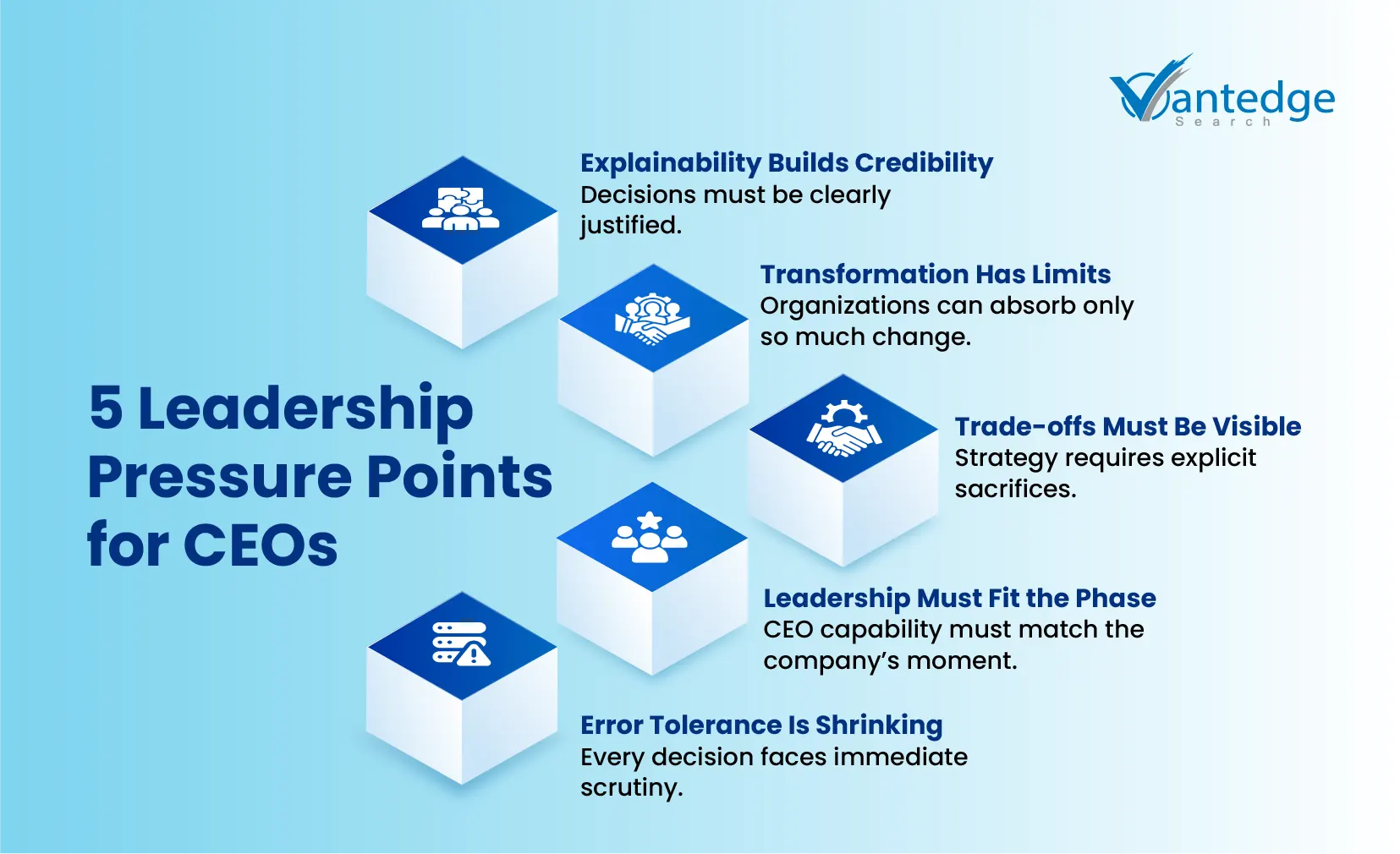
CEO leadership challenges are not abstract. The pressure on CEOs is surfacing in five specific, repeatable ways that now determine whether leaders are shaping outcomes through effective leadership decision making or reacting to them.
- Leadership Credibility Is Now Measured by Explainability, Not Confidence
In 2026, leadership credibility is increasingly forged — or fractured — in the moments after decisions are made. Not when results are announced, but when the organization begins asking: Why this? Why now? What did we give up to get here? Workforce actions, investment shifts, restructurings, and strategic pivots all invite the same quiet test. Can the CEO explain the logic behind CEO decision making without leaning on outcomes that are not yet visible? And would that explanation still hold if the context shifts months later?
This tension shows up clearly in how leaders now talk about innovation and change. As Stanislav Markovich, engineer and member of the Institute of Electrical and Electronics Engineers, observed in his October 2025 interview (published in CEOWORLD Magazine), innovation often fails not because ideas are weak, but because they are introduced as surface enhancements rather than integrated into the structural, legal, and operational design of the enterprise. A similar emphasis on explainability appears in how Jane Fraser, CEO of Citigroup, has addressed AI-driven restructuring — openly naming which roles will change, which will disappear, and why those trade-offs are being made (article published in Business Insider). In both cases, the signal is the same: when rationale is implicit or retrofitted after the fact, credibility erodes between decisions rather than because of them. In contrast, leaders who articulate assumptions, constraints, and trade-offs upfront retain control of the narrative — even when outcomes remain uncertain.
- The Real Constraint on Enterprise Transformation Is Organizational Absorption
For many CEOs in 2026, the hardest judgment call is no longer what to transform, but how much change the organization can realistically carry at once. AI deployment, operating model redesign, cultural shifts, portfolio moves, and regulatory adaptation are often pursued in parallel. The risk is not lack of ambition but misreading the organization’s capacity to absorb large-scale organizational change. How much disruption can teams absorb before momentum turns into confusion? At what point does speed begin to erode coherence? And who, exactly, is tracking whether the organization is still converting change into progress—or merely enduring it?
This tension is visible in how some leaders are deliberately pacing reinvention. According to an article in Northwest Education, Martin Waters, former CEO of Victoria’s Secret & Co., framed transformation not as a series of isolated initiatives, but as a coordinated reset across culture, digital capability, and customer experience. That approach implicitly answers a question many CEOs now face: can transformation move faster than the organization’s ability to internalize it? When change is sequenced with absorption in mind, coherence holds. When it isn’t, even well-designed initiatives start to compete for attention, credibility, and energy. The real test for CEOs is whether they are calibrating transformation to organizational rhythm—or discovering too late that the organization has fallen behind the strategy.
- Constraint Is No Longer Implicit — It Must Be Declared
For years, CEOs could soften trade-offs behind optimistic language: “transformation,” “modernization,” “efficiency.” In 2026, that insulation has thinned. Stakeholders no longer assume constraint; they look for it. If capital is being redirected, what slows down? If automation scales, what shrinks? If productivity rises, who absorbs the displacement? The absence of declared sacrifice now invites suspicion.This is where candor becomes structural, not stylistic. In discussing Bank of America’s AI strategy (as per an article published in Business Insider), CEO Brian Moynihan acknowledged that automation has reduced coding workloads by roughly 30%, creating savings equivalent to about 2,000 roles, while emphasizing redeployment and reskilling to maintain overall staffing levels. That framing matters. He did not present AI purely as acceleration; he quantified what it displaces. He named the compression alongside the opportunity. The signal was clear: efficiency is not abstract, it reshapes capacity.
The leadership question beneath this shift is uncomfortable but unavoidable, reflecting the growing expectations around CEO accountability. When you announce growth, are you also clear about what is being deprioritized? When you fund innovation, are you transparent about which legacy investments are winding down? When you commit to resilience, have you declared the constraints that make resilience necessary? In this environment, constraint that is unnamed becomes a credibility gap. Constraint that is articulated becomes strategy.
- Leadership Is Becoming Phase-Specific, Not Universal
Executive appointments are no longer neutral events; they are strategic declarations that increasingly shape an organization’s executive leadership strategy. Boards are increasingly hiring for the phase the enterprise is entering, not for generic leadership breadth. The question is no longer, “Is this a strong CEO?” but, “Is this the CEO for this moment?”
Diageo’s appointment of Sir Dave Lewis illustrates this shift with unusual clarity. As per a BBC news article, the Guinness-maker saw operating profits fall 28% year-on-year to £3.2bn, net sales stagnate, and its share price slide to a 10-year low amid weaker US demand and slowing sales in China. Markets responded immediately to the appointment of Lewis, widely credited for stabilizing Tesco during its crisis years: shares rose 7% on the announcement. Analysts were blunt about the mandate. This was “repair work, not long-term growth.” Even his reputation, earning the nickname “Drastic Dave” for decisive restructuring, reinforces the signal. The board did not hire a growth evangelist. It hired a stabilizer.
This pattern is emerging across sectors. AI-native leaders are appointed when technology scaling becomes existential. Operational veterans step in after abrupt exits to restore order. Turnaround specialists replace expansionists when margins compress. Leadership selection is becoming diagnostic: a reflection of how boards assess enterprise condition. The sharper question for CEOs, then, is not simply how well they lead, but whether they are aligned to the organization’s true phase: stabilization, recalibration, reinvention, or acceleration. In 2026, misreading that phase may be the costliest leadership error of all.
- The Margin for Leadership Error Has Narrowed
Leadership no longer operates with automatic credibility, and expectations around leadership effectiveness have become far more exacting. The benefit of doubt that once gave CEOs room to sequence change, recalibrate strategy, or absorb short-term missteps has thinned materially. When restructurings are announced, markets interrogate motive before applauding discipline. When AI initiatives scale, employees evaluate displacement before productivity. When performance softens, boards move faster to question direction. The environment has shifted from optimism to verification.What makes this cycle different is not volatility, but conditional belief. Every major decision now triggers a second layer of scrutiny. Is this move proactive or reactive? Is this transformation strategic or corrective? Is this succession planned or forced? Timing, tone, and sequencing are being read as signals of strength or strain. Even silence is interpreted.
The real compression in 2026 is not only in capital markets or operating margins. It is in credibility reserves. Trust is no longer a starting position, but a variable that must be reinforced with each decision. And once that buffer erodes, recovery becomes exponentially harder than growth.
Conclusion
In a cycle where credibility is conditional, constraint must be declared, leadership is phase-bound, and error tolerance is thin, the advantage will not belong to the boldest CEO — but to the most disciplined. Those who can read the enterprise’s true condition, calibrate change to its capacity, and align structure with intent will not merely withstand conditions; they will shape them. The rest may find that momentum, once lost, is far harder to reclaim than market share. In many ways, these pressures define the evolving CEO leadership challenges of 2026.
In a cycle where leadership fit determines strategic traction, alignment cannot be assumed. We partner with organizations to identify and position leaders who match the moment — and the momentum ahead.
FAQs
The most significant CEO leadership challenges today stem from navigating enterprise transformation, managing geopolitical uncertainty, and making high-stakes decisions under greater scrutiny. Leaders must balance growth ambitions with organizational capacity while maintaining credibility with employees, investors, and boards.
CEO decision making is increasingly examined by stakeholders across the organization and the market. Employees evaluate workforce impacts, investors assess strategic intent, and boards closely monitor execution. As a result, leaders must clearly articulate the rationale, trade-offs, and timing behind major decisions.
Successful enterprise transformation requires careful sequencing rather than simultaneous change across every dimension. Leaders need to assess the organization’s capacity to absorb large-scale organizational change and align transformation initiatives with operational realities and workforce readiness.
Geopolitical risk for businesses is shaping decisions around supply chains, investments, partnerships, and regulatory compliance. CEOs must increasingly factor geopolitical dynamics into strategic planning while ensuring resilience across global operations.
Leadership credibility is now closely tied to transparency and explainability. Stakeholders expect CEOs to clearly communicate the reasoning behind strategic moves, workforce changes, and technology investments. Credibility is built not only through results but through the clarity of decision-making processes.
Leadership effectiveness today depends less on bold individual moves and more on disciplined strategy, thoughtful sequencing of transformation, and the ability to manage competing pressures. CEOs who align strategy, organizational capacity, and stakeholder expectations are better positioned to navigate uncertainty.
Leave a Reply