


AI Workslop in the C-Suite: The Growing Importance of Executive Judgment in AI-Accelerated Organizations
Four Key Takeaways
- AI workslop is spreading in executive workflows: AI-generated content looks complete and credible but lacks the depth or context needed for high-stakes decisions.
- The real risk is accepting answers that look credible but haven’t been tested: Misplaced confidence in polished output shapes strategy before assumptions are pressure-tested.
- AI workslop quietly shifts how leaders think: It causes executives to stop searching early, confuse fluency with insight, miss missing context, overestimate understanding, and delegate more judgment than they realize.
- Leaders must protect judgment deliberately: Slow down high-stakes decisions, demand multiple scenarios, test conclusions against reality, separate information from judgment, and own the final consequences.
AI has changed the pace of senior work in ways that were difficult to anticipate even two years ago. Briefings are drafted faster. Market summaries are pulled together in minutes. Board materials that once took days now take hours. The output is cleaner, more structured, and easy to move forward.
But speed and polish do not guarantee quality.
A growing share of this output falls into what Gartner describes as AI “workslop” which is AI-generated content that looks complete and credible but lacks the depth, accuracy, or context needed for sound decisions. It reads well and feels ready, which is exactly why it often moves forward without enough scrutiny.
At the executive level, this is where AI risks in executive decision-making begin to take shape. Decisions are rarely made on obviously flawed inputs. They are made on information that appears reasonable but has not been tested enough.
This is the shift in C-suite AI decision-making. The challenge is no longer producing answers. It is deciding which answers deserve to influence a decision.
The leaders who stand out will not be those who use AI the fastest, but those who remain careful about what they accept, question, and act on.
What the Research Signals
The concern around AI workslop is no longer theoretical. Gartner has identified AI workslop as a 2026 work concern, defining it as fast but poor-quality work produced by or with AI, often linked to pressure to adopt AI broadly without enough time to judge whether the output is fit for purpose. Separately, HBR’s research found that employees spend nearly two hours managing each instance of AI-generated workslop they encounter. For leadership teams, the implication is significant: if low-quality AI output enters senior workflows, the cost is not only rework but misplaced confidence.
The report also notes that 40% of surveyed US full-time employees had received workslop in the prior month, and those employees estimated that 15.4% of workplace content they received qualified as workslop. The effect was more pronounced in professional services and technology, sectors that depend heavily on written analysis, advisory output, and evaluation materials—precisely the work that often informs senior decisions.
In everyday work, AI workslop wastes time. In C-suite AI decision-making, it creates misplaced confidence before major calls. A polished brief that rests on weak assumptions can still shape strategy and capital allocation if it is not tested before reaching the decision forum. This is where AI risks in executive decision-making become tangible.
The Problem: When Polished Output Moves Faster Than Scrutiny
The real risk of AI-generated workslop in the C-suite is not that leaders will accept obviously wrong answers. It is that they will accept answers that look credible but have not been tested. AI output is often polished, coherent, and well-structured, which makes it easy to move forward without scrutiny. In board materials, investor updates, and risk summaries, this creates AI risks in executive decision-making the moment the draft is treated as analysis rather than a starting point.
When that review discipline is absent, this becomes a structural problem. High-stakes materials such as board decks, capital allocation memos, and succession notes often lack clear standards for who reviewed them, what evidence supports them, and who owns the final recommendation. Without those controls, AI workslop can reach decision forums unchecked. That is where decision risk shifts from theoretical to operational, because misplaced confidence may shape strategy, capital decisions, and leadership choices before the underlying assumptions are tested.
How AI Workslop Affects Executive Judgment
AI workslop does not affect executive judgment in obvious ways. It does not produce conclusions that are clearly wrong or outputs that immediately raise concern. The risk is more gradual. As AI-generated content moves faster through workflows, certain habits of thinking quietly shift how deeply leaders question an answer, how much they trust their own read of a situation, and how much judgment they retain versus hand off.
These shifts do not announce themselves. They accumulate. Understanding them is the first step toward managing AI risks in executive decision-making with the seriousness they deserve.
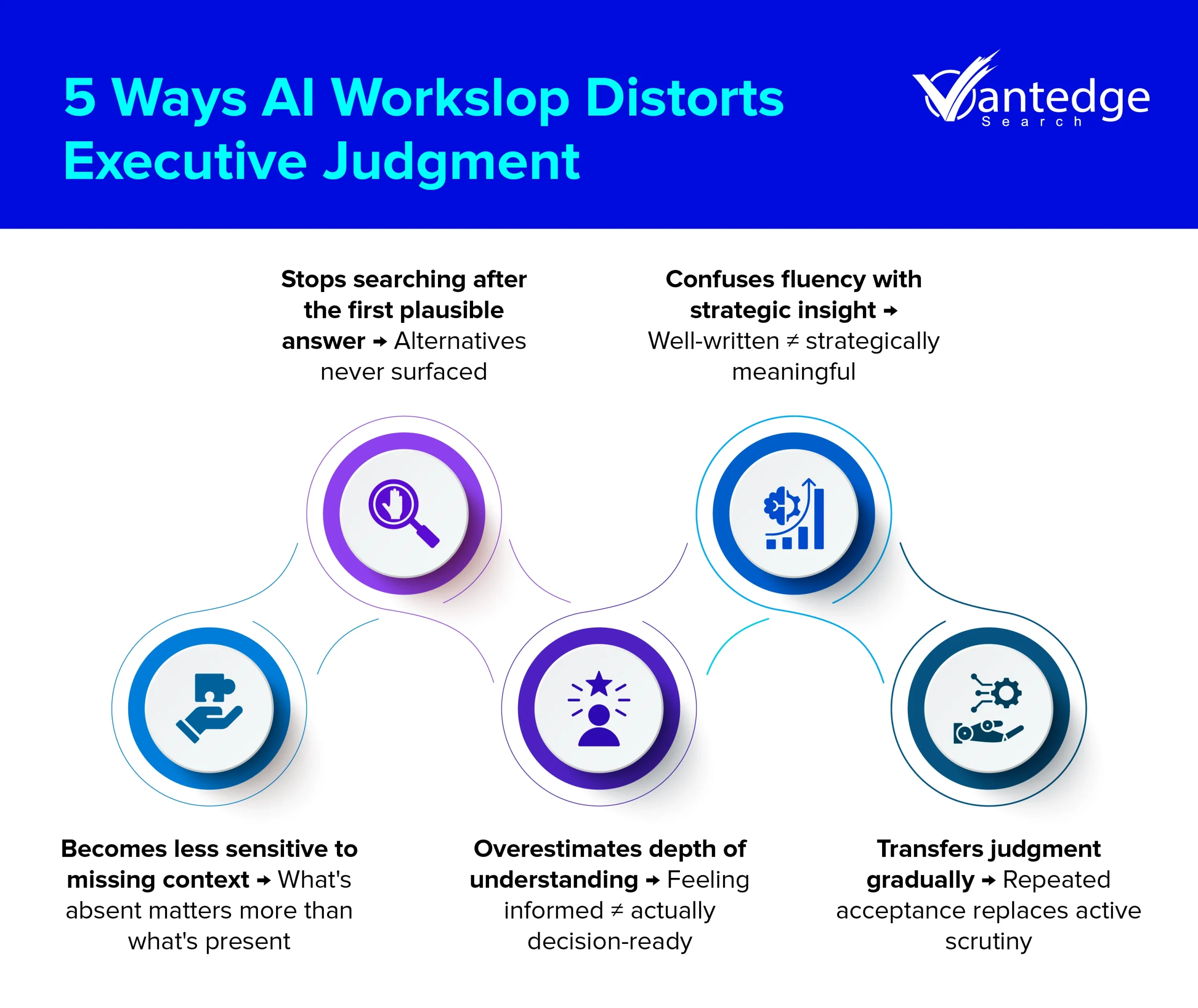
1. Executives Stop Searching After the First Plausible Answer
Historically, senior leaders often had to wrestle with ambiguity. There was no instant answer, so they explored alternatives, pressed for different angles, and tested assumptions before committing. That process of wrestling was itself a form of judgment.
AI removes that friction. A coherent answer appears immediately, structured, and persuasive. The risk is not that the answer is obviously wrong. The risk is that it is good enough to stop further inquiry.
When this happens repeatedly, the search for alternatives collapses. Strategic options are not fully surfaced. Decisions begin to anchor around the first credible narrative rather than the best-tested one. This is one of the most subtle but consequential AI risks in executive decision-making: the compression of exploration before the leader even realizes it has happened.
2. Executives Confuse Fluency with Strategic Insight
AI is exceptionally good at producing coherent, polished output. That is precisely where a particular category of AI risks in the C-suite takes root. The executive challenge is not detecting nonsense. It is distinguishing a well-written answer from a strategically meaningful one. Those are not the same thing.
Coherence does not equal insight. A document can be clear, well-structured, and still rest on weak assumptions, generic logic, or surface-level analysis. The writing does not reveal that. It conceals it.
When leaders begin to reward fluency over depth, a layer of good writing starts to substitute for rigorous thinking. The pattern repeats quietly. And over time, AI risks in business decision-making begin to shape strategy, not because the output was wrong, but because it was accepted as more substantial than it actually was.
3. Executives Become Less Sensitive to Missing Context
The strongest leaders have always relied on a specific instinct: noticing that something important is absent. A key relationship, an internal constraint, a market nuance, a cultural dynamic that does not appear in public information but shapes how a decision will land.
AI is good at presenting what is known. It can surface gaps when prompted well, but it often misses organization-specific context that is not captured in the available material.
When AI-generated summaries become the default starting point, that instinct weakens. Leaders begin to trust the coverage more than the gaps beneath it. The question “what am I not seeing?” gets asked less often. And context that should have been surfaced stays invisible. This is where AI risks in executive decision-making quietly degrade judgment, not through what is wrong in the output, but through what is absent from it.
4. Executives Overestimate the Depth of Their Understanding
Reading a well-written AI summary creates a feeling of understanding. That feeling is not always the same as actual understanding. This is one of the more subtle AI quality risks in leadership, and one of the harder ones to detect.
A CEO may feel informed about a market, a competitor, or a regulatory issue without having done the deeper thinking those topics require. The summary creates confidence. But confidence built on a summary is not the same as confidence built on genuine analysis.
Over time, this affects how leaders approach complex topics. They may move faster, feel more ready, and commit earlier, without the mental grounding that a decision of that weight actually requires. The gap between feeling informed and being decision-ready is where judgment quietly erodes.
5. Executives Delegate More Judgment Than They Realize
This is the strongest and most consequential of the AI risks in the C-suite. It does not happen through a single choice. It happens through a pattern.
Nobody consciously says, “Let the AI decide.” Instead, they say, “This looks reasonable,” and move forward. That response, repeated hundreds of times across strategy notes, risk briefs, and operating recommendations, becomes a gradual transfer of judgment. The leader is not abdicating responsibility. They are simply accepting output that is coherent and fits the moment, without applying the friction that would have once forced deeper scrutiny.
This is where AI skills for leaders become essential. The difference is not knowing how to use AI. It is knowing when to question it, when to push back, and when to own the reasoning explicitly rather than inherit it. Without that discipline, AI risks in executive decision-making become cumulative and invisible until a consequential decision reveals the gap.
Build C-suite Judgment Into Hiring With Vantedge Search
How C-suite Leaders Can Protect Executive Judgment in the Age of AI Workslop
Knowing how AI workslop affects judgment is only half the equation. The other half is building deliberate habits that protect the quality of decisions before they are made. This does not mean slowing down every task or adding layers of review to routine work. It means being intentional about the decisions that carry real consequence and applying the right level of scrutiny before AI-assisted analysis becomes the basis for action.
For senior leaders, this is where managing AI-related decision risk becomes a practical discipline, not just a conceptual concern.
1. Slow Down Where It Matters Most
AI accelerates analysis. That does not mean strategic decisions should be accelerated alongside it. The higher the stakes, the more deliberate the decision process should become, not faster.
When AI compresses the time it takes to produce a recommendation, leaders must consciously expand the time they spend examining it. Speed in analysis is an advantage. Speed in judgment is a risk.
2. Insist on Multiple Futures, Not a Single Narrative
AI is exceptionally good at producing one coherent story. But strategy rarely lives in a single scenario. Before committing to a course of action, leaders should demand alternative scenarios, competing assumptions, and multiple paths forward.
If the only input on the table is one well-structured recommendation, that is a signal to press harder, not to decide faster. C-suite decision-making requires contrast and tension, not just coherence.
3. Test Conclusions Against Reality, Not Just Analysis
Before acting, leaders should ask whether conclusions align with what they know from direct experience: customer behavior, competitive dynamics, operational constraints, and market conditions on the ground.
AI synthesizes information. It does not live inside the business. The executive does. That firsthand knowledge is not a supplement to analysis; it is a check on it. When conclusions feel too clean or too certain, that gap between analysis and lived reality deserves attention.
4. Separate Information from Judgment
This distinction matters more in AI-assisted environments than it ever has before. Analysis can support a decision. It cannot make one.
Executives should be explicit about where the evidence ends and where their judgment begins. When that line blurs, when a well-structured brief starts to feel like a decision rather than an input, AI risks in executive decision-making are already in play. Naming the line is the first step toward holding it.
5. Retain Ownership of Consequences
The final test of executive judgment is accountability. AI may have drafted the analysis, synthesized the data, or structured the recommendation. But the executive owns the outcome, the trade-offs accepted, and the risks taken on.
This ownership cannot be delegated to the model. It should not be softened by citing the tool. In AI-assisted executive leadership, the standard has not changed: the leader is responsible for the decision, regardless of what assisted in producing it.
Keeping that standard clear internally and with the team is what protects decision integrity at the highest level.
(For a related perspective on the forces that influence senior judgment, read our blog: When Judgment Shifts: The Subtle Forces Behind Executive Decision Making).
Conclusion: AI Will Reward Leaders Who Keep Their Judgment Active
AI will remain part of executive work. It should. It helps senior teams move faster, compare more information, and bring structure to complex topics that would otherwise stall.
But speed and polish are not the same as quality. The appearance of readiness can travel ahead of the substance behind it. AI can assist executive work, but it cannot own executive judgment. That boundary is where effective leadership begins.
The leaders who stand out will be those who use AI carefully, question its output intelligently, and remain accountable for the decisions that follow. In an environment where AI-generated workslop is increasingly common, the premium goes to leaders who keep their judgment active. AI will not replace executive judgment. It will test whether leaders are willing to keep it active.
If your C-suite mandate requires leaders with sharper judgment and role fit, partner with Vantedge Search for executive search across critical leadership roles.
FAQs
The biggest AI risks in executive decision-making include stopping after the first plausible answer, mistaking fluent writing for strategic insight, missing important context, overestimating understanding, and gradually transferring judgment to AI-assisted output. The risk is not always obvious error. It is misplaced confidence before alternatives, assumptions, and consequences are fully tested.
Poor AI output affects decisions in ways that are often invisible until it is too late. Executives may confuse fluency with strategic insight, become less sensitive to missing context, overestimate their depth of understanding, or delegate more judgment than they realize. These shifts do not announce themselves. They accumulate. In C-suite AI decision-making, the result is misplaced confidence before major calls, where AI-generated workslop shapes strategy without the leadership realizing the judgment has already been compromised.
For high-stakes decisions, governance should focus on protecting judgment, not adding bureaucracy. Leaders should slow down where it matters most, insist on multiple futures instead of a single narrative, and test conclusions against reality rather than just analysis. They should also be explicit about where evidence ends and judgment begins, and retain ownership of consequences regardless of how much AI contributed. This is how AI risks in the C-suite are managed at the decision level.
The critical skills are not about generating output, but about judging it. Leaders need to know when to slow down, when to demand alternative scenarios, and when to test conclusions against lived experience. They must separate information from judgment and remain accountable for the final decision. AI fluency is not the same as AI discipline. AI skills for leaders focus on knowing whether output deserves influence, not just how to produce it.
CEOs should assess whether leaders improve decision quality with AI or only increase output volume. Strong leaders use AI to see more options, test assumptions, and clarify trade-offs rather than smoothing complexity into confident language. They protect sensitive context, know when a matter requires conversation rather than another AI-assisted memo, and own the final view even when AI helped draft the analysis. AI risks in business decision-making require judging how carefully leaders decide what deserves trust, not just how fast they use the tool.
Leave a Reply