


Chief Commercial Officer Role in 2026: Why the CCO Is Expanding Beyond Sales
Table of Content
- Introduction: The Growing Importance of the Chief Commercial Officer Role
- When Does a Company Need a Chief Commercial Officer
- Chief Commercial Officer vs Chief Revenue Officer: What Is the Difference
- The Evolution of the Chief Commercial Officer: From Sales Leader to Enterprise Strategist
- What Boards Look for When Hiring a Chief Commercial Officer
- What Recent CCO Appointments Signal
- Conclusion: The CCO Role Is Expanding Because Growth Is More Connected
- FAQs
Four Key Takeaways
- Growth stalls when commercial decisions are made in silos. A CCO aligns sales, pricing, customer strategy, partnerships, and market expansion behind one growth plan.
- The CCO role differs from a CRO by design. A CRO drives revenue execution. A CCO connects the decisions that shape how revenue is created and sustained.
- Fragmented commercial accountability becomes visible when the CEO repeatedly resolves disputes over pricing, channels, customer ownership, or market priorities.
- Boards should define the commercial decisions that need a single owner before deciding whether to hire a CCO.
Introduction: The Growing Importance of the Chief Commercial Officer Role
A CEO can hire the best sales leader in the market and still watch growth stall. That is not a contradiction. It is a signal that the problem was never really about sales.
Companies are not only asking who can sell more. They are asking who can connect the different parts of growth: sales, pricing, customer strategy, partnerships, digital channels, and market expansion. A sales leader can hit quota while pricing stays inconsistent, customer feedback stops reaching product, and partnerships operate in isolation from the rest of the commercial function. None of that shows up on a pipeline report, but all of it limits growth.
This is the gap the chief commercial officer role is being asked to close. Gartner’s research on commercial leadership points to a similar shift: senior revenue executives are now expected to close a “value gap” by aligning teams around customer value, not just around closing activity. That is a broader mandate than sales execution alone, and it is closer to what boards now expect from a CCO.
The chief commercial officer is becoming more significant in companies where growth has become too complex to sit inside sales alone. For boards, CEOs, and talent leaders making top-level hiring decisions, this is a question of whether the company’s growth model still fits the leadership structure built around it or not.
When Does a Company Need a Chief Commercial Officer
A company does not need a chief commercial officer simply because revenue has slowed. It needs one when growth is being limited by commercial decisions that are made separately, without one executive accountable for their combined effect.
The issue becomes more pressing as buying moves across channels. Gartner’s 2025 research on B2B buyer preferences shows that while 61% of buyers prefer an overall rep-free buying experience, they still rely on seller input for tasks requiring contextual intelligence, such as determining whether a product or service fits their company’s needs. At the same time, 69% of B2B buyers report inconsistencies between information on a sales organization’s website and that provided by sellers.
A business operating through both digital and sales-led routes needs consistent decisions on customer segments, pricing, account coverage, partner involvement, and the customer experience.
Common signs a company needs a CCO may include:
- Sales, marketing, partnerships, and customer success pursue different priorities or measure success differently.
- Pricing varies across products, markets, or sales teams without clear commercial rationale.
- Customer insight reaches sales or service teams but does not inform product, market, or investment decisions.
- Growth depends on multiple routes to market that require coordination rather than isolated channel optimization.
- The CEO repeatedly resolves disagreements over market priorities, commercial investment, or customer ownership.
- Strategic change fails because commercial execution remains fragmented across functions.
The central question is not whether individual teams are capable. It is whether their decisions support the same commercial growth strategy.
Before determining when to hire a chief commercial officer, boards should first define the decisions that need a single owner. That may include pricing governance, market-entry choices, channel design, strategic accounts, commercial input into product priorities, or the balance between new acquisition and customer expansion.
A CCO hire will not resolve an unclear strategy by itself. However, where the strategy is clear and commercial accountability is fragmented, the right leader can provide direction, decision discipline, and a coherent link between the company’s growth priorities and its day-to-day commercial activity.
Hire C-suite leaders who drive unified growth with Vantedge Search
Chief Commercial Officer vs Chief Revenue Officer: What Is the Difference
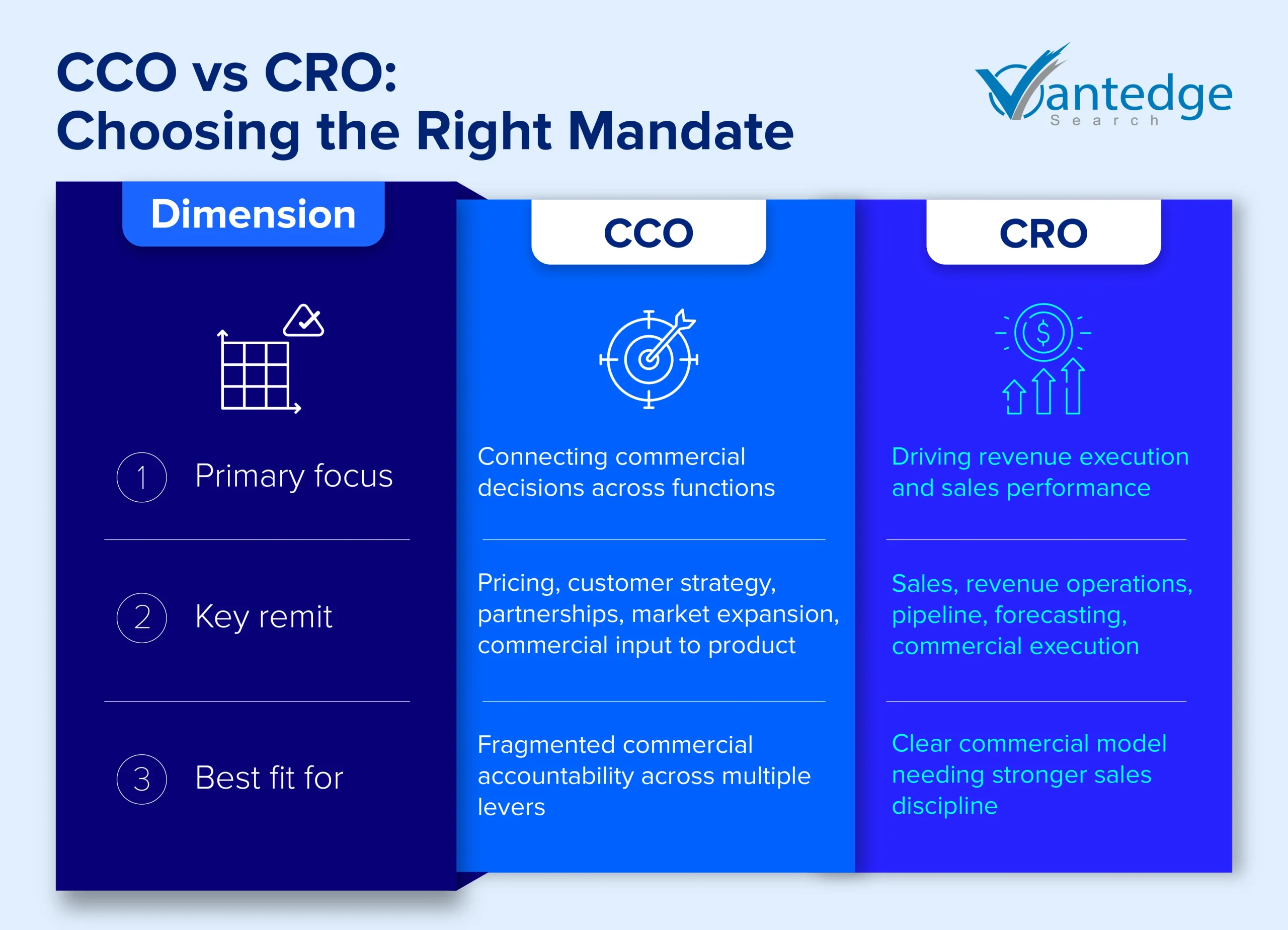
The discussion around chief commercial officer vs chief revenue officer often starts with job titles, but boards should begin with the company’s growth challenge. Both positions influence business performance, yet they are designed to address different commercial priorities. Defining the wrong role can result in hiring an executive whose strengths do not match what the business actually needs.
A Chief Revenue Officer Focuses on Revenue Execution
A chief revenue officer is primarily responsible for improving how revenue is generated. The role typically oversees sales performance, revenue operations, forecasting, pipeline management, and commercial execution. Companies often appoint a CRO when they have a proven commercial model but need stronger sales discipline, better forecasting, or greater consistency in revenue delivery.
A Chief Commercial Officer Connects the Entire Commercial Strategy
The chief commercial officer role has a broader commercial mandate. While sales remains an important responsibility, the role also brings together pricing, customer strategy, partnerships, channel development, market expansion, and, in some organizations, commercial input into product decisions.
The objective is to improve how different commercial functions work together so that growth decisions support one another instead of operating independently. These broader chief commercial officer responsibilities have become increasingly relevant as customer journeys and go-to-market models have grown more complex.
The Right Choice Depends on the Company's Commercial Priorities
The difference between chief commercial officer and chief revenue officer is ultimately determined by the company’s biggest growth constraint. If the priority is improving sales execution and revenue performance, a CRO may be the better fit. If commercial decisions across pricing, partnerships, customer strategy, and market expansion require stronger alignment, the chief commercial officer role is often more appropriate.
In some organizations, both roles can coexist successfully. However, boards should clearly define decision-making authority before beginning commercial executive recruitment. Clear accountability helps prevent overlapping responsibilities and gives each executive the authority to deliver against their mandate.
The Evolution of the Chief Commercial Officer: From Sales Leader to Enterprise Strategist
The CCO role was once commonly associated with leading sales and business development. Its scope has broadened because commercial performance increasingly depends on decisions that cross functional boundaries.
The modern remit may include pricing direction, channel strategy, strategic partnerships, customer retention and expansion, market-entry planning, and commercial input into product decisions. The role can also become important after an acquisition, when customer coverage, accounts, offers, and routes to market must be aligned.
This does not mean that the CCO should control every commercial team or decision. It means the role needs authority to resolve decisions with shared consequences. Pricing affects margin and sales execution. Product decisions affect customer value. Partner agreements affect market access. Customer success affects renewal and expansion potential.
The evolution is visible even in research focused on sales leaders. Gartner’s 2025 Leadership Vision for Chief Sales Officers identifies three priorities: leading a unified commercial strategy, creating an adaptable sales organization, and radically simplifying seller roles.
If CSOs are being pushed toward commercial unification, the case for a CCO is stronger still. For companies appointing a CCO, the mandate should therefore be defined by the commercial decisions the executive must bring together, rather than by a broad list of functions they are expected to oversee.
What Boards Look for When Hiring a Chief Commercial Officer
When boards assess a CCO candidate, the focus should extend beyond a track record of revenue growth. They need to understand how that growth was created, and whether the approach transfers to the company’s specific commercial complexity.
Several capabilities are particularly relevant in 2026. One is experience in commercial transformation: can the leader improve how the growth engine is organized, not only push it harder? Another is pricing judgment: can the candidate protect margin while supporting scale? International experience is also important, given the need to adapt commercial strategy to different markets.
Gartner lists market expansion, routes to market, and M&A integration as key strategic gaps tech CEOs address through deal activity, highlighting the need for executives who can integrate and align commercial teams after acquisitions.
A strong CCO candidate should demonstrate:
- Capability in commercial transformation beyond sales process redesign.
- Evidence of pricing discipline that supports both growth and profitability.
- Success in leading commercial strategy in multiple markets or regions.
- Use of data and commercial insight without reducing the role to dashboard management.
- Experience working across product, marketing, finance, and operations, not only within sales.
- A record of integrating commercial teams following mergers or acquisitions.
- A customer-centric approach that connects growth strategy to real buying behavior.
What boards look for in a CCO candidate is therefore not a generic commercial leader. It is a leader whose commercial experience matches the company’s current constraints and growth model.
What Recent CCO Appointments Signal
Recent chief commercial officer appointments suggest that boards are defining the role more broadly than commercial sales leadership alone. While every organization has its own priorities, many appointments point to the same underlying objective: bringing greater coordination to customer strategy, commercial execution, and long-term growth.
DHL Global Forwarding
In May 2025, DHL Global Forwarding named Amanda Rasmussen as Chief Commercial Officer, reporting to the CEO of DHL Global Forwarding, Freight. The company pointed to her background across commercial leadership, operations, and general management, along with experience spanning the United States, Asia, and Europe. DHL tied the appointment to strengthening its customer value proposition amid a more complex trade and tariff environment.
The mandate places commercial leadership at the intersection of customer value, global operations, and market complexity. In logistics, the commercial proposition depends on coordinating capacity, digital tools, customs support, and network reach around what customers actually need, not just on selling more volume.
Dexcom
Dexcom made a comparable move in March 2025, appointing Jon Coleman as Chief Commercial Officer. Coleman took charge of the company’s global commercial organization, spanning global sales, marketing, and customer experience. Dexcom pointed to his experience across healthcare segments, channels, regions, market entry, product development, and operational scaling.
The scope reflects how a CCO can connect customer experience with sales and marketing execution across multiple markets. For a company operating in numerous geographies and channels, an inconsistent customer experience can limit growth even when individual functions are hitting their targets.
Together, the two appointments point to a common pattern: companies are increasingly defining the CCO mandate around coordinating customer strategy, commercial execution, and market complexity, rather than confining the role to sales performance.
This evolution mirrors how other C-suite roles are being redefined to meet new enterprise demands. (For a parallel look at how boards are reshaping executive mandates, read our blog: Redefining the Chief Information Officer Role: CIO Responsibilities, Priorities & Leadership in 2025.)
Conclusion: The CCO Role Is Expanding Because Growth Is More Connected
A business with a focused product line, a clear route to market, and a simple sales model may be well served by strong sales leadership and clearly defined functional accountability. In those settings, commercial decisions tend to be straightforward, and the CEO or a sales leader can manage the key trade-offs without creating a separate commercial executive role.
The case for a chief commercial officer strengthens when growth depends on multiple commercial levers working in sync: sales, pricing, customer strategy, partnerships, digital channels, product decisions, and market expansion. At that level of complexity, the issue is no longer the performance of a single team. It is the quality and consistency of decisions made across teams.
For boards and CEOs, the practical task is to locate where commercial accountability has become fragmented. If the CEO is repeatedly settling disputes over pricing, channel conflicts, customer ownership, investment priorities, or market entry, the organization likely lacks a single owner for decisions that carry enterprise-wide consequences.
The CCO role has emerged as one response to this reality. Its relevance depends on whether the company’s growth model has outgrown what sales leadership alone can manage.
If your growth model spans multiple channels, markets, and functions, connect with Vantedge Search for CCO and senior commercial leadership hiring that coordinates execution and strategy.
FAQs
A Chief Commercial Officer unites sales, marketing, partnerships, pricing, and customer strategy behind one growth plan. The role ensures commercial decisions across functions reinforce each other rather than operate in silos, connecting customer value to revenue execution and market expansion.
A CRO focuses on revenue execution—sales performance, pipeline, forecasting, and revenue accountability. A CCO has a broader mandate, connecting pricing, customer strategy, partnerships, channels, and market expansion to ensure commercial decisions support one another.
A company needs a CCO when growth is constrained by fragmented commercial decisions across functions. Common triggers include multiple routes to market, inconsistent pricing, siloed customer insights, or the CEO repeatedly resolving disputes over commercial priorities and customer ownership.
Growth has become more interconnected, requiring coordinated decisions across sales, pricing, customer strategy, digital channels, and partnerships. As B2B buyers expect consistent experiences across digital and sales-led interactions, companies need leaders who can align the entire commercial system.
Boards should seek candidates with experience in commercial transformation, pricing discipline, cross-functional leadership, and multi-market strategy. The right CCO demonstrates the ability to connect customer insight to commercial decisions and integrate teams following acquisitions or business-model changes.
Leave a Reply