


Insurance Executive Search for New Risk Arenas: Does the Leadership Team Have the Right Expertise
Table of Content
- New Insurance Growth Can Create a Knowledge Problem Before It Creates a Hiring Problem
- The Real Gap May Be Between Domain Knowledge and Insurance Judgment
- Five Risk Arenas That Could Expose the Leadership Gap
- How US Insurers Are Positioning Expertise Around New Risks
- Where Does the Missing Expertise Need Authority
- When Does the Capability Gap Become an Executive Search Mandate
- Conclusion: Define the Knowledge Requirement Before Defining the Candidate
- FAQs
Four Key Takeaways
- New insurance opportunities can expose capability gaps before they create a hiring need. The first task for boards and CEOs is to identify what the organization cannot yet judge with enough confidence.
- The missing capability may sit in insurance judgment, domain knowledge, or the connection between the two. Technical expertise only becomes useful when it can inform underwriting, claims, actuarial, product, and portfolio decisions.
- Cybersecurity, EVs and batteries, robotics, space, and biotechnology show why new risks do not create one standard leadership requirement. Each brings a different type of specialist knowledge into insurance decision-making.
- Executive search should follow a clear mandate. Insurers need to decide what expertise is missing, how much authority it requires, and if the gap calls for a new executive, specialist capability, business-line leadership, or external support.
New Insurance Growth Can Create a Knowledge Problem Before It Creates a Hiring Problem
As insurers consider growth in unfamiliar risk categories, the first question is not necessarily who they need to hire. It is what the organization already understands about the exposure it plans to take on, and where important knowledge may still be missing.
In its September 15, 2026 report, McKinsey identifies 18 high-growth arenas across AI foundation, digitization, electrification, hard tech, and new bio-frontiers. These arenas could create new insurance demand while changing risk exposures, claims economics, products, underwriting approaches, and the capabilities insurers require.
For insurance leadership, this creates a practical decision. Boards and chief executive officers need a clear view of the strength of existing underwriting, risk, actuarial, claims, and technical expertise against the exposures the business wants to pursue.
A new risk does not automatically require a new executive. Technical complexity does not automatically require C-suite authority. Unfamiliar exposure also does not automatically mean hiring outside insurance.
The capability gap should be defined first. From there, the organization can decide if the answer is a changed mandate, specialist expertise, or an insurance executive search.
The Real Gap May Be Between Domain Knowledge and Insurance Judgment
Executive recruitment discussions can quickly narrow into a choice between experienced insurance leaders and specialists from outside the sector. That can miss the real issue. The gap may sit in insurance judgment, in knowledge of the underlying risk, or in the connection between the two.
An insurance-judgment gap appears when the organization understands the technology or science involved but lacks sufficient capability to price, underwrite, aggregate, reinsure, or manage the exposure. A domain-knowledge gap appears when insurance risk management is strong, but leadership lacks enough technical understanding of the asset, technology, or failure mechanism involved.
In some cases, both forms of expertise already exist inside the organization but do not connect closely enough to support the same decisions.
A cybersecurity specialist may understand attack paths and control weaknesses, while an insurance leader understands portfolio exposure and aggregation. The challenge is connecting those perspectives, so technical evidence can inform appetite, terms, pricing, capacity, and claims decisions.
For an insurance executive search, the starting point should be the decisions that lack the knowledge required to support them, not the background a candidate is expected to have.
Clarify insurance leadership needs with Vantedge Search
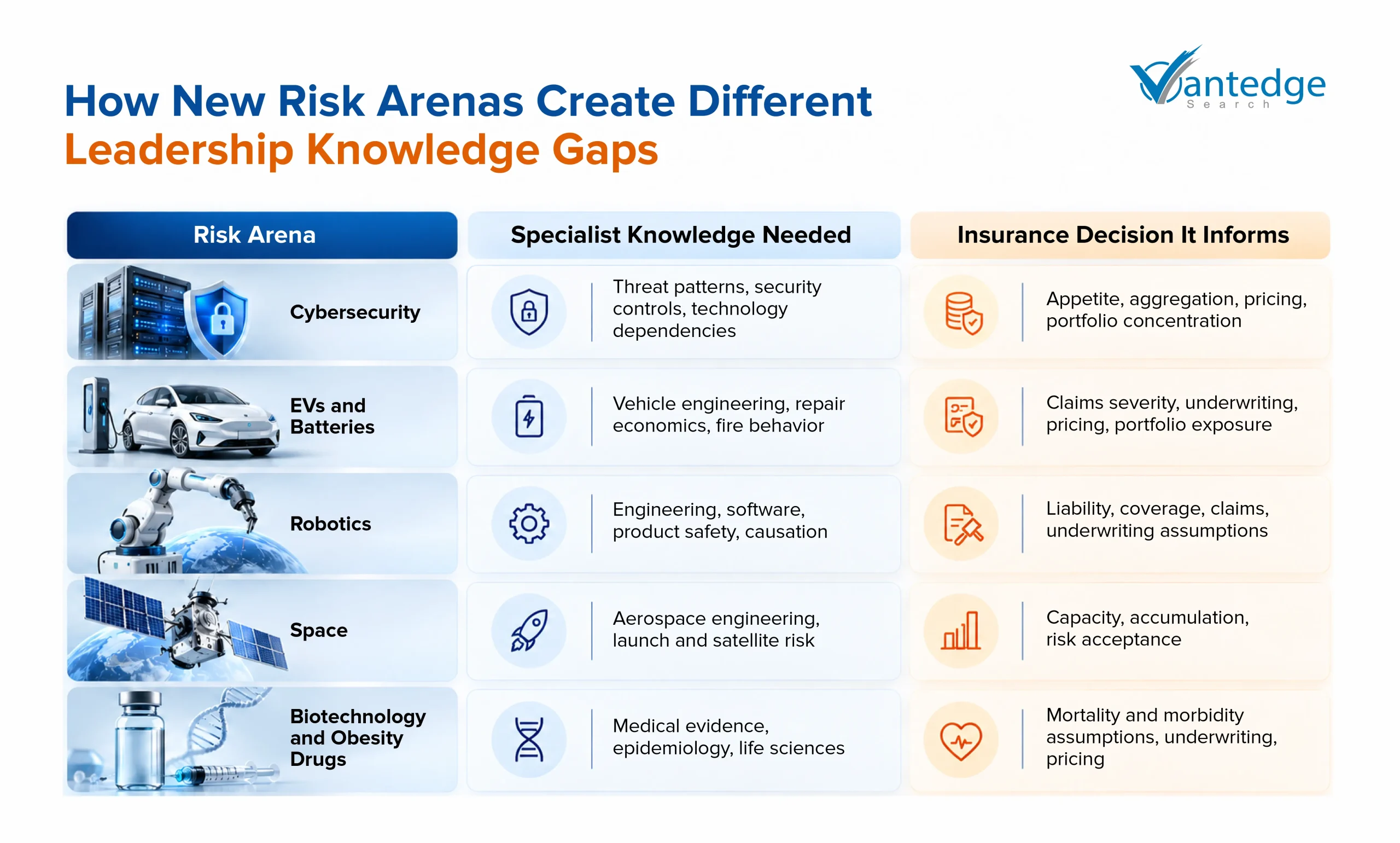
Five Risk Arenas That Could Expose the Leadership Gap
The leadership challenge becomes clearer when new risks test different parts of the insurance model. Some change faster than claims history can keep pace with. Some depend heavily on engineering or scientific evidence. Others make causation harder to assign, leave insurers with limited historical loss data, or affect assumptions that play out over decades.
For boards, CEOs, and insurance leadership teams, the question is how these differences change the knowledge required to make sound insurance decisions. This section focuses on five areas where that issue is especially visible across commercial P&C, personal P&C, and life insurance.
These areas were selected because they bring specialist knowledge into different parts of the decision process, from underwriting and claims to actuarial assumptions, product design, and portfolio exposure. Examining them side by side helps show where existing insurance judgment may be sufficient and where additional domain expertise may be needed.
1. Cybersecurity: Translating Threat Change Into Portfolio Exposure
Cyber risk can change faster than claims experience reflects it. McKinsey points to ransomware, AI-enabled attacks, identity theft, connected-device vulnerabilities, and systemic correlation as factors that can reshape exposure across a cyber portfolio.
For cyber insurance underwriting, historical loss data cannot provide the full picture on its own. Underwriters also need current insight into attack methods, security controls, technology dependencies, and concentration across insured organizations.
That creates a clear leadership question. Technical threat information has to reach decisions on appetite, limits, pricing, aggregation, and portfolio concentration before losses make the change obvious.
An insurer may already have experienced underwriters and strong cyber specialists. The weakness can arise in the connection between them, particularly when responsibility for turning threat intelligence into portfolio decisions is unclear.
2. EVs and Batteries: Translating Engineering Change Into Claims Economics
McKinsey reports that electric vehicles are contributing to higher auto claims severity. Battery damage can result in total-loss write-offs, repairs can cost 20 to 30% more than comparable internal-combustion vehicles, and thermal runaway can create fire propagation risk across auto and property lines.
These changes bring engineering knowledge much closer to claims and underwriting decisions. Insurers may need a clearer understanding of battery technology, vehicle design, repair economics, fire behavior, and the interaction between vehicle and property exposure.
For leadership teams, the challenge is keeping insurance assumptions aligned with changes in the asset itself. Strong auto insurance experience remains important, but it may not provide enough technical context to judge how new vehicle designs are affecting severity, repairability, pricing, and portfolio exposure. The capability gap can therefore emerge between engineering insight and the insurance decisions built around it.
3. Robotics: Translating Technical Causation into Liability Judgment
Autonomous systems are moving into warehouses, hospitals, and public spaces. McKinsey points to software failures, fleet interconnections, machine decision-making, and more difficult fault attribution as robots operate alongside people. It also notes a potential shift in exposure from workers’ compensation toward product liability.
These losses can bring several forms of expertise into the same assessment, including robotics engineering, software, product safety, cyber connectivity, claims, and liability. When an autonomous machine causes physical damage or bodily injury, the cause may sit in the mechanics, software, connectivity, product design, or machine behavior.
For insurers, the challenge is connecting that technical assessment with coverage, claims, and underwriting judgment. Robotics liability insurance can therefore require closer coordination between technical specialists and insurance teams when responsibility is not immediately clear from the loss event.
4. Space: Translating Specialist Engineering With Limited Loss History
Commercial satellites, launch operations, and other space assets combine high values with technically complex loss scenarios. McKinsey notes that space insurance requires specialist underwriting and engineering expertise because of high event severity, limited historical loss data, and accumulation risk. KPMG’s September 2026 Insurance Industry Conference also included a dedicated session on how space technologies are reshaping risk and capital in insurance.
For insurers, limited historical evidence places more weight on technical assessment. Engineering insight around launch failure, satellite malfunction, and in-orbit collision can become important to underwriting, capacity, accumulation, and risk acceptance decisions.
The leadership capability gap appears when technical expertise is available, but senior insurance leaders cannot readily translate that insight into decisions about exposure. In space insurance, the challenge is connecting engineering judgment with capacity, accumulation, and risk acceptance when past loss experience provides only limited guidance.
5. Biotechnology and Obesity Drugs: Translating Medical Evidence Into Insurance Assumptions
Advances in life sciences are challenging assumptions that have long supported life and disability insurance. McKinsey points to GLP-1 obesity drugs, genetic modification, and personalized medicine for their potential implications for mortality and morbidity assumptions.
For insurers, the difficulty lies in deciding when new medical evidence is strong enough to influence actuarial models, underwriting criteria, pricing, or long-duration product decisions. Clinical findings, population-health trends, and treatment outcomes may all matter, but they still need to be interpreted through an insurance lens.
The leadership capability gap can emerge when scientific knowledge sits outside the people responsible for those decisions. Medical specialists do not replace actuaries, but life insurance leaders may need stronger access to scientific judgment when treatment advances begin to challenge established assumptions about mortality and morbidity.
How US Insurers Are Positioning Expertise Around New Risks
Recent US appointments in cyber and aerospace show how differently insurers can position specialist expertise depending on the business they are building or managing. At Markel, the appointment concerns leadership of an established portfolio. At Novacore, the appointments accompany the launch of a new insurance segment. The distinction matters because the expertise is being asked to do different things in each business.
Markel: Connecting Cyber Expertise with Portfolio Decisions
On May 7, 2026, Markel appointed Raphael Da Costa to lead its U.S. cyber and tech E&O portfolio. His responsibilities include underwriting strategy, portfolio management, and product development, with the role working across underwriting, claims, and actuarial teams. Markel also cited his technical knowledge and market experience.
The significance lies in the scope of the role. Da Costa’s remit connects specialist cyber knowledge with responsibility for the decisions that shape an existing portfolio. His technical expertise forms part of a leadership mandate spanning underwriting strategy, product development, and portfolio management.
Novacore: Building Aerospace Capability with Specialist Insurance Leaders
On April 7, 2026, Pennsylvania-based Novacore launched an Aerospace segment and appointed Rob Schenone as Head of Space and Tom Callahan as Head of Aviation. Schenone brought more than 35 years of aviation and space insurance experience, including satellite and launch underwriting. Callahan also brought more than 35 years of aerospace underwriting experience.
Novacore’s situation was different. With a new segment being established, specialist knowledge was placed directly within the leadership of the new business. Schenone and Callahan brought decades of experience in the very risks the segment was created to underwrite. Their appointments illustrate that insurers entering technically demanding markets may find the combination of domain expertise and insurance judgment in executives whose careers have been built within specialist lines.
For boards and insurance leadership teams, the contrast is less about cyber versus aerospace than about the responsibility the expertise must carry. An established portfolio may need a leader whose specialist knowledge informs ongoing underwriting and portfolio decisions. A newly launched segment may need leaders whose experience can support the development of the business itself.
Neither appointment suggests that every emerging risk requires a new executive or that specialist talent must come from outside insurance. The more useful question is what decisions the business needs the expertise to support, and whether that calls for portfolio leadership, a new business mandate, or another form of specialist capability.
Where Does the Missing Expertise Need Authority
Finding the capability gap is only the first step. Boards and executive teams also need to decide how much authority that expertise should carry and which decisions it needs to shape.
A practical way to make that distinction is to look at four levels of responsibility.
Level 1: Enterprise executive authority
Enterprise-level ownership becomes relevant when the capability affects growth strategy, risk appetite, capital allocation, several insurance businesses, portfolio composition, or major product decisions. The case for senior authority comes from the breadth of responsibility, not from technical complexity alone.
Level 2: Business-line or functional leadership
Where the exposure sits mainly within one portfolio or business unit, the capability may belong with a business-line or functional leader. That role can still carry direct responsibility for underwriting, product, claims, or portfolio decisions without extending to enterprise-wide authority.
Level 3: Embedded specialist capability
Deep technical knowledge does not always need executive ownership. Engineers, cybersecurity specialists, life-sciences experts, or other technical professionals can support insurance teams directly while an existing leader retains responsibility for the final decision.
Level 4: External or advisory access
External expertise can make sense when the need is intermittent, the exposure is still developing, or the knowledge is highly specialized. This gives the insurer access to technical judgment without creating a permanent role before the business case is clear.
The final distinction is between where the capability sits and where the talent comes from. An insurer may bring in technical expertise from an adjacent sector without creating a new executive post. Equally, an executive appointment may be filled by someone whose insurance background already includes the required domain knowledge.
When Does the Capability Gap Become an Executive Search Mandate
Finding a knowledge gap does not necessarily mean the insurer needs another executive. The case for an insurance executive search becomes stronger when the missing capability carries continuing responsibility for decisions that matter to the company’s strategy, portfolio, or risk position.
Boards and executive hiring committees can look at six factors before turning that need into a search mandate.
- Strategic materiality: The risk category should have a clear place in the insurer’s growth or portfolio strategy. Market attention alone is not enough reason to create an executive role.
- Decision ownership: The mandate needs defined accountability. If the role will influence underwriting, portfolio exposure, product direction, or capital decisions, that responsibility should be clear before candidate evaluation begins.
- Permanence: Some technical needs arise periodically and can be supported through specialist expertise. A permanent leadership role makes more sense when the capability is required on an ongoing basis.
- Organizational scope: A gap confined to one portfolio may call for business-line leadership. A requirement cutting across several businesses or enterprise decisions can justify broader authority.
- Existing leadership capacity: A new appointment is not the only option. An existing executive may be able to take on the responsibility if the mandate and supporting expertise can be extended credibly.
- Candidate market: Only after the role is defined should the organization decide how far the search needs to reach. Relevant expertise may already exist within specialist insurance talent, or the mandate may require candidates from adjacent sectors.
This sequence gives insurance executive recruiters a clearer basis for assessing the market. The search begins with the responsibility the business needs filled, rather than using candidate profiles to work out what the role should become.
(Defining the capability requirement is only one part of the hiring decision. Once a search begins, insurers may still face challenges around candidate availability, changing role expectations, and specialist skill requirements. Vantedge Search discusses these issues further in Challenges in Insurance Executive Recruitment and Strategies to Overcome Them.)
Conclusion: Define the Knowledge Requirement Before Defining the Candidate
As insurers move into less familiar risk categories, the hiring question should come after the capability question. Boards and senior leaders need a clear view of what the organization already understands, where important knowledge is missing, and which decisions depend on that expertise.
The answer may be a broader executive mandate, stronger specialist capability, business-line leadership, external expertise, or an insurance executive search. The right response depends on the gap the business is trying to close.
Before defining the candidate, leadership first needs to define the knowledge the insurer will need to make sound decisions as its risk exposure changes.
If new risk exposure is changing the leadership capabilities your business requires, partner with Vantedge Search to assess the mandate and identify executives with the right insurance and domain experience.
FAQs
An insurance executive search is a structured process for identifying and assessing senior leaders whose experience, decision authority, and technical knowledge match a defined leadership mandate within an insurance business.
An insurer should start a search after defining the capability gap, the decisions the role must own, the authority required, and whether existing leadership or specialist expertise can address the need.
Insurance executive recruiters assess candidates against sector-specific requirements such as underwriting authority, portfolio judgment, risk appetite, claims exposure, regulatory context, and the technical knowledge required for the role.
Cybersecurity, EVs and batteries, robotics, space, and biotechnology are among the risks creating new demands around technical interpretation, underwriting judgment, claims analysis, actuarial assumptions, and portfolio decision-making.
No. Some risks may require stronger business-line leadership, embedded specialists, or external expertise instead. A C-suite role is more appropriate when the capability affects enterprise strategy, capital, or risk appetite.
Leave a Reply