


Should the CFO Become the Enterprise’s Chief Performance Officer?
Table of Content
- Introduction: The CFO Is Moving Closer to Performance
- From Measuring Performance to Influencing Decisions
- Five Tests Before Expanding the CFO’s Performance Mandate
- Three Organizational Models the Five Tests Can Point To
- What the Chosen Model Changes in CFO Search and Assessment
- How US Companies Are Drawing the Performance Boundary
- CoStar Group: Extending the CFO Mandate into Performance
- Conclusion: The Right CFO Mandate Is Not the Broadest One
- FAQs
Four Key Takeaways
- A broader CFO mandate is justified only when Finance can see performance drivers early, influence the relevant resource decisions, and act within clearly defined authority.
- Performance ownership should remain separate from performance influence. The CFO may challenge assumptions, capital choices, and forecasts while operating leaders remain accountable for the actions that deliver results.
- Companies can place performance responsibility in different ways: within the CFO role, across a CFO and COO partnership, or in a separate chief performance officer mandate. The right model depends on where the performance problem actually sits.
- CFO search should begin only after the mandate is defined. Boards need evidence that candidates have operated with comparable decision rights, cross-functional influence, and accountability, rather than relying on broad claims of strategic or performance leadership.
Introduction: The CFO Is Moving Closer to Performance
As CFOs become more involved in shaping investment priorities, interpreting business performance, and challenging decisions across the enterprise, an important question is emerging: how much responsibility for business performance should follow that influence?
Finance may have a clearer view of where results are falling short and which choices need reconsideration, but the authority to change those outcomes often remains with the executives running the business. Where, then, should companies draw the boundary between guiding performance and being accountable for it?
That question is moving closer to the board agenda as Finance takes on a wider part in enterprise decisions. Deloitte’s September 2026 Finance Trends research, based on 1,434 finance leaders across 26 countries, shows Finance taking a greater part in strategy, investment decisions, and value measurement. BCG’s August 2026 research describes a similar shift from producing reports toward interpreting performance and advising the business. It also argues that the CFO could become the “chief performance officer.”
But wider influence does not automatically justify wider operating ownership. A CFO may challenge investment choices, shape resource allocation, and interpret business performance while the COO and business leaders remain responsible for execution.
Boards considering a broader CFO role in enterprise performance management need to be precise about the authority involved. The key issue is which decisions Finance should influence, which outcomes should remain with operating leaders, and how far CFO responsibilities should extend before accountability starts to blur.
From Measuring Performance to Influencing Decisions
Finance has always had a central role in telling management how the business performed. A wider CFO mandate changes what happens after the numbers are reported. The finance team is expected to connect results with their underlying causes and bring that analysis into decisions on spending, investment, and priorities.
Measuring
Reporting, forecasting, variance analysis, and performance measures establish the financial position of the business. They provide the common evidence used in business performance management, but they do not by themselves determine what management should do next.
Interpreting
The CFO becomes more involved when Finance connects an outcome with the factors producing it. A margin decline could come from pricing, sales mix, input costs, capacity, or productivity. BCG reported in August 2026 that Finance teams are moving from producing reports toward interpreting performance and advising the business.
Interpretation gives management a clearer view of where attention is required. It does not transfer responsibility for those underlying business drivers to Finance.
Influencing
Finance can then bring that evidence into decisions. The CFO may challenge an investment case, question a forecast, or recommend moving resources when expected returns change. McKinsey’s May 2026 budgeting research similarly describes CFO decision making that links resource allocation more closely with strategic priorities and changing performance signals.
If margins fall because of weak pricing and higher production costs, Finance can identify the financial effect and test the assumptions behind the plan. The commercial leader still controls pricing decisions, while operations remains accountable for production performance. The CFO may influence where capital or spending moves, and the CEO can resolve trade-offs that cross executive mandates.
Corporate performance management therefore depends on clear decision rights. Finance can have greater influence without making the CFO accountable for every action required to improve the result.
Define CFO performance decision rights with Vantedge Search
Five Tests Before Expanding the CFO's Performance Mandate
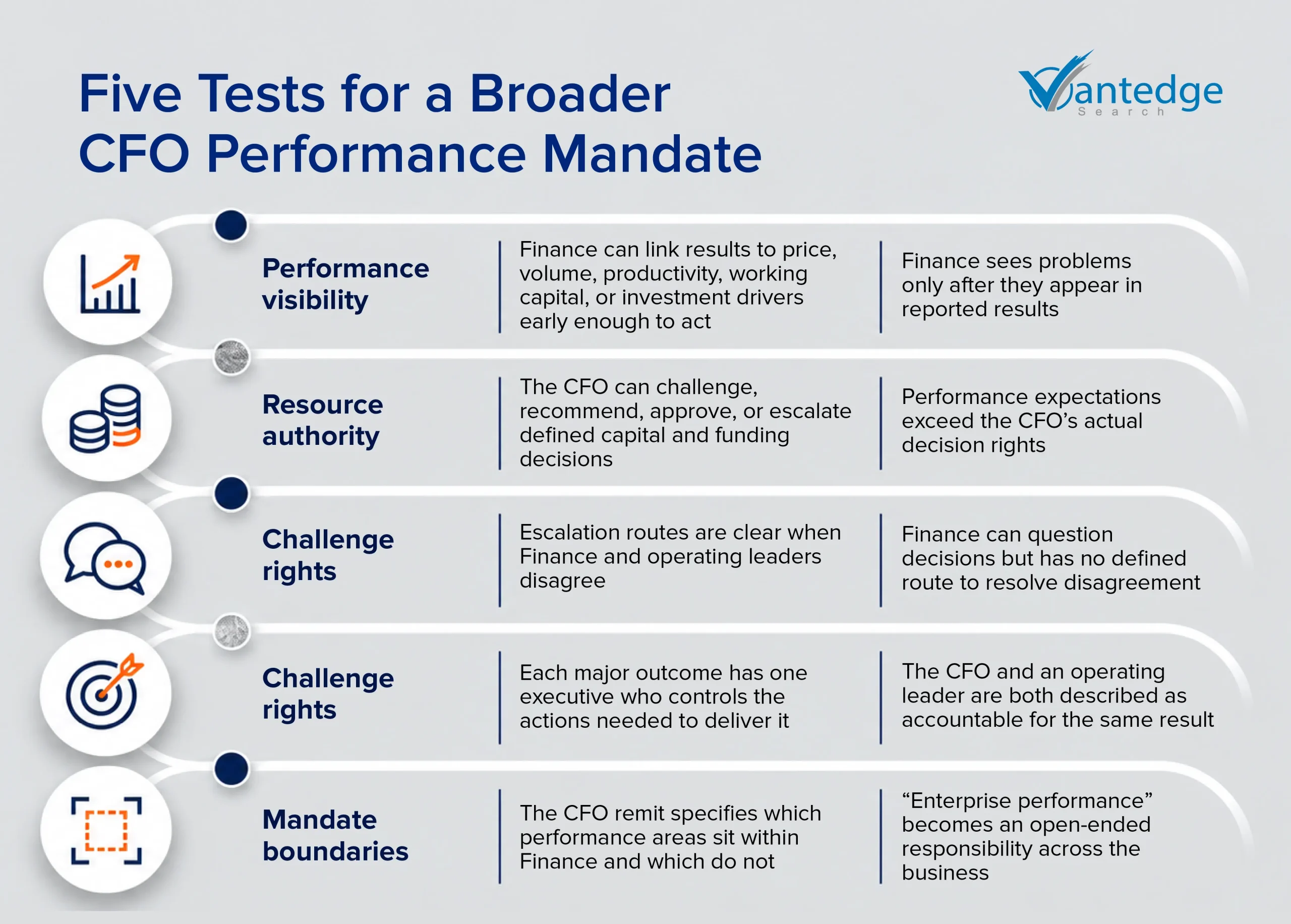
Expanding CFO responsibilities requires more than adding “enterprise performance” to the job description. The board needs to know whether Finance has the information, authority, and organizational position to influence performance without weakening accountability elsewhere. Five tests can help establish whether a broader mandate is workable.
1. Can Finance See the Drivers Early Enough to Influence the Outcome?
Financial reporting confirms that performance has changed. A broader CFO role requires Finance to see the factors producing that change before management has lost valuable response time.
Those factors will vary by business. They may include price, volume, customer mix, capacity, productivity, working capital, headcount, or returns on major investments. Finance does not need to control each driver, but it needs enough visibility to connect them with financial outcomes.
If Finance learns about a commercial or operating problem only after it appears in reported results, assigning wider accountability to the CFO changes the title more than the company’s ability to act.
2. What Resource Decisions Can the CFO Actually Influence?
Performance responsibility has limited value when the executive cannot affect the resources behind the result.
A board should distinguish between the CFO’s authority to recommend a reallocation, challenge an investment case, approve funding within agreed limits, or escalate an investment that is failing to meet expectations.
Deloitte’s September 2026 Finance Trends research found that 33% of finance leaders identified capital allocation and investment decisions as a priority through fiscal 2027, while 32% cited strengthening Finance’s strategic influence across the enterprise.
For a broader CFO role in strategy and performance to carry weight, expected influence needs corresponding decision rights.
3. Are the CFO's Challenge and Escalation Rights Explicit?
Finance may question forecasts, business assumptions, investment cases, resource requests, or expected returns without owning the activity being challenged.
The harder point is what happens when the CFO and an operating executive disagree. Who has the final decision? When does the issue move to the CEO? Which matters require board attention?
Clear challenge and escalation rights allow CFO decision-making to affect important choices without turning Finance into a parallel operating function.
4. Does Every Major Performance Outcome Retain an Operating Owner?
A wider CFO mandate should make accountability clearer, not divide it.
Pricing may sit with a commercial leader. Production efficiency may belong to operations. Customer retention may sit with a business-unit leader. Those executives control many of the actions that determine the result.
If the CFO is also described as accountable for the same outcome, responsibility can become difficult to trace when performance misses expectations.
Enterprise performance management therefore needs a named operating owner for each material result, even when Finance measures, questions, or influences the response.
5. Can the Additional Mandate Be Bounded Without Weakening Core CFO Responsibilities?
The phrase “enterprise performance” can quickly cover growth, margin, productivity, investment returns, customer outcomes, and workforce performance.
Boards need to define which of these areas belong within the CFO’s remit and which remain with other executives. They also need to consider what the broader mandate does to existing CFO responsibilities around financial integrity, reporting, liquidity, capital, and risk.
A chief performance officer mandate is useful only when its boundaries are clear enough to govern. Otherwise, the organization may create a wider title without resolving who has authority over the decisions that actually produce performance.
Three Organizational Models the Five Tests Can Point To
The five tests can lead to different structures because performance problems do not arise from the same source. The right model depends on whether the main constraint sits in financial choices, operating execution, or coordination across several functions. The structure should reflect where authority is needed, not simply which executive already has the broadest enterprise view.
Model 1: CFO-Led Performance Steering
This model fits when performance gaps are closely tied to capital allocation, investment discipline, portfolio choices, forecasting, or financial trade-offs.
The CFO can lead performance reviews, test whether resources still support the right priorities, and challenge investments that are no longer delivering the expected return. The CFO role in strategy becomes more direct because Finance is influencing where capital and management attention should move.
Operating accountability does not shift with it. Business leaders still own the commercial and operating actions required to improve the result.
The defining feature of this model is that the main performance problem can be addressed through stronger financial steering without moving operating authority into Finance.
Model 2: CFO and COO Partnership
This structure fits when the performance problem cannot be corrected through financial decisions alone.
The CFO may lead on economics, forecasts, capital, and resource choices. The COO may own productivity, operating processes, coordination, and execution. Business leaders remain responsible for results within their areas.
The value of this model lies in separating two forms of authority that need to work together. Finance can identify where resources or assumptions need to change, while Operations controls the actions required to improve delivery.
The CFO and COO roles must therefore be explicit where investment decisions, operating priorities, and performance targets meet. Otherwise, CFO vs COO accountability can become unclear when results fall short.
Model 3: Separate Enterprise Performance Mandate
A separate chief performance officer role may make sense when performance coordination spans Finance, Operations, and several business functions, and no existing executive can reasonably coordinate that work within the current remit.
The role should have a distinct purpose, such as coordinating enterprise performance reviews, tracking cross-functional commitments, or bringing together decisions that sit across several executive mandates.
It should not become a catch-all role for unresolved accountability.
A separate mandate is justified only when there is a real coordination gap that neither the CFO nor COO can reasonably own.
The organizational issue should determine the model. The title should come only after the authority, responsibilities, and decision rights are clear.
What the Chosen Model Changes in CFO Search and Assessment
Executive search committees often stumble by hunting for a strategic finance leader before deciding what that person will actually control. Asking candidates for performance leadership without defining decision rights leads to bad hiring calls. The operating model chosen by the board must dictate the exact evidence candidates present during assessment.
When the board chooses CFO-led performance steering, the interview panel must verify previous authority over capital allocation. The candidate should demonstrate a track record of cutting funding from lagging projects, restructuring operating budgets, and leading monthly business reviews that connected business-unit performance, such as revenue, margins, costs, and capital use, with their impact on enterprise-level returns.
If the mandate relies on a CFO and COO partnership, assessment shifts toward shared governance and influence. Committees should test how the candidate handled professional friction with operational peers. The candidate must show proof of challenging aggressive sales forecasts, resolving budget disputes, and guiding commercial terms without overstepping into shop-floor management.
Where enterprise performance rests with a dedicated unit or the CEO, search committees should resist widening the CFO profile. The business instead needs proven balance sheet discipline, debt management, and reliable financial control, not an executive looking to run commercial operations.
Boards must define the mandate before evaluating candidate backgrounds. Without clarity on CFO decision making, hiring committees risk selecting an executive whose past authority does not match the company’s real expectations.
How US Companies Are Drawing the Performance Boundary
The question of who should own enterprise performance becomes more consequential when it moves from a boardroom discussion into an executive mandate. Financial performance is shaped by decisions across the business, yet the authority to interpret results, allocate resources, and act on operating priorities does not necessarily sit with the same executive. Expanding the CFO’s remit can connect Finance more closely with performance decisions, but it also raises a question about where oversight ends and operating accountability begins.
Two US leadership appointments in 2026 illustrate different approaches to this boundary. CoStar Group has explicitly included financial and operational performance oversight in its CFO mandate. Discovery Senior Living has established a separate Chief Performance Officer function. The significance lies less in the titles themselves than in the responsibilities each company has chosen to assign.
CoStar Group: Extending the CFO Mandate into Performance
On July 13, 2026, CoStar Group appointed Robin Rossmann as CFO, effective July 31. His responsibilities include oversight of financial and operational performance, capital allocation, financial planning, and investor engagement. The company also highlighted his experience leading its European business, where he improved margins while delivering double-digit revenue growth.
The combination of responsibilities is important. Operational performance oversight sits alongside capital allocation and financial planning within the same executive remit. Rossmann’s prior business leadership experience also brings a record of financial and operating responsibility into the CFO role.
This does not, by itself, establish that operating execution has transferred to the CFO. The announced scope supports a narrower but meaningful conclusion: CoStar has made broader performance oversight an explicit part of the CFO’s responsibilities. Finance therefore has a wider performance remit without the announcement redefining who owns each underlying operating decision.
Discovery Senior Living: Giving Performance a Separate Executive Mandate
Discovery Senior Living illustrates a different organizational choice. On March 24, 2026, the company announced a Chief Performance Officer role and functional group led by former CFO Tom Costello, following the appointment of a separate CFO. Discovery’s leadership page also confirms that Costello previously served as CFO.
The new function covers asset-specific operating models, capital efficiency, margin durability, expense calibration, revenue stability, and performance intelligence across the portfolio. These responsibilities connect financial outcomes with the operating conditions that produce them. Discovery assigned that work to a dedicated executive function rather than describing it as part of the CFO mandate.
Costello’s move is relevant because it shows one company placing a former finance leader in a dedicated performance role while maintaining separate Finance leadership. The distinction is organizational rather than simply professional: performance responsibility has been given its own executive mandate.
Taken together, the appointments show why broader CFO influence does not lead to one organizational answer. CoStar has widened the performance oversight attached to its CFO role. Discovery has created a separate function spanning financial and operating performance.
Neither announcement establishes that one structure is more effective than the other. What they make visible is the decision boards need to resolve before defining or recruiting for a broader CFO mandate: which performance decisions need financial influence, which need dedicated coordination, and which should remain accountable to the executives who control execution? The authority attached to the role should follow that allocation of responsibility.
(Boards defining a wider CFO mandate also need clarity on the financial decisions, controls, and governance expectations that remain central to the role. Read our blog: 2026 Financial Governance: 5 Questions Boards Should Ask Their CFO, that examines the questions boards can use to assess those responsibilities before expanding the CFO’s remit further.)
Conclusion: The Right CFO Mandate Is Not the Broadest One
A wider CFO role can make sense when Finance has the visibility, authority, and decision rights to influence performance. It becomes less effective when responsibility expands faster than the CFO’s ability to affect the underlying outcome.
Boards therefore need to define the performance problem first, identify which decisions require stronger ownership, and decide where operating accountability should remain. Only then should they determine whether that authority belongs within Finance, alongside the COO, or in a separate performance mandate.
The strongest CFO mandate is not the one with the most responsibilities. It is the one where authority, accountability, and candidate evidence match what the company expects the CFO to influence.
If your CFO mandate is expanding into enterprise performance, Vantedge Search can help define the leadership requirement and assess executives against the scope of the role.
FAQs
A chief performance officer coordinates how an organization tracks, interprets, and improves performance across functions. The role may connect financial results, operating priorities, resource decisions, and accountability without replacing the executives responsible for delivery.
There is no universal answer. A broader CFO performance mandate may make sense when Finance has the visibility, authority, and decision rights to influence enterprise outcomes. In other organizations, a CFO–COO partnership or a separate performance function may be more appropriate. The decision depends on where performance challenges arise, who controls the actions needed to address them, and how accountability can remain clear.
The CFO helps interpret enterprise results, challenge assumptions, guide capital allocation, and influence resource decisions. The role can support enterprise performance management while operating leaders remain accountable for the commercial and operational actions they control.
The CFO typically leads financial stewardship, capital allocation, reporting, and economic decision support. The COO usually leads operating execution, productivity, processes, and coordination. Their responsibilities can intersect, but accountability should remain clearly defined.
Main CFO responsibilities include financial reporting, capital allocation, liquidity, risk oversight, planning, forecasting, investor communication, and financial decision support. In some companies, the role also includes broader responsibility for performance interpretation and enterprise resource choices.
Leave a Reply