


When the Executive Experience You Need Was Built Somewhere Else
Three Key Takeaways
- Look beyond capability: The experience that matters may be what an executive has already had to make work in another environment.
- Hire for where the business is going: The strongest fit may come from someone who has already faced the complexity your company is approaching.
- Test what will actually travel: Separate the executive’s judgment and experience from the advantages of the organization they are leaving behind.
Promoting from within gives a company something valuable: leaders who know how the place works. Sometimes, that is also the limitation. The experience around the leadership table has been shaped by many of the same decisions, assumptions and ways of working. An external executive arrives with a different reference point: what they have seen work somewhere else, under pressures this business may never have faced. At certain moments, that difference may be the experience worth hiring for.
When the Experience Isn’t in the Building
Companies spend years building their leadership bench. They should. But there is a limit to what even a strong internal pipeline can produce: you cannot give someone ten years of experience your company has never offered them. If the business has never scaled a particular model, connected certain capabilities or operated under a particular kind of pressure, its people could hardly have learned those lessons there.
That matters when the company is heading somewhere it has not been before. The obvious instinct is to ask whether someone inside can grow into what is needed. Sometimes they can. Sometimes the clock and the learning curve simply do not agree. An executive coming from another operating environment brings mistakes already made, patterns already recognized and judgment earned when the answer was not obvious. You are not skipping the learning. You are hiring someone who has already paid for some of it.
Of course, experience does not arrive with a universal adaptor. What worked brilliantly somewhere else can fail spectacularly when the conditions change. Which makes the real question for the C-suite more demanding than “Do we have this capability?” It is: “Do we have anyone who has actually had to use it where the stakes were real?”
What to Look for When Experience Comes From Elsewhere
Going outside is only the first decision. The harder one is knowing what you are actually bringing in, why it matters now, and how much of it can survive the move from one organization to another. Recent executive appointments offer four different ways to think about that choice—and a fifth question that sits behind all of them.
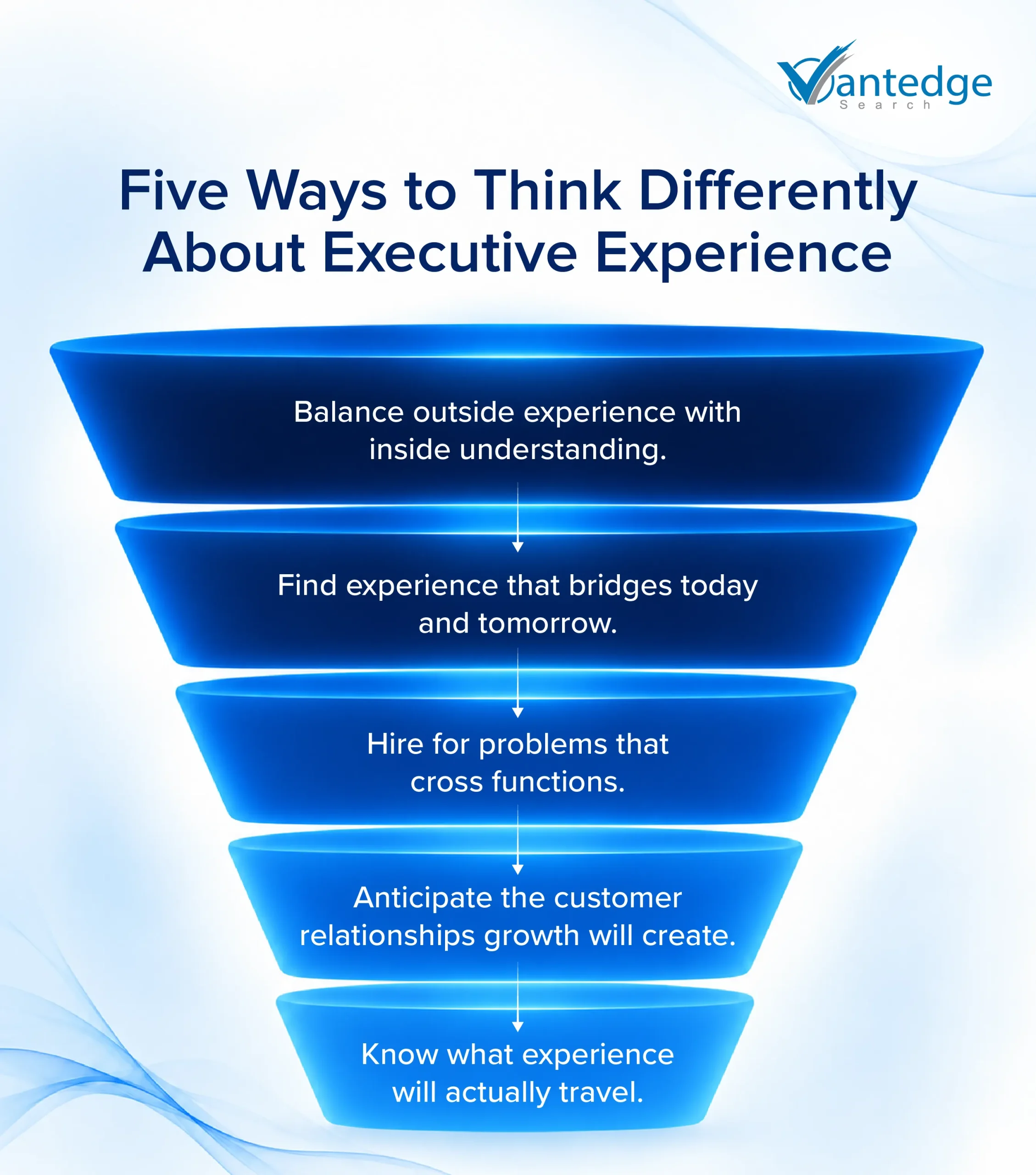
1. Ask How “Outside” Your Outside Hire Really Needs to Be
Robert Mills came to the B&G Foods CEO role with an unusual advantage. His operating experience had been built elsewhere, most recently across strategy, business operations, digital commerce, technology, AI and M&A at Tractor Supply, with direct P&L accountability. But B&G itself was hardly new territory. Mills had served on its board since 2018, giving him, as the company noted, a deep understanding of its business, brands, people, challenges and opportunities. His appointment also comes at a consequential point for B&G: the company is focused on reshaping its portfolio, improving margins and cash flow, reducing debt and leverage, strengthening performance and positioning itself for sustainable long-term growth. Mills, for his part, has identified execution, operating discipline and accelerating growth as his immediate priorities, and has spoken of using digital, data, technology and AI alongside portfolio management and capital allocation to strengthen business performance.
That combination is worth noticing because external hiring usually comes with a trade-off. The company reaches outside because it wants experience its own environment has not produced, then spends precious time helping the person carrying that experience understand the environment they have just entered. Mills presents a different version of the equation: the operating experience came from elsewhere; much of the context did not have to be learned from scratch. For a business pursuing portfolio change, stronger performance and growth, that distinction could matter. The value of outside experience is not simply that it is different. It is how quickly the executive can work out where that difference belongs—and where it does not.
Perhaps that gives boards another way to think about the familiar internal-versus-external choice. How much unfamiliarity are you actually trying to buy? Where would prior knowledge of the company allow an external executive to move faster without dulling the value of what they learned elsewhere? And when you look beyond the business for experience you do not have, who already understands enough about the business to know which parts of that experience will fit? The strongest outside perspective may not always come from a stranger.
2. Look for Someone Who Has Already Lived Both Sides of the Business
Michael Whitehead joins Matthews International as President and CEO from Lincoln Electric, moving between two companies with industrial technology at their core but distinctly different business profiles. At Lincoln Electric, his recent operating experience was concentrated in welding, automation and advanced manufacturing: he most recently led Americas Welding, its largest and most profitable business at more than $2.5 billion in annual revenue, and earlier led Global Automation, Cutting & Additive Solutions, which more than doubled to over $1 billion under his leadership. Matthews operates across two notably different core businesses, Industrial Technologies and Memorialization, as it enters what the company describes as its next phase of evolution, innovation and value creation. The move is not a leap across industries. It is a move between different versions of industrial business.
Find the experience you need with Vantedge Search.
The interesting part is not simply that Whitehead has run large industrial businesses or understands advanced technology. He has operated on both sides of a tension that many established companies know well: making the core perform while helping something newer become consequential. Those require different instincts. One rewards consistency, operating discipline and attention to what already works. The other asks for investment before every answer is known, patience with a different growth curve and judgment about when an emerging business deserves more of the organization’s weight. Having done one does not automatically prepare an executive for the other. Having been accountable for both may create a different kind of judgment.
That suggests a sharper question when a company is hiring for its next chapter. Is the challenge really to find someone who understands the business you have—or someone who has already managed the tension between that business and the one you are trying to build? Where will the next CEO be asked to protect value and disrupt it at the same time? And has the candidate ever had to decide, with real money and performance on the line, when tomorrow’s opportunity deserves resources that today’s business could still use?
Sometimes the experience worth going outside for is not experience of the destination. It is experience of managing the journey without neglecting what is paying for it.
3. Hire for the Problem, Not the Function
Target’s first Chief AI Officer, Chandhu Nair, is joining from Lowe’s, another large retailer. So the distance here is not industry. It is in the shape of the experience he brings. Nair’s most recent role at Lowe’s spanned stores, data, AI and innovation, after more than six years with the company. At Target, his remit is to bring greater focus and coordination to AI across the enterprise, while the company is deliberately drawing AI and user experience closer together. The appointment comes as Target pursues a multiyear turnaround aimed at reviving growth, modernizing customer experience and sharpening its brand identity.
That makes the appointment interesting for a reason that goes beyond AI. Companies still tend to organize senior roles around functions because functions give expertise a home. But some of the problems now arriving at the leadership table do not belong comfortably to any one of them. AI is a particularly visible example. Its value may depend on technology, data, operations, customer experience, product and the people doing the work, all moving together. The capability may have a name. The business problem rarely stays inside it.
That should change what the C-suite looks for in an executive brought in to lead an emerging capability. Deep expertise still matters, but so does evidence that the person has already worked where the boundaries became inconvenient. Where does this role need influence without ownership? Which outcomes will depend on functions the executive does not control? And are you hiring someone to lead a capability—or someone who already knows how to make that capability matter to the rest of the business?
Sometimes, the hardest part may not be knowing AI. It may be knowing how to make AI matter everywhere else.
4. Hire for the Customer Relationship You Are Becoming
Nvidia has appointed Nick Parker as Executive Vice President of Worldwide Field Operations, putting him in charge of global sales and customer relationships and reporting directly to CEO Jensen Huang. He joins from Microsoft after 26 years spanning OEM, device, partner and commercial sales roles, most recently leading its worldwide commercial sales business. Parker is not arriving to build Nvidia’s sales operation from scratch. He succeeds Jay Puri, who is retiring after 21 years running the company’s global sales organization and is credited with helping build the enterprise operation as Nvidia evolved from a consumer gaming brand into an AI infrastructure giant. Parker therefore takes on an already successful commercial engine at a moment when the scale—and potentially the nature—of Nvidia’s relationships with the world’s largest companies is changing.
Growth does more than increase the number of customers or the size of contracts. It can change what customers need the company to be. As a technology becomes more deeply embedded in how large enterprises operate, selling it can require more than explaining the product and winning the deal. Relationships stretch across partners, industries and senior decision-makers; customers may expect help navigating choices whose consequences reach well beyond the technology itself. The commercial organization that helped create today’s success may therefore face a rather different job because of that success.
Perhaps that is another reason to look outside: not to fix a capability that is failing, but to prepare a strong one for what it is becoming. How will your most important customer relationships change if the business succeeds at the scale you expect? What will customers ask of you then that they do not ask today? And does your next commercial leader need to have sold what you sell—or have already managed the kind of relationship you are about to have?
Sometimes the next capability gap appears because the current capability worked extraordinarily well.
5. Know What You Expect to Travel
None of these appointments offers a formula, nor should they. What makes sense for a retailer building an enterprise AI capability may have little relevance to an industrial company choosing its next CEO. An executive who is exactly right for one stage of a business can be wrong for another. Internal succession may be the stronger choice in one company; experience from elsewhere may be more valuable in the next. The interesting part is not the pattern itself, but the questions the pattern gives boards permission to ask.
One of the hardest is what, exactly, they believe will travel with the executive. A track record is produced by more than the person whose name sits beside it. There was a team around them, a culture beneath them, capital available to them, a brand opening doors, systems supporting decisions and market conditions creating possibilities. Change enough of those conditions and the same executive may produce a very different result. This is where admiration for what someone achieved elsewhere needs to give way to a more forensic question: which part of that performance actually belonged to the person?
That does not make experience built elsewhere less valuable. It makes the choice more exacting. What did this executive repeatedly make happen that the environment alone cannot explain? Which of those instincts will still matter under our conditions? What will they lose when they leave their previous organization behind—and what do they carry with them because it has become part of how they think, decide and lead? The answers will be different for every company, every mandate and every moment.
You cannot hire another company’s success. You can hire someone who learned something valuable while helping to create it. Knowing the difference may be the most important part of going outside.
The Experience Behind the Experience
Perhaps the most useful question is not where the next executive comes from, but what the company needs them to have lived through before they arrive. Knowledge can be acquired. Skills can be developed. But judgment is often the residue of decisions made repeatedly, under pressure, when the answer was not obvious. Sometimes that experience already exists inside the business. Sometimes it was built somewhere else.
For the C-suite, knowing when that difference matters may be the real search.
Your next executive may bring more than expertise. Partner with Vantedge Search to find leaders whose experience has been built for the challenges your business is preparing to face.
References:
Target taps Lowe’s executive as first chief AI officer | Retail Dive
Nvidia recruits longtime Microsoft sales leader Nick Parker with $40M+ pay package – GeekWire
FAQs
A chief performance officer coordinates how an organization tracks, interprets, and improves performance across functions. The role may connect financial results, operating priorities, resource decisions, and accountability without replacing the executives responsible for delivery.
There is no universal answer. A broader CFO performance mandate may make sense when Finance has the visibility, authority, and decision rights to influence enterprise outcomes. In other organizations, a CFO–COO partnership or a separate performance function may be more appropriate. The decision depends on where performance challenges arise, who controls the actions needed to address them, and how accountability can remain clear.
The CFO helps interpret enterprise results, challenge assumptions, guide capital allocation, and influence resource decisions. The role can support enterprise performance management while operating leaders remain accountable for the commercial and operational actions they control.
The CFO typically leads financial stewardship, capital allocation, reporting, and economic decision support. The COO usually leads operating execution, productivity, processes, and coordination. Their responsibilities can intersect, but accountability should remain clearly defined.
Main CFO responsibilities include financial reporting, capital allocation, liquidity, risk oversight, planning, forecasting, investor communication, and financial decision support. In some companies, the role also includes broader responsibility for performance interpretation and enterprise resource choices.
Leave a Reply