


Procurement Leadership Hiring: Five Capabilities to Test Against the CPO Mandate
Table of Content
- Why Procurement Leadership Requires a Different Capability Test
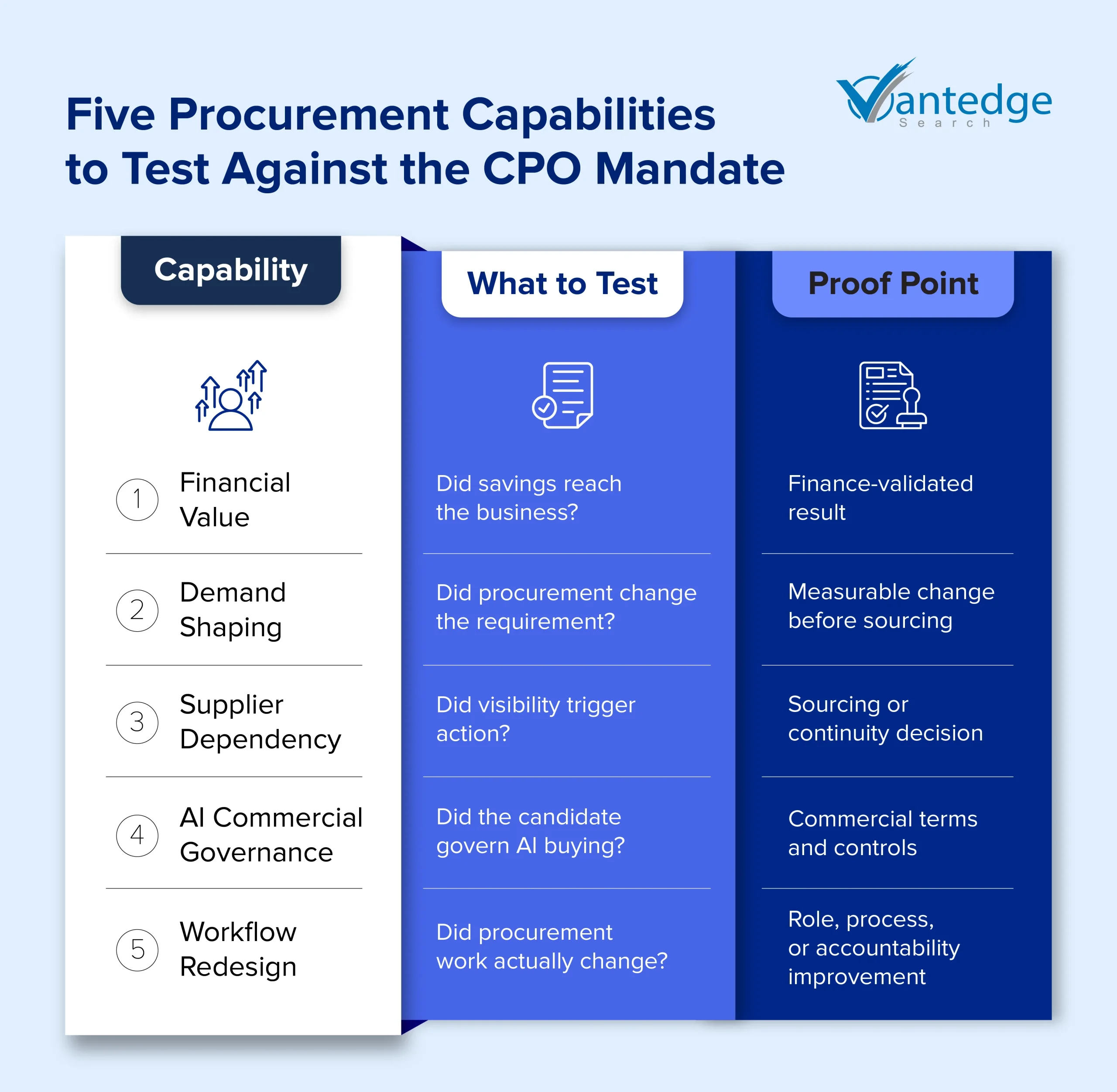
- Five Procurement Capabilities Hiring Sponsors Should Test
- How to Distinguish Capability From Exposure and Weigh the Gaps
- Recent Procurement Appointments Show Different Capability Priorities
- Conclusion: Test the Capabilities the Procurement Mandate Actually Requires
- FAQs
Four Key Takeaways
- Mandate comes first: Procurement leadership hiring should identify which capabilities matter most to the role before comparing candidates on title, tenure, company size, or reported savings.
- Savings need financial proof: Strong CPO evidence connects negotiated savings to realized value, clear baselines, finance validation, and measurable effects on cost, cash, margin, or working capital.
- Current capability tests go beyond sourcing: Demand shaping, multi-tier supplier judgment, AI commercial governance, and procurement workflow redesign reveal how a candidate handles decisions that increasingly sit within the CPO mandate.
- Ownership matters more than exposure: Hiring sponsors should separate decisions the candidate personally controlled from team or enterprise achievements, then weigh any gaps according to their importance to the mandate.
Why Procurement Leadership Requires a Different Capability Test
Standard credentials tell hiring committees surprisingly little about executive fit. A professional background built on enterprise pedigree, category spend, or reported savings figures frequently fails when placed into a different operating model. Procurement leadership hiring requires direct alignment with an organization’s specific operational mandate.
Data from Gartner and KPMG marks a structural shift across the function. KPMG research indicates that 71 percent of procurement organizations face critical talent shortages, while Gartner’s research shows that 74 percent of CPOs are restructuring operating models to manage supplier instability and artificial intelligence. Executive accountability now combines complex financial verification, internal demand choices, and external supplier dependencies.
Yet no single candidate profile solves every corporate requirement. Boards and chief executives managing chief procurement officer hiring must determine what the business actually needs procurement to achieve. Evaluation panels must establish where direct authority will sit and what commercial decisions matter most. A candidate shortfall is only a weakness when it directly conflicts with that explicit mandate.
Five Procurement Capabilities Hiring Sponsors Should Test
Hiring teams cannot evaluate procurement leadership capabilities through résumé keywords or high-level program claims alone. Effective CPO candidate evaluation demands proof of a specific decision, the authority personally held, the commercial trade-off managed, the resulting outcome, and independent verification supporting that account.
1. Financial Value Reconciliation, Not Just Savings Delivery
During chief procurement officer hiring, committees should verify how negotiated savings became financial value for the business. Deloitte’s Global Chief Procurement Officer Survey reports that 72% of procurement leaders prioritize margin improvement through direct cost reduction. However, top-line percentages on a résumé mean little without fiscal proof. BCG’s 2026 procurement guidance notes that negotiated savings do not always translate into financial-statement impact and recommends clear baselines, finance validation, and tighter implementation controls to reduce value leakage.
When hiring a procurement leader, committees should look for the analytical discipline to reconcile negotiated savings with what the business actually realized. Relevant evidence includes the original spending baseline, the distinction between realized savings and cost avoidance, and any value lost during implementation.
Hiring sponsors should ask which internal finance executive independently confirmed the figures. Strong candidates explain clearly how the corporate comptroller or CFO credited margin gains, working capital adjustments, or audited cost reductions directly to business unit profit statements. If corporate finance never audited and approved the final bottom-line effect, the candidate directed an agreement, not verified business value.
2. Demand-Shaping Judgment Before Sourcing Begins
Executive assessment must prove whether an incoming leader influences internal business requirements before supplier discussions start. McKinsey’s 2025 procurement research indicates that cross-functional interventions addressing product specifications and internal consumption alongside engineering teams generate an 11 percent cost reduction within twelve months, far exceeding isolated rate negotiations. Sound procurement leadership strategy centers on controlling spend before purchasing commitments take legal form.
Hiring sponsors should test candidates against a concrete operational trade-off involving specifications, consumption limits, or service levels. Interview panels should ask what the internal business unit originally requested, why procurement contested that requirement, and who retained final decision authority. The candidate must specify how component variants were cut, how service standards were reset, and what measurable operational impact followed the intervention without hurting ongoing business delivery.
This assessment separates commercial authority from passive requisition processing. Knowing how to evaluate procurement leadership candidates requires checking whether the applicant reshaped baseline demand or simply accepted fixed scopes of work. An executive who merely negotiates supplier discounts against inflated, unchallenged internal specifications leaves the primary drivers of enterprise expenditure across business units completely untouched.
3. Multi-Tier Dependency Judgment, Not Supplier Visibility Alone
Dashboards and supplier maps do not guarantee supply security. When evaluating procurement executive candidates for supplier risk, hiring committees must assess whether a candidate identifies which sub-tier vulnerabilities demand direct commercial intervention. Visibility into tier-two and tier-three networks provides little value unless an executive acts on that insight.
KPMG’s 2026 supply chain analysis confirms that operational exposure stems from network bottlenecks, sole-source lead times, and component substitutability rather than gross expenditure. A minor raw material supplier can halt an entire manufacturing line if single-sourced in a constrained market. Gartner’s July 2026 research similarly advises CPOs to prioritize supplier risk alongside cost reduction across multi-tier networks.
Assessment must isolate the candidate’s exact intervention threshold. Interviewers should examine whether the executive rewrote supplier contracts, mandated buffer inventory, qualified alternative sources, or adjusted component specifications. Hiring committees should require the candidate to specify where direct procurement authority ended and where supply chain operations took over.
The decisive test of supplier risk management leadership is deciding what commitments to adjust before supply shortages hit. Candidates must isolate an exact bottleneck, detail how they managed operational trade-offs, and prove the resulting business stability. Strong procurement leadership capabilities show up in defensive contractual and sourcing choices, not in passive supplier tracking tools.
4. Enterprise AI Commercial Governance
Artificial intelligence enters organizations through fragmented routes, including cloud subscriptions, consulting contracts, software updates, and direct purchases by separate business units. Gartner’s August 2026 procurement research advises CPOs to treat AI as a dedicated category management domain to improve visibility and control over fragmented spending, consumption growth, pricing transparency, data rights, and commercial governance. Knowing how to hire a procurement leader with AI experience requires looking past basic software pilots and supplier demonstrations.
Hiring committees must examine how candidates structured commercial terms across build, buy, and partner sourcing decisions. The assessment should review how the executive controlled financial exposure to volatile seat-plus-consumption pricing models, sudden cloud compute surges, and automatic annual contract renewals. Candidates must demonstrate how they secured explicit contractual data rights that stop technology suppliers from using proprietary company information to train external foundation models.
Strong AI in procurement leadership requires direct partnership with internal legal, cyber security, and corporate data governance teams. Competent candidates establish clear commercial oversight across all enterprise technology commitments, thoroughly reviewing embedded autonomous tools before any vendor contracts are signed. Interview panels should verify the exact liability caps, intellectual property protections, and supplier audit rights the candidate personally negotiated into final enterprise agreements during previous commercial assignments.
5. Procurement Workflow and Role Redesign
Software tools yield little value when applied to flawed processes. Gartner’s August 2026 research on AI readiness confirms that CPOs face an acute execution gap when attempting to integrate automated systems into legacy departmental workflows. McKinsey’s 2025 procurement research indicates that two-thirds of leading organizations deliberately separate strategic decision-making from transactional tasks, proving that productivity gains require restructuring daily work habits before introducing automation.
Hiring sponsors must examine how a candidate altered the core duties of buyers and category managers. Evaluation panels should track which manual tasks were removed, which responsibilities shifted to centralized teams, and how sign-off thresholds were cut down. Real procurement leadership capabilities show up in how teams are retrained for judgment-heavy work, such as managing critical supplier negotiations, evaluating commercial risks, and aligning with business leaders.
Assessment panels should require candidates to show measurable operational changes from their reorganizations. Strong candidates point to concrete metrics, such as reduced purchase-order cycle times, lower contract dispute rates, or lower department operating expenses. Buying software tools does not equal operational improvement. Effective procurement leadership strategy requires verifiable proof that the executive restructured team responsibilities, removed bottlenecks, and made procurement decisions faster and clearer for the wider organization.
How to Distinguish Capability From Exposure and Weigh the Gaps
Hiring sponsors must separate direct capability from passive exposure to large corporate programs. In procurement executive search, an applicant might work inside a well-known corporation without ever designing its supplier risk policies, contract validation rules, or team workflows. On the other hand, an executive from a smaller business may have managed lower total spend while personally owning difficult supplier negotiations, operational trade-offs, and bottom-line results.
During CPO candidate evaluation, the most frequent warning sign is persistent team language. When applicants describe major achievements using only words like we and our group, assessment panels must isolate the exact decisions the candidate made. Interviewers should determine what the individual directly handled, what other departments controlled, what business trade-offs were settled, and which internal stakeholders can independently verify the reported outcome.
Knowing how to evaluate procurement leadership candidates also requires matching any identified gaps against the company’s operating mandate. Hiring sponsors should avoid rigid numerical checklists. Instead, committees should separate mandate-critical gaps from secondary weaknesses that existing teams can support after the appointment.
A gap in software category strategy carries minor operational weight if the immediate mandate centers on direct manufacturing materials. That same gap becomes disqualifying when the incoming CPO must immediately fix enterprise software costs, address vendor lock-in, and reset purchasing controls across business units.
Strengthen CPO hiring decisions with Vantedge Search
Recent Procurement Appointments Show Different Capability Priorities
Recent procurement appointments show how companies can place different requirements behind the same CPO title.
International Motors: Sebastian Leger
International Motors appointed Sebastian Leger as Senior Vice President and Chief Procurement Officer, effective April 1, 2026. Reporting to President and CEO Mathias Carlbaum, Leger leads global procurement strategy and operations, supplier partnerships, and alignment with TRATON Group. The company also highlighted his experience in cost management, supplier quality, and strategic procurement.
The disclosed responsibilities give the role a broad operational and organizational remit. Alongside cost management and supplier quality, Leger is responsible for global procurement operations, supplier partnerships, and coordination with the wider TRATON Group.
Maverick Power: Brandon Ray
appointed Brandon Ray as Chief Procurement Officer on July 3, 2026, reporting to Chief Operating Officer Bill McCanless. His responsibilities include procurement strategy, supplier partnerships, commodity management, strategic sourcing, and supply-side risk management across mission-critical infrastructure markets.
Maverick Power linked the appointment to strengthening its supplier network, supporting operating capacity, and meeting customer demand. The publicly stated remit therefore places particular emphasis on commodity management, strategic sourcing, supplier partnerships, and supply-side risk.
What is useful about these appointments is not that they establish one model for procurement leadership hiring. They show two different combinations of responsibility under the same executive title. International Motors places visible weight on global procurement operations, supplier partnerships, and alignment with a broader group structure. Maverick Power gives greater prominence to commodity management, strategic sourcing, and supply-side risk. The comparison reinforces why CPO candidates should be judged against the requirements of the role rather than against a standard procurement profile.
(For broader context on supplier continuity and operational preparedness, refer to our blog: Supply Chain Resilience: The New Strategic Imperative for Leaders)
Conclusion: Test the Capabilities the Procurement Mandate Actually Requires
A polished résumé does not prove that a candidate can handle a company’s specific procurement mandate. Well-known employers, large savings claims, and technology exposure show only part of an executive’s record.
Sound procurement leadership hiring starts by defining what the role must accomplish. Evaluation should then focus on the decisions the candidate personally made, the authority held, the trade-offs managed, and the results that finance, operating leaders, or references can verify.
The appointment decision should reflect the capabilities most important to the business and the gaps that carry the greatest operational or commercial risk.
For procurement and supply-chain leadership hiring, connect with Vantedge Search to discuss the executive search requirements behind your mandate.
FAQs
Boards must verify whether finance teams audited the claimed numbers directly. Committees should evaluate how the candidate separated realized cash from cost avoidance and reconciled post-contract value leakage against bottom-line margin.
Committees should evaluate how the candidate structured commercial terms, capped exposure to consumption pricing, secured contractual enterprise data rights against model training, and negotiated strict vendor liability limits and audit protections.
Identical CPO titles carry fundamentally different operational requirements. Establishing a clear mandate ensures committees evaluate the exact commercial trade-offs, supplier risks, and organizational challenges the business needs the incoming leader to solve immediately.
Persistent reliance on collective language like “we” signals passive program exposure rather than direct capability. Interviewers must check whether the candidate personally owned key commercial decisions, resolved trade-offs, and drove verified outcomes.
Committees should avoid rigid scorecards and evaluate missing capabilities against the immediate operating mandate. Gaps are disqualifying only if they conflict with primary business goals that internal teams cannot support post-appointment.
Leave a Reply