


The Quiet Exit: Why Organizations Lose Their Best Executives Long Before They Resign
Three Key Takeaways
- Performance can outlast belief.
Organizations often measure what executives continue to deliver, while overlooking what they have quietly stopped investing. - The absence of friction is not always the presence of commitment.
The most consequential executive departures often begin when leaders stop believing their influence will change the outcome. - Exceptional executives stay because institutions continue to deserve them.
Retention is sustained less by incentives than by preserving an environment where conviction still feels worthwhile.
Introduction
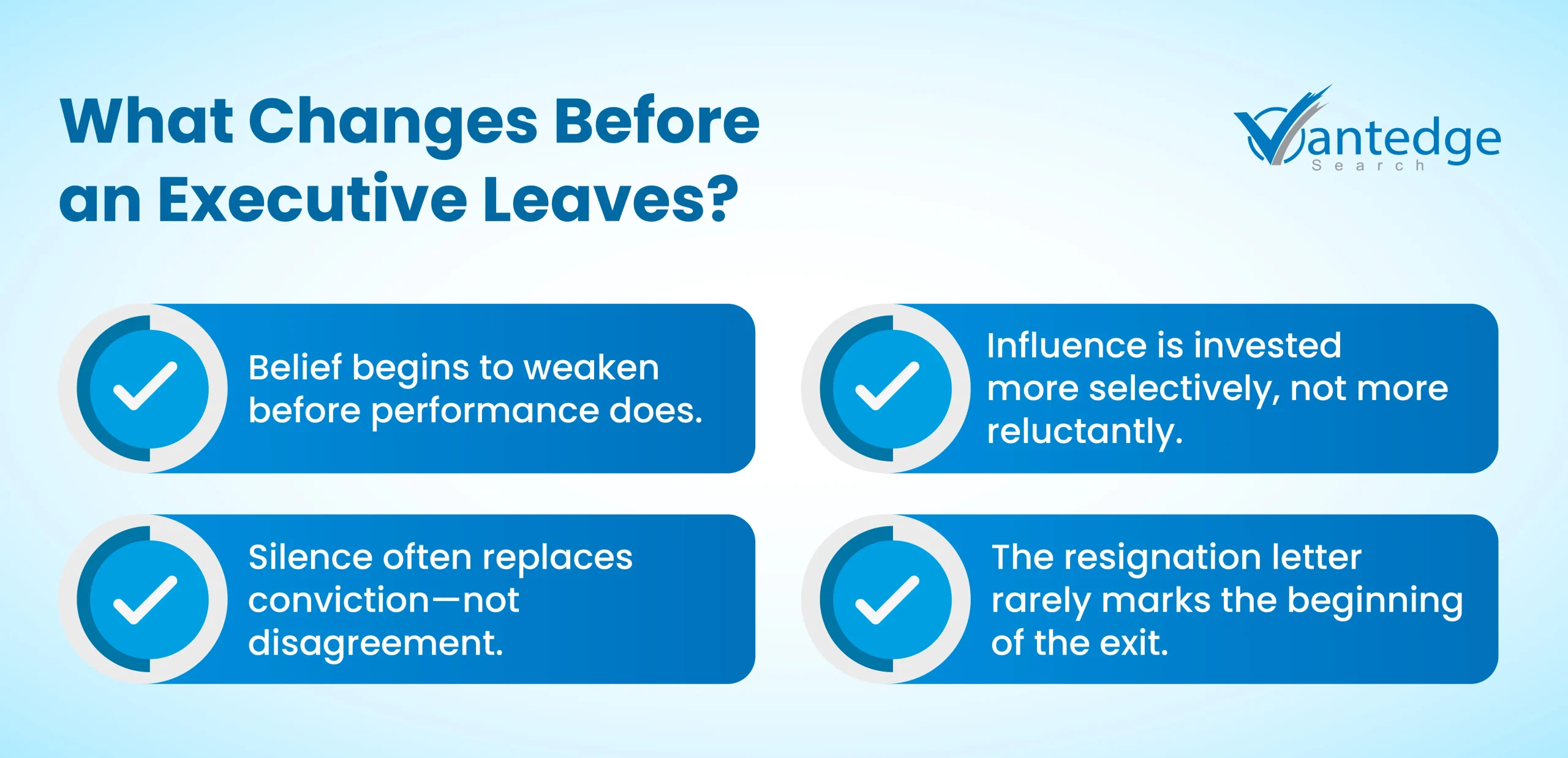
Most mid-sized and large organizations believe they will know when they are about to lose a top executive. In complex institutions, where leadership influence is exercised through multiple stakeholders, layers of decision-making, and established organizational norms, executive departures are often assumed to be visible long before they occur. After all, senior leaders do not simply wake up one morning and resign. There will be signals. Performance will slip. Enthusiasm will fade. Commitment will waver. Yet the most accomplished executives rarely leave that way. In fact, the first sign of executive disengagement is often the exact opposite of what organizations are taught to look for. The executive continues to deliver. Meetings remain productive. Targets are met. Relationships stay professional. From the outside, everything appears intact. What has quietly changed is something far more important: they have stopped investing their full conviction in the institution. By the time an executive resignation letter arrives, the real departure may have happened months earlier.
Your Best Executives Don't Leave When They Stop Working Hard: Executive Disengagement Starts Earlier
What makes executive disengagement so difficult to detect? Most organizations are conditioned to look for visible decline. Missed targets. Reduced energy. Deteriorating performance. Yet high-performing executives are often the least likely people to display those signals. Their reputation, self-respect, and professional standards compel them to continue delivering results long after their emotional commitment to the institution has begun to erode, affecting senior leadership engagement.
The shift occurs elsewhere. It happens when executives stop taking risks on behalf of the organization. They stop challenging assumptions they believe will be ignored. They stop pushing ideas that require political capital to advance. They become more selective about where they invest their influence. What looks like maturity is sometimes withdrawal. What appears to be alignment is occasionally resignation in slow motion.
This is why executive turnover often surprises organizations. They are measuring performance while the executive is measuring belief. And belief tends to disappear long before performance does.
When Belief Begins to Fracture
Belief rarely disappears because of a single decision. More often, it erodes through observation. Senior executives watch what organizations reward, what they tolerate, and what they choose to ignore, revealing their leadership belief and culture. They notice when values apply selectively, when difficult issues remain unresolved, or when commitments quietly expire without consequence. Most understand that leadership involves compromise. What becomes harder to accept is inconsistency. The moment an executive begins questioning whether the institution genuinely believes what it says, they also begin reconsidering how much of themselves they are willing to invest in it.
The Signals Most CEOs Misread
The challenge for CEOs is that executive disengagement rarely looks like dissatisfaction. Senior leaders understand responsibility too well. They know how to deliver through uncertainty, navigate frustration, and perform through disagreement. The question, therefore, is not whether an executive is happy. It is whether they still believe their effort can meaningfully shape the future of the institution. Once that belief begins to erode, the outward signs are often subtle—but they are there, leading to executive resignation.
1. They Stop Spending Political Capital
Political capital is one of the few resources senior executives spend voluntarily. They use it to challenge assumptions, advocate for difficult decisions, sponsor talent, and push initiatives that may not have immediate support. When executives believe they can influence outcomes, they are willing to invest that capital. When they stop believing, they become far more selective about where they spend it.
The danger is that this often looks like maturity. The executive appears calmer, more aligned, and easier to work with. Meetings become smoother and disagreements fewer. Yet what has changed is not attitude, but conviction. The executive is no longer asking, “How do we make this happen?” but “Is it worth trying?” And once that shift occurs, disengagement is often already underway, one of the earliest signs an executive is about to resign.
2. They Become More Agreeable at Exactly the Wrong Time
Most CEOs assume that reduced friction is a sign of alignment. But senior executives rarely stop seeing risks, flaws, or missed opportunities. What changes is their willingness to challenge them. After raising the same concerns repeatedly, some leaders eventually conclude that their input is unlikely to alter the outcome and begin conserving their energy elsewhere, a subtle decline in senior leadership engagement.
This is what makes the signal so easy to misread. The executive appears supportive, constructive, and cooperative. Meetings move faster and consensus arrives more easily. Yet the absence of disagreement does not always reflect agreement. Sometimes it reflects a quiet decision that the conversation is no longer worth having.
Build stronger leadership teams with Vantedge Search
3. They Stop Lending Their Credibility to the Institution
Senior executives spend years building credibility—with employees, customers, investors, and peers. When they believe in the institution, they willingly attach that credibility to its decisions, priorities, and promises. They become advocates because they trust that what is being communicated today will still be true tomorrow.
The shift begins when that confidence erodes. The executive notices commitments that quietly disappear, values that apply selectively, or messages that change depending on the audience. They do not necessarily become cynical or confrontational. They simply become more careful about what they personally endorse. The organization still has their expertise, but it no longer has their full conviction. And once executives stop lending their credibility to the institution, their departure often becomes a question of timing rather than intent, increasing the risk of executive turnover.
4. They Stop Being Disappointed
One of the least recognized signs of executive disengagement is the disappearance of disappointment. Engaged leaders get frustrated. They react when standards slip, opportunities are missed, or decisions fall short of what the organization is capable of achieving. Their disappointment is often a reflection of belief—the belief that things could, and should, be better.
When that belief begins to fade, so does the emotional response. The executive becomes calmer, more measured, and seemingly less affected by setbacks that would once have energized debate. This composure is often mistaken for maturity or perspective. Sometimes it is. But sometimes it signals something else entirely: the executive has quietly lowered their expectations of what the institution is willing or able to become, revealing why top executives lose belief in an organization.
5. They Stop Carrying the Institution in Their Head
The most engaged executives in complex organizations do not think about the organization only when a decision lands on their desk. They connect dots across functions, anticipate second-order consequences, and worry about issues that may never directly affect their own role. Their perspective extends beyond responsibility because they see themselves as custodians of the institution, not simply leaders of a function.
One of the quieter signs of executive disengagement before resignation is when that mental horizon begins to shrink. The executive continues to perform, but their attention narrows to what they own, control, and are measured on. Problems elsewhere become someone else’s responsibility. Strategic questions become functional ones. The organization loses a leader who once carried the whole institution in their head and gains one who is simply managing their part of it.
6. They Begin Reducing the Institution's Dependence on Them
The strongest executives rarely leave abruptly. They transfer knowledge, broaden decision-making, strengthen the leadership bench, and ensure that critical relationships extend beyond them. These are hallmarks of good leadership, which is precisely why the signal is so easy to miss. On the surface, the executive appears more empowering, more strategic, and more focused on executive succession planning than ever before.
The question is whether those efforts are being made in service of the institution—or in preparation for an exit. When an executive begins systematically reducing organizational dependence on their role, the behavior deserves closer attention. The best executives do not leave chaos behind. They leave continuity, reducing organizational dependence before leaving a job. By the time that continuity is fully in place, they may already have one foot out the door.
What the Dashboard Doesn't Show
Most CEOs spend their careers learning to ask better questions. About markets, strategy, capital allocation, risk, and growth. Yet some of the most important questions are directed inward. Not because they reveal what the organization is doing wrong, but because they expose assumptions that may have gone unchallenged for too long. The quiet exit often begins where certainty ends, long before executive turnover becomes visible.
- When was the last time a senior executive changed your mind about something important?
- Which of your top leaders would choose to join this organization again, knowing everything they know today?
- What truths do your executives discuss with one another that never reach the leadership table?
- If the best in your organization submitted an executive resignation tomorrow, what reasons would they privately give that you would never hear?
- What has your leadership team stopped debating?
- What has become easier to ignore inside the organization than it was three years ago?
Conclusion
The best executives do not give organizations their time. They give them their belief. Time can be contracted, measured, and compensated. Belief cannot. It is earned through trust, consistency, challenge, and the sense that meaningful contribution is still possible. The quiet exit begins when that belief starts to weaken, making executive retention strategies far more important than reacting to executive turnover after it occurs. The resignation merely makes it visible.
Partner with us to identify leaders who don’t just fill critical roles—they strengthen the institutions they lead. We help organizations make leadership decisions that endure, connecting them with executives whose judgment, influence and values align with long-term business success.
FAQs
Executive disengagement rarely begins with declining performance. Early indicators include reduced willingness to challenge decisions, less investment in political capital, narrowing strategic focus, and a gradual withdrawal from influencing the broader organization. These are often the earliest signs of executive disengagement before resignation.
Senior leaders typically disengage when they lose confidence that their ideas, influence, or leadership can meaningfully shape the organization. Rather than leaving immediately, many continue delivering results while quietly reducing their emotional investment—a key reason why executives quietly disengage before resigning.
Organizations should look beyond performance metrics and pay attention to behavioral changes. Executives who stop challenging assumptions, avoid strategic risks, become unusually agreeable, or reduce organizational dependence on themselves may be signaling future departure. Understanding these patterns helps detect executive turnover before it happens.
High-performing executives stop taking risks when they believe their influence no longer changes outcomes. Instead of investing political capital in difficult conversations or transformational initiatives, they become more selective about where they expend their energy—a common precursor to executive disengagement.
The strongest executive retention strategies focus on preserving trust, consistency, and meaningful influence rather than relying solely on financial incentives. Organizations that reinforce leadership belief and culture, encourage constructive debate, invest in executive succession planning, and act on early signs of disengagement are better positioned to retain exceptional leaders.
Leave a Reply