


The Changing Nature of Executive Fatigue: Decision Fatigue in Leadership and Cognitive Load
Table of Content
- Introduction: Why Executive Fatigue Is Becoming Harder to Diagnose
- Why Decision Fatigue in Leadership Feels Different Today
- The Five Strains Behind Executive Cognitive Stress
- How Organizations Can Reduce Executive Cognitive Load Without Weakening Accountability
- Protecting Executive Judgment as a Leadership Performance Priority
- FAQs
Four Key Takeaways
- Executive fatigue is becoming harder to diagnose because the load now comes from hidden cognitive strain, not only visible pressure, long hours, or heavy workloads.
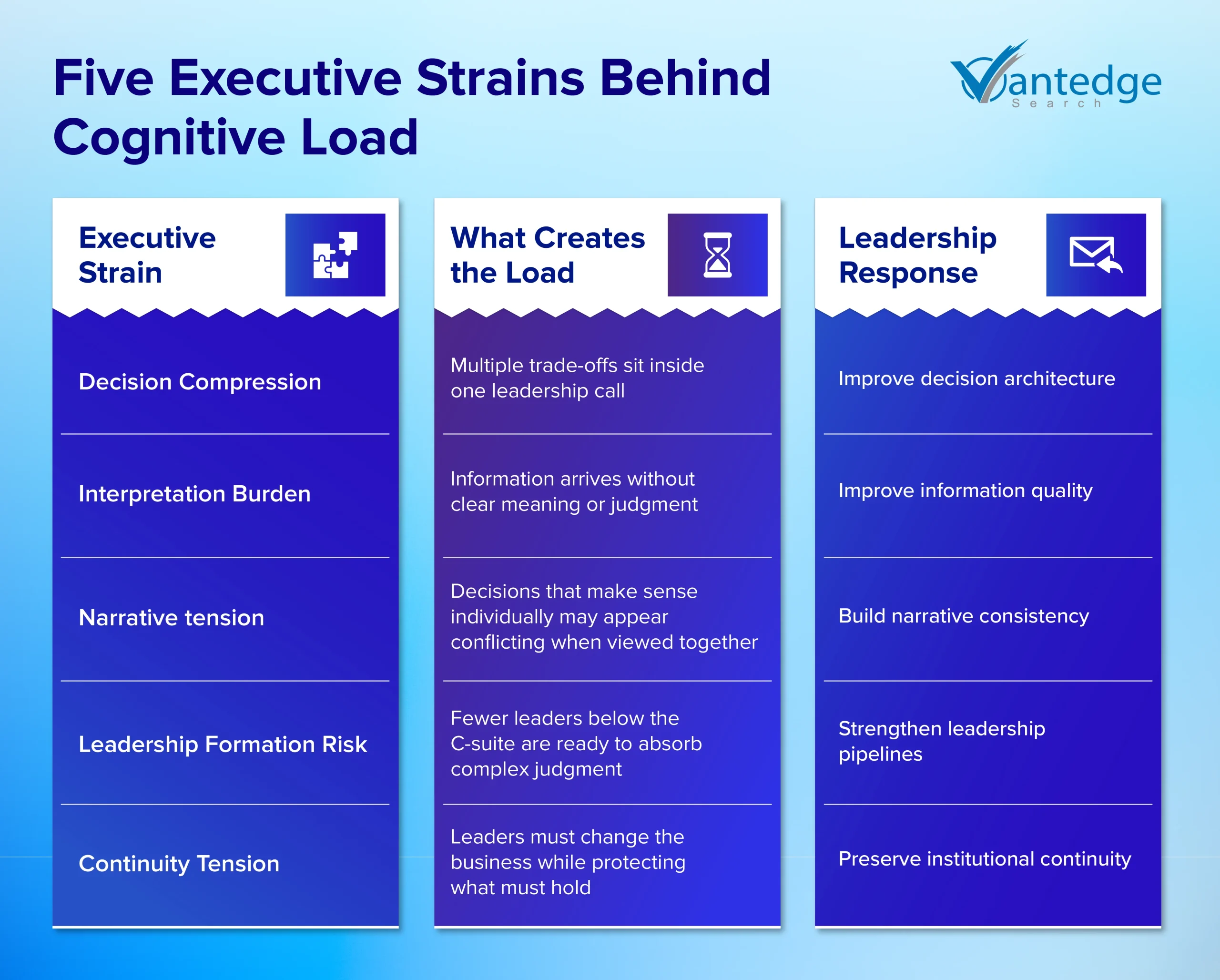
- Decision fatigue in leadership now forms through five distinct strains: decision compression, interpretation burden, credibility pressure, leadership formation risk, and continuity tension.
- The concern for C-suite leaders is not simply that decisions are increasing. It is that each decision now carries more connected consequences across cost, talent, AI, risk, trust, and continuity.
- Reducing cognitive load in leadership requires sharper decision architecture, better information quality, clearer leadership narratives, stronger leadership pipelines, and protection of institutional continuity.
Introduction: Why Executive Fatigue Is Becoming Harder to Diagnose
Executive cognitive stress is not new. Senior leaders have always carried pressure that is difficult for the wider organization to see. They weigh capital decisions, talent risks, stakeholder expectations, market shifts, and reputation concerns while still being expected to project clarity and control.
What has changed is the nature of the load. Decision fatigue in leadership now builds through compressed decisions, heavier interpretation demands, credibility pressure, leadership depth concerns, and the tension between change and stability. The strain is not always visible. A senior executive may still attend every meeting, approve plans, and speak with confidence while their judgment capacity is being stretched.
That is why executive burnout at the top can be harder to diagnose. It may not first appear as exhaustion. It may appear as slower judgment, narrower debate, delayed decisions, or a reduced ability to separate signal from noise.
For C-suite leaders, the concern is not simply how much pressure they can carry. It is whether the organization is asking them to carry the wrong kind of cognitive load for too long.
Why Decision Fatigue in Leadership Feels Different Today
Senior leaders have always made difficult decisions. What is changing is the amount of unresolved judgment that now surrounds those decisions. Leadership calls that once moved relatively quickly into execution increasingly remain active long after they are made.
Market conditions evolve, technologies mature, workforce implications emerge, stakeholder expectations shift, and assumptions that appeared sound can require reassessment within months. Decisions reach conclusion points, but they rarely reach complete closure.The pressure to move quickly adds another layer of complexity.
Deloitte’s 2026 Global Human Capital Trends found that seven in ten business leaders view speed and adaptability as critical priorities for the years ahead. Faster decision-making can help organizations respond to change, but it also increases the likelihood that leaders must act while information is still evolving and multiple outcomes remain uncertain.
This creates a different kind of executive burden. The challenge is no longer confined to choosing a course of action. It extends to anticipating second-order consequences, revisiting assumptions, interpreting new signals, and maintaining confidence while outcomes continue to unfold. The mental demand comes not from a single decision, but from carrying multiple decisions whose implications are still developing.
As a result, executive fatigue is becoming less about workload and more about cognitive strain. The pressures affecting senior leaders today are varied, but they share a common characteristic: each places additional demands on judgment. Understanding these distinct sources of strain provides a clearer picture of how cognitive load is developing at the top of the organization.
The Five Strains Behind Executive Cognitive Stress
Executive fatigue rarely comes from a single source. Different pressures often arrive at the same time, but they do not create the same kind of strain. Understanding decision fatigue requires looking beyond generic ideas such as complexity or pressure and identifying the specific mental demands each situation places on leaders.
A more useful question is: What kind of thinking, judgment, or attention is this situation requiring from me?
Decision Compression
Decision compression occurs when multiple business trade-offs arrive bundled into a single leadership decision. A decision about cost may also affect workforce planning, AI investment, customer commitments, risk exposure, infrastructure, and capital allocation.
The strain comes from simultaneity. Senior leaders are not only choosing a path. They are weighing how several trade-offs may interact once the decision moves through the business.
This is different from simply having more decisions on the calendar. It is having fewer decisions that each carry more consequences. For C-suite leaders, executive decision making under pressure becomes more demanding because the mental effort sits in seeing the full pattern before the organization commits.
Interpretation Burden
Interpretation burden emerges when information reaches senior leaders faster than meaning can be extracted from it. Reports, dashboards, forecasts, AI-generated insights, stakeholder updates, and market signals provide unprecedented visibility into the business. Yet visibility does not automatically create clarity.
The challenge is not the volume of information. It is the responsibility for deciding what that information means. Senior leaders must determine which signals reflect genuine shifts, which risks deserve attention, which opportunities warrant action, and which developments are temporary noise. In many cases, the data can describe what is happening without offering confidence about why it is happening or what should happen next.
This creates a distinct form of cognitive strain. While others may see information flowing through the organization, executives often carry the burden of turning competing, incomplete, or ambiguous signals into judgment. The mental effort lies less in consuming information and more in assigning meaning to it before the organization acts.
Narrative Tension
Narrative tension emerges when leaders must make decisions that appear contradictory when viewed in isolation. Organizations may invest for growth while reducing costs, accelerate transformation while emphasizing stability, or adopt new technologies while reassuring employees about the future. Each decision may be strategically sound, yet together they can create competing interpretations across the organization.
The strain lies in maintaining a coherent story that helps employees, investors, customers, and leadership teams understand how individual decisions connect to a broader direction. Without that coherence, even well-reasoned decisions can appear inconsistent, reactive, or disconnected from previously stated priorities.
This creates a distinct form of executive cognitive load. Senior leaders are not only evaluating what decision to make. They are also considering how a series of decisions will fit together over time and whether the organization can continue to see a clear direction through periods of significant change.
Leadership Formation Risk
Leadership formation risk arises when the organization depends heavily on a small group of senior leaders because fewer people below them have had enough judgment-building experience. Leaner structures and AI-supported work may improve efficiency, but they can also reduce exposure to ambiguity, operational friction, and accountable trade-offs.
The strain is not only a long-term succession concern. It affects current executive load because more complex decisions remain concentrated at the top.
For senior leaders, this can appear as repeated escalation, limited delegation confidence, or a narrower group of people trusted to absorb difficult calls.
Continuity Tension
Continuity tension is the strain of changing the business while protecting what still needs to hold. Senior leaders may need to alter cost structures, operating models, technology use, talent strategy, or customer focus while also preserving trust, institutional knowledge, cultural coherence, and execution discipline.
The pressure comes from carrying two opposing risks at once. Move too slowly, and the organization may lose relevance. Move too aggressively, and it may lose knowledge, confidence, or consistency.
This is not generic change fatigue. It is the cognitive stress of deciding what must shift and what cannot be weakened.
How Organizations Can Reduce Executive Cognitive Load Without Weakening Accountability
Reducing executive cognitive load does not mean reducing accountability. Senior leaders should still own the decisions that require enterprise judgment. The issue is whether too much avoidable strain is reaching the top because the organization has not prepared decisions, information, trust, leadership depth, or continuity well enough.
Improve Decision Architecture
Decision compression should be addressed before the final meeting, not during it. When a major decision reaches the CEO, board, or executive committee, the connected trade-offs should already be visible: capital impact, people implications, operating constraints, customer effect, risk exposure, and timing pressure.
This allows senior leaders to spend their attention on judgment, not reconstruction. The executive question becomes sharper: what must be decided now, what can remain reversible, what risk is acceptable, and who owns execution after the decision is made?
Improve Information Quality
Interpretation burden falls when information is prepared for judgment, not presentation. A board pack, executive summary, or AI-supported brief should not simply report what happened. It should clarify what changed, why it matters, where the risk sits, what options exist, and what decision is being requested.
This protects attention at the top. Senior leaders can challenge assumptions, test consequences, and compare trade-offs instead of spending time decoding material that should have arrived with clearer implications.
Build Narrative Consistency
Credibility pressure increases when different audiences hear different versions of the same decision. A major leadership call needs one coherent rationale across the boardroom, executive team, workforce, and stakeholder conversations.
This is not communication polish. It is trust protection. When intent, action, and expected outcome are aligned, leaders spend less time repairing confusion and more time reinforcing direction. For C-suite leaders, narrative consistency reduces the cognitive burden of defending the same decision in multiple forms.
Strengthen Leadership Pipelines
Leadership formation risk cannot be solved by naming successors on paper. Rising leaders need experiences that build judgment before they are asked to carry enterprise pressure: ambiguous decisions, cross-functional trade-offs, customer consequences, financial exposure, and accountability for outcomes.
This reduces overdependence on a small group of senior executives. If more people below the C-suite are capable of handling difficult judgment calls, fewer decisions need to be escalated to the CEO and top leadership team.
Preserve Institutional Continuity
Organizations typically define transformation through the lens of change: new structures, new technologies, new processes, and new ways of working. Continuity deserves the same level of attention. Before major initiatives begin, leaders should establish what must remain recognizable when the transformation is complete. This may include customer relationships, decision-making principles, cultural norms, critical capabilities, or sources of competitive advantage.
The goal is not to slow change. It is to create clarity around what the organization is trying to preserve while it evolves. When continuity is defined as deliberately as change, leaders spend less time resolving unintended consequences and more time focusing on execution. The question shifts from “How do we transform?” to “How do we transform without losing the qualities that made the organization successful in the first place?”
Managing cognitive load is not only about reducing pressure. It is also about improving the quality of inputs reaching senior leaders, especially when AI is part of decision support. (For a related view on decision speed without loss of control, read our blog: How AI Manages Data to Speed Up Decisions: Reducing Decision Cycle Time Without Losing Control).
Protecting Executive Judgment as a Leadership Performance Priority
Executive fatigue is often discussed as a question of individual capacity. At the senior level, it is increasingly becoming a question of organizational design. The quality of executive judgment is shaped not only by the capability of leaders, but by the quality of decisions reaching them, the clarity of information surrounding them, the strength of leadership pipelines beneath them, and the organization’s ability to distinguish between what must change and what must endure.
Pressure has always been part of leadership. What is changing is the amount of unresolved judgment accumulating at the top of organizations. When too many trade-offs, interpretations, escalations, and competing priorities converge on the same small group of leaders, executive capacity becomes a constraint on organizational performance.
The most resilient organizations are not necessarily those with the most capable executives. They are often the ones that distribute judgment more effectively, develop stronger decision-making capability throughout the business, and create conditions where senior leaders can focus their attention on the decisions that genuinely require executive intervention.
Viewed through that lens, protecting executive judgment is not simply a leadership wellbeing initiative. It is an organizational capability. The way decisions are framed, information is interpreted, leadership is developed, and continuity is preserved ultimately determines how much cognitive burden accumulates at the top—and how effectively the organization is able to respond when the next critical decision arrives.
If your organization needs senior leaders who can carry pressure without compromising judgment, partner with Vantedge Search to identify executive talent aligned with your mandate, culture, and succession priorities, so critical decisions are led with clarity, discretion, and confidence.
Build C-suite Judgment Into Hiring With Vantedge Search
FAQs
Decision fatigue in leadership is the mental strain created when senior leaders must judge compressed decisions, competing trade-offs, and unresolved inputs without enough closure. In 2026, it matters because C-suite choices increasingly combine cost, talent, AI, risk, trust, and continuity in the same decision cycle.
Executive burnout differs from employee burnout because the impact sits at enterprise level. When a senior leader is overloaded, the effects can reach capital choices, succession confidence, strategic pace, stakeholder trust, and leadership tone. The risk is not only reduced energy, but weaker judgment at the top.
The main causes of cognitive overload at work for senior leaders are decision compression, interpretation burden, credibility pressure, leadership formation risk, and continuity tension. These forces make executives process more consequences, interpret weaker inputs, maintain trust, carry talent-depth concerns, and balance change with stability simultaneously.
Poor decision architecture causes leadership burnout by sending unresolved issues upward before trade-offs, dependencies, ownership, and risk are clear. The C-suite then spends attention reconstructing the problem instead of judging the decision. Over time, this creates avoidable mental load and repeated escalation patterns across teams.
Signs that a CEO or senior executive is experiencing cognitive overload may include slower judgment, narrower debate, repeated escalation, difficulty separating signal from noise, and reduced tolerance for ambiguity. The warning sign is not always visible exhaustion. It is often a decline in decision quality.
Leave a Reply