


The Global “Anywhere” Executive: Thriving in International and Hybrid C-Level Roles
Table of Content
- Introduction: The “Anywhere” Label Is Not the Mandate
- Does Executive Authority Actually Travel
- What Is the Executive Actually Committing To
- What Career Evidence Proves Readiness for an Anywhere Mandate
- What Recent Appointments Show About Global Leadership Experience
- Conclusion: An Anywhere Executive Needs an Anywhere Mandate
- FAQs
Four Key Takeaways
- Location flexibility must be matched by operating authority. Hybrid C-suite roles work best when decision rights, information access, stakeholder access, and accountability remain aligned across locations.
- Executives should assess the full commitment behind the role. Headquarters presence, travel, time-zone coverage, relocation expectations, and cross-border employment terms can materially affect whether the appointment is workable.
- The durability of the location arrangement matters. Senior candidates should understand whether attendance requirements, geographic scope, or relocation expectations could change during the tenure.
- Global leadership readiness should be demonstrated through evidence. Boards and search advisers should look for geographic scope, decision authority, cross-market responsibility, and measurable outcomes rather than broad claims of international experience.
Introduction: The “Anywhere” Label Is Not the Mandate
A senior executive role is not truly flexible just because the executive can work away from headquarters. It works only when decision authority, access to key people and information, travel, in-person expectations, and employment terms support the role from that location.
The term “Anywhere” Executive describes a senior leader whose responsibilities extend across offices, regions, or countries while the executive is based in an approved location. It is not a formal employment category. It is a practical way to assess whether the role’s responsibilities match the conditions under which the executive is expected to perform them.
This question has become more relevant as companies reconsider how work is organized across locations. Deloitte’s 2026 Global Human Capital Trends survey found that seven in ten business leaders consider speed and adaptability important competitive priorities. That finding concerns the broader workforce rather than C-suite appointments, but it reinforces the importance of clear operating structures when leadership responsibilities span locations.
Terms such as hybrid, remote, and international do not reveal where consequential decisions are made, how often headquarters attendance is required, or whether access to the CEO, board, and executive peers changes with location. They also do not clarify the level of domestic or international travel, the time zones the executive must cover, or whether the location agreement may change during the appointment.
In hybrid C-suite roles, C-level executive roles, and remote executive positions, the operating reality matters more than the location label.
Does Executive Authority Actually Travel
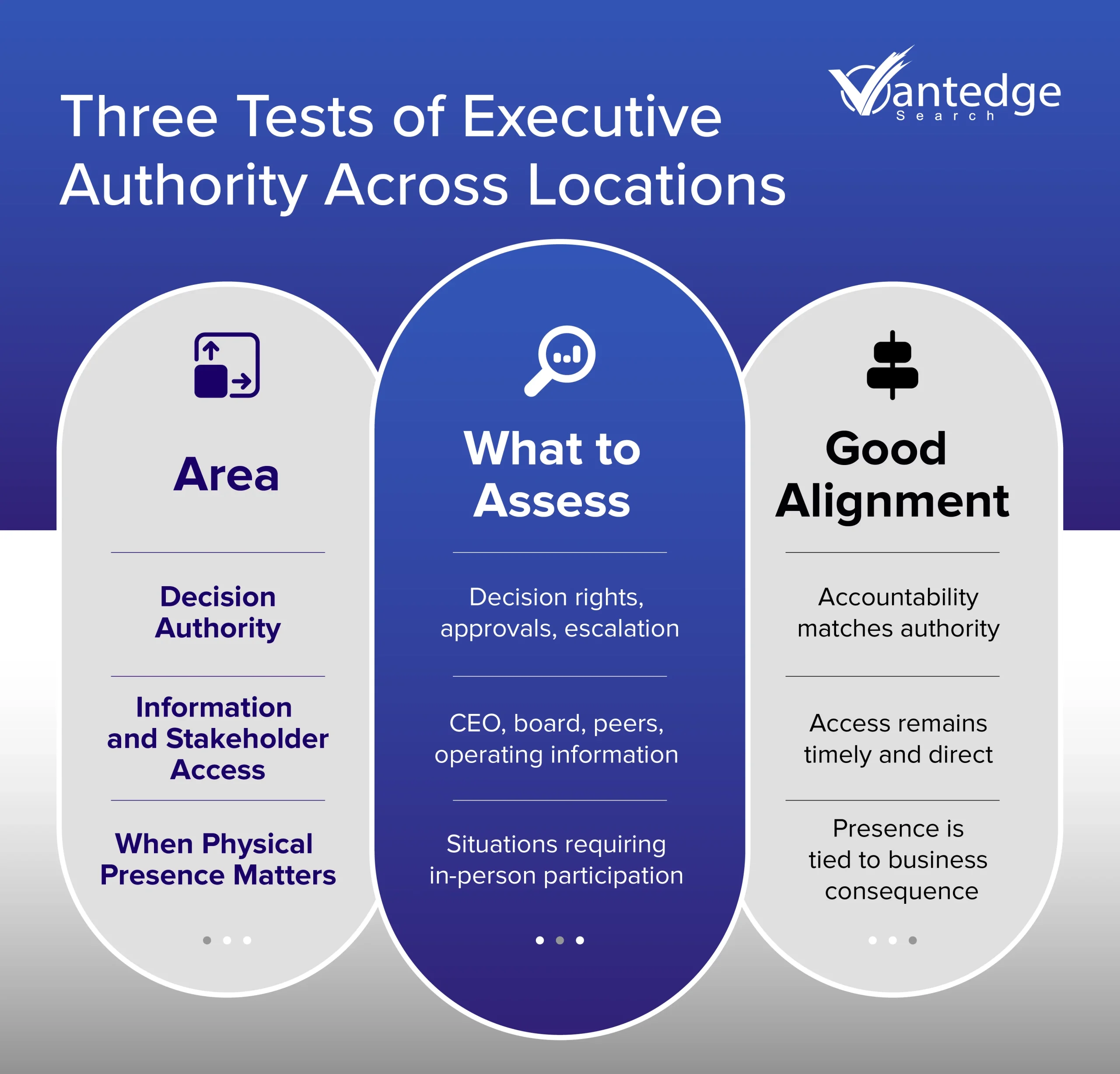
A senior leader working from another location needs more than permission to work remotely. The role must provide enough authority, information, and organizational access for the executive to fulfil the mandate without repeatedly referring material decisions back to headquarters.
This issue sits at the center of hybrid C-suite roles. A flexible work arrangement may appear attractive, but its value depends on whether accountability matches the authority the executive actually holds. Clear decision rights and ownership are also important in distributed operating models, where leaders may not share the same office or working hours.
Decision Authority
The executive should understand which decisions can be made independently and which remain centralized. This includes financial approval limits, functional authority, regional decision rights, escalation thresholds, and the authority delegated to local leaders.
A Chief Financial Officer based outside headquarters, for example, may carry responsibility for international performance but lack approval rights over capital allocation, pricing, or senior appointments. A Chief Operating Officer may be accountable for regional execution while major supply, customer, or staffing decisions remain with headquarters.
Such arrangements can create a gap between responsibility and control. The executive may be held accountable for results without having the authority, budget, or access required to influence them. Before accepting executive leadership roles, the candidate should ask whether the formal mandate reflects the practical decision structure.
Information and Stakeholder Access
Authority also depends on timely information. Receiving a board pack or monthly performance report is not the same as receiving early insight into a customer issue, leadership concern, regulatory matter, or regional performance problem.
The executive should assess access to the CEO, board members, executive peers, regional leaders, and material operating data. They should also understand how informal information reaches senior leadership. If important concerns are discussed first in headquarters meetings or personal conversations, a geographically distant executive may receive the facts only after the outcome has largely been shaped.
This is particularly important in global executive leadership, where decisions may move across markets before appearing in formal reporting.
When Physical Presence Matters
Physical presence should be linked to moments that materially affect the mandate, not to arbitrary office-day expectations. Significant board discussions, senior leadership changes, major customer negotiations, serious operating issues, and important regional decisions may justify attendance in person.
The key question is whether those moments are identified in advance and whether the executive has enough authority to act between them. A flexible address does not automatically create effective hybrid executive leadership. Authority, information, and access must operate across location as well.
What Is the Executive Actually Committing To
Not all hybrid C-suite roles create the same operating reality. A headquarters-based hybrid executive may have a defined office cadence, while a distributed leader may work across several business locations without a routine headquarters base. An executive leading internationally from another country adds a further layer of employment, mobility, and tax considerations.
These are practical distinctions rather than formal legal categories. For candidates, the important task is to establish what the appointment will require consistently, not simply what the location description suggests.
Presence, Travel and Time-Zone Expectations
The executive should establish how often headquarters attendance is required and which meetings demand in-person participation. Board meetings, annual planning sessions, senior leadership discussions, major customer negotiations, and serious operating matters may carry different presence expectations from routine management meetings.
Travel should be discussed in specific terms. Domestic travel may involve operating sites, customers, investors, or regional offices. International travel may involve board discussions, market reviews, leadership meetings, or negotiations with important customers and partners. The expected frequency, duration, notice period, and level of availability during each trip can materially affect the practicality of the appointment.
Time-zone coverage also requires clarity. The executive may need to participate in meetings across North America, Europe, or Asia, depending on the company’s operating footprint. The agreement should distinguish between occasional availability and a recurring expectation to begin early, work late, or remain reachable during significant regional matters.
The central question is not simply where the executive may work. It is what the executive must repeatedly do because the business operates across locations.
How Durable Is the Location Agreement
The executive should understand whether the agreed location is recorded in the employment contract, offer documentation, board approval, or another formal written arrangement. The documents should state whether headquarters attendance may increase, when the arrangement will be reviewed, and whether relocation could become necessary.
They should also address what happens if the executive’s geographic responsibility expands or if a material change in the mandate creates new presence requirements. A location agreement that works for one market may require revision if the role later covers additional regions.
The relevant question is not only where the role can be performed at the time of appointment. It is also under what circumstances the company may ask the executive to work elsewhere or attend headquarters more frequently.
Cross-Border Employment and Compensation Conditions
For international C-level jobs, location can affect the employing entity, work authorization, payroll, tax residence, social-security treatment, compensation currency, benefits, equity arrangements, retirement provisions, and relocation support.
A hybrid or international appointment should not be assumed to carry higher compensation simply because it crosses borders. The economic package depends on the role, employing entity, base location, internal pay approach, benefits, equity terms, and mobility arrangements.
Cross-border work can also create obligations beyond the individual executive. KPMG’s May 2026 analysis notes that remote working across jurisdictions can raise corporate income tax, individual income tax, social-security, and employment-law questions, including possible permanent-establishment issues depending on the circumstances.
These matters vary by jurisdiction and facts. Specialist tax, immigration, and employment advice may therefore be required before an international appointment is finalized.
Assess your next global executive role with Vantedge Search
What Career Evidence Proves Readiness for an Anywhere Mandate
For global leadership roles, international exposure is not the same as international executive responsibility. A candidate may have travelled extensively, worked with overseas teams, or participated in regional projects without ever holding meaningful authority across those markets.
Boards, CEOs, and search advisers therefore need evidence that shows what the executive actually owned, decided, and delivered across locations.
Prove Scope, Authority and Outcomes
A credible record should show the countries or regions previously managed, the scale of distributed responsibility, reporting relationships across locations, and the senior leaders accountable to the executive.
It should also show the level of decision authority held. That may include approving regional investments, resolving conflicts between central and local priorities, making leadership decisions, or taking responsibility for outcomes across several markets.
For global executive leadership, the strongest evidence connects geographic responsibility with consequential decisions and measurable business results.
Frequent international travel alone does not prove readiness for these mandates. Nor does managing employees in several countries automatically show enterprise-level authority across those markets.
The more useful evidence connects four elements:
Geographic scope + authority + consequential decision + business outcome
Candidates pursuing C-level executive roles should be prepared to explain not only where they have worked, but what decisions they were trusted to make and what changed because of those decisions.
During international executive recruitment, candidates should also be clear with search advisers about acceptable base locations, travel parameters, time-zone availability, relocation willingness, and work authorization. These conditions can materially affect whether an otherwise strong appointment is workable.
For executives considering how to position executive experience for global roles, specificity carries more weight than broad statements about being a “global leader.” Verified responsibility, decision authority, and results provide a more credible basis for assessing readiness.
What Recent Appointments Show About Global Leadership Experience
Recent appointments offer a useful way to think about what “global” should mean when assessing an executive. The interesting signal is not how many countries appear on a résumé, but whether geographic breadth has been accompanied by progressively greater authority. International exposure can be accumulated through travel, projects and collaboration. A global mandate is different: it asks an executive to make consequential decisions across markets where customers, teams and operating conditions may differ considerably.
Henrique Braun, The Coca-Cola Company
Henrique Braun’s path to the CEO role at The Coca-Cola Company illustrates that distinction. Before becoming CEO on March 31, 2026, Braun had led businesses including Greater China and South Korea, Brazil and Latin America, before moving into roles with responsibility across seven of the company’s nine operating units and subsequently all operating units worldwide as COO. The progression matters because the geography widened alongside the mandate. His career did not simply become more international; the scope of responsibility attached to those roles expanded with it.
Paul McAndrew, Mueller Water Products
Paul McAndrew’s appointment as CEO of Mueller Water Products offers a different version of the same idea. Across his earlier roles, McAndrew combined international operating experience with responsibility for global manufacturing and supply chain, as well as full P&L and cross-functional leadership. Here too, the useful signal is not international exposure in isolation. It is the combination of geography with operating responsibility.
These careers suggest a more useful way for boards and search advisers to assess executives for geographically distributed mandates. Instead of asking simply whether a candidate has “global experience,” the better questions concern the authority carried across that experience: What responsibility did the executive hold? Which decisions extended across markets? What outcomes were they accountable for?
For the Anywhere Executive, geography may be the most visible part of the role. The more consequential question is whether the executive has already demonstrated the ability to carry authority across it.
(For a related perspective, read our blog: Remote Leadership: Finding and Hiring C-Level Executives in a Hybrid World, which looks at the leadership capabilities and hiring considerations that support effective C-suite performance across distributed teams.)
Conclusion: An Anywhere Executive Needs an Anywhere Mandate
The viability of hybrid C-suite roles depends on more than where an executive is permitted to work. The role must support clear authority, timely information, sufficient stakeholder access, realistic travel expectations, workable employment terms, and accountability that matches actual control.
Executives should examine these conditions with the same rigor applied to compensation, reporting relationships, and strategic responsibility. Companies should define them with equal clarity before beginning a search.
If you are evaluating a hybrid or international C-suite opportunity, connect with Vantedge Search to assess how your leadership experience, location preferences, and mobility requirements align with the practical demands of the role.
FAQs
A hybrid C-suite role combines remote work with defined in-person expectations, often involving headquarters or key meetings. A remote executive position may have no regular office requirement, although travel and direct stakeholder access can still form part of the mandate.
Executives should clarify decision authority, headquarters presence, travel, time-zone coverage, relocation expectations, stakeholder access, location-review terms, employing entity, work authorization, compensation structure, and relevant tax or employment requirements before accepting the appointment.
Not necessarily. Compensation depends on the mandate, employing entity, base location, internal pay structure, currency, equity arrangements, benefits, and mobility terms. A hybrid or international designation alone does not establish a compensation premium.
Depending on the jurisdictions involved, considerations may include tax residence, payroll, social security, work authorization, employment-law coverage, equity treatment, and possible corporate tax implications. Specialist tax, immigration, and employment advice may be required.
Executives should provide evidence of geographic responsibility, decision authority, distributed reporting structures, cross-market decisions, regional leadership, and measurable outcomes. Strong evidence shows what the executive actually controlled and delivered, rather than relying on broad claims of international experience.
Leave a Reply