


Why Tomorrow’s CEOs May Not Resemble Yesterday’s Successors
Three Key Takeaways
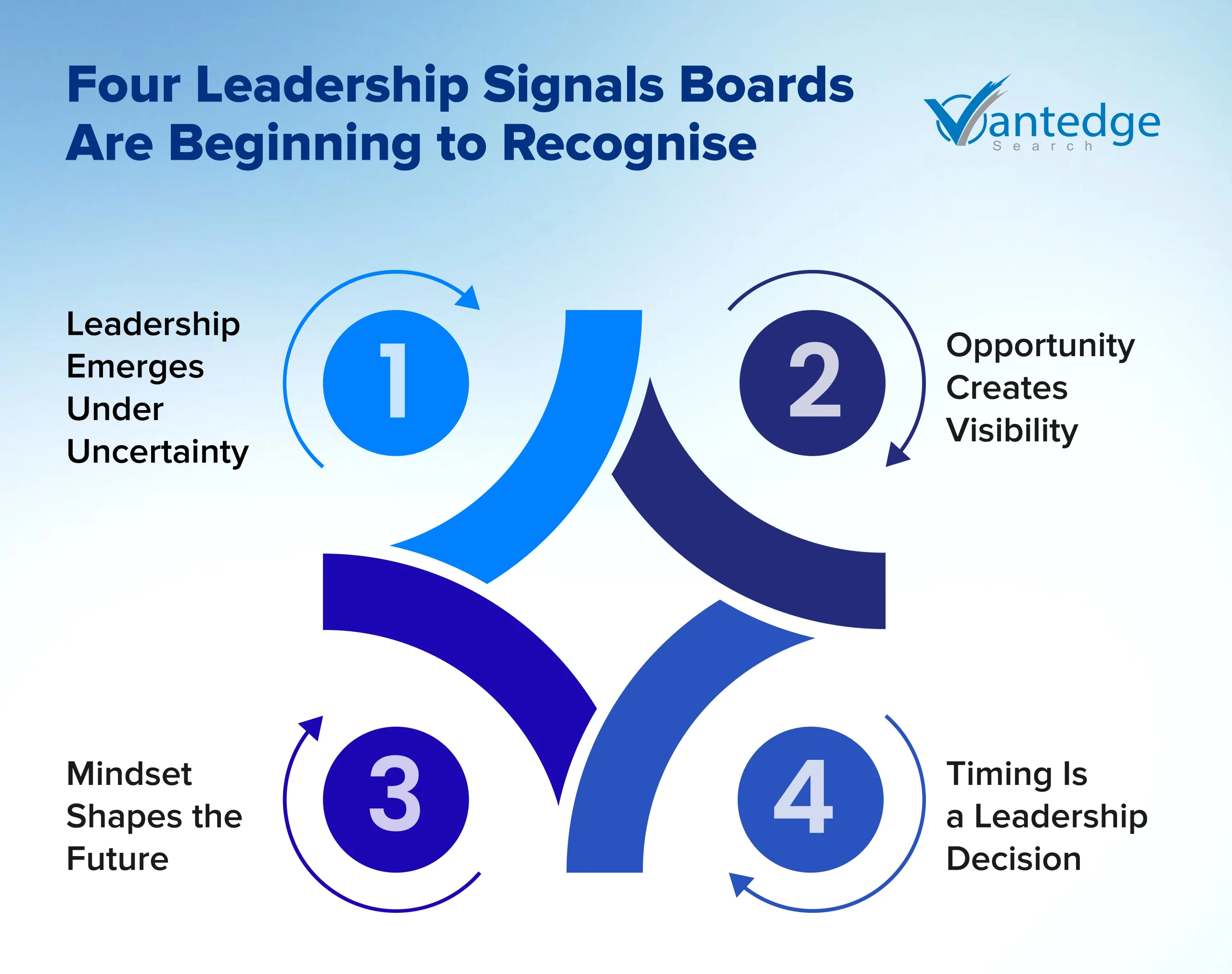
- Leadership often reveals itself before it is formally recognized. Future CEOs may distinguish themselves less through uninterrupted career progression and more through how they respond to uncertainty, assume responsibility without recognition, and earn trust before they earn titles.
- Succession is shaped as much by organizational design as individual talent. Strong leadership pipelines are built by creating opportunities for executives to demonstrate enterprise-level judgment, while boards increasingly look beyond experience to leadership mindset, strategic perspective and cultural fit.
- Effective succession is about managing transition—not simply appointing a successor. The strongest boards recognize that timing, continuity and deliberate leadership handovers are strategic decisions that influence organizational stability as much as the choice of the next CEO itself.
The Leadership Signals That Matter More Than Ever
Every board believes it has a process for identifying future leaders. Yet some of today’s most successful CEOs were never the obvious successors. They emerged through unexpected opportunities, moments of uncertainty, or career paths that traditional leadership frameworks would have struggled to predict. The uncomfortable question for boards is not whether CEO succession planning matters—it unquestionably does. The real question is whether the leadership signals many boards continue to rely on are still the ones that matter most.
The Changing Context of Leadership Succession
Leadership succession has become one of the defining responsibilities of today’s boards. Across industries, CEO succession planning discussions are starting earlier, receiving greater board attention, and extending well beyond emergency replacement planning. Recent boardroom conversations across some of the world’s largest companies underscore how CEO succession has become an ongoing strategic priority rather than a future contingency. Yet they also reveal a more nuanced challenge. Succession today is no longer just about identifying the next CEO; it is about preserving the authority and market confidence associated with the incumbent while giving future leaders enough visibility, responsibility, and opportunity to remain committed to the organization. Boards are therefore expected not only to build strong leadership benches, but also to manage the delicate CEO transition period in which today’s leader and tomorrow’s leaders must successfully coexist.
At the same time, the nature of leadership itself is becoming less predictable. Many of today’s successful leaders have reached the top through unconventional career paths, unexpected opportunities, or moments of uncertainty rather than carefully planned trajectories. As business models evolve, the qualities that distinguish future leaders are evolving too.
What Succession Conversations Are Beginning to Reveal
If the qualities that distinguish future CEOs are evolving, then so too are the moments in which those qualities become visible. Increasingly, leadership seems to announce itself in ways that conventional succession frameworks neither predict nor deliberately create.
Leadership Reveals Itself in Moments That Succession Plans Cannot Predict
Leadership has an unusual way of announcing itself. It rarely arrives when every variable is controlled or every stakeholder agrees someone is ready. More often, it surfaces when expectations collapse. A promotion goes elsewhere. An opportunity disappears. Responsibility arrives without recognition. These are the moments organizations typically view as career setbacks. Yet they often reveal something far more valuable than uninterrupted success ever can: how an individual responds when commitment is no longer rewarded by certainty. Ambition is easy to observe when the path ahead is visible. Character becomes visible only when it isn’t.
As reported by Fortune, J. Michael Prince, now CEO of U.S. Polo Assn., offers an unusually clear illustration of this. In 2005, shortly after Nike acquired Converse, a vacancy emerged for the company’s Chief Financial Officer. Having been part of the Nike organization for barely six months, Prince was told he was not the candidate for the role and was expected to keep the function running while the company searched internally for someone with longer tenure. Rather than treating the decision as rejection, he treated it as a deadline. Over the following months, he immersed himself in the role, assumed full ownership of the responsibility before the title was ever his, and consistently demonstrated his capability until the company ultimately reversed its decision and appointed him CFO.
The episode is instructive because the CEO leadership qualities that changed the organization’s judgment—ownership, resilience, composure under uncertainty, and the willingness to lead without the promise of recognition—only became visible after it had already formed an opinion. Leadership, it turns out, sometimes reveals itself most clearly when responsibility is entrusted before recognition is.
Partner with Vantedge Search to strengthen CEO succession.
Organizations Create the Conditions That Make Leadership Visible
Leadership potential is often treated as though it exists waiting to be discovered. In reality, it is frequently shaped by the opportunities an organization creates—or withholds. Few executives demonstrate enterprise leadership while operating within the narrow boundaries of their formal responsibilities. They become visible when they are asked to solve problems they have not solved before, make decisions without complete certainty, or carry responsibilities that temporarily exceed their authority. Leadership pipeline development therefore depends not only on who sits within it, but also on whether the organization has created enough meaningful opportunities for future leaders to reveal capabilities that job descriptions alone rarely expose.
Doug McMillon, former CEO of Walmart, has often attributed his progression to repeatedly volunteering to step into his manager’s responsibilities whenever opportunities arose. By the time larger leadership roles became available, senior leaders had already observed him operating beyond his formal remit, allowing him to become what he later described as “a low-risk promotion.” A similar pattern appears in CEO Neil Clifford’s career at Kurt Geiger. Accepting responsibility for a struggling store with deep operational challenges became less a promotion than an opportunity to demonstrate judgment under difficult circumstances.
Neither story suggests that leadership emerged because of a carefully orchestrated CEO succession process. Rather, both illustrate that organizations often discover future leaders after they have entrusted them with meaningful responsibility before granting them formal authority. The strongest succession pipelines are built not by predicting leadership potential more accurately, but by creating enough consequential experiences for that potential to become unmistakable.
Boards Are Increasingly Choosing Mindsets, Not Just Managers
Increasingly, boards find themselves choosing between executives who all look capable on paper. What begins to separate them are CEO leadership qualities that are far less tangible: how they see the business, how they make decisions when the playbook runs out, and ultimately, what kind of organization they are likely to build. Every CEO leaves behind a legacy. The more consequential question is what kind of future a successor is naturally inclined to create.
Ocean Spray’s appointment of Abigail Buckwalter reflects this subtle shift. The Board acknowledged her global experience, operational discipline and record of driving innovation. Yet Chairman Peter Dhillon was careful to explain that these were not what ultimately distinguished her. What truly set her apart, he noted, was her people-first approach to leadership, combined with the global perspective needed to guide the cooperative into its next century. The distinction is easy to miss. The Board was not simply endorsing an accomplished executive; it was expressing confidence in a particular way of leading. That may well become one of the defining questions in CEO succession—not who has done the most, but whose instincts are best suited to the future the organization hopes to build.
Knowing When Can Be Harder Than Knowing Who
Identifying the next CEO is only one part of succession. Deciding when to hand over leadership can prove just as consequential in terms of CEO transition planning. Move too early, and the organization may forgo the continued value and stakeholder confidence that an incumbent still commands. Wait too long, and the transition itself begins to create uncertainty—for investors, for employees and, perhaps most importantly, for the very executives being prepared to lead next. Succession, therefore, is not simply a question of selecting the right successor. It is a question of orchestrating the right moment.
JPMorgan Chase’s CEO succession planning illustrates this balancing act. While Jamie Dimon has publicly indicated that he expects to remain CEO for up to three more years, Reuters reports that the Board is already dedicating significant attention to the transition, with potential successors assuming broader responsibilities well before any formal announcement. At the same time, the bank has reportedly taken steps to retain senior executives during this extended period, recognizing the importance of preserving leadership continuity while avoiding unnecessary disruption. The story is instructive not because it reveals who may eventually succeed Dimon, but because it highlights a less visible reality of succession: the strongest boards are not only preparing the next CEO—they are managing the timing of change with equal care.
Conclusion
Boards often speak about succession as though it were an event waiting to happen. In reality, succession is always unfolding. It is present in the assignments leaders receive, the challenges they are trusted to navigate, the perspectives they are encouraged to develop and, perhaps most importantly, the behaviors organizations choose to notice. By the time a CEO retires or steps aside, the most consequential succession decisions have usually been made long before the announcement itself.
Tony Ball’s CEO transition at Entrust offers a thoughtful counterpoint. Reflecting on the nearly year-long handover in a Forbes interview, he observed that its greatest advantage was not simply the time to learn the business, but the opportunity to step back before stepping in. Rather than being rushed into demonstrating immediate impact, he was able to understand what was working, consider where the organization needed to go next, and shape its future with intention rather than urgency. His advice to boards is deceptively simple: patience is an undervalued commodity. In a world that rewards quick decisions and visible action, succession may benefit just as much from creating the space to think before expecting leaders to act.
Every successor inherits more than a strategy. They inherit a culture, a history, and a set of choices that made the organization worth leading in the first place. Organizations rarely lose their way because leaders change. More often, they lose it because what deserved to endure was mistaken for something that needed replacing.
Partner with us to look beyond conventional leadership signals and identify the executives with the judgment, perspective, and potential to lead what comes next.
Sources:
CEO of $248 billion cybersecurity firm says workers face a ‘Darwinian moment’ thanks to AI | Fortune
As JPMorgan succession takes shape, insiders say this time it is for real | Reuters
America needs 3.8 million manufacturing workers. This CEO has a blueprint to find them | Fortune
Success Stories, Career Tips & Productivity Trends | Fortune | Section
US Polo Assn. CEO grinded 90-hour weeks after Nike told him he wasn’t C-suite material | Fortune
Ocean Spray Names Abigail Buckwalter President and Chief Executive Officer
FAQs
Boards should look beyond conventional career progression and assess how executives respond to uncertainty, assume responsibility beyond their formal remit, exercise enterprise-level judgment, and earn trust before authority is formally granted. These experiences can reveal leadership potential that traditional succession frameworks may overlook.
CEO succession planning should be treated as an ongoing strategic responsibility rather than a process triggered by an approaching departure. Long before a transition is announced, boards can create opportunities for potential successors to assume broader responsibilities and demonstrate their readiness to lead.
Strong leadership pipelines depend on more than identifying high-potential executives. Organizations need to give future leaders consequential experiences—solving unfamiliar problems, making decisions amid uncertainty, and operating beyond the boundaries of their existing roles—so their leadership capabilities can become visible.
Experience and operational capability remain important, but boards may increasingly differentiate candidates through less tangible qualities: judgment under uncertainty, resilience, ownership, strategic perspective, cultural fit, and the leadership mindset they would bring to the organization’s future.
Selecting the right successor is only part of a successful CEO transition. Boards must also determine when to transfer leadership while balancing the value and stakeholder confidence associated with the incumbent against the need to retain, prepare, and give visibility to potential successors.
A successor inherits more than a strategy; they also inherit an organization’s culture, history, and existing strengths. Effective succession requires enough space for the incoming CEO to understand what should endure before determining what needs to change, helping preserve continuity without constraining the organization’s future.
Leave a Reply