


CHRO Priorities: How Speed-to-Value Is Redefining People Leadership Amid Productivity Pressure
Table of Content
- Introduction
- Why Speed-to-Value Has Become Non-Negotiable
- From Process Efficiency to Product-Style Value Delivery
- What Speed-to-Value Requires of CHROs
- Practical Barriers and How to Overcome Them
- Action Agenda for Boards, CEOs, and CHROs
- How US Companies Are Demonstrating Measurable Workforce Delivery
- Conclusion
- FAQs
Four Key Takeaways
- Speed-to-value is becoming a critical CHRO priority. Rising productivity expectations are placing greater emphasis on how quickly workforce decisions contribute to business objectives and address critical capability requirements.
- Workforce readiness provides stronger evidence than HR activity alone. Recruitment speed and training completion do not establish business impact. Time-to-capability, internal mobility, and critical-role readiness help assess whether workforce requirements are being met within business timelines.
- CHRO accountability requires clear decision ownership. Delivering workforce outcomes demands sound prioritization and coordination with finance, technology, and business leaders, while distinguishing HR-controlled commitments from decisions requiring shared executive responsibility.
- Boards need documented execution records when assessing CHROs. Leadership evaluation and succession planning should examine decisions made, constraints addressed, delivery timelines, and verified workforce outcomes rather than relying primarily on functional credentials or strategic experience.
Introduction
Administrative efficiency has long been a familiar measure of HR performance. Yet smooth HR processes do not necessarily translate into timely business results. Fast recruiting workflows or high training completion rates do not establish business readiness if critical teams still lack the capabilities needed to hit business targets on time. When workforce readiness lags behind strategy, even well-funded commercial plans can stall.
Gartner’s October 6, 2026 research on CHRO priorities for 2027 addresses the same gap between HR speed and business value. Alongside establishing human accountability for AI, concentrating investments on differentiated skills, and preparing leaders for organizational change, Gartner identifies accelerating HR speed-to-value as one of four priorities.
Examining speed-to-value specifically, senior people leaders face mounting pressure to raise workforce productivity and meet shifting skill requirements within strict business timelines. Consequently, CHRO performance should be evaluated through both the outcomes of workforce decisions and the time required to achieve them. For boards and CEOs, this standard establishes a more demanding benchmark for CHRO assessment, succession planning, and CHRO executive search.
Why Speed-to-Value Has Become Non-Negotiable
Rising productivity expectations are putting greater pressure on HR leaders to support business execution. In a July 2026 survey of 297 CHROs, Gartner found that 67 percent reported increased expectations for employee productivity.
These demands are becoming more pressing as companies revise their operating models. Gartner’s May 2026 survey of 203 CEOs and other senior executives found that 63 percent were radically redesigning operating models to accelerate financial returns from AI. Such changes can introduce new skills requirements, management responsibilities, and expectations for employees whose roles are affected.
The pace of workforce preparation matters when business investments depend on people acquiring unfamiliar capabilities. An organization may have approved a technology investment and established implementation deadlines, yet shortages of qualified employees or managers can delay its intended benefits. The longer these gaps persist, the greater the potential consequences for business execution.
Recruitment volumes, training completion rates, and administrative cost reductions provide useful information about HR activity. They offer limited evidence of when employees become capable of performing the required work or contributing to operational objectives. This makes workforce readiness and delivery timelines increasingly relevant to CHRO priorities, particularly where delayed capability development affects the expected returns from business investments.
From Process Efficiency to Product-Style Value Delivery
To close this execution gap, Gartner observes that leading organizations are applying product principles to accelerate HR value delivery. Adopting a product approach to HR shifts management attention from internal administrative speed to measurable business outcomes. Process efficiency reduces the time, cost, or effort required to complete routine HR tasks. In contrast, speed-to-value reduces the elapsed time between identifying a commercial requirement and achieving a functional workforce result.
Under a product-style delivery model, teams treat workforce initiatives as iterative capabilities rather than one-off administrative programs. People leaders prioritize work strictly around defined commercial needs and operate through shorter delivery and feedback cycles. Teams hold clear accountability for specific workforce outcomes, reviewing progress regularly and adjusting initiatives using operational evidence rather than static project schedules.
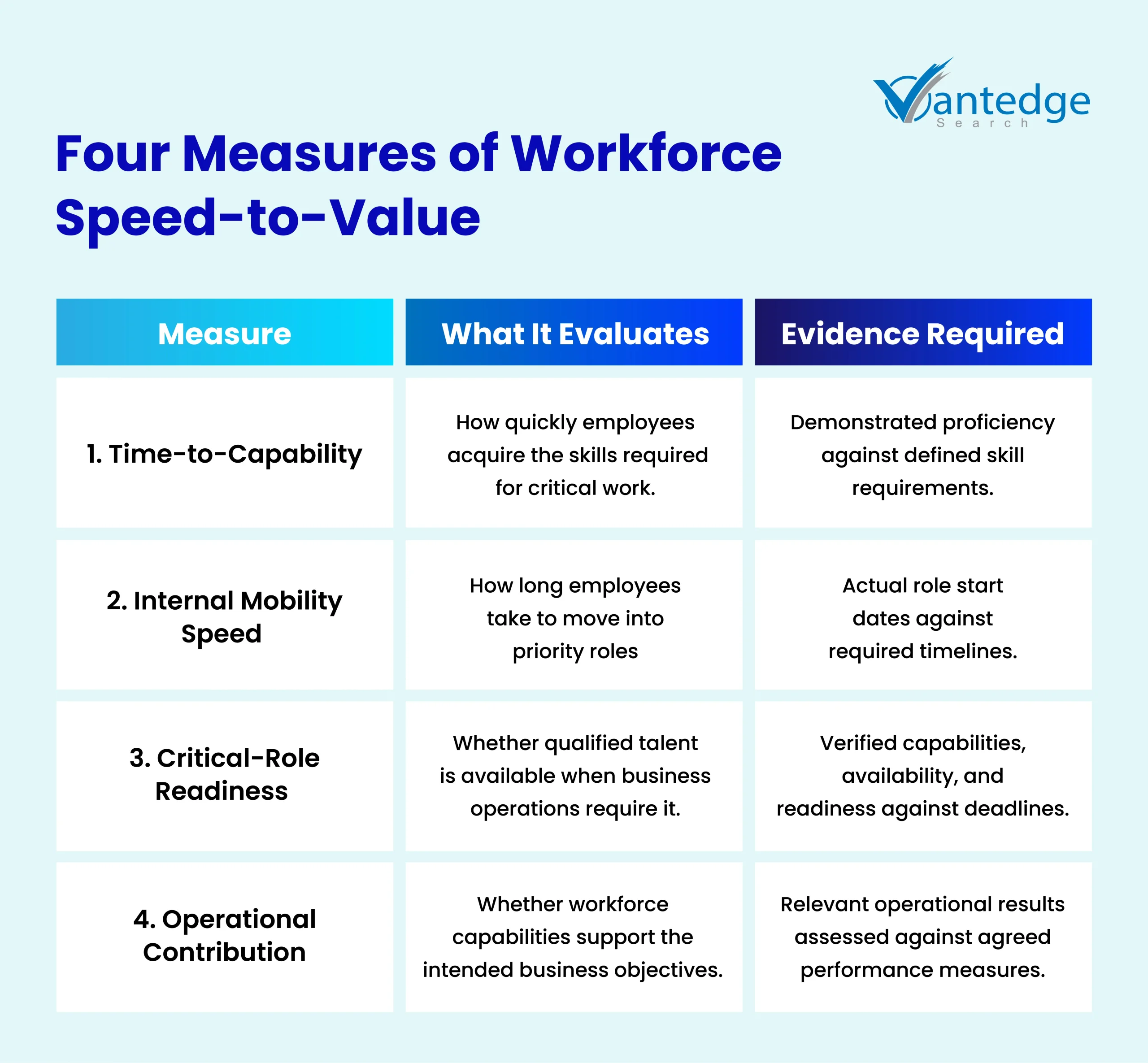
This discipline connects HR strategy directly with operational and financial requirements, establishing clearer standards for how to measure HR impact on business outcomes. Alongside counts of completed training modules or filled requisitions, organizations track indicators tied to building a skills-based workforce. Relevant measures include time-to-capability for business-critical skills, the time required to move employees into priority roles, critical-role readiness, progress against workforce capability targets, and demonstrated productivity gains where reliable evidence exists.
Completing an HR activity quickly does not automatically establish wider business impact. For example, filling a technical vacancy in three weeks does not establish that the new hire can perform the required work by the business deadline. Measuring speed-to-value keeps leadership attention fixed on when the capability actually supports commercial execution on the ground.
What Speed-to-Value Requires of CHROs
Delivering workforce results within commercial timelines changes the core demands placed on the role of CHRO. Strong business judgment comes first, requiring people leaders to identify which capability gaps carry the highest commercial stakes and demand immediate action.
Alongside judgment sits strategic prioritization. Because budgets and leadership bandwidth remain finite, chief people officers must make disciplined trade-offs across competing initiatives, resource constraints, and delivery schedules rather than funding every request equally.
Speed also depends on cross-functional influence. Workforce outcomes rarely sit inside human resources alone, making close CHRO and CFO collaboration essential alongside alignment with chief executives, technology leaders, and business unit heads. When new technology changes how work is performed, CHROs must help define the roles and skills required before implementation. Execution accountability means owning agreed HR commitments while distinguishing decisions under HR’s authority from outcomes that require shared executive leadership.
Evidence-based decision-making anchors these responsibilities in daily practice. Rather than relying on anecdotal updates or activity counts, effective leaders evaluate progress through documented workforce outcomes, operational evidence, and relevant business measures.
These demands also matter when boards assess CHRO candidates. Broad claims of functional expertise are insufficient on their own. A documented record of difficult workforce trade-offs, decisions made, and results achieved provides a clearer basis for assessing leadership readiness.
Discuss CHRO executive search needs with Vantedge Search
Practical Barriers and How to Overcome Them
Faster workforce delivery can be hindered by legacy governance, unclear ownership, and reporting practices that do not reflect changing business requirements. Several operational constraints can delay results:
- Activity-centered reporting: Tracking completed HR tasks alone provides limited visibility into business progress. Leadership teams can counter this by agreeing on clear workforce outcome measures and realistic delivery timelines before launching initiatives.
- Fragmented decision authority: Unclear responsibilities across human resources, finance, technology, and business units delay critical talent decisions. Establishing explicit decision rights and clear accountability can reduce approval delays.
- Limited workforce visibility: Incomplete data on employee capabilities and critical skill gaps slows down resource allocation. Improving the quality of workforce evidence available to decision-makers provides a stronger basis for internal talent placement decisions.
- Delayed evidence of impact: Leadership development and technical reskilling may show early capability gains before their effects on business performance can be established. Pairing credible interim progress indicators with longer-term outcome measures helps distinguish early progress from verified results.
For CHRO assessment, these constraints provide important context when evaluating missed delivery timelines. Boards should examine whether the executive identified the obstacles early, acted within their authority, and escalated decisions requiring other leaders.
Action Agenda for Boards, CEOs, and CHROs
Translating speed-to-value into governance requires coordinated decisions across the boardroom and executive suite. Each leadership group holds distinct responsibilities for setting expectations, removing friction, and assessing workforce delivery against business requirements.
For Boards of Directors
Boards should review CHRO performance expectations against concrete business requirements and workforce delivery timelines. Directors should examine documented examples of past performance, covering the original business problem, actions taken, delivery period, and reported outcomes when assessing candidates and succession readiness.
For CEOs
Chief executives need to establish clear commercial objectives against which workforce contributions can be evaluated. They must clarify executive authority and accountability where initiatives span multiple functions, bringing CHROs into strategic decisions early whenever major workforce requirements arise.
For CHROs
People leaders should focus on a limited set of critical workforce priorities with measurable outcomes. Establishing baseline measures, delivery milestones, and agreed review periods allows CHROs to report progress, constraints, and demonstrated outcomes against agreed business requirements.
In executive search for CHRO roles, candidate assessment should examine business judgment, cross-functional influence, and delivery experience. Search committees should distinguish outcomes directly attributable to the executive from results achieved through wider organizational efforts.
How US Companies Are Demonstrating Measurable Workforce Delivery
Recent corporate disclosures show how large employers report measurable workforce delivery across different people initiatives. Two US examples illustrate different ways organizations set workforce targets, shorten timelines, and report operational progress.
Walmart: Delivering Workforce Capability Goals Ahead of Schedule
In its July 16, 2026 Jobs Spotlight Report, Walmart announced it had met a 2024 three-year goal to help associates move into 100,000 in-demand US roles ahead of schedule. More than half of those moves occurred through promotions, with Chief People Officer Donna Morris highlighting structured internal career pathways.
Walmart’s disclosure shows how an enterprise can set a clear workforce target, track progress, and report delivery ahead of a deadline, without presenting the milestone as independent proof of broader financial or productivity gains.
Providence: Shortening Internal Talent Movement Timelines
In an October 7, 2026 announcement with IBM, health system Providence reported results from redesigning its internal hiring and transfer processes. According to the organizations, the changes cut hiring managers’ administrative effort by 90 percent, lowered transfer costs by 60%, and allowed internal employees to start new roles an average of 12 days sooner.
Providence Chief People Officer Greg Till underscored the value of improving internal talent workflows. The reported results demonstrate shorter internal mobility timelines, although they do not independently establish wider productivity or profitability gains.
Together, these cases illustrate two sides of measurable delivery. Walmart reports achieving a defined workforce target ahead of schedule, while Providence reports reducing the time required for internal talent movement. Both illustrate why delivery timelines matter when assessing workforce initiatives.
(The growing emphasis on measurable workforce outcomes also raises questions about how boards assess CHRO performance and leadership readiness. For a closer look at these expectations, read our blog, 5 Questions Boards and CEOs Should Be Asking Their CHRO in 2026, which examines the strategic responsibilities and capabilities expected of senior people leaders.)
Conclusion
A smooth HR operation offers little comfort to a board when critical teams miss business deadlines because the required talent or skills are unavailable. Evaluating CHRO performance now requires evidence of what workforce capability was built, how quickly it reached the business, and what the executive contributed. Functional credentials and strategic vision remain important, but neither establishes an executive’s ability to deliver under commercial pressure on its own.
Boards and CEOs must carry that standard into both internal succession planning and CHRO executive search. Selection committees gain sharper insight by examining documented decisions, cross-functional influence, and results against agreed workforce targets.
Making speed-to-value part of leadership assessment gives boards a clearer basis for distinguishing executives with demonstrated delivery experience from those whose records primarily reflect functional HR management.
If your organization is hiring a CHRO or preparing for a senior HR leadership transition, connect with Vantedge Search to identify and assess executive candidates against specific business priorities, leadership capabilities, and delivery expectations.
FAQs
Gartner identifies four CHRO priorities for 2027: accelerating HR speed-to-value, maintaining human accountability for AI, focusing on differentiated workforce skills, and preparing leaders for organizational change. These priorities reflect growing expectations for productivity, workforce readiness, and business performance.
The role of CHRO includes overseeing people strategy, workforce planning, leadership development, and succession readiness. CHROs also work with executive teams to address critical capability gaps, manage workforce risks, and connect talent decisions with business objectives.
Enterprise CHRO priorities increasingly emphasize measurable business contributions because faster HR processes do not necessarily produce faster workforce results. Operational efficiency remains important, but organizations also need evidence that critical capabilities are available when business requirements demand them.
CHRO executive search helps organizations identify candidates with relevant leadership experience and capabilities. Boards can examine candidates’ records of business judgment, cross-functional coordination, and workforce delivery to assess their suitability for changing executive responsibilities.
Strategic human resource management connects workforce planning, talent development, and leadership readiness with business objectives. It supports growth by identifying critical capability requirements, addressing workforce shortages, and preparing employees to meet operational demands within required timelines.
Leave a Reply