


Beyond the Track Record: What Is an Executive Worth After They Leave?
Four Key Takeaways
- Headline deal values provide an incomplete measure of CBO capability. Announced transaction values may include contingent payments and reveal little about negotiated terms, retained commercial rights, or the agreement’s economic value.
- Individual contributions matter more than association with major transactions. Boards must distinguish a candidate’s role in deal origination, strategic decisions, negotiations, and post-deal accountability from the contributions of other executives.
- CBO hiring requirements depend on the biotech company’s business priorities. Scientific maturity, financing constraints, and partnership commitments determine the importance of commercial judgment, scientific understanding, and cross-functional leadership.
- Effective executive assessment requires evidence beyond deal records. Structured references, realistic business scenarios, and company-specific scorecards help boards evaluate candidates against the decisions and responsibilities they will face as CBO.
Executive track records have a natural stopping point: the date the executive leaves. The consequences of their leadership rarely do. Capabilities they built may keep compounding, executives they developed may go on to lead, and choices made years earlier may widen—or constrain—the options available to whoever follows. In other cases, departure reveals something less comfortable: that performance attributed to the institution depended heavily on one person’s judgment, relationships or authority. None of this makes post-tenure performance a retrospective scorecard; too much changes once a leader leaves. But it does raise a question executive leadership assessment rarely makes explicit: when evaluating what a leader accomplished, how much weight should we give to what remained possible because they had been there?
Five Ways to Look Beyond the Track Record
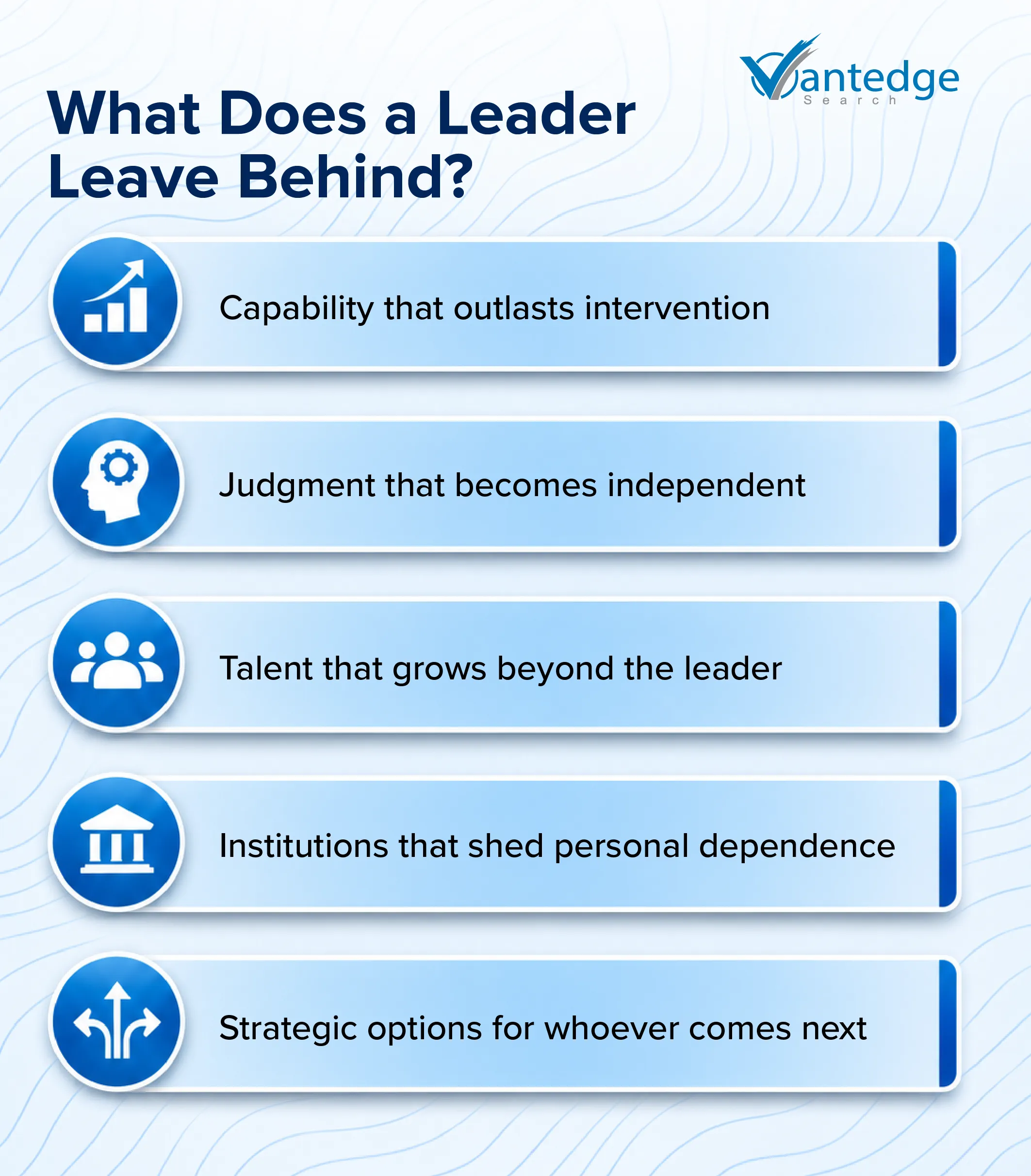
If an executive’s influence does not end with their tenure, neither should our understanding of what they built. The more revealing evidence of their leadership legacy may lie in what the organization retains once their authority is removed. Five dimensions help bring that less visible inheritance into view.
1. Capability Residue: What Still Works When the Leader Stops Pushing?
Some achievements have an executive’s fingerprints all over them. A business enters a difficult market because one leader keeps the conviction alive through years of uncertain returns. Innovation gathers pace because they create room for experiments that ordinary operating pressures would have killed. A transformation advances because they understand where resistance is structural, where it is political, and where another intervention will unlock movement. Over time, the organization can become exceptionally proficient at executing these ambitions. Yet part of that proficiency may reside in a source rarely visible on an operating dashboard: the executive’s accumulated authority, relationships, pattern recognition and ability to move the institution at precisely the right moment. During a successful tenure, those assets become almost indistinguishable from the capabilities of the enterprise itself.
Departure separates them. The organization faces another market decision, another uncertain investment, another transformation that begins to stall—and the familiar source of momentum is absent. What happens next reveals how deeply the earlier experience entered the institution. People may have acquired the judgment to navigate similar problems; processes may preserve lessons that once lived in one person’s head; teams may know how to mobilize without waiting for senior intervention. In the strongest cases, yesterday’s exceptional leadership has altered tomorrow’s baseline: the organization has become capable of doing routinely what once required an exceptional executive to make possible.
2. Judgment Transfer: Did the Organization Learn to Disagree With You?
Long-tenured executives leave behind a trail of decisions, and organizations become adept at reading it. People know which risks will get approved, how much evidence the CEO wants, what makes an investment feel premature, when persistence is admired and when it begins to look stubborn. This knowledge makes organizations efficient. It can also create a peculiar inheritance: people become highly competent at exercising judgment inside the boundaries of someone else’s judgment. The distinction is difficult to see through conventional executive assessment criteria while the executive remains in charge. Decisions are sound, debate is informed, and experienced people are involved. The real test arrives when circumstances demand a conclusion the former leader would probably never have reached.
That is where judgment becomes more interesting than knowledge transfer. An executive who leaves behind people trained to reproduce their instincts has extended their influence; one who leaves behind people capable of overturning those instincts may have created something more durable. Markets change, technologies overturn old economics, and assumptions that once deserved defending eventually deserve abandoning. The organization has to recognize that moment without waiting for a new authority to grant permission. Perhaps judgment has traveled furthest when the people who learned from an exceptional leader also know when to stop thinking like them.
3. Talent Multiplication: Who Became More Formidable Because You Were There?
Executives are often credited with building strong teams when what they have really built is a team that works exceptionally well around them. The difference can remain hidden for years. A gifted leader knows where each executive is strongest, steps into gaps almost instinctively, arbitrates tensions before they become disabling, and gives people enough cover to operate at the edge of their range. Performance rises, careers advance, and the leadership bench strength appears high. Departure changes the conditions under which that assessment was made. People who appeared ready for greater responsibility now have to exercise it without the person who had been quietly supplying context, air cover or the final twenty percent of judgment. A strong team under an exceptional executive and a team made stronger by an exceptional executive are two very different assets.
The more interesting evidence may appear in what those people subsequently become. Do they take on larger mandates without needing to recreate the environment in which they flourished? Can they lead executives who think differently from them, carry authority they once borrowed, and develop leaders whose strengths the former executive might never have recognized? This pushes executive leadership development beyond succession charts and promotion counts. An executive can leave behind several impressive protégés and still have reproduced a narrow version of themselves. The larger contribution is visible when leadership capacity expands in directions the departing executive neither controls nor resembles. The strongest talent legacy may be a generation of leaders whose success eventually stops looking like evidence of who developed them.
Evaluate CBO Leadership Fit with Vantedge Search
4. Institutional Independence: What Still Has Your Name on It?
Some executives accumulate responsibilities that never appear in an organization chart. A major customer calls them when a relationship is strained. Investors trust their reading of an uncertain quarter. Two powerful functions can work together because the executive knows how to broker the tension between them. A critical hire accepts because of a personal conversation. A difficult initiative survives because everyone knows who will step in when formal mechanisms run out of road. Over time, these arrangements stop looking exceptional. They become part of how the company works, which makes their dependence on one individual increasingly difficult to see. An organization can institutionalize its reliance on an executive without institutionalizing what that executive actually provides.
That distinction becomes clearer when we ask what still carries the leader’s name, even metaphorically. Which relationships remain credible because they hold them? Which conflicts stay manageable because they can settle them? Where does influence still travel through personal standing rather than organizational authority? The strongest executives gradually move these assets beyond themselves: trust acquires more than one custodian, authority survives a change of name, and recurring interventions become mechanisms others can use. Their departure then removes a person without removing the connective tissue that person once supplied. Perhaps institutional independence begins when the things an executive was once indispensable to no longer need to remember who made them work.
5. Strategic Inheritance: How Much Future Did You Leave Behind?
Every executive inherits a field of possibilities. Some are obvious: markets the company could enter, businesses it could acquire, technologies it could back, capital it could deploy. Others have to be created over years—a capability that makes a new business model credible, a reputation that attracts a different class of partner, an investment whose value is still uncertain, a position in an emerging market that gives the company the right to play. Executive performance evaluation tends to reward choices converted into results. Yet leadership also shapes the choices that remain available later. A successful tenure can leave a company performing strongly while quietly narrowing its future, particularly when today’s economics have been optimized so tightly that tomorrow’s alternatives have received little room to develop.
The next leadership team eventually discovers the size of that inheritance. It may find several credible paths forward, each made possible by investments whose original sponsor will never receive the eventual credit. Or it may inherit impressive numbers alongside a surprisingly thin set of choices: capabilities built for one strategy, capital already committed, businesses difficult to unwind, and few experiments mature enough to become the next engine of growth. This gives executive value a longer horizon than the strategy delivered during tenure. A leader leaves the future in a particular condition—and part of that legacy is how many serious choices the organization can still make once someone else is choosing.
The Context Behind the Leadership Legacy
No executive gets an empty canvas. A turnaround CEO inherits urgency; a founder may carry freedoms that would be unthinkable for a divisional leader; a regulated business places boundaries around choices that another industry leaves open. Ownership, board appetite, capital availability, organizational maturity and the mandate itself all shape what a leader can reasonably build beyond the immediate job. Even time changes the equation. An executive given seven years to reshape an institution has opportunities to embed capability, deepen leadership and create future options that someone hired to stabilize a business in eighteen months simply does not. What remains after a leader leaves therefore carries traces of the conditions under which they were asked to lead.
This also makes the five dimensions less useful as a scorecard and more revealing as a set of questions. Concentrated decision-making may signal dependence in one company and provide necessary control in another. A narrow strategic inheritance may reflect years of short-term optimization, or the disciplined use of scarce capital when survival allowed few alternatives. The same visible outcome can carry very different leadership meaning once mandate and circumstance enter the picture. Boards are part of that story too: they set latitude, approve investment, influence time horizons and determine how much room an executive has to build beyond current performance. The leadership legacy an organization inherits from an executive is shaped, in part, by the kind of leadership the organization made possible while they were there.
Nike: Reading a Tenure Through What Comes Next
Two accounts, written at very different points in Nike’s leadership transition, provide an interesting view of what can become visible after a CEO departure. A 2024 Forbes article published around John Donahoe’s departure described a tenure associated with greater emphasis on e-commerce and supply-chain capabilities, while also recording concerns around Nike’s pace of product innovation. Nearly two years later, WWD reported Nike’s continuing turnaround under successor Elliott Hill: Nike had reorganized 8,000 employees into vertical sport teams, reduced classic footwear franchises by more than $2 billion in fiscal 2026, increased its focus on innovation, marketing and the marketplace, and was resetting parts of the business including Greater China and Converse. Hill also described supply chain, technology and the operating model as continuing areas of focus.
Seen through the lens of executive inheritance, the interesting point is not to divide those actions neatly between what one leader got right and another is correcting. The evidence does not support such a simple accounting. It shows something more useful: after a leadership transition, some organizational capabilities continue to matter while a successor may set different priorities, structures and investments for the conditions ahead. Hill himself has cautioned that progress will not follow a straight line and has framed Nike’s current work around the next decade. Nike therefore offers a useful illustration of why an executive’s contribution cannot always be closed out on their departure date. What remains, what is reworked, and what the next leadership team chooses to build from it can reveal another part of the record.
When the Executive Can No Longer Intervene
An executive’s departure changes the conditions under which their contribution can be observed. The authority, access, relationships and ability to intervene that accompanied the role are no longer theirs to exercise. What follows cannot be attributed neatly to the leader who has left; successors make different choices, markets move, boards change, and consequences emerge that no one could reasonably have anticipated. Yet that distance may still reveal something that was harder to see during the tenure itself. Once the executive can no longer protect, propel or reshape what they built, the organization begins to show what it was able to absorb from their time there. Perhaps some of the most interesting evidence of an executive’s contribution appears only after their ability to influence it has ended.
The true value of executive leadership extends beyond tenure. Partner with Vantedge Search to identify leaders who build enduring organizational capabilities, strengthen leadership succession, and leave businesses better positioned for the future.
FAQs
Boards should consider not only the results an executive delivered but also what the organization remains capable of doing after their departure. This includes the durability of organizational capabilities, the independence of decision-making, the development of senior talent and the strategic options available to successors. However, post-tenure outcomes should be interpreted in the context of the executive’s original mandate, operating conditions and the latitude they were given.
A leadership legacy is best understood through what endures without the executive’s continued involvement. Boards can examine whether capabilities remain effective, relationships retain their institutional value, and teams exercise sound judgment independently. The objective is not to assign a retrospective performance score but to understand how much of the executive’s contribution became embedded in the organization rather than remaining dependent on their personal influence.
A CEO departure can expose dependencies that were difficult to recognize during a successful tenure. Decision-making, critical stakeholder relationships and cross-functional collaboration may have relied more heavily on the departing leader than previously understood. Conversely, the organization’s ability to sustain and adapt these capabilities can reveal the depth of what the CEO built. Neither outcome, however, should be attributed solely to the former leader.
CEO succession planning should consider not only who is ready to assume the role but also what the incoming CEO will inherit. Apparent leadership bench strength may depend partly on the outgoing executive’s judgment, authority or intervention. Boards should therefore distinguish between executives who perform effectively under an exceptional leader and those who have developed the independent judgment and leadership capacity to succeed under different conditions.
Financial and operational results reveal what an executive delivered, but they may not fully capture the long-term consequences of their decisions. A successful tenure can strengthen current performance while narrowing future strategic options. A broader executive performance evaluation should consider whether the leader expanded organizational capabilities, developed independent leadership talent and preserved credible paths for future growth, while accounting for the constraints under which those decisions were made.
Executive search can look beyond a candidate’s reported achievements to examine the organizational capabilities and leadership talent they helped develop. Relevant questions include whether former team members have succeeded under different leadership, whether critical capabilities endured after the candidate’s departure, and whether their decisions created opportunities for successors. For boards evaluating C-suite leadership candidates, this provides an additional perspective on executive value without treating subsequent organizational performance as a definitive measure of individual contribution.
Leave a Reply