


Has Your Executive Team Hit Its Design Limit?
Three Key Takeaways
- The challenge is no longer leadership capability—it is leadership design. As complexity becomes more interconnected, executive effectiveness increasingly depends on how leadership teams are structured, not just who sits around the table.
- The assumptions that shaped yesterday’s executive teams may no longer serve today’s enterprise. The question for boards is not whether leaders are capable, but whether decision-making, authority and accountability are organized for a fundamentally different operating environment.
- There is no universal blueprint for the future C-suite. Every organization must design its executive architecture around its own strategy, context and risk appetite—but the conversation can no longer be postponed.
Has Your Executive Team Hit Its Design Limit?
Several years ago, one of Amazon’s most senior executives raised an unusual concern with Jeff Bezos. The company wasn’t struggling with a shortage of ideas or strategic priorities. It was struggling with the sheer volume of them. As former Worldwide Consumer CEO Jeff Wilke later recalled, so many initiatives had become top priorities that Bezos was “releasing too much work into the system.” Rather than scaling back ambition, Bezos challenged his team to find ways to increase the organization’s capacity. It is a conversation that increasingly reflects a broader challenge confronting executive team performance everywhere.
The Executive Team Was Designed for a Different World
The challenge is not simply that business has become more complex. It is that organizations are now expected to operate through several different logics at once. They must be globally integrated and locally responsive. They must move quickly without weakening control. They must fund long-term reinvention while delivering near-term performance. They must standardize where scale matters and decentralize where context matters. None of these tensions is new on its own. What is new is that they now arrive together, demand resolution in real time and rarely offer leaders the comfort of choosing one side over the other.
This changes the nature of executive decision-making and work. The senior team is no longer just setting direction and allocating resources. It is continuously deciding which operating logic should prevail, where and for how long. A market may require local autonomy while the technology platform demands global consistency. An AI investment may call for experimentation even as regulation requires tighter oversight. A supply-chain decision may improve resilience while weakening cost efficiency. The real work happens in these trade-offs, and the answer often changes by geography, business line or moment. There is no universal playbook for navigating these tensions. Every organization must resolve them in ways that reflect its own strategy, operating model and appetite for risk. Leadership has become less about applying a stable model and more about managing a portfolio of competing truths.
That is where the design question begins. Most executive team structures are still built around enduring roles, fixed decision paths and a center expected to reconcile the enterprise. But the work increasingly requires decisions to be made across different speeds, contexts and horizons without every tension travelling upward for resolution. The issue is not that the traditional model belongs to a distant past. It is that the operating environment has changed faster than the assumptions embedded in the model. The important question, then, is not whether executive teams need to modernize in some general sense. It is whether they are designed to hold contradiction without turning every contradiction into delay.
Leadership Is Already Being Redesigned
It’s already happening.
A recent Fortune profile of Nissan’s transformation offers an interesting example of how some organizations are responding to a changing business environment. As the company reshapes its global operations, CEO Ivan Espinosa describes headquarters as providing “guardrails” while regional businesses take greater ownership of execution. Elsewhere, Nissan has reduced the number of executives involved in certain design decisions from twelve to three in order to operate at what its leaders describe as “China speed.” The company is also using AI and digital tools to shorten development cycles and simplify decision-making.
Our reading is that these are more than isolated operational changes. Taken together, they point to a broader shift in how leadership itself is being organized. Nissan is not simply redesigning its business; it appears to be rethinking how decisions move through the organization. The emphasis seems to be shifting from centralized control towards greater clarity about where decisions should be made and how quickly they can be made, bringing the question of centralized vs decentralized decision making into sharper focus. That may not represent a universal blueprint for executive teams—nor should it. Every organization operates within its own strategic and governance context. But it does raise an important question for boards and CEOs alike: if the environment has fundamentally changed, should the architecture of leadership evolve with it?
Continue the conversation with Vantedge Search.
Five Conversations Boards Should Be Having
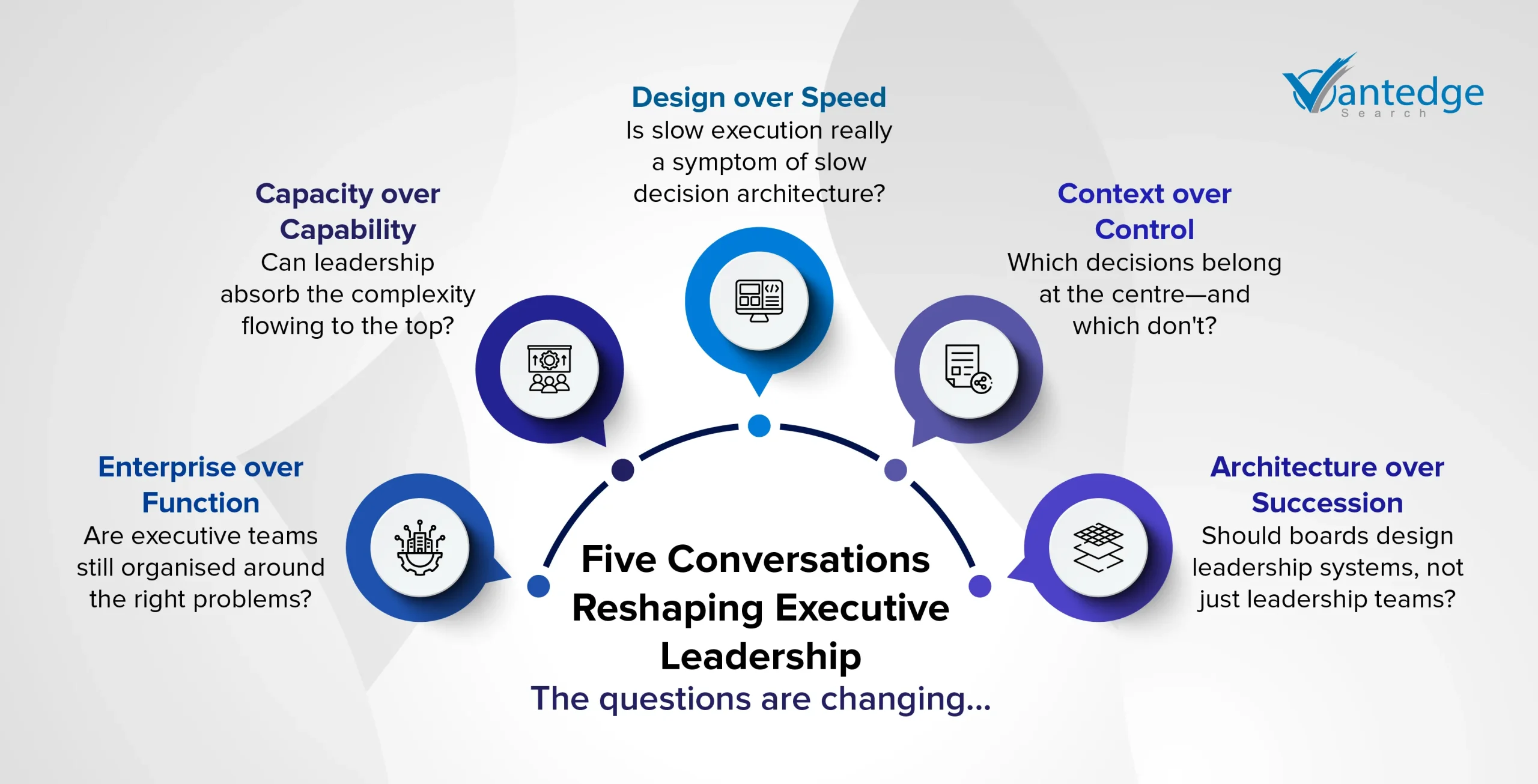
Our intention is not to suggest that there is a new blueprint for executive leadership. There isn’t. Every organization must respond to its own strategy, industry and context. Yet the underlying questions are becoming increasingly difficult to ignore. Increasingly, the conversation is moving beyond who sits around the executive table to how leadership team structure is designed to govern an increasingly complex enterprise. We believe these five conversations deserve greater attention.
When Problems Stop Respecting Functions, Should Leadership Still Be Organized Around Them?
The functional C-suite wasn’t an accident. It was an elegant solution to a world where expertise created advantage and responsibilities were easier to define.
That world hasn’t disappeared. It has become layered.
Present-day defining challenges don’t arrive with labels attached. Artificial intelligence doesn’t begin and end with technology. Customer trust isn’t owned by Marketing. Geopolitical risk doesn’t stop at Operations. The issues shaping enterprise value increasingly cut across every function at once, placing a greater premium on cross-functional leadership.
The executive team, however, often remains organized as if those boundaries still exist.
Perhaps that’s the conversation.
Not whether functional leadership has outlived its usefulness—it hasn’t. Deep expertise will always matter. But if the most consequential decisions are enterprise-wide, should the leadership team continue to be organized primarily around functional ownership?
Imagine building your executive team today, with a blank sheet of paper rather than an inherited organization chart.
Would you still begin with functions?
Or would you begin with the enterprise problems that define your strategy?
There may not be a single right answer. But increasingly, it feels like the right question.
Can a Leadership Team Run Out of Capacity Before It Runs Out of Talent?
Boards spend considerable time asking whether they have the right leaders around the table.
Perhaps the harder question is whether they’re asking too much of them.
Not because today’s executives are less capable. Quite the opposite. Few leadership teams have ever had to navigate the breadth of issues they do today. Every strategic decision now seems to arrive carrying three or four others with it.
The challenge isn’t simply making more decisions. It’s making more interconnected decisions. Decisions that refuse to stay within one function, one market or one time horizon.
At some point, even exceptional leadership teams encounter a limit. Not a limit of talent, but of capacity.
The question then shifts. How much complexity should an executive team be expected to absorb? And at what point does the concentration of decisions at the top become a constraint on the organization rather than a source of strength?
Perhaps that’s the conversation boards need to have. Not whether their leaders can do more. But whether the leadership system they’ve built is asking them to do too much, and what that means for executive team effectiveness.
What If Speed Is Really a Design Problem?
When organizations slow down, the first instinct is often to ask people to move faster.
But what if speed has less to do with effort and more to do with design?
Every additional approval, every extra committee, every unnecessary handoff feels reasonable in isolation. Over time, however, they create something few organizations intend—a leadership system where decisions spend more time travelling than progressing.
The question, then, is not simply how quickly executives make decisions. It is how quickly the decision-making process enables good decisions to be made.
That shifts the conversation.
Instead of asking, How do we make leaders move faster? perhaps boards should ask, Where does decision-making lose momentum? Which decisions genuinely require executive attention? Which ones could move closer to where the best information already exists? And how much organizational energy is spent navigating the system rather than creating value?
Perhaps speed is not a leadership challenge after all. Perhaps it is a design choice.
Does Every Important Decision Still Need to Find Its Way to the Centre?
For decades, centralization made perfect sense. It brought consistency, reduced risk and ensured that decisions reflected the interests of the enterprise rather than the priorities of individual businesses or functions.
But the world has become less uniform.
Markets move at different speeds. Customers don’t behave alike. Regulation varies across geographies. Competitive threats emerge without waiting for the next executive meeting. Increasingly, the people closest to the challenge are also the people with the richest context.
Perhaps that’s the shift.
The role of the center in organizational decision making may no longer be to make every important decision. It may be to define what should remain consistent across the enterprise, what should never be compromised, and where judgement can safely be exercised closer to the business.
That isn’t a case for less governance. If anything, it demands greater clarity. The question isn’t whether organizations need a strong center. It’s whether a strong center should always mean a more centralized one.
Should Boards Spend as Much Time Designing Executive Teams as Appointing Them?
Few responsibilities are more important to a board than choosing the leaders who will shape an organization’s future. Succession planning, leadership assessment and CEO selection have rightly become boardroom priorities.
But perhaps there is another question worth asking.
What if leadership effectiveness depends as much on the system those leaders inherit as the leaders themselves?
An exceptional executive team can still struggle if decisions accumulate in the wrong places, if accountability becomes blurred, or if the architecture of leadership no longer reflects the realities of the business. The challenge, then, is not simply finding the right leaders. It is ensuring they inherit a leadership system designed to help them succeed.
Perhaps that is the next frontier of board oversight. Not just succession planning, but the architecture of executive leadership. Because while leaders eventually change, the systems they inherit often endure for far longer.
A Final Thought
Organizations rarely outgrow the assumptions on which they were built. More often, they outgrow the assumptions they no longer pause to question. Perhaps that is where executive leadership finds itself today. Not because organizations are short of capable leaders or bold ambition, but because the design principles that have served executive teams so well for decades are being tested by a very different operating reality.
There may never be a single blueprint for the executive team of the future, nor should there be. Every organization will arrive at its own answer, shaped by its strategy, culture and context. But the questions themselves are becoming harder to ignore. Is the executive team structure designed to solve the problems that matter most today? Or is it still optimized for a world in which those problems looked very different?
Perhaps the next competitive advantage will not come from asking more of leaders. It may come from asking different questions about leadership itself.
The future may not need different leaders. It may need leadership designed differently.
Partner with Vantedge Search.
FAQs
A useful signal is when capable leaders repeatedly encounter the same friction: decisions accumulate at the top, cross-functional issues take too long to resolve, or senior executives spend increasing amounts of time reconciling matters that do not fit neatly within individual functions. In such cases, changing the people may not address the underlying issue. The executive team structure itself may need examination.
Yes. Leadership capacity is not determined by talent alone. As strategic issues become more interconnected, a highly capable team can still become a bottleneck if too many decisions, trade-offs and exceptions require its direct involvement. The relevant question is not simply whether executives can handle more, but whether the leadership system should continue sending so much to them.
Because additional leadership capacity does not automatically simplify the system. More roles can also create more interfaces, overlapping accountabilities and additional points of coordination. Before adding another executive position, boards and CEOs may therefore want to understand whether the underlying problem is missing expertise—or the way authority and decisions are currently organized.
The distinction is less about whether centralized or decentralized decision making is inherently better and more about what each decision requires. Matters involving enterprise-wide standards, material risk or shared strategic interests may warrant central oversight. Decisions whose quality depends heavily on local knowledge, customer context or speed may benefit from being made closer to where that information resides. The critical requirement is clarity about the boundaries between the two.
Not necessarily. Functions remain important because deep expertise and clear accountability still matter. The design question arises when the problems creating or threatening enterprise value routinely cross those functional boundaries. Boards and CEOs can then ask whether the existing leadership team structure gives executives an effective way to resolve enterprise-wide issues without forcing every cross-functional tension upward.
Potentially, yes. Waiting for poor performance can make leadership design a reactive conversation. A more useful moment to examine it may be when the business itself changes—through growth, new technology, geographic expansion, regulatory complexity or a shift in strategy. The question is not whether the current executive team is succeeding, but whether the architecture supporting it remains suited to what the organization is becoming.
Leave a Reply