


Internal CEO Candidate Evaluation: Proven or Simply Familiar? Five Questions for the Final Board Decision
Table of Content
- Familiarity Can Create Confidence Before Proof Exists
- Before Assessing the Candidate, Define What Must Be Proved
- Five Questions for the Final Board Decision
- Turn the Five Answers into a Decision, not a Score
- What Recent Internal CEO Selections Show About the Evidence Boards Can Examine
- Conclusion: Familiarity Should Not Lower the Standard of Proof
- FAQs
Four Key Takeaways
- Familiarity is useful, but it is not proof. Boards should test whether the internal CEO candidate has evidence of readiness for the exact mandate ahead, not just long-standing exposure to the company.
- The mandate must be defined first. Before reviewing the candidate, directors should identify the outcomes the next CEO must deliver and separate what is directly proved, partly proved, or still unproved.
- The final decision should rest on evidence, not title. Boards need to examine broader authority, attributable results, enterprise judgment, independent thinking, and remaining gaps before confirming the appointment.
- A central gap does not automatically disqualify the candidate. It does, however, require honest board discussion, clear support requirements, and, where needed, a market comparison before the final call.
Familiarity Can Create Confidence Before Proof Exists
At the final stage of CEO selection, an internal candidate often arrives with a substantial advantage: the board knows the executive’s record, leadership style, relationships, and understanding of the business.
That knowledge has value, but it is not the same as proof. A board may know how a candidate performs within a current remit without holding equal evidence of how that person will perform with full CEO authority.
McKinsey’s 2026 research on family-owned businesses, based on 200 publicly traded companies and a survey of 170 additional businesses, found that total shareholder return declined by an average of 5.7 percentage points in the five years after a CEO transition compared with the preceding five years. The finding does not establish causation or apply to every company, but it reinforces the need for rigorous assessment at the point of appointment.
There is a material difference between knowing the candidate, trusting the candidate, and having evidence that the candidate can deliver the next mandate.
The final decision should rest on what the board can prove, not simply on how well it knows the candidate.
Before Assessing the Candidate, Define What Must Be Proved
An internal CEO candidate evaluation starts with the mandate, not the individual. Before weighing reputation, tenure, or leadership style, the board must agree on what the incoming CEO is required to accomplish during the critical early months of the appointment.
The mandate may involve improving operating or financial performance, changing capital-allocation priorities, managing a strategic shift, expanding across markets, reshaping the leadership team, or building confidence among investors or regulators. These requirements are not interchangeable. Each carries a different degree of risk, accountability, and required evidence.
For every priority, the board should classify the candidate’s record as:
- Directly proved: The candidate has delivered a comparable result with similar authority.
- Partly proved: The candidate has relevant experience, but not at the same scale or level of accountability.
- Not yet proved: The candidate has no direct evidence for that requirement.
This provides clear CEO selection criteria. Once the mandate is defined, the board can examine the evidence behind the candidate through five distinct questions.
Assess internal CEO readiness with Vantedge Search
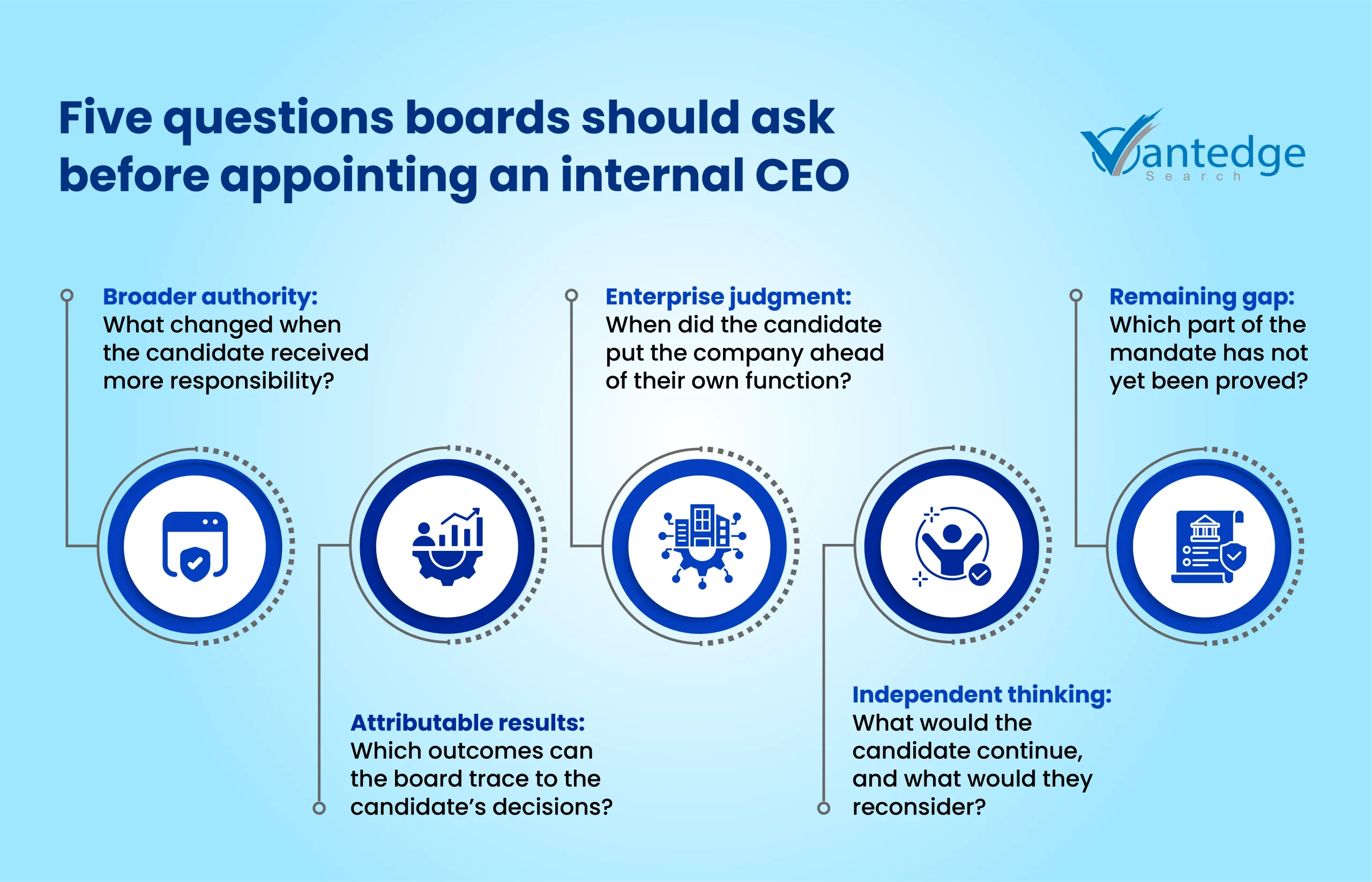
Five Questions for the Final Board Decision
The mandate now gives the board a defined basis for assessment. The questions that follow examine whether the candidate’s record provides evidence for its most important requirements, including performance under wider authority, personal decision-making, enterprise judgment, independent thinking, and any remaining exposure.
1. What Changed After the Candidate Received Broader Authority?
The first question asks whether the company has already observed the candidate operating with more authority, wider responsibility, or greater direct accountability. That responsibility may have come through an interim CEO appointment, a COO mandate, business-unit leadership, or an expanded regional position.
The board should request specifics. What decisions did the candidate make after their authority increased? Which business problems became their direct responsibility? What changed in performance, pace of decision making, or stakeholder confidence after the change?
The evidence should include results before and after the new remit, decisions the candidate delayed or avoided, and feedback from people affected by those decisions. The board should also consider whether the candidate’s performance strengthened as responsibility increased.
A weak answer describes a larger title or remit but cannot identify what the candidate accomplished with it. This question replaces speculation about potential with observed performance. It asks what the company learned after it gave the executive more responsibility, rather than what it hopes may happen after the CEO appointment.
2. Which Results Can the Board Directly Trace to the Candidate’s Decisions?
A strong reputation is not automatically evidence of personal impact. Business-unit performance may reflect market conditions, inherited teams, earlier investments, acquisitions, or decisions made by the current CEO. CEO performance assessment requires the board to separate those factors from the candidate’s own judgment.
For every material result cited in the candidate’s favor, the board should establish:
- The starting position before the candidate’s decision
- The decision the candidate personally owned
- The measurable change that followed
- The period over which that change occurred
- Other factors that contributed
- Whether the result continued over time
- Who can confirm the candidate’s role
A weak answer depends on broad statements such as “we delivered growth” or “we improved performance,” without identifying the executive’s personal contribution.
This is not an attempt to discount team achievement. The purpose of CEO performance evaluation is to establish what the candidate personally proved through decisions, judgment, and accountability. It is a question of attribution, not career breadth or enterprise tradeoffs.
3. When Did the Candidate Put the Enterprise Ahead of the Business or Function They Led?
Holding several senior positions does not, by itself, prove enterprise-level judgment. The board should ask for a moment when the candidate made a difficult decision for the wider company, knowing their own business, region, or function would lose something in the process.
The board should seek an example in which:
- The candidate’s area lost budget, resources, authority, or recognition
- Another part of the company received the benefit
- The candidate accepted responsibility for the tradeoff
- The reasoning rested on wider company needs
- The business effect can be verified
A weak answer offers a collaboration example where no function accepted a meaningful cost and no genuinely difficult choice was required. Cooperation matters, but it is not the same as accepting a genuine tradeoff for the enterprise.
This is one of the most important questions boards should ask internal CEO candidates. It tests enterprise-first judgment, not functional versatility. The focus is the quality of the decision and the willingness to act beyond the interests of the candidate’s own area, rather than the final performance number.
4. What Would the Candidate Continue, and What Would They Reconsider?
This question tests whether the candidate can protect what is already working while forming an independent view of current priorities. The board should not demand change simply to make a candidate appear independent. It should, however, distinguish continuity based on sound judgment from continuity based on habit, loyalty, or comfort with familiar decisions.
The candidate should identify:
- One priority that should continue and why it remains relevant
- One assumption that now requires review
- One investment, activity, or practice that may need to change
- The evidence behind each position
- The consequences of making, or avoiding, the proposed change
A weak answer promises complete continuity or proposes major changes without a specific business reason. Neither response demonstrates the measured judgment expected in an executive leadership assessment.
This question does not assume the candidate created the current strategy. Nor does it treat continuity or change as inherently correct. It asks whether the executive can make an independent assessment of what the company should preserve, reconsider, and alter under the next CEO mandate.
5. Which Part of the Next CEO Mandate Has the Candidate Not Yet Proved?
No candidate will have direct evidence for every element of a CEO role. The crucial question is whether the unproved requirement is manageable or central to the mandate. A credible internal CEO candidate evaluation should identify uncertainty clearly before the appointment, not after it.
The board should request clarity on:
- The mandate requirement with the least direct evidence
- Related experience that provides partial support
- Why the gap matters to the business
- The consequence if the gap becomes a problem
- Board or leadership-team support that may address it
- When progress should be reviewed
- Whether an external market comparison is necessary
A weak answer claims there are no meaningful gaps, offers a rehearsed weakness unrelated to the role, or indicates that the candidate would require extensive support in a non-negotiable area.
This question does not ask whether the candidate is generally ready. It identifies the specific risk the board would accept by making the appointment. That distinction is central to how to assess CEO readiness before a promotion.
Turn the Five Answers into a Decision, not a Score
The five questions should not become five equally weighted checklist items. One significant weakness in a central part of the mandate may outweigh several genuine strengths elsewhere. A mechanical score can create a false sense of certainty when the board needs a judgment grounded in evidence.
Three outcomes generally describe where the evidence lands:
- Proved for the mandate: Direct and verifiable evidence covers the central requirements of the role.
- Proved with a defined gap: A specific gap remains, but its business effect and the support required to manage it are understood.
- Evidence remains insufficient: Proof is missing in an area the company cannot reasonably compromise.
Insufficient evidence does not mean the executive is weak. The candidate may be highly capable but not fully proved for this company’s requirements at this point.
When a central gap remains, an external market comparison can give the board an additional reference point without automatically rejecting the internal candidate. This board decision framework for CEO succession supplements formal performance, financial, legal, reputational, and reference checks. It does not replace them.
The final CEO appointment depends partly on the leadership bench built before the decision. (Read our blog: CEO Succession Planning: Fixing the Leadership Pipeline Crisis, for insights into preparing credible internal candidates well before a leadership transition).
What Recent Internal CEO Selections Show About the Evidence Boards Can Examine
Recent internal CEO appointments show the kinds of evidence that may be available to a board before it makes a final decision: performance during an interim mandate, experience gained through company-wide operating responsibility, and a documented progression into broader accountability.
Apple
Apple announced that John Ternus will become Chief Executive effective 1 September 2026, with Tim Cook moving to Executive Chairman.
Ternus had served as Senior Vice President of Hardware Engineering, a role tied to a major part of Apple’s product and revenue base. That gives the board a clear way to assess the executive’s company-wide exposure, decision scope, and readiness for the next CEO mandate.
Dow
Dow appointed Karen S. Carter as Chief Executive effective July 1, 2026, following her service as Chief Operating Officer and a multiyear succession-planning process.
A company-wide operating mandate gives a board a basis to assess how an executive has handled wider responsibilities before moving into the CEO role. It does not, by itself, answer every question about the next mandate. Directors still need to determine which responsibilities were directly held, which outcomes can be attributed to the candidate’s decisions, and what material requirements remain less proven.
These appointments show how a board can assess visible evidence before a final decision, including the scope of the role, the work completed under broader authority, and the progression into CEO-level accountability.
Conclusion: Familiarity Should Not Lower the Standard of Proof
Internal knowledge is an important advantage in CEO succession. It gives the board a deeper view of an executive’s judgment, relationships, and record than any external process can provide at the outset.
Still, familiarity cannot substitute for evidence. Before confirming an appointment, the board should establish what changed when the candidate held wider authority, which results can be traced to the candidate’s decisions, and whether the executive has acted for the enterprise rather than a single function or business.
The board should also test the candidate’s independent view of current priorities and identify any unproved part of the mandate. Where central evidence remains incomplete, an external market comparison may help test the board’s assumptions. It is a reference point, not a presumption against the internal candidate.
For structured CEO succession support grounded in evidence and discretion, partner with Vantedge Search for board-level advisory on internal candidate evaluation.
FAQs
It involves testing whether the candidate can deliver the next CEO mandate, based on observed performance, attributable results, enterprise judgment, independent thinking, and any remaining gaps the board must understand before appointment.
It should measure how the candidate has performed with broader authority, which results can be traced directly to their decisions, whether they have made enterprise-first tradeoffs, and where the mandate remains unproved.
Boards should assess the candidate against the company’s actual mandate, then review direct proof, partial proof, and unproved areas across performance, decision quality, judgment, continuity, and unresolved risk.
General succession planning builds the leadership bench over time. Internal CEO succession is the final appointment decision, where the board tests whether a known internal candidate is sufficiently proved for the specific role.
Boards should ask when the candidate chose the enterprise over their own function, what tradeoff they accepted, why it served the wider company, and how the impact of that decision can be verified.
Leave a Reply