


The Emerging Hybrid C-Suite: Roles That Blend AI Governance, People Strategy, and Enterprise Resilience
Four Key Takeaways
- Hybrid C-suite roles are changing executive expectations as AI governance, workforce strategy, and enterprise resilience increasingly require decisions across established business functions.
- Broader responsibilities do not always require new C-suite positions. Companies must determine when to expand existing mandates, appoint specialists, or strengthen coordination between executives.
- Effective hybrid mandates depend on clear authority and accountability. Overlapping responsibilities can lead to conflicting priorities, delayed decisions, and confusion over who is responsible for specific business outcomes.
- Succession planning and executive search require a broader assessment of experience. Boards must evaluate demonstrated cross-functional judgment, direct accountability, and business outcomes when selecting executives for expanded mandates.
Introduction
In a July 2026 survey of 152 CEOs, BCG found that 55% identified redesigning work and roles as a barrier to scaling AI. However, only 30% included HR in AI governance, compared with 82% who included technology. The findings expose a gap between the responsibilities affected by AI and the functions involved in overseeing its adoption.
The traditional division of C-suite responsibilities is becoming harder to maintain as agentic AI enters business operations. Technology decisions increasingly carry workforce implications, while automated processes introduce questions about operational continuity, security, and accountability. These demands extend across the established mandates of CIOs, CHROs, and risk executives.
Companies are beginning to respond through expanded executive responsibilities, specialist appointments, and positions requiring experience across multiple functions. The emergence of hybrid C-suite roles reflects a growing need for leaders who can exercise judgment beyond their primary areas of expertise.
For boards, CEOs, and CHROs, this creates important considerations for organizational design, leadership succession planning, and executive hiring. The blog examines where AI governance, people strategy, and enterprise resilience intersect, how these combinations are influencing executive mandates, and what boards should consider when identifying candidates for broader responsibilities.
Why Hybrid Roles Are Emerging Now
Three operational pressures are forcing C-suite leadership to rethink functional boundaries: automated system integration, workforce restructuring, and escalating operational vulnerability. As automated tools move from back-end processing into daily operations, the lines separating technology, human resources, and risk management blur.
The first pressure comes from the growing use of AI agents across business functions. McKinsey’s August 2026 State of AI research reveals that 40 percent of enterprises with annual revenues over $1 billion are scaling AI agents, up from 27 percent in 2025. Introducing autonomous agents into business workflows requires rigorous oversight within an AI governance framework to prevent compliance failures and algorithmic drift. Consequently, AI governance leadership must now align directly with daily operational management.
Workforce planning represents the second pressure. Gartner’s June 2026 research, The AI-Ready CHRO, reports that human resources chiefs increasingly manage technical enablement alongside job design. Combining people strategy and AI requires redesigning workflows, assessing internal skills, and maintaining human oversight over automated recommendations.
The third factor is organizational defense. Deloitte’s 2026 Global Human Capital Trends report underscores that coordinating human workers with automated systems demands tighter operational continuity. Cyber threats, vendor software dependencies, and regulatory mandates mean enterprise resilience cannot sit exclusively with a single Chief Information Security Officer.
These forces converge at the executive committee level, sparking demand for hybrid C-suite roles. The need for cross-functional executive leadership is altering the capabilities companies require in senior executives. Governing bodies now seek leaders who understand technical guardrails, workforce implications, and operational risk simultaneously.
Assess cross-functional leadership with Vantedge Search
Mapping the Emerging Hybrid Archetypes
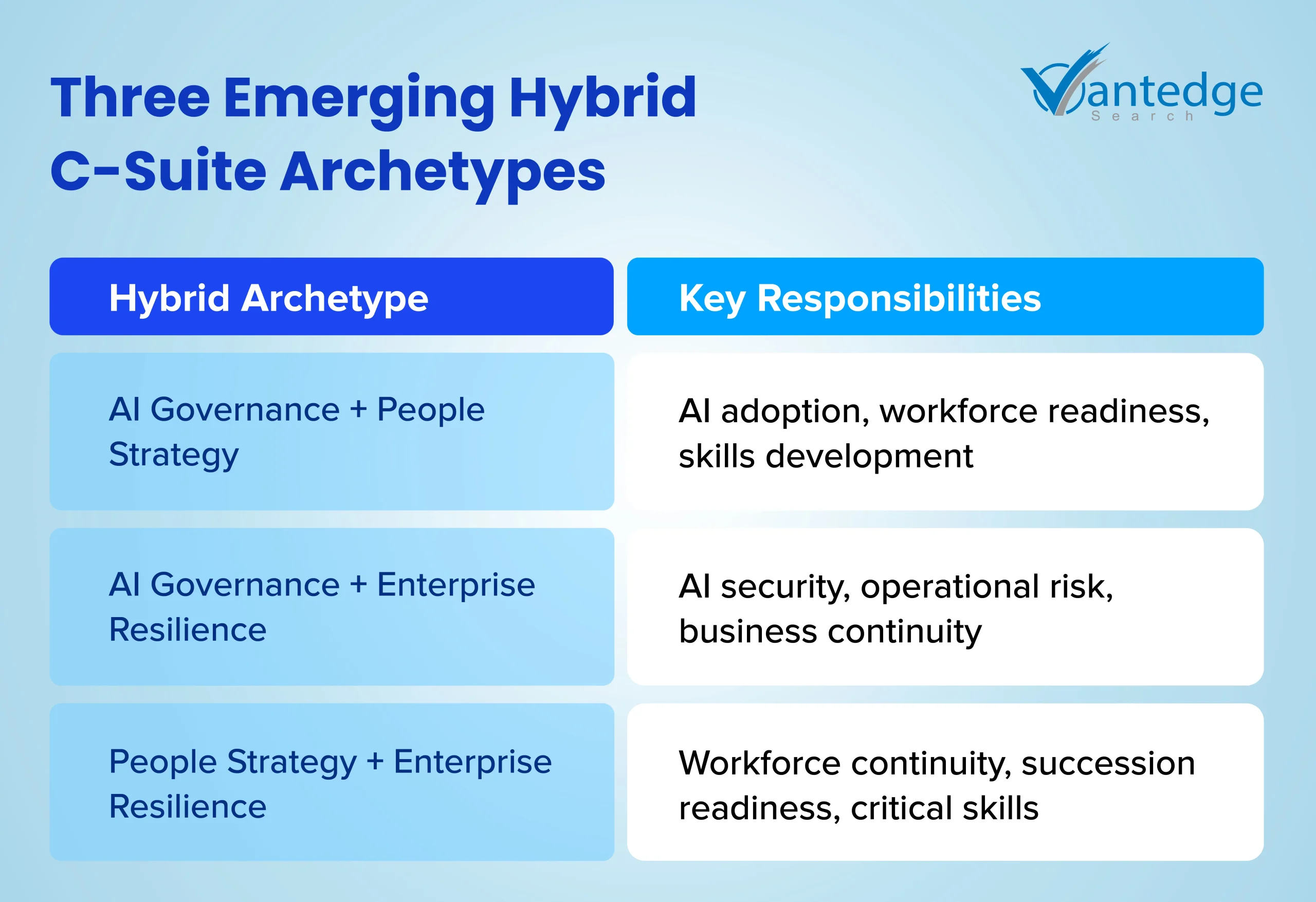
Hybrid C-suite roles are developing in response to different business requirements. Some companies are bringing workforce strategy closer to AI adoption, while others are combining expertise to address security risks or operational demands. The three archetypes discussed below illustrate some of these emerging combinations rather than an exhaustive set of possibilities. Other configurations may develop as organizational priorities and business requirements evolve. The responsibilities assigned to C-suite executives reveal how organizations are reconsidering established functional boundaries.
AI Governance + People Strategy
Introducing AI into daily work requires more than technical implementation. Employees need to develop new capabilities, managers must reconsider how work is assigned, and organizations need clear expectations for human oversight. These responsibilities are bringing people leaders into decisions previously concentrated within technology functions.
At ServiceNow, Jacqui Canney’s position as Chief People and AI Enablement Officer brings talent strategy and workforce AI adoption under one mandate. The practical scope of her responsibilities became clearer in May 2026, when ServiceNow introduced AI Learning Guide and SimStudio within ServiceNow University. These tools provide personalized coaching and practical simulations to help employees, customers, and partners develop AI-related capabilities.
The arrangement gives people leadership a direct role in preparing the workforce for AI adoption. While enterprise-wide technical governance remains a separate responsibility, the mandate requires expertise in connecting workforce development with technology priorities.
AI Governance + Enterprise Resilience
The relationship between AI and enterprise resilience becomes particularly important when automated systems are used in security-critical operations. Decisions about model performance, system reliability, and human intervention can have immediate consequences for an organization’s ability to respond to threats.
In June 2026, CrowdStrike appointed Bartley Richardson Chief AI and Autonomous Systems Officer, drawing on his previous experience leading agentic AI and cybersecurity AI engineering at NVIDIA. His responsibilities include directing CrowdStrike’s AI strategy and advancing autonomous security capabilities.
The company extended this work in September 2026 with its Cyber Superintelligence Lab, led by Richardson. The initiative brings AI researchers, threat intelligence specialists, and incident responders together to develop AI capabilities for cybersecurity.
His mandate connects AI development with the demands of security operations, where automated decisions must account for real-world threats. It represents specialist AI leadership within cybersecurity rather than formal ownership of enterprise-wide resilience.
People Strategy + Enterprise Resilience
An organization’s ability to maintain operations also depends on the people responsible for delivering essential services. Workforce capacity, leadership preparedness, and operational requirements become closely connected when service demands change or business conditions create pressure.
In June 2026, Synchrony expanded DJ Casto’s responsibilities, appointing him Executive Vice President, Chief People and Operations Officer. Alongside his existing responsibility for Human Resources, Casto assumed oversight of operations, including servicing, collections, and customer care.
The expanded mandate places workforce decisions and major customer-facing operations under the same executive. It connects talent management with the staffing, management, and operational capabilities required to sustain service delivery.
Although the position does not include formal enterprise risk ownership, it provides a clear example of people leadership extending into operational accountability.
These appointments show how different business requirements can shape hybrid C-suite roles. Some mandates may eventually call for expertise spanning AI governance, people strategy, and enterprise resilience together. The more immediate consideration for boards is how much cross-functional authority a position requires and what experience qualifies an executive to exercise it.
Implications for Boards, CEOs, and Organizational Design
An expanded executive mandate changes what boards should look for in potential successors. A CHRO with an established record in talent management may also need experience leading AI-related workforce initiatives. Similarly, a technology executive assuming broader risk responsibilities must demonstrate judgment beyond technical delivery. Succession criteria should reflect the actual scope of the position.
Board oversight also warrants attention. When executive responsibilities extend across technology, human capital, and enterprise risk management, directors need clarity about committee responsibilities and reporting arrangements. Existing board expertise and director skill matrices may require review, particularly where AI governance introduces oversight requirements beyond established functional boundaries.
For CEOs, the immediate consideration is how much authority an expanded executive mandate should carry. Reporting relationships, resource allocation, and responsibility for decisions involving multiple functions need to be established before making an appointment. Deloitte’s 2026 research on AI-supported decision-making highlights the importance of clearly assigning decision rights as human and AI responsibilities become more closely connected.
The choice between expanding an existing position and creating a separate role should depend on business requirements, specialist expertise, and the capabilities already available within the leadership team. Adding responsibilities to an executive with insufficient capacity or relevant experience may create further management difficulties.
These decisions also affect executive hiring. Boards need to assess internal leadership potential against revised role requirements before determining where external talent may be necessary.
(The broader implications for leadership structure are examined in Vantedge Search’s blog, Has Your Executive Team Hit Its Design Limit?, which considers how executive accountability and decision-making responsibilities affect organizational effectiveness.)
Challenges, Risks, and Practical Guardrails
Expanding executive responsibilities can create problems when the authority attached to a position does not match its expectations. For hybrid C-suite roles, these difficulties become more pronounced when decisions involve several established functions.
Where Hybrid Leadership Mandates Can Fall Short
An executive responsible for AI adoption may be judged on workforce uptake while technology leaders control system investments and risk executives determine acceptable use. Without an agreed process for resolving conflicting priorities, accountability becomes difficult to establish.
Title inflation presents another concern. A broader designation may imply greater authority without changes to decision rights, resources, or reporting arrangements. Functional leaders may also resist expanded mandates that affect their established responsibilities.
Establishing Clear Accountability and Performance Measures
Boards and CEOs should document which decisions an executive can make independently, which require joint approval, and how disagreements should be resolved. For AI-related mandates, this includes defining AI governance roles and responsibilities across the relevant functions.
Performance measures must reflect these responsibilities. For an AI-related workforce mandate, adoption figures alone offer limited evidence of success without considering employee proficiency, operational performance, and compliance requirements.
Regular reviews should examine whether assigned authority and resources remain sufficient for the responsibilities involved.
Assessing Candidates Beyond Previous Job Titles
Cross-functional experience does not necessarily establish readiness for broader executive authority. Candidates should be assessed on decisions they personally owned, competing priorities they managed, and outcomes they can substantiate.
Executive search partners can examine these capabilities through structured interviews, leadership assessments, and references that verify the candidate’s actual responsibilities.
The central consideration is whether an executive has demonstrated the judgment and authority required to manage responsibilities extending beyond a single function.
Preparing for the Hybrid C-Suite: Action Steps for Leaders
The need for hybrid C-suite roles may become apparent well before a new executive position is proposed. AI initiatives that affect workforce requirements, operational risk, and business performance provide opportunities to assess how effectively existing leaders manage responsibilities beyond their primary functions.
For boards: C-suite succession planning should account for the broader experience required of executives assuming overlapping responsibilities. Reviewing how potential successors have handled decisions involving technology, workforce changes, and business risk can reveal capability gaps. These findings can inform leadership development priorities and the need for external appointments.
For CEOs: Major business initiatives offer a practical basis for identifying where executive responsibilities may need to change. Recurring gaps in expertise or decision ownership can indicate the need for an expanded mandate, while existing leadership arrangements may remain appropriate where coordination is effective.
For CHROs: Internal talent assessments can identify executives capable of assuming broader responsibilities. Cross-functional assignments involving technology, operations, and risk provide opportunities to develop relevant experience and assess leadership judgment through actual business decisions.
For executive search partners: Market mapping can help establish the availability of executives with the required combination of experience. Comparing external talent capabilities with internal succession options can also help boards determine if the proposed mandate reflects realistic executive hiring requirements.
Conclusion
As AI becomes more closely connected with workforce decisions and business operations, the responsibilities of senior executives are beginning to overlap in ways that existing roles may not fully address. The emergence of hybrid leadership roles reflects how companies are responding to these demands through expanded mandates, specialist appointments, and broader functional expertise.
The implications for boards and CEOs are practical. They need to determine where existing capabilities are sufficient, where responsibilities require clearer ownership, and where additional expertise is necessary. Creating a new position is not always the answer, particularly when established executives can effectively manage the demands.
These decisions should guide organizational design, succession planning, and executive search. Appointments grounded in actual business requirements and demonstrated experience provide a stronger basis for accountability, operational resilience, and sustained performance.
If your organization is hiring for executive roles requiring experience across multiple functions, connect with Vantedge Search for executive search services focused on identifying and assessing candidates against specific role requirements and organizational needs.
FAQs
C-suite roles are an organization’s most senior executive positions, typically including the CEO, CFO, CIO, and CHRO. These leaders oversee major business functions, make strategic decisions, and carry accountability for performance within their assigned mandates.
C-suite leadership is changing as AI adoption affects technology decisions, workforce requirements, and operational risk simultaneously. Companies are reviewing executive mandates to clarify accountability and identify leaders capable of making decisions across established functional boundaries.
Enterprise resilience is an organization’s capacity to anticipate, withstand, respond to, and recover from disruptions while maintaining critical operations. It matters for C-suite executives because technology, workforce, security, and operational decisions collectively influence business continuity.
An AI governance framework defines the policies, decision rights, oversight processes, and controls governing how an organization develops, adopts, and monitors AI. It helps clarify accountability for risks, compliance, performance, and human intervention across business functions.
AI governance rarely rests with one executive. Depending on the organization, CIOs, chief AI officers, risk executives, and CHROs may own different responsibilities. Boards oversee management’s approach, while documented decision rights establish executive accountability.
Leave a Reply