


When the Incumbent CEO Quietly Shapes the Successor Shortlist: Board Control in CEO Succession Planning
Table of Content
- How Can the Incumbent CEO Shape the Shortlist Without Making the Final Decision
- Can the Board Form Its Own View of Each Candidate
- Who Has Decision Rights Over the Successor Shortlist
- What Happens When the Board and Incumbent Back Different Candidates
- What Recent US CEO Appointments Show About Succession Governance
- Conclusion: Board Control Starts Before the Final Vote
- FAQs
Four Key Takeaways
- The final board vote does not reveal how the candidate field was formed. CEO succession planning depends on who received visibility, who advanced, and why credible contenders left consideration.
- Incumbent influence can operate without formal appointment authority. Candidate exposure, information framing, sequencing, and informal objections can affect how the successor shortlist develops before directors reach final review.
- Board independence depends on both information and decision rights. Directors need sufficient direct evidence on serious candidates and clarity on who can add, advance, pause, or remove names from the shortlist.
- A strong succession process must still work when the CEO and board prefer different candidates. The key governance test is whether the same shortlist rules still apply when views differ.
A board of directors holds formal responsibility for appointing the chief executive. Even so, casting the final vote does not guarantee full command over how the candidate options took shape. In corporate governance, the critical choices that determine which executives reach final consideration can happen long before formal board interviews occur.
This distinction marks a fundamental challenge in CEO succession planning. Board leadership guidance from KPMG highlights this balance of responsibilities. While the outgoing chief executive provides valuable organizational input, the nominating and governance or compensation committee most often leads the process, with independent directors carrying ultimate responsibility for the CEO succession process. KPMG also notes that the list of potential internal and external candidates may change over time.
When directors evaluate a final slate, they need visibility into the progression that produced those names. The critical issue is whether independent directors helped govern the candidate field or simply selected from choices refined by management. That leads to a central question regarding the role of the board in CEO succession planning: Can the board explain why each serious candidate remained in, advanced through, or left the successor shortlist?
How Can the Incumbent CEO Shape the Shortlist Without Making the Final Decision
A board may assume it commands the CEO succession planning process because independent directors conduct final interviews and cast the decisive ballot. However, practical influence functions differently from voting authority. The chief executive typically has close involvement in daily operations, senior-executive performance, and management priorities. This proximity can create channels through which an incumbent influences the internal candidate shortlist for CEO before formal board reviews begin. When directors review only names brought forward through management, active board succession planning can become difficult to distinguish from executive endorsement.
This influence can occur through four mechanisms:
- Candidate visibility affects which corporate officers gain direct exposure to the board during regular committee meetings.
- Information framing can affect how directors view executive capabilities, particularly when an incumbent characterizes an executive’s readiness or temperament.
- Candidate sequencing affects when specific contenders receive formal exposure relative to other viable peers.
- Finally, informal objections regarding cultural alignment or working relationships can reduce a candidate’s standing before independent directors form their own view.
These possibilities do not indicate improper motives. They reflect the ambiguity inherent in executive succession. BCG’s 2026 research describes the CEO candidacy process as ambiguous and idiosyncratic, notes that selection criteria may change over time, and says candidates may begin preparing years in advance.
KPMG’s 2026 guidance separately asks how boards gain exposure to top company talent and monitor external leaders who may become CEO candidates, while placing ultimate responsibility for succession with independent directors.
Without clear oversight of these early dynamics, CEO succession risks can arise within the succession management process. Influence over visibility, framing, or timing can introduce CEO succession bias and narrow the candidate field prematurely. The core challenge is not whether an outgoing executive should provide organizational insight, but how boards keep succession independent of the CEO so that credible contenders remain subject to consistent board consideration.
Keep successor shortlist control clear with Vantedge Search
Can the Board Form Its Own View of Each Candidate
Direct exposure gives independent directors a stronger basis for forming their own view during CEO succession planning. When information about serious candidates comes mainly through management summaries, directors have less opportunity to separate documented facts from interpretation. Meaningful interaction with candidates can give the board additional context before the shortlist narrows.
Information independence also requires comparable treatment of serious candidates. Directors should be able to distinguish documented performance from personal impressions when strengths or concerns are discussed. Phrases such as “not ready” or “not the right fit” can surface in succession discussions, but they are more useful when connected to defined requirements rather than left as broad judgments.
Directors should also be able to request additional information when the existing record does not answer a material question. That may involve clarification of a concern already raised, additional evidence about past responsibilities, or further interaction with the candidate. The purpose is not to create another assessment process, but to prevent the board’s view from depending mainly on information selected or interpreted by one party.
KPMG’s 2026 guidance asks how boards gain exposure to the company’s top talent and monitor external leaders who might become potential CEO candidates. It does not prescribe one format for that exposure.
For board succession planning, the relevant question is therefore whether directors have enough direct and comparable information to reach their own judgment before CEO successor selection moves to a narrower field.
Who Has Decision Rights Over the Successor Shortlist
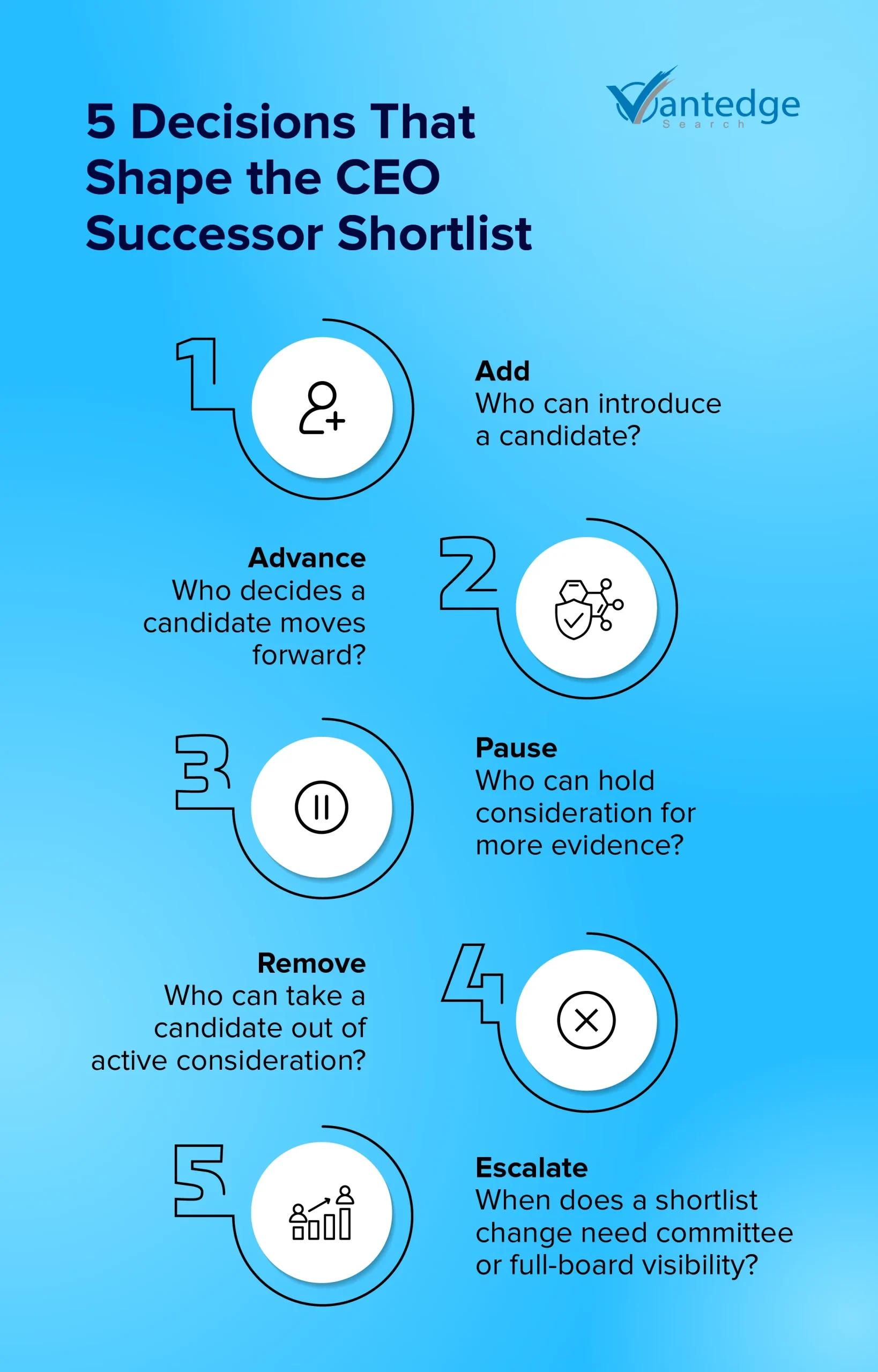
A disciplined CEO succession planning process requires clarity about who can change the candidate field. Boards may spend considerable time on the final appointment while giving less attention to the decisions that add, advance, pause, or remove candidates before that point. One practical element of CEO succession planning best practices is making those responsibilities explicit before a contested decision arises.
Boards should clarify decision rights across the CEO succession planning process steps:
- Who can add a promising executive to consideration?
- Who decides when a contender advances to deeper review or when consideration is paused?
- If a candidate is removed, who has authority to make that decision, and what explanation accompanies it?
- The board should also determine when a material change to the shortlist requires visibility from the relevant committee or the full board.
A useful distinction exists between administrative and judgment-based candidate movement. A candidate withdrawing from consideration is different from a viable contender ceasing to advance because one stakeholder no longer supports that person. The second situation involves judgment that can materially change the options available to directors.
KPMG’s 2026 guidance provides a governance basis for these questions. It asks how the full board, nominating and governance committee, CEO, and CHRO work together throughout succession, while stating that CEO input does not replace the ultimate responsibility of independent board members. KPMG also identifies coordination and communication between the board and its standing committees as a separate 2026 priority.
For board succession planning, the key issue is whether responsibility for material shortlist changes is clear before those changes occur. Clear decision rights give directors visibility into how the candidate field changed and who made each substantive decision before final CEO successor selection.
What Happens When the Board and Incumbent Back Different Candidates
A key test of governance structure arrives when director judgment diverges from executive preference. In sound CEO succession planning, the central question is whether the outgoing chief executive’s view is treated as helpful operational advice, balanced evidence, or an unstated veto. When directors ask should the outgoing CEO choose their successor, the governance answer is clear. The chief executive offers organizational insight, yet a credible candidate must be able to advance even without executive endorsement.
When preferences diverge, directors must be able to state clearly why their evaluation differs from management recommendations. Sound board succession planning requires the relevant board committee to establish clear guidelines before personal loyalties complicate discussions. Boards need an agreed protocol determining how CEO involvement in succession planning changes as the candidate field narrows to final contenders. While executive input provides useful operational context, independent directors carry final accountability for the decision.
BCG’s January 2026 research describes CEO candidacy as ambiguous and idiosyncratic, with selection criteria that may change over time and board expectations that can appear contradictory while still being complementary. This reinforces the need for the board to apply consistent decision rules when different stakeholders reach different conclusions.
KPMG’s 2026 guidance states that the CEO has input into succession, while the process is most often led by the nominating and governance or compensation committee and ultimately by independent board members. That distinction becomes especially important when the incumbent and directors support different candidates.
Boards must govern how contenders reach finalist status and verify that established shortlist rules still apply when opinions split. Managing this threshold allows independent directors to direct CEO successor selection with objectivity and discipline.
What Recent US CEO Appointments Show About Succession Governance
Recent US CEO succession announcements illustrate an important distinction between continuity of leadership and authority over succession. An outgoing CEO can remain involved in the organization, support the incoming leader, and even move into an executive chair role without the public record suggesting that the board has relinquished its formal role in the appointment.
Hartford
On September 30, 2026, The Hartford announced that its Board of Directors had named company president A. Morris “Mo” Tooker to succeed Christopher Swift as CEO, effective March 1, 2027. Swift will transition to executive chair, where the company says he will lead the board, help guide and oversee corporate strategy, and serve as an advisor to the CEO. Lead independent director Trevor Fetter described the transition as a thoughtful succession plan intended to preserve strategic continuity, business momentum, and operational strength.
The announcement therefore shows continuity extending beyond the CEO handover: Swift will remain involved after Tooker assumes the role. At the same time, the company explicitly identifies the board as the body that named Tooker as CEO.
Kadant
Kadant disclosed a comparable transition structure on September 10, 2026. The company announced a succession plan adopted by its Board of Directors under which Michael C. Colwell will become president and chief operating officer on October 1, 2026, before becoming president and CEO on January 2, 2027. Jeffrey L. Powell will remain CEO until that transition and will then become executive chairman.
Powell publicly supported the appointment, stating that he believed the board had made an outstanding choice in selecting Colwell. Kadant also said Powell would continue participating in strategic planning and acquisition activities, consult with management on operational matters, and handle corporate governance matters as executive chairman. Here again, incumbent support and continued involvement sit alongside a succession plan formally adopted by the board.
Together, the two announcements show why continuity and control should not be treated as the same question. An outgoing CEO can endorse a successor and remain actively involved after the transition, while the public disclosure still attributes the appointment to the board.
But these announcements also reveal the limits of what can be concluded from a public CEO appointment. Neither disclosure explains how the full candidate field was formed, which other executives may have been considered, how candidates advanced or left consideration, or what influence different participants had as the shortlist developed. Those elements remain outside the public record.
That distinction matters for succession governance. A final announcement can establish who made the appointment and how leadership continuity will be managed. It cannot, by itself, establish how independently the successor shortlist was built and governed before the final decision.
(While this discussion addresses who influences and governs the candidate field, boards face an equally critical question once an internal leader reaches serious consideration. Read our analysis, Internal CEO Candidate Evaluation: Proven or Simply Familiar?, to examine how boards substantiate executive capability once candidates enter final review.)
Conclusion: Board Control Starts Before the Final Vote
Effective governance over the CEO succession planning process depends on four points: how executive influence affects candidate visibility, whether the board has independent information to evaluate contenders, who holds decision rights over candidate movement, and how the process works when director judgment differs from executive preference.
When boards focus solely on casting the final vote, they can overlook earlier decisions that narrow the candidate slate. Those earlier choices matter because they determine which contenders remain available when the board reaches final consideration.
Independent CEO succession planning depends not only on who makes the final decision, but also on whether the board understands how the successor choices presented for that decision were shaped.
Work with Vantedge Search to prepare the board for CEO succession with independent market insight and succession advisory. Build a broader candidate view before final selection begins.
FAQs
The board holds ultimate responsibility for CEO succession planning, often working through the nominating and governance or compensation committee. The incumbent CEO and CHRO can provide information and recommendations, but independent directors remain responsible for governing the process and making the final CEO appointment.
The incumbent CEO may have significant influence over succession and may recommend or strongly support a preferred candidate. However, the board retains ultimate responsibility for the CEO appointment. The governance question is whether directors independently oversee the shortlist and final selection rather than simply ratifying the incumbent’s preference.
A board can maintain independence by gaining direct exposure to serious candidates, using comparable information across the shortlist, defining who can add or remove candidates, and setting decision rules before preferences divide. Independent oversight matters throughout the CEO succession process, not only at the final vote.
Possible signs include uneven candidate visibility, repeated reliance on the CEO’s interpretation of executive readiness, vague objections such as “not the right fit,” or candidates dropping from consideration without clear board visibility. These signals do not prove improper intent, but they warrant closer board scrutiny.
CEO succession planning should begin well before a transition becomes immediate. Boards need enough time to understand internal and external possibilities, gain direct exposure to potential candidates, clarify decision responsibilities, and adjust the candidate field as company requirements change. Starting only when a departure is imminent can restrict available choices.
Leave a Reply