


Cybersecurity Training for Employees: How Leaders Can Make It More Effective in 2026
Table of Content
- Introduction: Why Cybersecurity Training Needs to Be More Practical in 2026
- The Real Training Gap Is the First Few Minutes After Suspicion
- What Employees Need Before They Escalate: Clear Decision Rules
- How Leaders Make Cybersecurity Training Usable in Real Work
- What Leaders Should Measure Beyond Training Completion
- A Short Leadership Audit Before the Next Training Cycle
- Conclusion: Effective Training Reduces Confusion When It Matters
- FAQs
Four Key Takeaways
- Cybersecurity training for employees must prepare people for the first few minutes after something feels suspicious, not just help them recognize risk labels.
- The real gap is not awareness but first-response discipline: pausing the wrong action, reporting before certainty, and protecting the first record of what happened.
- Leaders make training usable by making it role-specific, giving explicit permission to slow down unusual requests, and reinforcing the same habits outside formal modules.
- Completion rates alone are not enough. Leaders must measure reporting speed, report quality, evidence handling, communication discipline, simulation response, and manager reinforcement.
Introduction: Why Cybersecurity Training Needs to Be More Practical in 2026
Cybersecurity training for employees is now standard practice, but standard practice does not confirm readiness for the moments that matter most. An employee may face a suspicious email, a payment change request, a credential prompt, a vendor message, or a data access question before security teams see any of it.
What happens in that first response can protect the organization’s position or make containment harder later. Harvard Business Review argued in February 2026 that cyber resilience depends on coordination across an ecosystem, not protection inside a single organization alone. That point matters to boards and CEOs because internal response quality still begins with the first person who notices the signal.
Effective employee cybersecurity awareness training should prepare people to slow down the wrong action, report before certainty, preserve facts, and avoid informal communication when details remain unclear. Cybersecurity training in 2026 needs to build exactly this kind of judgment, and that responsibility now sits with leadership, not just the training calendar.
The Real Training Gap Is the First Few Minutes After Suspicion
Many employees can recognize obvious risk signals. They may know that an unfamiliar link, an unexpected attachment, an unusual payment request, or a sudden credential prompt deserves caution. The harder issue appears when the signal is incomplete. An employee may sense that something is wrong but still hesitate because the message looks partly legitimate, the sender appears familiar, or the request seems tied to urgent business activity.
That uncertainty is becoming harder to manage as AI makes deception more convincing. Deloitte’s 2025 Cyber Threat Trends report notes that AI-powered phishing can make attacks more personalized, relevant, and persuasive. Deloitte’s 2025 mid-year report also flags deepfake video and generative AI as risks that can make impersonation and fraud harder to detect.
That short window between suspicion and formal response is where employee cybersecurity training often falls short. Training may help people identify risk labels, but it does not always prepare them for unclear judgment calls during a normal workday. Under pressure, an employee may delete a suspicious email to feel safe, forward it to colleagues for opinions, continue a vendor exchange, process a payment before verification, or discuss a possible data issue before facts are confirmed.
These actions are rarely careless. Most employees act from urgency, workload, hierarchy, or a genuine desire to help:
- A finance associate may not want to delay a payment requested by a senior leader.
- An HR manager may respond quickly to a payroll data question because the request appears time sensitive.
- An executive assistant may prioritize speed when a message seems to come from the CEO.
The first few minutes decide whether the response begins with clean facts or added confusion. Strong security awareness training for employees prepares people for that uncertainty, giving them the judgment to stop the wrong next action, report early, and protect the facts before the response process fully begins.
What Employees Need Before They Escalate: Clear Decision Rules
Employees do not need to diagnose an incident. They need simple decision rules that hold up when pressure is high and facts are incomplete. This is where cybersecurity training for employees should move from awareness to first-response discipline.
Pause the Action When Risk Signals Appear
The first decision rule is to stop the business action when a request carries risk signals. That may include unusual payment instructions, credential prompts, confidential data requests, vendor bank detail changes, secrecy, urgent executive-style language, or any request that bypasses the normal approval path.
This matters because many workplaces reward speed. Employees may feel that slowing down a payment, access request, or client response makes them look inefficient. Security awareness training best practices treat pausing a questionable action as sound business judgment, not as a delay to be avoided.
Report Suspicion Before Certainty
Employees should be trained to report suspicion before they are fully sure. A report does not need a technical conclusion. It should capture the sender, request, time, attachment, link, system prompt, account change, or action already taken.
This is central to how to train employees to report cybersecurity incidents. The employee’s role is not to prove whether the issue is malicious. Their role is to pass specific facts through the right channel quickly enough for security teams to assess the risk.
Preserve Facts and Control Communication
Training should also teach what not to do during a cyber security incident. Employees should not delete, rename, alter, or forward suspicious items widely. They should not discuss unverified details across informal channels or attempt to fix the issue without guidance.
Good intent can still create response problems. A deleted message may remove evidence. A widely forwarded email may spread risk. An informal discussion may create confusion before facts are checked. Strong employee cybersecurity training teaches restraint: keep the record intact, limit communication, and let the response team work from clean facts.
Strengthen cyber risk leadership with Vantedge Search
How Leaders Make Cybersecurity Training Usable in Real Work
Leaders make cybersecurity training usable by tying it to decisions employees face under normal business pressure. Longer modules do not help if the examples feel distant. Cybersecurity training for staff becomes stronger when it reflects real requests, AI-shaped deception risks, and the hesitation points employees face before certainty is available.
Gartner’s 2026 cybersecurity trends report supports this direction. The firm recommends shifting from general awareness training to adaptive behavioral programs that include AI-specific tasks. This matters because employees may now face more convincing phishing messages, impersonation attempts, vendor communications, or urgent requests that appear credible at first glance.
A June 2026 BreachRx announcement adds a useful leadership signal. BreachRx appointed Stephen Garcia as Chief Information Security Officer, citing his frontline CISO perspective and more than two decades of experience building and leading security programs. The company said he would lead its internal security program and help shape how its platform supports governed, enterprise-wide incident response for complex AI-driven threats. It also described cyber incidents as business-critical events that can involve legal, communications, IT, compliance, executive leadership, and the board.
That kind of response requires clean early inputs. If an employee deletes a message, forwards it widely, continues a questionable exchange, or discusses unverified details, the response team may begin with weaker facts. Cybersecurity training for employees should therefore prepare people to protect the first record of what happened, not simply recognize that something looks suspicious.
This is where training design needs to become more practical.
- Make scenarios role-specific. Role-based security awareness training makes risk easier to recognize. Finance may face vendor bank detail changes or urgent transfer requests. HR may handle payroll records or candidate data. Legal, sales, and executive support teams may encounter sensitive documents, unusual client files, leader impersonation, or access requests.
- Give employees permission to slow down. Employees may continue questionable actions because speed, hierarchy, and responsiveness are treated as business expectations. IT and security can define the reporting path, but leaders shape whether people trust it under pressure. If hesitation is treated as inefficiency, workplace cybersecurity training will not hold when the real moment arrives.
- Reinforce the habit through managers. Manager reinforcement gives the training durability. A finance leader can discuss a last-minute supplier account change. A CHRO can review how payroll or candidate data requests should be checked. A sales leader can test how the team would respond to an unexpected client file. These short, role-specific moments help convert employee cybersecurity training from a completed module into repeatable response discipline.
The leadership role in cybersecurity awareness training is to make careful first responses feel normal, not exceptional, so that employees do not hesitate when the first unclear signal appears.
What Leaders Should Measure Beyond Training Completion
Completion data belongs in the report, but it should not dominate it. A high completion rate can still leave leaders unsure whether cybersecurity training for employees is changing conduct when pressure rises.
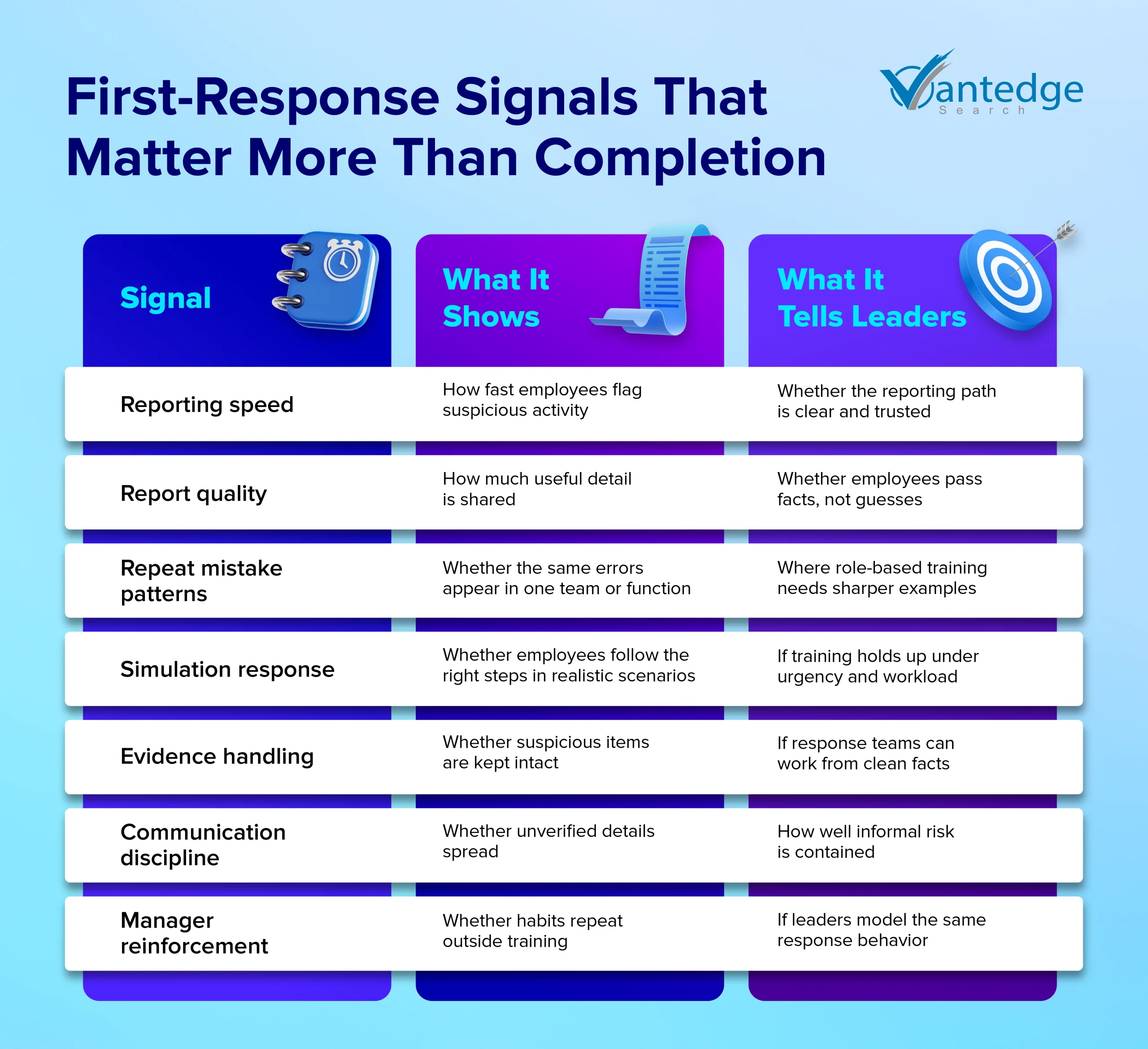
To understand how to measure cybersecurity training effectiveness, leaders need behavior-based measures rather than participation counts alone.
- Reporting speed: Shows whether employees know where to report and trust the process enough to act quickly. Slow reporting may point to unclear paths or fear of escalation.
- Report quality: A useful report includes the sender, request, time, attachment, link, system prompt, or action already taken. Employee cybersecurity awareness training should teach facts, not guesses.
- Repeat mistake patterns: Repeated forwarding, delayed reporting, or poor evidence handling can show where training is too broad for a function’s actual risk.
- Simulation response: Realistic scenarios show whether security awareness training for employees holds up under urgency, hierarchy, and workload pressure. A quiz tests recall; a simulation tests response discipline.
- Evidence handling: Leaders should know whether employees avoid deleting, renaming, altering, or widely forwarding suspicious items.
- Communication discipline: Shows whether employees avoid spreading unverified details, which protects the quality of the response.
- Manager reinforcement: Training is stronger when managers repeat the same habits outside formal sessions.
These measures help leadership separate training reach from operational reliability, and they show which teams need sharper practice before the same weaknesses appear again.
A Short Leadership Audit Before the Next Training Cycle
Before approving the next training cycle, leaders should test whether the current program gives employees clear action confidence. The audit should be practical enough for a board, CEO, CHRO, COO, or operating partner to use in one discussion.
- Do employees know where to report without asking several people first?
- Can employees stop a payment, access request, or data action when something feels wrong?
- Do high-risk teams receive examples from their actual work, not generic awareness content?
- Does role-based security awareness training cover finance, HR, legal, sales, and executive support risks with enough specificity?
- Are employees trained not to delete, forward, alter, rename, or debate suspicious items?
- Do managers reinforce the same habits outside formal employee cybersecurity training?
- Are leaders reviewing behavior signals, not only attendance and completion?
If the answers are unclear, the training cycle needs sharper ownership before it reaches employees.
Cybersecurity training becomes stronger when leadership expectations are clear from the top. (For a related view on how boards should assess cybersecurity leadership beyond technical depth, read our blog on What Boards Should Evaluate When Hiring Modern CISOs.)
Conclusion: Effective Training Reduces Confusion When It Matters
Cybersecurity training for employees should strengthen judgment before a situation is fully understood. Employees should not carry technical responsibility for investigation or response. They should know how to avoid the first actions that can make response harder, especially when a message, request, system prompt, or data issue feels unusual but not yet clear.
For leaders, the real question is whether training shapes dependable conduct under pressure. That requires more than annual participation. It requires business-relevant practice, manager reinforcement, clear reporting paths, and permission to slow down questionable actions.
The strongest employee cybersecurity training does not ask people to become security experts. It prepares them to make safer first decisions until the right team takes over.
If your organization needs senior leaders who can align cybersecurity risk, governance, and business priorities, connect with Vantedge Search for executive search support across C-suite and critical leadership roles with role clarity, discretion, and market insight.
FAQs
Cybersecurity training for employees is a structured program that helps staff recognize suspicious activity, follow reporting paths, protect evidence, and avoid risky first actions when emails, access prompts, vendor requests, or data issues appear unusual.
Employee cybersecurity awareness training often fails when it focuses on completion, quizzes, or generic warnings. Employees may recognize a risk signal but still hesitate, delete evidence, forward messages widely, or wait for certainty before reporting.
Leaders can make cybersecurity training more effective in 2026 by linking it to real work, using role-based scenarios, supporting early reporting, giving employees permission to slow down, and reinforcing response habits through managers.
Employees should stop the questionable action, report through the approved channel, preserve the message or record, avoid forwarding widely, and share only factual details such as sender, time, request, link, attachment, or action already taken.
Leaders should measure reporting speed, report quality, repeat mistake patterns, simulation response, evidence handling, communication discipline, and manager reinforcement. These signals show whether security awareness training for employees is shaping reliable conduct under pressure.
Leave a Reply