


CMO Hiring in 2026: Why Companies Want Customer Growth Leaders, Not Just Brand Leaders
Table of Content
- Why CMO Hiring Looks Different in 2026
- Why Brand Leadership Alone Is No Longer Enough
- What Companies Are Now Expecting from Marketing Leaders
- Where CMO Hiring Can Go Wrong
- What CEOs and Boards Should Clarify Before CMO Hiring
- What Recent C-Suite Appointments Say About the Changing CMO Role
- Conclusion: The Next CMO Is a Customer Growth Leader
- FAQs
Four Key Takeaways
- Customer behavior is changing the CMO mandate. Companies need marketing leaders who understand how customers discover, buy, stay, return, and build trust across digital and physical touchpoints.
- Marketing performance is under closer commercial scrutiny. Boards and CEOs now expect clearer links between marketing leadership, retention, demand quality, customer value, and business performance.
- The required CMO profile is more cross-functional than before. The role now depends on working with sales, product, finance, digital, and customer teams, not only leading campaigns or protecting brand reputation.
- The biggest hiring risk is unclear role design. Before assessing candidates, boards need to define what the CMO should own, what the role should influence, and how success will be measured.
Why CMO Hiring Looks Different in 2026
A strong brand can still win attention, but attention alone does not protect revenue anymore. Customers move quickly, compare more easily, and expect a smoother digital experience at every touchpoint. That is why CMO hiring in 2026 is being shaped less by brand visibility alone and more by the leader’s ability to influence customer behavior, loyalty, and growth.
The business case for marketing has become more demanding. Boards and CEOs want clearer proof that marketing leadership can support retention, digital engagement, customer value, and commercial performance, not only awareness or messaging.
McKinsey’s research on CEO, CMO, and CFO alignment makes this point directly: sustainable growth depends on keeping the customer at the center of the operating model and giving marketing a more defined role inside the C-suite.
That pressure is also visible in the performance gap. Gartner reported that only 27 percent of CEOs and CFOs said their CMO’s performance exceeded expectations in the previous year. That does not mean CMOs are failing across the board. It suggests that many companies still judge, structure, or hire for the role in ways that do not match current business expectations.
What companies now want is broader than a traditional brand mandate. They need a CMO who can connect brand strength with customer value, use digital channels with greater precision, and speak in commercial terms that matter in the boardroom.
This blog looks at how that hiring brief is changing in practice. It explains why brand leadership alone is no longer enough, where CMO searches can go wrong, what boards should clarify before they hire, and what recent C-suite appointments reveal about the changing expectations placed on marketing leaders.
Why Brand Leadership Alone Is No Longer Enough
HBR’s research on brand associations found that each additional positive brand association correlated with an 18 percent spending lift, while each negative association was linked to a 12 percent decline. That makes brand value a business issue, not only a communication issue.
What has changed is what boards expect brand leadership to support. Boathouse’s Fifth Annual CEO Study, based on 150 U.S. CEOs surveyed in January 2026, shows that CEOs are still trying to understand how marketing contributes to growth, how CMOs are being assessed, and where marketing is meeting or missing expectations. The message is clear: brand reputation is important, but it now sits inside a larger question of growth, execution, and measurable business contribution.
This is where many CMO briefs miss the point. A leader who can build brand value is still important, but the role now also needs someone who can convert that value into customer trust, repeat purchase, retention, and stronger customer value. That is why CMO hiring in 2026 has to assess both brand strength and business impact.
Hire CMOs Who Connect Brand to Growth with Vantedge Search
What Companies Are Now Expecting from Marketing Leaders
CEOs and CMOs do not always define marketing success in the same way. McKinsey’s research found that the gap between the CEO and CMO has grown by 20 percent. While 70 percent of CEOs said part of how they assess marketing’s impact is year-on-year revenue or margin growth, only 35 percent of CMOs had margin growth on their list.
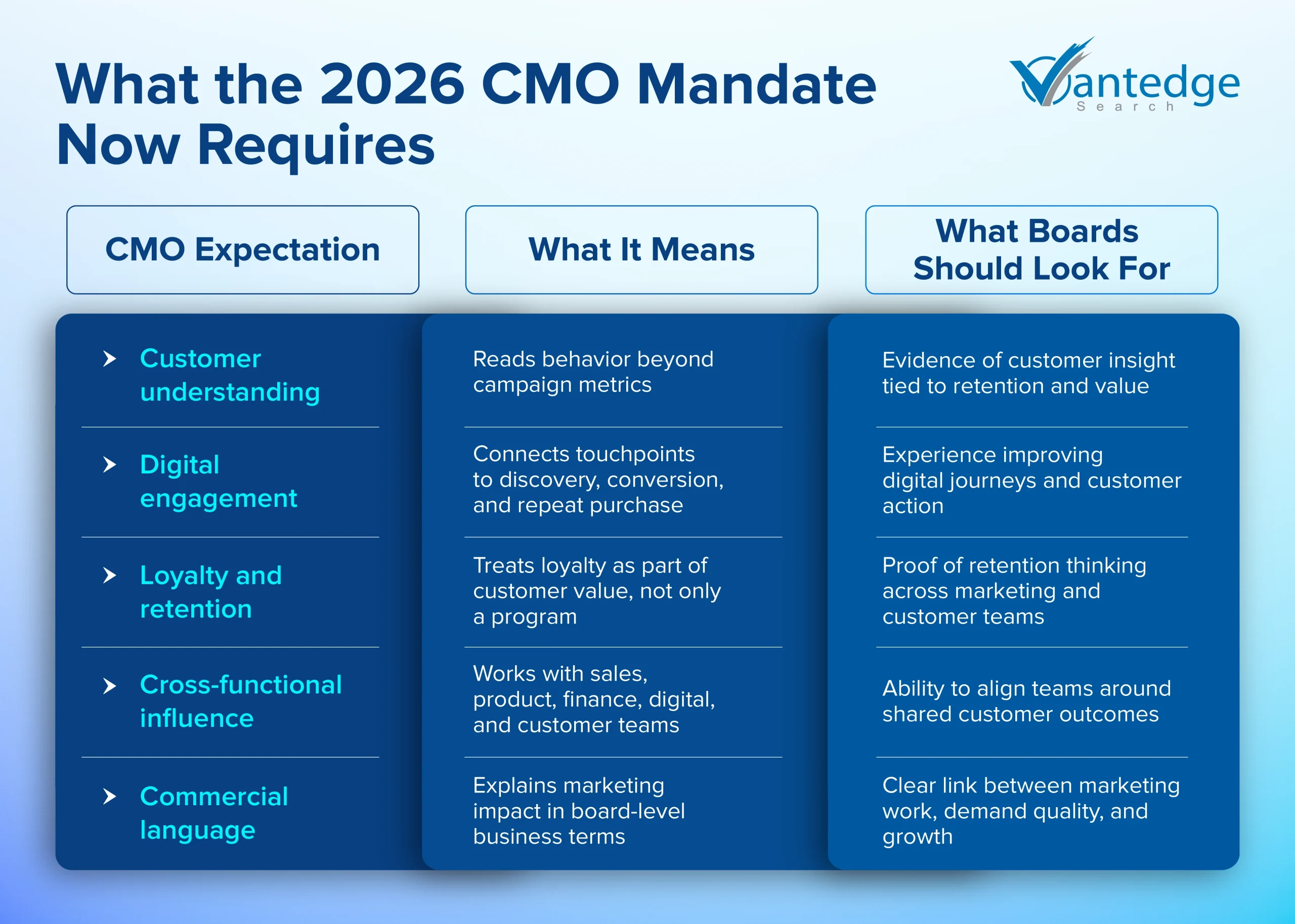
That gap is now central to CMO hiring. Companies are not only looking for leaders who can build campaigns, protect reputation, or manage agencies. They want marketing leaders who can connect customer understanding with business performance. In practice, that creates five expectations:
Customer Understanding Beyond Campaign Data
Campaign metrics can show reach, clicks, and response. They cannot, by themselves, explain why a customer stays, why they leave, or what creates trust over time. Boards now want a CMO who can read customer behavior in a deeper way and connect it to buying signals, service friction, and loyalty patterns.
That is a very different kind of leadership test. It requires judgment about customer value, not just performance reporting. It also requires the ability to connect what marketing sees with what sales, customer service, and product teams are seeing.
Digital Engagement That Supports Growth
Digital engagement is not about being present on more channels. It is about understanding how those channels influence discovery, conversion, retention, and reactivation. A CMO in 2026 needs to know which touchpoints matter, where customers drop off, and what changes can improve the path from interest to action.
That makes the role more operational and more commercial. Digital work cannot sit apart from growth work. It has to show how customer behavior, channel performance, and commercial outcomes connect.
Loyalty and Retention as Part of Marketing Leadership
Loyalty is often discussed as a program, but the more useful view is to treat it as part of the customer value model. It tells the business not only who returns, but also why they return and what keeps them connected to the brand over time. That makes it a leadership issue, not just a campaign or rewards issue.
This matters because retention often shapes the quality of growth more than acquisition alone. A CMO who treats loyalty as part of the customer relationship can help the company build steadier value over time, instead of relying only on new customer inflow.
Cross-Functional Influence
The CMO role now depends on influence across functions, not only strength within marketing. Sales, product, finance, digital, and customer teams all shape the customer experience in different ways. The marketing leader has to bring those threads together into one coherent direction.
Hence, a customer growth leader cannot succeed by working in isolation. The role requires collaboration, but it also requires enough authority to keep the organization focused on the same customer outcomes.
Stronger Commercial Language
Boards expect the CMO to speak in terms they can act on. That means revenue quality, customer value, retention, demand, and growth contribution. The language of reach and impressions still has a place, but it is not enough on its own when the conversation moves into the boardroom.
This is where many searches become misaligned. A candidate may be strong creatively and even highly respected in the market but still struggle to connect marketing work to business results. The CMO in 2026 needs both sides of that ability: marketing judgment and commercial clarity.
Where CMO Hiring Can Go Wrong
One common mistake is hiring for the profile that feels safest rather than the profile the business actually needs. A company may be drawn to a candidate with strong brand credentials, public recognition, or category experience. Those qualities can matter, but they do not automatically prove the leader can improve retention, digital engagement, or customer value.
A second mistake is separating brand from the customer journey. When the CMO owns messaging while another team owns digital experience, loyalty, or customer insight, the structure can create gaps. The company may have strong campaigns, but still lack a connected view of how customers discover, buy, return, and stay engaged.
A third mistake is expecting loyalty and retention results without defining ownership. If retention sits across marketing, sales, product, and customer teams without clear accountability, it becomes everyone’s priority in theory and no one’s priority in practice. The same problem appears when companies give the CMO too many objectives without deciding which outcome matters most.
That is why CMO hiring in 2026 has to be more disciplined. The role has become broader, but breadth alone does not create impact. Without a clear mandate, a company may hire a capable executive and still miss the business outcome it needed the role to deliver.
What CEOs and Boards Should Clarify Before CMO Hiring
Deloitte’s research on CMO roles identifies four distinct functions a modern marketing leader can play: growth driver, innovation catalyst, brand storyteller, and capability builder. Most companies may need a mix of all four, but very few CMOs can lead every priority with equal strength at the same time. Before opening a search, boards need to decide which role matters most for the business now.
A few questions make that decision concrete:
- Is this primarily a brand-led, growth-led, customer-led, or digital-led role, and which priority comes first?
- What should the CMO directly own, and what should the CMO influence through other teams?
- How will marketing success be measured, and does that measure match what the CEO and board actually track?
- Which teams, such as sales, product, finance, digital, or customer service, must work closely with the CMO for the role to succeed?
- What kind of leader fits the company’s current business problem, not the version of the business that existed two years ago?
These questions matter because CMO hiring often becomes too title-driven. A company may ask for a modern marketing leader without deciding whether it needs stronger brand direction, better customer insight, more disciplined growth execution, or tighter digital-commercial alignment. When that choice is unclear, the search brief becomes too broad, and the assessment process becomes harder to trust.
The better approach is to define the mandate before defining the candidate profile. Boards do not need to reduce the CMO role to one narrow function, but they do need to know which outcome carries the most weight. That clarity helps separate impressive candidates from relevant candidates.
That clarity also makes the search process stronger because it helps boards assess candidates against the role the business actually needs, not just the title they have held before.
What Recent C-Suite Appointments Say About the Changing CMO Role
Recent appointments show how some companies are redefining the senior marketing brief in practice. The pattern is not simply that CMOs are getting broader titles. It is that marketing is being placed closer to digital engagement, loyalty, consumer insight, and commercial growth.
That matters for CMO hiring in 2026 because the title alone can be misleading. Two companies may both hire a CMO, but one may need a brand steward while another needs a customer growth leader who can connect marketing with digital behavior, retention, and long-term customer value.
Southwest Airlines: Bringing Digital and Marketing Together
Southwest Airlines is one example. In April 2026, the company announced Sabrina Callahan as its first Chief Digital and Marketing Officer and Nandika Suri as Vice President of Rapid Rewards. Southwest said the appointments were intended to support the evolving customer experience, invest in the digital journey, and strengthen the airline’s brand.
The significance lies less in the titles themselves and more in what they reveal: customer loyalty and digital engagement are becoming strategic leadership priorities rather than operational marketing responsibilities.
DXC Technology: Linking Brand, Demand, and Business Outcomes
DXC Technology appointed Anthony Pappas as Chief Marketing Officer in October 2025, with the role reporting directly to the CEO. He was tasked with leading the global marketing organization, building a data-driven function centered on demand generation, and aligning marketing closely with sales enablement.
This appointment shows how CMO responsibilities in enterprise technology now extend well beyond brand positioning. Here, the marketing mandate is tied directly to demand generation, sales alignment, and outcomes the business can measure.
For companies reviewing the CMO role in 2026, this points to a broader pattern where marketing leadership is increasingly judged by its contribution to customer growth, not by brand visibility alone.
(For a deeper look at why senior appointments need to be assessed against current business context, read our blog on Why the Executive Hiring Process Now Requires More Than Traditional Due Diligence.)
Conclusion: The Next CMO Is a Customer Growth Leader
The real shift is not that brand matters less. It is that brand now has to prove its value through customer behavior, not only reputation. That is why the next CMO must be judged as a growth leader who can connect customer experience, loyalty, digital engagement, and commercial outcomes in one mandate.
For boards, that means the hire should not be shaped by an attractive title history alone. It should be shaped by the business question the company needs answered next. If the mandate is unclear, the search will be unclear. If the mandate is precise, the hire can create real momentum.
In 2026, the strongest CMO will not be the one who speaks only for marketing. It will be the one who helps the business understand customers more clearly and act on that understanding with discipline. That is what high-quality CMO hiring should now reflect.
If your next CMO hire must carry a broader commercial mandate, connect with Vantedge Search to identify senior marketing leaders who can match the role’s expectations, business context, and board-level priorities.
FAQs
CMO hiring in 2026 is shifting from brand visibility alone to broader commercial leadership. Companies want CMOs who can connect customer behavior, digital engagement, loyalty, and growth outcomes.
Yes. Brand leadership still matters because perception influences trust and buying behavior. The difference is that boards now expect brand strength to support retention, customer value, and business performance.
A CMO should own the marketing mandate clearly and influence the wider customer journey. That may include brand direction, customer insight, demand quality, loyalty thinking, and cross-functional alignment.
A CEO should ask what the business needs most from the CMO, what the role should own, which teams must align, and how marketing success will be measured.
A CMO executive search firm should start with mandate clarity. It should assess whether candidates fit the company’s growth problem, customer priorities, commercial expectations, and cross-functional leadership needs.
Leave a Reply