


Why Executive Hiring Process Now Requires More Than Traditional Due Diligence
Table of Content
- Introduction: Why Executive Hiring Is Harder to Predict Today
- Leadership Success Is Becoming More Context-Sensitive
- Why Executive Due Diligence No Longer Tells the Full Story
- Why Boards Need Senior Leadership Assessment to Go Beyond Verification
- What Boards Should Pressure-Test Before Making the Appointment
- The Role Is Changing Faster Than the Resume
- Conclusion: Why Context Matters in the Executive Hiring Process
- FAQs
Four Key Takeaways
- Executive hiring can no longer rely only on credentials, references, and past performance. Boards need to understand whether a leader’s success can transfer into the company’s current context.
- Traditional due diligence remains essential, but it has limits. It verifies what a leader has done, not always why those results happened or whether the same conditions exist now.
- Leadership context fit has become a critical hiring factor. Mandate clarity, board alignment, decision rights, culture, capital pressure, and organizational readiness all shape executive performance.
- Boards can improve executive hiring decisions by pressure-testing the role before finalizing the appointment, assessing both the candidate’s capability and the company’s readiness for that leader.
Introduction: Why Executive Hiring Is Harder to Predict Today
Boards today walk into executive hiring with more information than they have ever had. Career histories are documented. References are structured. Psychometric assessments are standardized. Reputation checks have become more rigorous. And yet, senior leadership outcomes remain difficult to predict with confidence.
This is not a data problem. Organizations are not under-informed when they make these appointments. The challenge is something harder to measure: whether the leader being hired can succeed inside this company, at this point, with this board, this culture, this level of capital pressure, and this set of expectations placed on the role.
Traditional executive hiring has always centered on verification: confirming what a leader has done, where they have worked, and how they have performed. That work remains necessary. But it answers only part of the question. What it may not fully explain is why that performance happened. Was it the leader’s judgment that drove results? Or was it strong board alignment, a well-resourced team, favorable market timing, and a clear mandate? Those conditions do not automatically transfer to the next role.
For boards and senior leadership teams, the real question in executive hiring is not only whether a candidate is qualified. It is whether that candidate can succeed under the specific conditions the company is carrying right now.
Leadership Success Is Becoming More Context-Sensitive
Executive performance does not exist in a vacuum. A leader’s track record reflects not only their capability but also the conditions they operated in: the board they reported to, the team they inherited, the capital they had access to, the mandate they were given, and the timing of the business cycle they were working through. When those conditions change, the same leadership approach does not always produce the same result.
This is what leadership context fit means in practice. It is not about a leader being good or not good. It is about whether a leader’s strengths are the right strengths for the specific pressure the company is carrying right now.
Consider some of the most common mismatches boards encounter in executive hiring:
- A leader built for high-growth environments may lack the discipline required for cost restructuring or margin recovery.
- A leader who operated under a unified board mandate may find it difficult to drive decisions when board alignment is divided or unstable.
- A direct, high-velocity leadership style may produce strong outcomes in one culture and create friction or disengagement in another.
- Leading with strong investor backing and resource availability is a fundamentally different challenge from leading under capital constraint or tight scrutiny.
- Inheriting a seasoned, high-performing senior team is different from being asked to rebuild one from the ground up.
Company type also shapes leadership demands. Public companies carry shareholder visibility and quarterly scrutiny. PE-backed firms often require faster decisions and tighter financial discipline. Founder-led companies have deeply embedded cultural identity. Regulated businesses carry institutional responsibility and slower decision cycles. Each context places different demands on the leader.
Recent CEO research reinforces how much the external environment compounds internal pressure. PwC’s 29th Annual Global CEO Survey found that CEO confidence in short-term revenue growth has reached a five-year low, with only three in ten CEOs expressing confidence in their revenue outlook. Leaders are simultaneously managing concerns around AI investment, cyber risk, technology change, and geopolitical uncertainty. For boards, this makes context more important in executive hiring decisions, not less.
A leader’s record may be real. But boards need to examine whether the conditions behind that record are present in the next role. If they are not, the appointment carries risk that no reference check will surface.
Why Executive Due Diligence No Longer Tells the Full Story
Executive due diligence remains necessary for any senior appointment. Boards still need to verify facts before making decisions that affect company direction, performance, and reputation. That work is not in question.
What executive due diligence can reliably confirm include:
- Career history and role progression
- Educational and professional credentials
- Reference quality and peer reputation
- Past conduct and compliance or legal flags
- Performance record and scope of prior responsibility
These are important data points giving the board a factual foundation. No serious appointment should skip this stage.
But verification has a ceiling. Reference checks and background reviews may not fully answer key questions, and boards treating due diligence as the complete picture risk missing what matters most in context.
What executive due diligence may not fully show:
- Whether results came from the leader’s own judgment or from strong organizational support, better timing, or a more stable environment around them.
- Whether the prior company had stronger brand trust, more accessible capital, or clearer internal alignment that made execution easier.
- Whether the leader can earn trust in a culture that operates differently from the one they came from.
- Whether the leader can handle a more public mandate, higher board scrutiny, or a more complex stakeholder environment.
- Whether the company itself is genuinely ready for the type of leadership it is bringing in.
That last point is one boards frequently overlook. Due diligence focuses almost entirely on the candidate, but executive hiring also depends on the company’s readiness. A leader is far more likely to succeed when the board is aligned, priorities are clear, and the organization is prepared for the leadership it wants to bring in.
Why Boards Need Senior Leadership Assessment to Go Beyond Verification
Boards need to know whether an executive can perform inside actual role conditions. Senior leadership assessment moves the conversation from confirmation to judgment, from history to readiness. It helps boards look beyond what a leader has done and assess whether they are ready for the role as it actually exists.
A strong assessment examines judgment under pressure as a practical capability. Can the executive make sound choices when information is incomplete, timelines tight, and stakes visible? That matters more than polished experience alone.
Adaptability is equally important. A leader may succeed in one company stage, ownership model, or team structure but struggle when context changes. Moving from growth to stabilization, or from a founder-led setting to a board-directed one, changes the pace and style leadership requires.
Trust-building is central to assessment. Senior leaders rarely succeed by authority alone. They must earn confidence from the board, senior team, employees, investors, and sometimes customers or regulators. If communication style creates distance rather than clarity, the role becomes harder than needed.
This is where organizational readiness becomes part of the hiring question. Boards should ask if the company is ready for the leadership it wants to appoint. Is the mandate clear? Do decision rights exist? Is the board aligned on success criteria? A capable leader can still struggle if the organization is unclear, divided, or unprepared.
Senior leadership assessment should help the board understand the relationship between the person, role, and company. Boards should ask practical questions:
- What conditions helped this leader succeed in the last role?
- Which of those conditions will not exist here?
- Is the company ready for the leadership style it says it wants?
- Where could board misalignment limit this leader’s effectiveness?
This makes the appointment more likely to work in practice rather than only on paper.
Assess executive readiness with Vantedge Search
What Boards Should Pressure-Test Before Making the Appointment
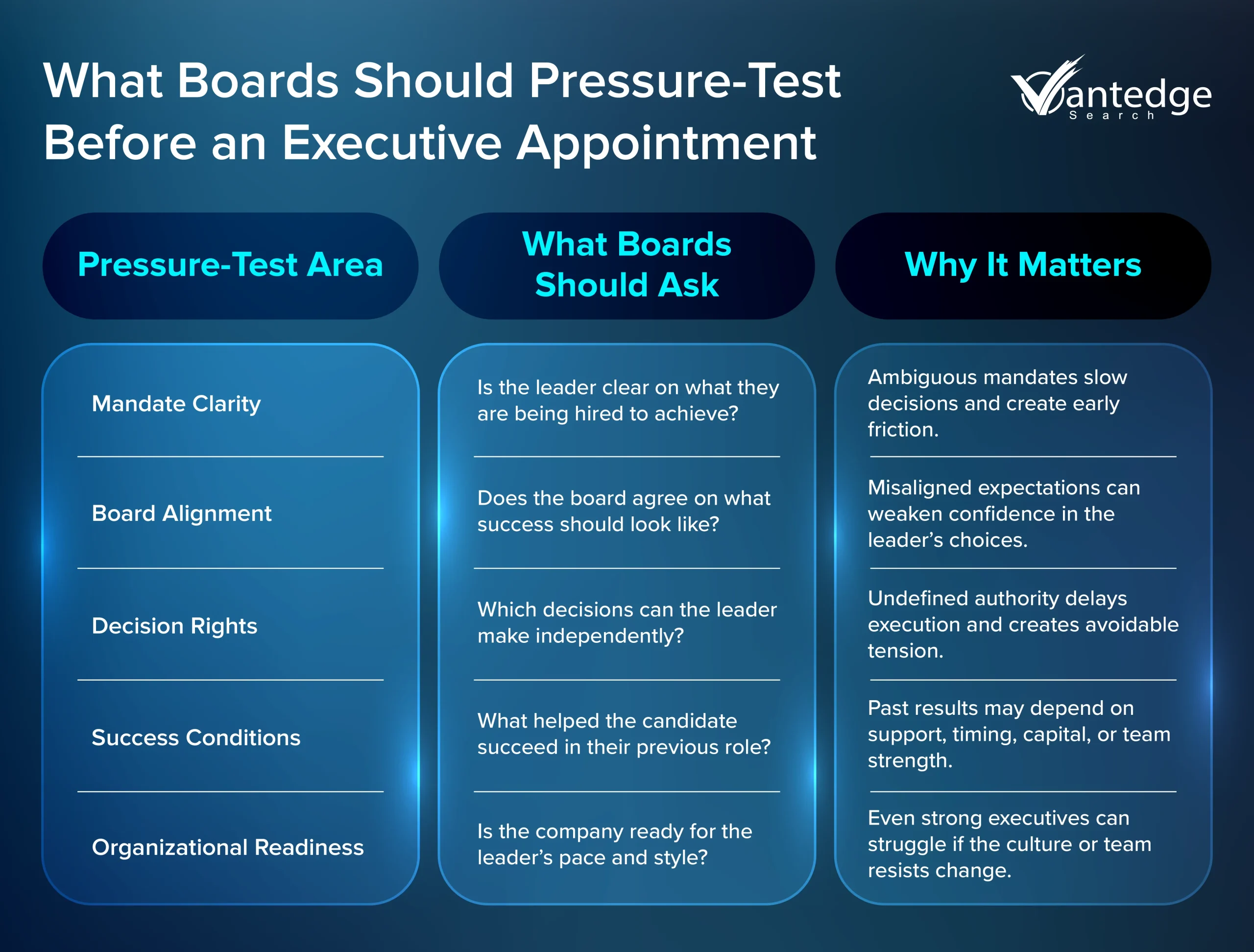
Before finalizing an executive appointment, boards should pressure-test five practical areas. These questions move the process from verifying the candidate’s record to assessing whether the company is ready for the leader it wants to hire.
Is the mandate clear enough for the leader to act? Ambiguous mandates create friction once the leader begins making decisions. Without clear direction, even capable executives can lose time clarifying priorities that should have been settled before the appointment.
Is the board aligned on what success means? Misalignment among board members can slow execution and weaken confidence in the leader’s early decisions. If the board expects growth, cost discipline, and cultural change at the same time, the sequence and trade-offs need to be clear.
Are decision rights defined? The leader needs to know which decisions they can make independently and which require board approval. Unclear authority can delay execution and create avoidable tension between the board and the executive.
Does the company understand which conditions helped the candidate succeed previously? Boards should identify what support, timing, resources, team strength, or capital access shaped the candidate’s past results. Those conditions should then be compared with what the new role will actually provide.
Is the organization ready for the pace, style, and change the leader may bring? A strong executive can still struggle if the senior team, culture, or operating model resists the approach they were hired to bring. Readiness includes whether the organization can absorb the leader’s pace and decision style.
These tests help boards see whether the company is prepared for the appointment to succeed. They reveal the gap between what the leader may need and what the organization is currently able to support.
The Role Is Changing Faster Than the Resume
In executive hiring traditionally, the organization defines the position, identifies candidates with relevant experience, and evaluates who is most qualified to execute the mandate. Increasingly, however, the mandate itself is becoming a moving target.
Across industries, leadership roles are being reshaped by forces that sit outside traditional organizational boundaries. Technology adoption influences operating models. Capital markets influence strategic timelines. Regulatory expectations shape investment priorities. Talent shortages affect execution capacity. As these pressures converge, the responsibilities attached to senior leadership positions are expanding and, in many cases, changing faster than organizations formally redefine them.
This creates a less visible hiring risk. Boards may believe they are recruiting for a familiar role when, in practice, the demands of that role have already evolved. A CFO may now be expected to guide transformation as much as financial stewardship. A CEO may spend as much time managing ecosystem relationships as operating performance. A business leader may be required to integrate technology, workforce, regulatory, and commercial considerations simultaneously rather than sequentially. The title remains the same, but the work does not.
As a result, executive hiring increasingly requires boards to evaluate the role before evaluating the candidate. The central question is no longer simply who is best qualified for the position as it existed previously. It is whether the organization has accurately defined the leadership capabilities its next chapter will require. Only then can experience, track record, and fit be assessed against the realities of the role ahead rather than the assumptions of the role behind.
Recent executive appointments show how leadership mandates themselves are changing.
S&P Global: When Two Mandates Become One
S&P Global’s appointment of Firdaus Bhathena as its first Chief Technology and Transformation Officer illustrates how organizations increasingly expect leaders to connect technology adoption, operating change, and business-wide execution rather than operate within traditional functional boundaries. The significance is not only that S&P Global appointed a senior technology leader. It is that the company created a role combining technology leadership with a broader change mandate.
In many organizations, those responsibilities may previously have been held by different executives with different reporting lines. Combining them into one role reflects a broader shift: separating those responsibilities may no longer match how the work actually moves through the organization. For boards hiring at this level, the evaluation cannot begin only with credentials. It must begin with whether the role has been accurately defined.
Southwest Airlines: When Growth Requires a Different Kind of Leader
Southwest Airlines’ appointment of Sabrina Callahan as its first Chief Digital and Marketing Officer reflects a similar shift. The role brings together responsibilities that were traditionally managed in separate functions: customer experience, digital capability, and brand strategy. Southwest’s decision to unify them signals that customer engagement and digital growth are now viewed as connected leadership challenges rather than parallel priorities.
The appointment reflects the organization’s belief that growth depends on managing those domains together. For boards, this kind of role design is itself a strategic decision. It signals where the company believes performance will be built, and it sets the expectations the incoming leader must meet from day one.
As a result, executive hiring increasingly requires boards to evaluate the role before evaluating the candidate. The central question is no longer simply who is best qualified for the position as it existed previously. It is whether the organization has accurately defined the leadership capabilities its next chapter will require.
Executive appointments now carry meaning beyond succession. They signal how a company understands its next mandate, its leadership needs, and the conditions required for future performance. (For a related perspective, read Vantedge Search’s blog: Leadership Strategy: Why C-Suite Appointments Now Signal More Than Succession).
Conclusion: Why Context Matters in the Executive Hiring Process
Executive hiring now requires more than traditional due diligence. The key question is no longer only whether a leader has succeeded before, but whether that success can carry into a role shaped by different expectations, culture, timing, and internal conditions
Due diligence remains essential. Past performance, references, and credentials still matter. But boards need clear views of mandate clarity, culture fit, pressure levels, timing, and organizational readiness. A qualified leader can be the wrong appointment if the company misunderstands what the role demands.
The executive hiring process has shifted from pure verification to context-based judgment. Boards that understand this shift make appointments more likely to succeed in practice.
In the executive hiring process, facts matter. But context determines whether those facts turn into performance.
If your organization needs leadership that can perform under real business pressure, connect with Vantedge Search to assess executive fit beyond experience and past performance.
FAQs
The executive hiring process is the structured approach organizations use to define a leadership mandate, identify senior candidates, assess qualifications, check references, evaluate fit, and make an appointment. For board-level roles, it should also test whether the company’s expectations, culture, and decision rights support the leader’s success.
Traditional due diligence confirms what a candidate has done, but it may not show why those results happened. Past success can depend on board alignment, capital access, market timing, team strength, or culture. Executive hiring needs deeper assessment of whether that success can transfer into the new role.
Leadership transferability means assessing whether a leader’s past performance can work in a different company context. A record of success may not carry over if the new role has different capital pressure, board expectations, culture, team maturity, decision rights, or stakeholder demands.
The biggest risks include unclear mandates, weak board alignment, overreliance on past performance, poor culture fit, undefined decision rights, and limited organizational readiness. A candidate may be qualified on paper but still struggle if the company has not created the conditions needed for success.
Boards can improve executive hiring decisions by going beyond verification. They should clarify the mandate, align on success criteria, define decision rights, assess leadership context fit, and compare the candidate’s past success conditions with the company’s current reality before making the appointment.
Leave a Reply