


Chief Underwriting Officer Recruitment: The Decisions Behind Portfolio Performance
Table of Content
- Strong Portfolio Results Do Not Tell the Whole Story
- Three Decision Records That Matter in a Chief Underwriting Officer Search
- Chief Underwriting Officer Recruitment Should Separate Judgment from Hindsight
- Different Underwriting Mandates Behind Two 2026 CUO Appointments
- Conclusion: CUO Executive Search Should Test the Judgment Behind the Record
- FAQs
Four Key Takeaways
- Portfolio results do not tell the full story. Chief underwriting officer recruitment should examine the decisions behind reported performance, including what the candidate personally controlled, restricted, changed, or corrected.
- Three decision records provide stronger evidence of judgment. Growth opportunities, underwriting authority, and early portfolio intervention reveal how candidates balance commercial pressure, risk discipline, accountability, and incomplete information.
- Decision quality should be separated from hindsight. A favorable outcome does not automatically prove strong judgment, just as an adverse result does not automatically mean the original decision was unsound.
- Decision ownership matters as much as the result. Boards should establish what authority the candidate actually held, which choices were personally made, and how the candidate responded when new evidence challenged the original position.
Strong Portfolio Results Do Not Tell the Whole Story
A strong underwriting record can make a candidate credible at the outset. Premium growth, improved profitability, stronger rate achievement, and successful portfolio correction are all meaningful indicators in a chief underwriting officer search. But the numbers alone do not show how those results were achieved.
The market conditions surrounding the performance matter too. Deloitte reports that U.S. property and casualty underwriting performance was at its strongest level in more than a decade in 2024. It expects the combined ratio to increase from 97.2% in 2024 to 98.5% in 2025 and 99% in 2026 as premium growth slows and margin pressures build. A strong result may therefore reflect a combination of sound executive judgment and favorable conditions.
That is why an effective chief underwriting officer search needs to examine more than the final figures. It should establish what the candidate inherited, which risks they chose to accept or restrict, how much authority they personally held, when they intervened, and how they responded as new information emerged.
The more important question is how the result was achieved: what the candidate saw, which choices they made, and how they acted when the outcome was still uncertain.
Three Decision Records That Matter in a Chief Underwriting Officer Search
A chief underwriting officer search can often learn more from a few consequential decisions than from reviewing every technical capability in equal detail. The strongest examples reveal what the candidate knew at the time, what they personally controlled, which alternatives were available, what commercial consequences followed, and how their approach changed as new information emerged.
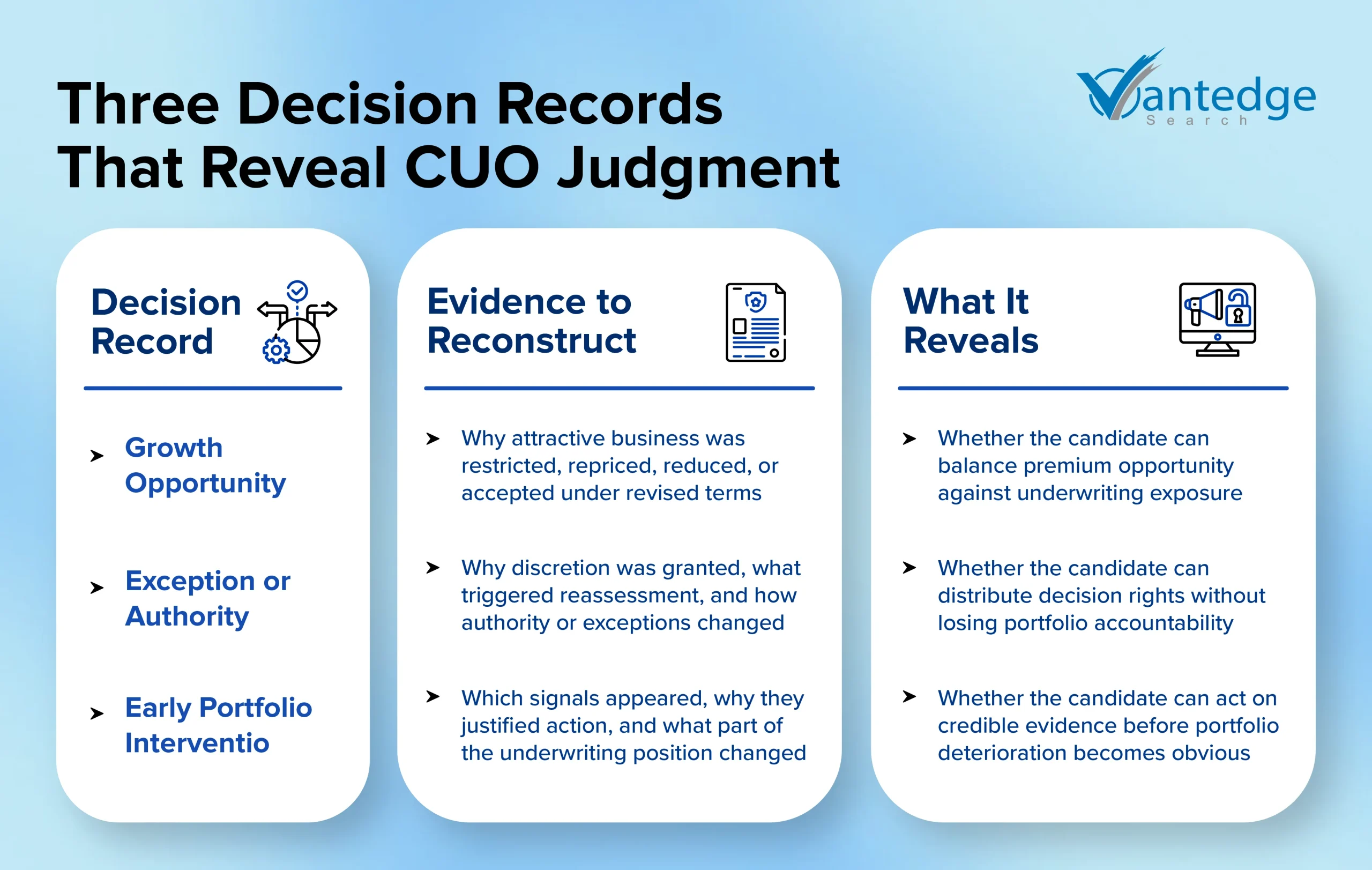
Three types of decision records are particularly useful in chief underwriting officer recruitment. Each examines a different point in the underwriting process: whether to accept new business, how to manage decision rights, and when to intervene in an existing portfolio.
The Growth Opportunity the Candidate Chose to Restrict
One useful record begins with the business the organization wanted to write.
The candidate may have encountered an attractive account, segment, program, or market opportunity that promised meaningful premium but raised concerns about pricing, exposure, policy wording, concentration, capital, or available capacity. The eventual decision may have been to decline the opportunity, reduce participation, increase the price, tighten coverage, alter limits, or accept the business under revised conditions.
The assessment should establish why the opportunity initially made commercial sense and what caused the candidate to reconsider the underwriting decision. It should also identify the alternatives available before the final choice was made.
The consequences matter as much as the decision itself. A more restrictive position can affect premium targets, broker confidence, customer relationships, distribution plans, and capacity commitments. A credible candidate should be able to explain that trade-off rather than present underwriting discipline as cost-free.
This is also where underwriting leadership hiring needs to avoid a simple assumption: saying no is not automatically evidence of good judgment. Retaining the business under revised terms may have been the stronger decision.
The relevant question is whether the candidate recognized when the economics of further growth no longer justified the risk being accepted, and whether a different structure could preserve worthwhile business without weakening the underwriting position.
The Exception or Authority the Candidate Changed
A different type of decision concerns who was allowed to make underwriting decisions and the boundaries within which they operated.
The example might involve recurring exceptions to appetite or pricing guidance, a regional or product team with defined authority, an MGA or program arrangement, or a decision to expand, restrict, suspend, or withdraw underwriting authority.
The starting point matters. Why was the exception allowed or the authority granted? Which risks still required referral? What reporting was available? Who could approve departures from standard parameters?
The candidate’s record should then show what prompted a reassessment. It may have been a pattern of referrals, an unexpected portfolio mix, repeated exceptions, deteriorating results, poor data quality, or a growing gap between agreed parameters and the business actually being written.
Not every exception indicates weak control. Individual risks can justify departures from standard rules. The more important issue is whether repeated exceptions begin to change the portfolio without a deliberate decision to change the organization’s appetite.
Distributed underwriting authority is not inherently a control problem either. It can support specialist expertise, speed, and access to business. The test for chief underwriting officer responsibilities is whether decision rights can be distributed across teams and partners while accountability for the portfolio remains clear.
The strongest example therefore shows both judgment and intervention: why discretion was appropriate initially, why it later became questionable, and what the candidate changed once the original boundaries were no longer suitable.
The Portfolio Problem the Candidate Addressed Early
The third record concerns business that is already on the books.
A candidate should be able to identify a situation in which emerging evidence raised concerns before mature claims results made the problem obvious. The signal might have been a change in submission or bound-business mix, increasing referrals, rate movement that no longer matched the exposure, broader coverage, higher limits, growing concentration, early claims activity, or diverging results across programs, brokers, regions, or risk classes.
The assessment should focus on the point between suspicion and action.
Which indicator first raised concern? What additional evidence made the concern more credible? Why did intervention become justified at that stage rather than one quarter earlier or later?
The response may have involved changes to appetite, pricing, terms, authority, participation, capacity, or a combination of measures. What matters is whether the candidate can connect the action to information that was actually available at the time.
BCG’s June 2026 Insurance Value Creators Report identifies long-tail casualty risk, secondary-peril property losses, and changing litigation dynamics as material pressures for U.S. property and casualty carriers. BCG argues that these conditions call for preemptive portfolio management rather than reliance on later repricing alone.
That context reinforces the relevance of this decision record without changing the hiring test. Early action is not automatically better. Acting on weak evidence can damage a portfolio just as readily as waiting too long.
For a CUO executive search, the stronger candidate is the one who can explain why the available evidence had crossed the threshold for action, what remained uncertain, and what additional information would have justified a different response.
Chief Underwriting Officer Recruitment Should Separate Judgment from Hindsight
An underwriting decision is easier to defend once the result is known. That is why chief underwriting officer recruitment needs to focus on the reasoning behind the decision before the outcome was clear.
When a decision is followed by favorable performance, the assessment should test whether the original position would still have seemed reasonable if the result had been less positive. Which assumptions involved the most uncertainty? What evidence would have caused the candidate to reconsider? Did market pricing, reinsurance protection, or another external factor contribute significantly to the reported result?
The same test applies when performance is adverse. The question is not simply what went wrong. It is whether the original decision was reasonable based on the information available at the time, when contrary evidence became credible, and whether the candidate responded once the basis for the decision began to weaken.
Harvard Business Review examined the broader challenge of making consequential decisions under uncertainty in October 2025. It highlighted the risks of relying too heavily on intuition and of holding to a position when later evidence points in another direction. That principle matters when assessing a chief underwriting officer because the full impact of some underwriting decisions may take years to become clear.
Decision ownership should also be established. References can help confirm whether the candidate initiated the decision or inherited it, what approval authority they personally held, and which actuarial, claims, reinsurance, distribution, or other leaders were involved.
This distinction helps a CUO executive search avoid two common errors: giving one individual too much credit for a favorable outcome or treating an unfavorable outcome as automatic evidence of poor judgment. The stronger assessment asks whether the reasoning was sound when the decision was made and whether the candidate changed course when the evidence warranted it.
Secure stronger underwriting leadership with Vantedge Search
Different Underwriting Mandates Behind Two 2026 CUO Appointments
The responsibilities of a chief underwriting officer depend heavily on where underwriting decisions sit within the business. Two appointments announced in 2026 illustrate the difference. Although the announcements do not explain how either executive was assessed, the mandates and experience described by the companies show why a chief underwriting officer search cannot rely on a single candidate profile.
Jeanmarie Giordano at AXA XL
AXA XL appointed Jeanmarie Giordano as Global Chief Underwriting Officer on June 18, 2026. Her remit extends beyond the management of underwriting itself. She is responsible for shaping AXA XL’s global underwriting strategy and working with business unit CEOs and product lines to support disciplined growth, technical excellence, and portfolio resilience.
Giordano joined AXA XL from Everest, where she served as North America Chief Underwriting Officer and previously held the role of Chief Underwriting Officer for Financial Lines & Specialty. Before joining Everest, she spent nearly 15 years at AIG in senior underwriting and financial-lines leadership roles. AXA XL highlighted her technical expertise, market relationships, experience building books of business, and record of stabilizing businesses through market cycles.
The appointment illustrates an important executive search principle. A global underwriting leader is unlikely to be selected solely for having managed one successful portfolio. The stronger evidence lies in sound judgment across different businesses, product lines, and market environments. Those are the decisions a recruitment process ultimately needs to examine.
Brett Saternus at Coterie Insurance
Coterie Insurance appointed Brett Saternus as Chief Underwriting Officer on May 19, 2026. His responsibilities include underwriting strategy, portfolio management, and capacity alignment as the company continues to scale its small-commercial MGA platform.
That mandate calls for a different type of leadership. Saternus brings more than 15 years of experience across specialty carriers, insurtech MGAs, and commercial insurers. Coterie highlighted his actuarial expertise, program insurance experience, operating judgment, team-building record, capacity management, carrier and reinsurer relationships, and ability to turn data into underwriting decisions.
In a global underwriting role, the mandate may require judgment across multiple businesses and product lines. In an MGA, portfolio management, capacity alignment, and profitable growth may carry greater weight. For a comparable appointment, the recruitment process would therefore need to examine how the candidate’s decisions affected portfolio performance, capacity management, carrier and reinsurer relationships, and profitable growth.
The comparison points to a broader conclusion: the title may be the same, but the mandate changes with the business model. Effective chief underwriting officer recruitment begins by identifying the decisions for which the role will ultimately be accountable.
(Boards and insurance leaders looking beyond underwriting-specific assessment can also read our blog: Challenges in Insurance Executive Recruitment and Strategies to Overcome Them, a useful resource on broader executive hiring pressures.)
Conclusion: CUO Executive Search Should Test the Judgment Behind the Record
Strong performance should remain an important part of chief underwriting officer recruitment, but it should not be treated as complete evidence of leadership quality.
A credible CUO executive search should establish which significant decisions the candidate personally influenced, what information informed those decisions, what commercial trade-offs they accepted, and when they changed course as new evidence emerged.
For executive search firms assessing specialist underwriting roles, the aim is not simply to identify an underwriting officer with a record of favorable results. It is to determine whether the judgment behind those results is relevant to the decisions the new mandate will require.
The strongest record can withstand scrutiny beyond the final numbers. It shows clear ownership, sound reasoning, and an ability to apply underwriting judgment when the outcome is not yet certain.
The right CUO appointment starts with evidence of sound underwriting judgment. Work with Vantedge Search to assess leadership fit beyond titles and reported results.
FAQs
Chief underwriting officer recruitment is the process of identifying and assessing senior underwriting leaders who can set risk appetite, guide portfolio decisions, govern underwriting authority, and balance commercial priorities with disciplined risk selection across an insurance business.
Companies should look for sound underwriting judgment, commercial discipline, portfolio management experience, clear accountability, strong decision-making under uncertainty, and the ability to manage pricing, risk appetite, authority, capacity, and relationships across functions and business partners.
Decision-making matters because reported portfolio results do not fully explain how they were achieved. Chief underwriting officer recruitment should test what information candidates used, which trade-offs they accepted, when they intervened, and how they responded when evidence changed.
Executive search firms can assess candidates by examining material underwriting decisions, confirming personal authority and decision ownership, testing reasoning without hindsight, reviewing commercial consequences, and using references to verify how candidates acted when portfolio conditions or available evidence changed.
The role of a chief underwriting officer typically includes setting underwriting strategy, defining risk appetite, overseeing pricing and portfolio quality, governing underwriting authority, monitoring exposure, and aligning underwriting decisions with the insurer’s commercial, capital, and capacity requirements.
Leave a Reply