


Before Saying Yes to the C-Suite: 5 Questions Every Candidate Should Ask About the Role They’re Really Taking On
Table of Content
- Introduction: The Real Role Is Often Beneath the Job Description
- Why C-Suite Candidates Need a Different Kind of Due Diligence
- Question 1: “If I do exactly what you’re hiring me to do, who internally is most likely to be disrupted or lose influence?”
- Question 2: “What’s the one thing you want changed—but haven’t been able to change so far?”
- Question 3: “Where will I need to push harder than you’re comfortable with to get the outcome you want?”
- Question 4: “If I make the right decisions but they don’t land well politically, how will you back me?”
- Question 5: “A year from now, what outcome would justify the disruption this hire is going to create?”
- What the Answers Reveal About the Role
- What Candidates Can Learn from Recent CEO Moves
- Closing: The Best C-Suite Moves Are Chosen with Precision
- FAQs
Four Key Takeaways
- Senior C-suite candidates should assess the mandate beneath the title, not just the role description, because the real assignment often involves shifting power, correcting unresolved issues, and leading through internal tension.
- Standard diligence is not enough at this level; candidates need to test authority, sponsorship, alignment, and the organization’s readiness for the disruption the hire may create.
- The five questions in the blog help candidates identify who may push back on the hire, what problems have survived previous leadership, how much pressure the role will genuinely demand, whether sponsorship is real and visible, and what outcome will make the disruption worthwhile.
- The right C-suite opportunity is not simply attractive on paper; it is one where the mandate is clear, the support is visible, and the expected return from the hire is defined with precision.
Introduction: The Real Role Is Often Beneath the Job Description
At the C-suite level, a job description is not a contract. It is an opening position. The title, the compensation structure, the reporting line, and the stated remit all matter, but they rarely reveal the full weight of what the organization is actually asking a senior executive to take on. What lies beneath those formal parameters is frequently more consequential than anything documented in the offer.
Senior executive candidates are not simply evaluating opportunity. They are evaluating a mandate, one that may shift internal power, unsettle existing leadership patterns, and expose organizational tensions that have been carefully managed, sometimes for years.
The question worth asking early is not whether the role is attractive. The more important question is what the organization is really asking the candidate to change, and whether it is prepared for the consequences of that change.
The Conference Board’s 2025 C-Suite Outlook, drawn from 1,722 executives and board members globally, describes the operating environment as “turbulent and unpredictable,” with leaders expected to thrive rather than just survive.
But the sharper challenge for incoming C-suite executives entering senior leadership roles is this: they are being asked to deliver outcomes in environments where the assumptions underpinning those outcomes may shift mid-execution. It requires more than capability. It requires understanding whether the organization will still support the mandate once the assumptions behind it begin to change.
Why C-Suite Candidates Need a Different Kind of Due Diligence
The standard checklist of candidate diligence—KPIs, reporting structure, team size, compensation, and board access—covers the mechanics of a role. It does not reveal the true operating conditions. For anyone stepping into C-suite leadership, that gap between what the role looks like on paper and what it demands in practice is where most transitions either gain traction or quietly begin to fail.
The real diligence questions sit a level deeper. They ask whether the mandate carries actual authority, not just positional title. They ask whether the CEO and Board are genuinely aligned on what must change, or whether that alignment is assumed rather than tested. They ask whether the organization has fully reckoned with the disruption the hire will create, and whether the candidate is being brought in to solve a defined problem or to absorb unresolved tension that previous leadership could not address.
KPMG’s 2025 Global CEO Outlook highlights that CEOs cite agility, faster decision-making, communication transparency, and risk management as the most critical leadership capabilities for the period ahead. The same report acknowledges the growing pressure to rethink roles and leadership capabilities at the top.
The harder truth this points to is that Boards are expanding expectations of C-suite decision-making faster than they are redesigning the leadership roles meant to carry those expectations.
For candidates assessing how to evaluate C-suite leadership roles, the five questions ahead are not negotiation tactics. They are meant to help the candidate understand the real situation before accepting the role.
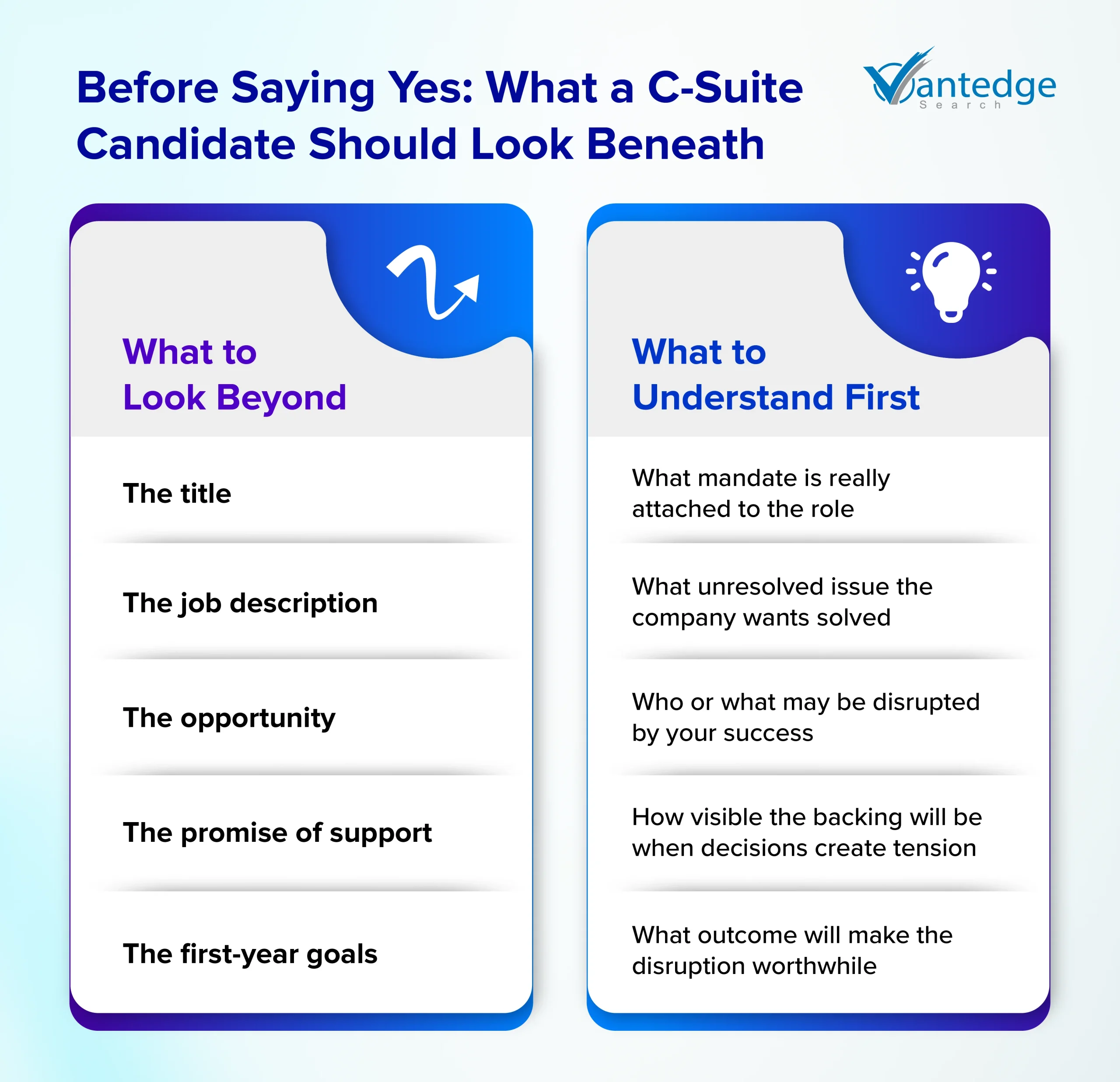
Question 1: “If I do exactly what you’re hiring me to do, who internally is most likely to be disrupted or lose influence?”
This is the most revealing question a senior executive can ask before accepting a role. Not because it signals hesitation, but because it signals precision. Every meaningful C-suite leadership mandate shifts the internal balance of power in some form, and the organization’s willingness to name that reality honestly is itself a signal worth reading.
Every hire at the C-level carries consequences beyond the formal remit. For example:
- A new CFO may challenge spending autonomy that functional leaders have held unchecked for years.
- A COO may reduce founder dependency in ways the founder has not fully accepted.
- A CHRO may expose leadership quality gaps that senior teams have quietly tolerated.
- A CRO may alter how commercial influence is distributed across the business.
- A leader brought in to drive organizational change resistance work may make informal power structures visible in ways that create discomfort at the very top.
Disruption itself is not the problem. In many cases, it is the very reason a company brings in a new executive leader. The real issue is whether the organization has clearly defined what needs to change before the leader steps in.
The quality of that clarity matters. A specific answer shows the company understands the changes the role is expected to drive. A vague answer often signals that the organization wants transformation, but may not be fully prepared for the impact that transformation will bring. That gap between wanting change and being ready for its consequences is where leadership transition risks often begin.
Question 2: “What’s the one thing you want changed—but haven’t been able to change so far?”
This question shifts the conversation from aspiration to reality. It asks the organization to name what has already resisted change, and that answer is often more instructive than anything in the job brief. For C-suite candidates assessing senior leadership roles, this is where the true complexity of the mandate begins to surface.
The answer shows what the company has already tried — and failed — to change. The next question is even more important: why hasn’t it changed? Usually, the problem is not a lack of talent or ambition.
More often, the real issue is:
- Reward systems that encourage people to keep things the same
- Confusion over who actually has decision-making authority
- Founder influence or long-standing loyalties that make certain areas hard to challenge
- Weak governance that slows decisions at the top
- A Board that is reluctant to fully commit to one direction
McKinsey’s 2025 work on operating models identifies the gap between strategic ambition and what organizations actually deliver, pointing to operating model shortcomings as a primary factor. This supports a straightforward conclusion: the blocker to change often sits in how the business is structured and governed, not in the ambition itself.
This is what makes the question so valuable in any C-suite decision-making conversation. A candidate who only asks what needs to change, without asking why it has not changed yet, may be accepting a recycled problem rather than a genuine mandate.
Make The Next Leadership Move With Vantedge Search
Question 3: “Where will I need to push harder than you’re comfortable with to get the outcome you want?”
This question tests something that rarely appears in any formal brief: the organization’s real appetite for change. CEOs, Boards, and investors may be fully aligned on the desired outcome, but significantly underestimate the pressure required to get there.
For C-suite candidates entering a business transformation leadership role, that gap is where mandates quietly collapse.
The question helps a candidate assess whether stakeholders are genuinely prepared for what delivery will require.
The areas that typically demand the hardest push include:
- Underperforming leaders who are protected by tenure or personal relationships
- Slow or avoidant decision-making at the senior level
- Unclear accountability structures that diffuse responsibility
- Inflated priorities that compete with the core mandate
- Margin discipline conversations that have been consistently deferred
- Weak succession depth that makes leadership changes feel too risky to pursue
A difficult mandate is not the risk. The risk is accepting a difficult mandate from stakeholders who still expect the process to feel comfortable.
This is an advisory question, not a confrontational one. A candidate raising it is not signaling reluctance. The candidate is surfacing the limits of sponsorship before those limits become a career risk.
In any serious organizational change leadership effort, the distance between what an organization says it wants and what it will tolerate in practice is the single most important variable to understand before a contract is signed.
If stakeholders can clearly identify what parts of the change will create discomfort, it usually shows the role has been carefully thought through. But when the response is limited to broad reassurance or generic expectations, it may indicate that the mandate is still tied to an outdated strategy rather than a clearly defined future direction.
Question 4: “If I make the right decisions but they don’t land well politically, how will you back me?”
Of the five questions, this one operates at the deepest level. C-suite failure is not always the result of poor judgment or weak execution. A significant number of senior executive exits trace back to insufficient sponsorship, where the right decisions were made, but the surrounding system was not designed to support them when resistance emerged.
For C-suite candidates evaluating a role, “you will have our full support” is not an answer. It is a placeholder. What matters is what that support looks like in practice, particularly when early decisions create internal friction.
Practical, operational backing at this level includes:
- Clear and documented decision rights from day one.
- Public alignment from the CEO or Board when the mandate is challenged.
- Private, honest feedback when tensions begin to rise.
- Protection from informal undermining by peers or legacy stakeholders.
- Agreement in advance on which battles are worth fighting.
- Reinforcement from senior leadership when early decisions create discomfort.
HBR’s 2025 article on setting up the C-suite to execute strategy argues that executive team design directly affects resource allocation, decision quality, accountability, and execution outcomes. The implication for candidates is direct: even strong executives can struggle when the system around them is not built to let them succeed.
Political resistance is predictable in any role that affects influence, reporting lines, resource allocation, or strategic control. That is not a reason to hesitate. It is a reason to ask the question clearly. In the context of C-suite executive recruitment, at this level, support cannot be implied. It has to be designed, agreed upon, and visible before the candidate steps in.
The executive operating model surrounding the hire matters as much as the hire itself. A candidate who secures role clarity without securing sponsorship clarity has only done half the due diligence.
Question 5: “A year from now, what outcome would justify the disruption this hire is going to create?”
Every C-suite role that carries a real mandate will create some degree of disruption. That is not a flaw in the design. It is the point. If the disruption is not tied to a clear result, it serves no purpose. This question helps the candidate understand what result the company actually expects.
For C-suite candidates entering roles tied to organizational change leadership, success must be defined in terms that are measurable or observable, not just aspirational. Vague definitions such as “better alignment,” “stronger leadership culture,” or “more strategic thinking” are not outcomes. They are descriptions of a process. A candidate should be listening for answers that are specific enough to be evaluated.
Outcomes that indicate a well-defined mandate may include:
- Faster, cleaner decision-making at the senior level.
- Improved margin discipline with visible results within defined timelines.
- Stronger succession depth across key leadership layers.
- Clearer accountability structures with reduced duplication.
- Improved board confidence in operational reporting.
- A more scalable executive operating model that supports growth.
- Stronger market position or improved customer economics.
If the organization cannot answer this question with reasonable specificity, that itself is important information. It may indicate that the mandate has not been fully defined, that stakeholders are not yet aligned on what success looks like, or that the hire is being made in response to pressure rather than a clear strategic decision.
What the Answers Reveal About the Role
The five questions work best as a diagnostic, not a script. For C-suite candidates, the value lies in what the answers reveal about power, pressure, and readiness before the role is accepted.
Strong Signals
When the answers are clear, the role is usually clear too. A strong response will name who may feel disruption, what has resisted change, where pressure will be needed, how backing will show up in practice, and what result will justify the shift. That kind of clarity supports better C-suite decision-making and gives the candidate a more accurate view of the executive operating model around the role.
Warning Signs
There are also signs that deserve caution. If stakeholders avoid naming who will be affected, the role may be carrying more change than the organization is ready to admit. If the mandate sounds transformational but the support sounds vague, the candidate may be stepping into a role with high expectation and low backing.
It is also worth noting when the same problem has survived previous attempts without a clear reason. That often points to a deeper issue in the leadership transition process or in how authority is shared across the business. In that case, the role may be more complex than the title suggests.
For C-suite candidates, the question is not only how to win the role, but whether the role is built for credible success once accepted. (For a deeper view on how senior candidates can show decision discipline, sponsorship readiness, and defensible leadership proof, read our blog What Will Make an Executive Candidate Truly Stand Out in 2026).
What Candidates Can Learn from Recent CEO Moves
Recent CEO transitions often reveal something important about senior leadership mandates: the title rarely tells the full story. In many cases, organizations are not simply hiring leaders for growth or operational oversight. They are hiring them to stabilize culture, restore confidence, redefine strategic direction, or guide the company through a difficult phase of transition that may not always be visible externally.
Elliott Hill, Nike
Nike’s public messaging around Elliott Hill’s first year as President and CEO has consistently emphasized reconnecting the company more closely with sport, rebuilding internal belief, strengthening marketplace relationships, and restoring innovation momentum. The language around the transition also suggests that the company views this as a longer-term recalibration rather than a short-term turnaround.
For senior candidates, the lesson is not simply about brand prestige or role visibility. It is understanding whether the organization expects the incoming leader to preserve momentum, repair internal alignment, rebuild trust, or quietly reset parts of the business that may have drifted over time. In many leadership transitions, the real mandate sits beneath the formal job description.
Tan Su Shan, DBS Group
DBS’s leadership transition to Tan Su Shan reflects a very different type of mandate. Public commentary around the transition has focused less on disruption and more on continuity — balancing AI adoption, operational discipline, customer trust, and long-term stability while carrying forward an already successful leadership era.
For candidates evaluating senior roles, this is an important distinction. Not every leadership transition is designed to drive dramatic change. Some require careful stewardship, measured evolution, and the judgment to recognize which parts of the organization should continue unchanged. In such cases, success often depends less on visible transformation and more on maintaining institutional confidence while adapting gradually to new strategic realities.
Closing: The Best C-Suite Moves Are Chosen with Precision
The best C-suite candidates are not hesitant about hard mandates. They are disciplined about understanding them before they say yes. That discipline matters because the real test is not whether a title sounds attractive, but whether the mandate is clear enough to carry.
A strong C-suite leadership opportunity should make the disruption visible, the sponsorship specific, and the expected outcome measurable. If those three elements are missing, the role may still be interesting, but it is not yet fully defined. That is where careful judgment matters most in senior leadership roles.
For candidates, the right decision is rarely about saying yes faster. It is about saying yes with clarity. For organizations, especially those involved in C-suite executive recruitment, the strongest leaders are usually the ones who ask the hardest questions early and respectfully.
At this level, the question is not only whether the role is attractive. It is whether the mandate is clear, the disruption is understood, and the sponsorship is strong enough to make success possible.
When the mandate is high-stakes, the hire cannot be left to assumptions. Partner with Vantedge Search to assess leadership fit with discretion, depth, and precision, so every senior appointment reflects the mandate, the dynamics around it, and the outcome your business needs to create.
FAQs
Due diligence should go beyond the job description. A candidate should test the real mandate, the authority behind it, the CEO and Board’s alignment, the expected disruption, and the level of support available once decisions start affecting people, power, or process.
The most important question is: if the candidate delivers exactly what is being asked, who internally is most likely to be affected or lose influence? That question reveals whether the organization understands the power shift the role will create.
Real board sponsorship is visible, practical, and consistent. It includes clear decision rights, public backing when the mandate creates tension, direct alignment with the CEO, and protection from informal resistance. It is not a vague promise of support. It is an operating stance that helps the executive act with confidence when early decisions begin to challenge established habits.
A candidate should ask what outcome will justify the disruption the hire is expected to create. Success should be described in measurable or observable terms, such as faster decisions, stronger accountability, better succession depth, or improved margin discipline.
Leave a Reply