


What Happens When Organizations Stop Feeling Human?
Emerging fractures CEOs may be underestimating as AI and digital transformation reshape modern enterprises.
Three Key Takeaways
- Organizations may be moving faster than they are absorbing change.
Speed, transformation, and efficiency are increasing — but institutional continuity may be weakening underneath. - Continuous adaptation may be reshaping how organizations develop people and preserve judgment.
Enterprises are becoming more responsive and capable, while potentially losing some of the slower processes through which trust, leadership depth, and institutional maturity historically formed. - Leadership today is increasingly about preserving stability inside constantly changing systems.
Modern leaders are being asked to continuously adapt while still maintaining coherence, confidence, and continuity across the enterprise.
Every CEO today understands the visible pressures. AI is reshaping decision-making, business models, and increasingly, AI in business strategy itself. Geopolitical tensions are influencing business strategy in real time. Organizations are being pushed to move faster, stay leaner, adapt continuously, and still project stability through it all. But beneath these visible shifts, another change is unfolding more quietly inside enterprises. As enterprises accelerate workplace transformation strategies and pursue AI-driven decision-making at scale, many are becoming exceptionally good at driving speed, efficiency, and transformation — while finding it harder to preserve the context, continuity, and institutional understanding that long-term leadership depends on.
As enterprises become faster, smarter, and more automated, what might they be unintentionally losing along the way?
I. What Organizations May Be Losing Along the Way
What makes this moment difficult is that many of these shifts still do not have clear playbooks or established solutions. This is also why this blog does not attempt to reduce them into simple prescriptions. Some of the most important changes unfolding inside organizations today are still being understood in real time. And in many cases, recognizing the fracture early may matter more than rushing to solve it before it is fully understood.
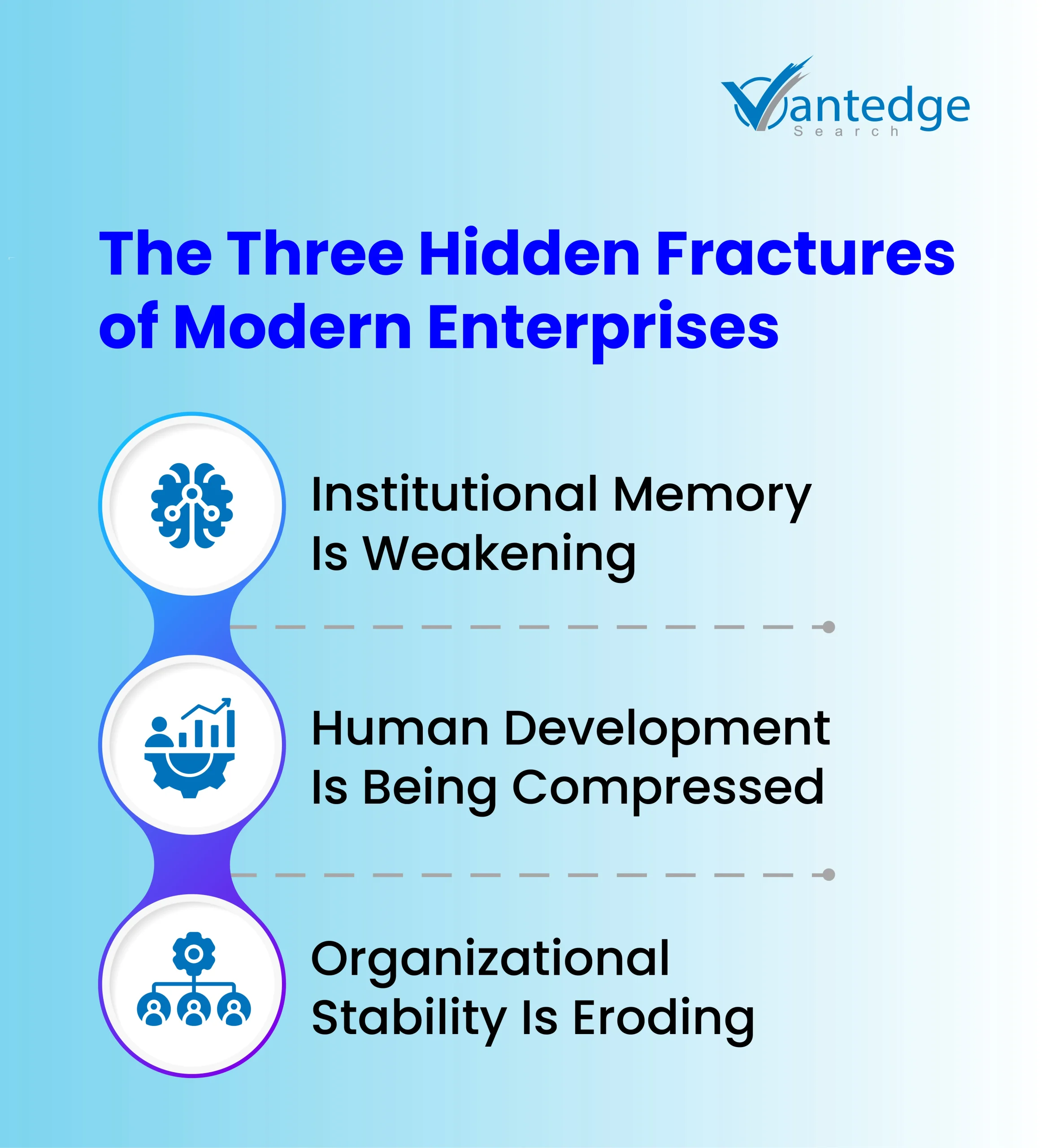
1. Organizations Are Forgetting Faster Than They Are Learning
Even as organizations become more information-rich, they may be becoming context-poor.
Part of the reason is structural. In many enterprises, transformation is no longer episodic; it is continuous. Teams reorganize frequently. Roles evolve rapidly. Leadership transitions overlap with technology transitions. Institutional knowledge that once traveled through long-tenured managers, informal networks, and operational continuity now disperses far more quickly across fluid structures. Organizations often assume that because information exists somewhere, knowledge has been retained. But institutional memory is not merely stored information. It is accumulated judgment: the understanding of why certain decisions were made, which assumptions failed previously, where hidden risks emerged, and how culture actually behaves under pressure.
This distinction matters more in the current environment because many of today’s leadership challenges are no longer linear. Decisions around AI adoption, workforce redesign, geopolitical exposure, cybersecurity, or organizational resilience increasingly create second- and third-order consequences across the enterprise. In such conditions, organizations rely heavily on contextual understanding built over time. When that continuity weakens, companies may continue moving quickly while becoming more vulnerable to repeating mistakes, misreading signals, or losing alignment between strategy and execution.
What makes this shift difficult to detect is that operational performance can remain strong for long periods. The organization still functions. Targets are still met. Transformation initiatives continue progressing. But beneath the visible indicators, the enterprise may gradually lose some of its ability to transfer judgment coherently across generations of leaders, teams, and systems. Over time, that loss compounds quietly. And in environments changing as rapidly as today’s, the ability to preserve institutional understanding may become just as important as the ability to innovate.Top of FormBottom of Form
The challenge, therefore, is becoming less about data retention and more about preventing institutional memory loss in organizations undergoing continuous transformation.
2. Organizations Are Becoming Increasingly Synthetic
For decades, organizations developed people gradually. Employees were allowed to grow into judgment through repetition, exposure, observation, and experience accumulated over time. Much of leadership formation happened indirectly — through difficult managers, operational setbacks, internal politics, long projects, and years spent understanding how institutions actually behave beneath formal structures. Organizations were not always efficient at developing people, but they were patient with the process.
That patience is beginning to erode. Many enterprises today are under pressure to compress readiness, accelerate productivity, and reduce developmental drag across the system. AI is absorbing portions of foundational work that once trained younger professionals through repetition. Teams are becoming leaner as part of workforce development in AI-driven companies. Roles are evolving faster. Executives are increasingly hired for immediate phase-fit rather than long-term institutional progression. In many environments, organizations now expect people to arrive operationally prepared far earlier than they once did.
Over time, this may quietly reshape what kinds of professionals enterprises produce. Organizations may become exceptionally effective at creating highly responsive, adaptable, technologically fluent performers — while becoming less tolerant of the slower processes through which deeper institutional judgment historically formed. The shift is subtle because performance indicators may continue improving. Work moves faster. Coordination improves. Capability appears stronger. But some organizations may also begin noticing a quieter pattern underneath: people who can execute efficiently inside systems, yet possess less accumulated context about how enterprises absorb pressure, ambiguity, failure, and long-cycle consequences over time.
The defining change is not simply that work is becoming automated. It is that enterprises may increasingly be redesigning human development itself around the logic of speed, responsiveness, and continuous adaptation. And over time, organizations may discover that while they successfully optimized performance, they unintentionally weakened some of the slower human processes through which leadership depth and institutional maturity were once built.
3. Organizations Are Losing the Stabilizers They Once Relied On
For decades, large enterprises depended on forms of stability that were so deeply embedded they were rarely noticed until they began weakening. Leadership transitions unfolded gradually. Expertise had time to mature. Strategic decisions moved slowly enough for organizations to absorb the consequences before the next wave of change arrived. Institutions had buffers — managerial continuity, operational slack, reputational resilience, clearer authority structures, and enough organizational patience to metabolize disruption without constantly destabilizing the system underneath.
Many of those stabilizers are now eroding simultaneously. AI adoption overlaps with restructuring. Workforce redesign collides with investor scrutiny. Geopolitical uncertainty intersects directly with supply chains, capital allocation, infrastructure planning, regulation, and technology strategy. Decisions that once remained contained within functions now create immediate consequences across the enterprise. In many organizations, leadership is no longer navigating isolated disruptions sequentially. It is managing overlapping pressure systems that move faster than the institution can fully absorb—a challenge that is reshaping the nature of enterprise change management itself.
What makes this environment particularly difficult is not simply the pace of change, but the disappearance of recovery time. Organizations are expected to transform continuously without appearing unstable, maintain credibility while strategies evolve in real time, reassure employees while operating models keep shifting, and preserve cohesion while the enterprise itself rarely remains still for long. Trust now weakens faster. Reputational cycles shorten. Workforce sentiment changes more quickly. Leadership decisions are interpreted instantly by employees, investors, customers, and markets simultaneously, increasing the complexity of executive decision-making under uncertainty. In many enterprises, adaptation is no longer episodic. It has become permanent.
This may explain why so many organizations today appear highly capable externally while feeling more fragile internally. The challenge is no longer whether enterprises can drive transformation. Many can. The deeper question is whether institutions still have enough stabilizing conditions left to emotionally absorb continuous transformation without gradually exhausting the coherence, trust, continuity, and leadership confidence that long-term organizational resilience has historically depended on.
II. What Organizations May Now Need to Preserve More Deliberately
What makes many of these shifts particularly difficult is that organizations do not experience them abstractly. They are ultimately absorbed by the people expected to lead through them. And as enterprises become more adaptive, accelerated, and continuously recalibrated, leadership itself may increasingly be asked to preserve forms of continuity that organizations no longer sustain naturally on their own. This is a challenge that sits at the heart of human-centered leadership today.
For earlier generations of executives, professional identity was often built cumulatively. Leaders spent decades refining expertise, strengthening authority, and operating within environments stable enough for judgment, reputation, and leadership style to mature gradually over time. The executive challenge was largely about scaling experience. Today, however, many leaders are operating inside systems where adaptation itself has become permanent. The qualities that once created leadership success in one phase — deep specialization, operational intensity, decisiveness, even established management instincts — may become less effective in the next.
As a result, many executives are being forced into a difficult modern contradiction. Organizations increasingly require leaders to preserve continuity, confidence, and institutional coherence externally — even while the enterprise itself may be changing continuously underneath. In many industries, leadership relevance is no longer something executives achieve and sustain steadily over time. Increasingly, leaders may need to repeatedly rethink how they operate, adapt, and lead in order to preserve stability inside organizations that no longer remain stable for very long themselves.
Some of these shifts are already becoming visible in the way enterprises are approaching leadership itself (with implications for leadership continuity under transformation).
At General Motors, Mary Barra recalibrated earlier assumptions around EV expansion and autonomous mobility as market conditions evolved, redirecting investments and repositioning parts of the company’s strategy after years of momentum behind a different industrial narrative. At Starbucks, Brian Niccol’s “Back to Starbucks” strategy moved toward simplification rather than further expansion complexity — eliminating corporate roles, simplifying menus, and re-centering operational focus around customer experience and store performance. In both cases, leadership effectiveness appeared increasingly tied not to maintaining strategic continuity at all costs, but to recognizing when organizations themselves required recalibration.
Disney’s appointment of Josh D’Amaro as chief executive in March 2026 reflected another dimension of the same shift. The company elevated the head of its Experiences division — one of Disney’s most operationally stable and financially reliable businesses in recent years — while continuing to navigate streaming economics, succession pressures, operational restructuring, political scrutiny, and changing consumer behavior. The decision suggested how leadership priorities inside large enterprises may increasingly become shaped by the specific stabilizing capabilities organizations believe they need during particular phases of uncertainty.
What makes this psychologically complex is that professional identity does not naturally evolve at the speed modern enterprises now demand. Leadership adaptation is no longer simply about learning new technologies or responding to market shifts. Increasingly, it may involve dismantling versions of oneself before they become organizationally outdated — often while still performing at a high level externally. The challenge, then, is not whether leaders are capable of change. Many are. It is whether organizations fully recognize the cognitive and emotional strain created when leadership continuity itself must now coexist with continuous professional self-reconstruction.
Conclusion
Ultimately, the challenge confronting many enterprises today may not simply be whether they can continue transforming fast enough. Many already are. The deeper question is whether organizations can continue accelerating, restructuring, optimizing, and adapting without gradually weakening some of the slower human conditions that institutions have historically depended on to remain coherent over time — judgment that matures through experience, trust that stabilizes through continuity, leadership that develops through long exposure to complexity, and cultures that absorb change without constantly fragmenting underneath it. Because as organizations become more intelligent, responsive, and technologically capable, the risk may not be that they stop performing effectively. It may be that they slowly become harder for human beings to inhabit, lead, and grow inside in deeply sustainable ways.
Partner with us to identify leaders who can do more than drive transformation — leaders who can preserve institutional coherence, judgment, and resilience while organizations evolve at speed.
In an era of continuous disruption, leadership continuity may become one of the most strategic advantages an enterprise can build.
Sources:
The 7 most overlooked CEOs in 2025—and the 5 to watch in 2026 | Fortune
Disney names Josh D’Amaro as new chief executive
Assess executive readiness with Vantedge Search
FAQs
AI is reshaping how organizations make decisions, manage workflows, allocate resources, and develop talent. While these changes can improve efficiency and responsiveness, they also raise important questions about leadership development, institutional knowledge, and organizational resilience.
Organizational resilience refers to an enterprise’s ability to adapt to disruption while maintaining stability, trust, and long-term effectiveness. In an AI-driven environment, resilience increasingly depends on balancing technological transformation with human judgment, continuity, and organizational learning.
Institutional memory helps organizations retain accumulated knowledge, historical context, and lessons learned from past decisions. When organizations lose this knowledge through turnover, restructuring, or rapid change, decision-making and long-term effectiveness can suffer.
As automation and AI take over more routine and foundational tasks, organizations may need to rethink how future leaders gain experience, judgment, and operational exposure. Leadership development increasingly requires deliberate investment rather than relying solely on traditional career progression.
Human-centered leadership focuses on preserving trust, continuity, and employee engagement while guiding organizations through change. As enterprises navigate ongoing transformation, leaders are increasingly expected to balance performance objectives with the human needs of the workforce.
Organizations can strengthen stability by preserving institutional knowledge, developing leadership pipelines, reinforcing organizational culture, and creating structures that support adaptation without undermining trust, continuity, or long-term resilience.
Leave a Reply