


When Judgment Shifts: The Subtle Forces Behind Executive Decision Making
Making visible the often-unspoken forces that shape executive judgment.
Table of Content
Three Key Takeaways
- Decisions are shaped before they are made
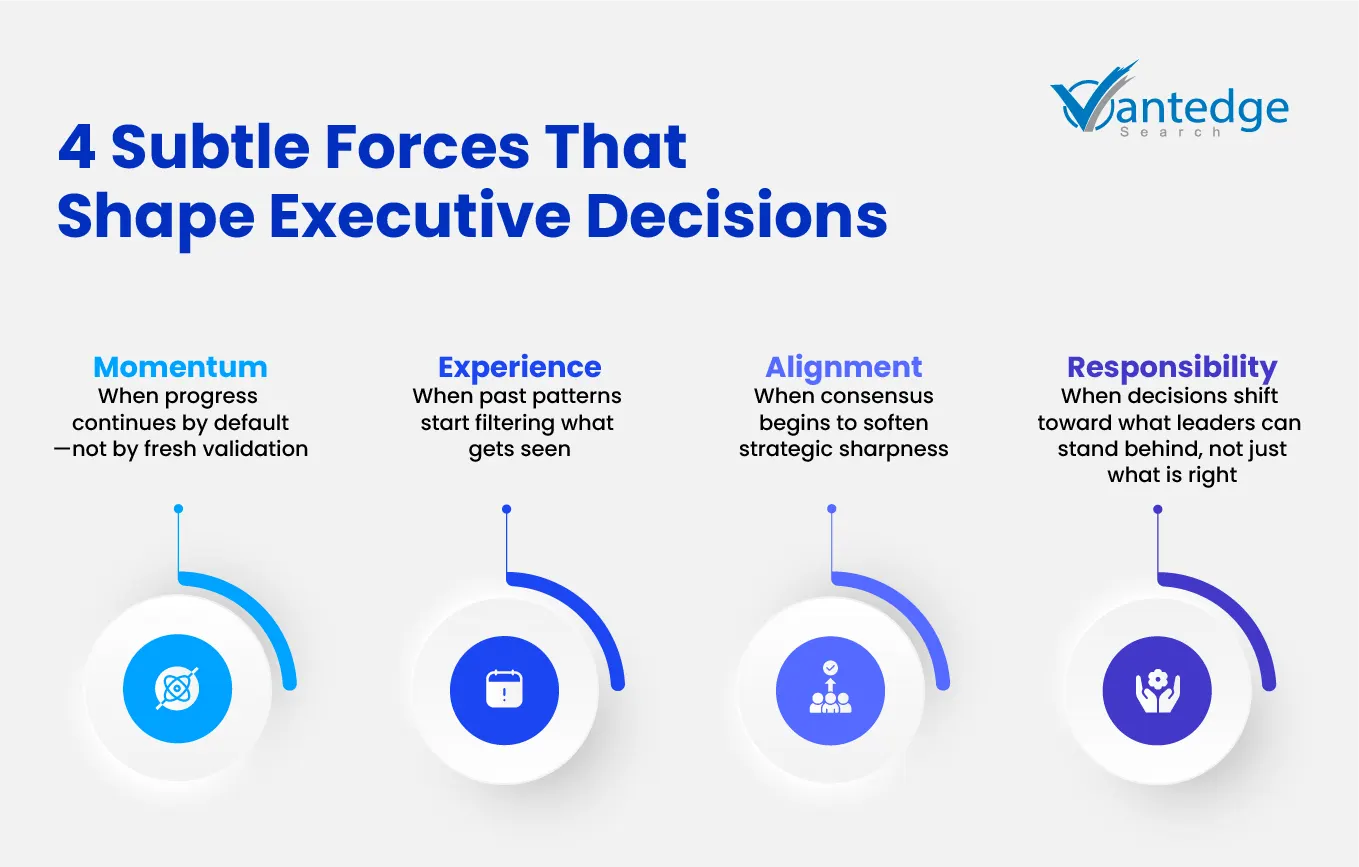
Momentum, experience, alignment, and responsibility quietly influence what feels possible. - Strong judgment can narrow options without noticing
What looks like clarity is often a filtered set of choices. - The key is not correction—but awareness
Recognizing these forces helps leaders see what may already be shaping their decisions.
Introduction
Most senior leaders do not struggle with knowing what to do. By the time they reach the C-suite, judgment has already been shaped through years of navigating markets, economic cycles, organizational complexity, and decisions that carry significant consequences. The fundamentals of leadership are rarely the issue. And yet, even in highly capable and well-run organizations, there are moments when decisions that seemed thoughtful, well-supported, and entirely reasonable at the time fail to lead where they were expected to.
This is not usually the result of poor capability or an obvious oversight. More often, it reflects a quieter reality of executive leadership: in complex environments, leadership decision making is rarely shaped by analysis alone. It is influenced by context — the pace of the business, the weight of prior success, the expectations attached to leadership roles, and the constant pressure to maintain momentum. None of these forces are unusual; in many ways, they are inseparable from the psychology of leadership itself. What is less visible, however, is how over time they can begin to subtly shape judgment, influencing what feels practical, realistic, or even possible long before a decision is consciously made.
Where Judgment Begins to Shift
The shifts in judgment don’t happen in obvious ways. They rarely appear as clear mistakes or visible missteps. More often, they show up in decisions that feel sound, timely, and well-reasoned in the moment.
But across different contexts, certain patterns tend to repeat: subtle enough to go unnoticed, yet influential enough to shape direction over time.
What follows are a few of those patterns. Not as prescriptions to correct, but as lenses to recognize. While these forces are closely related in how they influence executive decision making, each operates through a distinct mechanism and tends to surface in different moments of leadership decision making. The aim here is not to introduce new leadership concepts, but to reframe familiar dynamics as a small set of forces that shape how executive decisions take form and influence broader business decision making.
1. When Momentum Starts to Set the Direction
Momentum is often a sign that things are working. Decisions are being made, teams are moving, and progress is visible. In many situations, that forward motion is exactly what is needed. But there are moments—less obvious and harder to catch—when momentum itself begins to shape direction, not by design, but by default. The emphasis shifts almost imperceptibly from moving the right things forward to simply keeping things moving. Initiatives advance because they have already begun, priorities expand because they are gaining traction, and activity starts building upon activity. Each step appears reasonable, yet over time, movement and clarity can begin to fall slightly out of sync in ways that subtly shape executive decision making.
Consider a business that has found early success in a new capability or strategic initiative, whether through a product extension or a market entry. The initial signals are strong: early customer adoption, internal excitement, and positive board visibility. The natural response is to build on that momentum by allocating more resources, compressing timelines, and exploring adjacent opportunities. None of these actions is misplaced. But at some point, the underlying question subtly begins to change — from “What have we actually learned so far?” to “How do we scale this quickly enough?” The shift is small, but consequential, because scaling begins before the model is fully understood, and momentum starts answering questions that haven’t been fully examined — a dynamic that often shapes strategic decision making for leaders.
Momentum doesn’t just move the business forward; it also reduces friction. It becomes easier to back something that is already working, easier to continue than to pause, and easier to build than to step back and re-evaluate. Over time, this creates a kind of decision inertia, where continuing feels like progress and questioning begins to feel like disruption — a pattern that can quietly influence broader business decision making and long-term strategic direction.
Not all forward motion is directional. Some of it is simply momentum carrying itself forward.
Questions worth sitting with
- Which current priorities are being expanded primarily because they’ve gained early traction?
- Where has “continuing” become easier than re-evaluating?
- If this initiative were presented fresh today—with no history—would it receive the same level of commitment?
- What has been assumed as proven, that is still only partially understood?
2. When Experience Begins to Narrow the Field
Experience is one of the most valuable things a leader brings to the table. It sharpens judgment, speeds up decisions, and helps leaders recognize patterns early. Over time, experience becomes a shortcut for dealing with complexity, allowing leaders to move with confidence and clarity. In most situations, that is exactly what makes leadership decision making effective.
But there are also moments when experience begins to shape decisions more quietly. It doesn’t just guide judgment — it starts to filter it. This often happens when a business enters a space that feels familiar on the surface, even though the reality underneath may be changing. The signals seem recognizable: a market the company has seen before, a business model that feels similar, or early signs that resemble past successes. Naturally, leaders lean on what has worked before — proven playbooks, experienced people, and the confidence that comes from prior wins.
None of this is wrong. In fact, experience is often what helps organizations move quickly in uncertain situations. The challenge is that familiarity can sometimes create a sense of clarity too early. What looks similar at first may actually be different in important ways.
Over time, experience also influences what leaders notice first, what they pay less attention to, and what they instinctively dismiss. Some signals stand out immediately, while others take longer to register — not because they are unimportant, but because they don’t fit the pattern leaders expect to see. This is often where subtle forms of bias in leadership begin to emerge, not through poor intent, but through deeply conditioned patterns of interpretation.
Experience helps leaders recognize patterns faster. But it can also make assumptions form faster too.
Questions worth sitting with
- Where might familiarity be creating a sense of clarity that hasn’t been fully tested?
- What aspects of this situation feel similar—and which ones have we not yet fully understood?
- If this were approached without the benefit of past experience, what would be examined more closely?
- Which signals are being acted on quickly—and which ones are taking longer to be acknowledged?
The challenge is not to slow decision-making down entirely, but to occasionally pause and ask whether this situation is truly the same as the ones that came before it. What feels familiar may still contain shifts in customer behavior, market conditions, competitive dynamics, or timing that change the nature of the decision. Experience remains valuable, but its greatest strength often comes when it is balanced with enough inquiry to test whether old assumptions still apply in a new context.
Strengthen Executive Decision-Making
3. When Alignment Starts to Dilute Direction
Strong alignment is often seen as a sign of effective leadership. In high-performing organizations, leadership teams work hard to ensure that decisions are understood, supported, and collectively owned. Alignment creates cohesion, reduces friction, and helps large organizations move with clarity.
But there are times when the pursuit of alignment begins to shape the decision itself in quieter ways. This often surfaces during strategic decisions that involve both opportunity and risk — entering a new market, reallocating capital, or changing direction on a core initiative. In these situations, leadership teams naturally test assumptions, bring in multiple perspectives, and work toward broad support across the organization.
As discussions progress, viewpoints begin to converge. Concerns are addressed, trade-offs are balanced, and disagreements gradually soften. The outcome is usually a decision that feels thoughtful and broadly supported. Yet something subtle can happen in the process: the original sharpness of the decision — the very thing that made it bold or distinctive — can begin to fade. Not because the idea was wrong, but because alignment naturally tends to favor positions that more people can comfortably support.
Over time, this can create a kind of strategic smoothing driven by broader leadership team dynamics. Decisions become balanced and easier to align around, but sometimes less defined than they were at the start. Views that are harder to agree on receive less attention, while more moderate positions become easier to carry forward.
Alignment builds commitment. But it can also reshape conviction.
Questions worth sitting with
- Where has alignment strengthened this decision—and where might it have softened it?
- What perspectives were hardest to integrate, and what happened to them in the final outcome?
- If speed or consensus were not factors, would this decision look any different?
- In seeking broad agreement, what level of distinctiveness may have been traded off?
4. When Responsibility Starts Defining What Leaders Can Live With
Responsibility sits at the center of senior leadership. At the C-suite level, decisions are not only evaluated for their strategic value — they are carried personally by the people making them. Over time, this shapes how leaders approach difficult choices. But there are moments when responsibility begins to influence decisions in a quieter and more personal way. It stops being only about owning the outcome and starts shaping what feels possible to stand behind over the long term.
This often becomes visible in high-impact decisions involving restructuring, strategic shifts, investment trade-offs, or changes that will significantly affect people and performance. On paper, the options may all appear reasonable. Each has logic behind it, each comes with trade-offs, and each can be justified through analysis. But they do not always feel equal to the person making the decision.
Gradually, the question begins to shift — from “What is the right decision?” to “What decision can I genuinely stand behind if I have to carry it forward?” That change is subtle, but important, because it influences how leaders weigh choices internally and approach executive decision making under conditions of long-term accountability.
Some decisions may appear strategically sound but feel personally difficult to carry. Others may make intellectual sense while creating a level of internal discomfort that is harder to ignore. Over time, leaders begin testing decisions not only for whether they are correct, but also for whether they can remain aligned with them once the consequences unfold.
Questions worth sitting with
- Which decisions feel harder to carry forward—even when they make sense logically?
- Are we choosing based on best outcome, or based on what feels internally consistent to stand behind?
- Where is responsibility strengthening clarity—and where is it quietly narrowing options?
- What decisions are we able to justify externally, but struggle to reconcile internally?
Conclusion
No two C-suite environments are exactly alike. Even when leaders face similar pressures—growth targets, transformation, capital allocation, or performance expectations—the conditions surrounding each decision are different. Timing, board dynamics, the maturity of the business, and the broader external environment all shape what feels possible in a given moment.
That is why the forces discussed here—momentum, experience, alignment, and responsibility—do not affect every leader in the same way. In some situations, they create clarity, speed, and confidence. In others, they quietly influence what feels realistic long before a decision is fully formed. This is not a flaw in leadership judgment; it is part of what makes executive decision-making so dependent on context.
These patterns are not universal rules or corrections to apply. They are simply ways of looking more closely at how decisions take shape. Different leaders will recognize different forces in business decision making, depending on the environment they operate in and the responsibilities they carry.
Perhaps the most important realization is that executive decisions rarely begin from a completely open field. By the time discussions take place, certain assumptions, pressures, and expectations have often already narrowed what feels viable. And what matters most is not only the decision itself, but the conditions that quietly shaped it long before it was made.
If your organization is navigating complex strategic decisions, the leaders you appoint matter more than ever. Partner with us to find executives equipped to lead with clarity in dynamic environments.
FAQs
Executive decision making is often shaped by more than strategy, data, or financial logic alone. Factors such as organizational momentum, leadership experience, alignment pressures, responsibility, and business context can quietly influence how leaders interpret risk, opportunity, and long-term direction.
Leadership decision making is deeply influenced by context because no two C-suite environments operate under identical conditions. Board expectations, market timing, transformation pressures, organizational maturity, and stakeholder dynamics all shape how decisions are evaluated and carried forward.
Leadership team dynamics can influence how strategic decisions evolve over time. As teams work toward alignment and collective ownership, viewpoints often converge naturally. While this can strengthen execution and commitment, it can also soften sharper or less widely supported perspectives during decision-making discussions.
Experience helps leaders recognize patterns, navigate complexity, and make decisions with greater confidence. However, in rapidly changing environments, past success can sometimes shape assumptions too early, influencing how leaders interpret new signals, risks, and emerging opportunities.
Momentum can help organizations move quickly and maintain strategic focus. But over time, momentum itself can begin shaping business decision making by encouraging continuation over reassessment. In some situations, initiatives continue expanding because they are already in motion rather than because underlying assumptions have been fully re-evaluated.
The psychology of leadership matters because senior decisions are rarely made in purely analytical environments. Pressure, responsibility, prior experience, stakeholder expectations, and organizational dynamics all influence how leaders process uncertainty, evaluate trade-offs, and arrive at strategic decisions.
Leave a Reply